
The most dangerous moment in a malpractice case is not the lawsuit. It is the board complaint that quietly rides in alongside it.
If you mishandle that complaint in the first 72 hours, you can turn a defensible situation into a career-threatening mess. I have seen good clinicians get burned not because they were bad doctors, but because they treated the board like an insurance adjuster or an angry family member. That is a mistake.
This is the playbook you should have open the moment you learn there is a board complaint tied to a malpractice allegation.
1. First 72 Hours: Do This, Not That
The clock starts the moment you receive notice. Email, certified mail, hospital risk management — however it comes, you are on the board’s radar. Your job is not to “explain.” Your job is to protect your license first, everything else second.
Step 1: Stop talking
Immediate “do nots”:
- Do not call the patient or family.
- Do not email anyone about the case (colleagues, staff, friends, listservs).
- Do not alter the chart. At all. Even to “clarify.”
- Do not draft a response to the board on your own.
- Do not post about it anonymously online.
Every one of those has been used against physicians. More than once.
Step 2: Secure the documents
You need to quietly collect, not comment.
Gather:
- The complete medical record for the episode of care (including phone messages, portal messages, nurse notes, incident reports if accessible).
- The board’s complaint letter and attachments.
- Any prior complaints or investigations on you (board, hospital, payer).
- Your malpractice policy and contact information for your carrier.
- Employment contract or staff bylaws (they often define investigation obligations).
Save everything in a secure, access-controlled folder. Not on your personal Gmail. Not on a random USB stick.
Step 3: Notify the two entities that actually matter
Malpractice carrier
Use the claim/hotline number on your policy or the risk management contact for your group. Say:“I have received a board complaint related to a potential malpractice allegation involving [very brief description: ‘post-op infection after appendectomy’]. I need to open a claim and request counsel both for the malpractice matter and the board response.”
Do not launch into your full narrative on that first call. Just enough so they know what bucket to put you in.
Hospital / practice risk management (if employed / affiliated)
Tell them the same thing: board complaint linked to a malpractice allegation. Ask who in the organization coordinates legal responses.
Do not notify random administrators or colleagues beyond what the bylaws require. The more people that know, the more chance for leaks and casual comments that show up in discovery.
2. Understand the Two-Front War: Board vs Malpractice Case
Physicians keep mixing these up: the malpractice case is about money; the board case is about your license and your reputation in the data systems that follow you for the rest of your career.
You must treat them as related but distinct battles.
| Aspect | Board Complaint | Malpractice Lawsuit |
|---|---|---|
| Goal | Protect public, discipline | Compensate patient (money) |
| Standard | Minimum safe practice | Negligence + damages |
| Decision maker | Board / committee | Judge / jury |
| Outcome risk | License, restrictions | Money, NPDB report |
| Tone of response | Educational, corrective | Defensive, liability-focused |
The trap: trying to “win” the malpractice case by being defensive in your board response. Board reviewers do not care if you think the lawsuit is frivolous. They care whether you met minimum standards, documented your thinking, and acted ethically once something went wrong.
You tailor your board response to:
- Show insight, not just indignation.
- Acknowledge complications without confessing to negligence.
- Demonstrate that your current practice is safe for patients going forward.
The malpractice defense lawyer will help balance that with the civil case. This is why you do not answer the board alone.
3. Get the Right Legal Help — And Use Them Correctly
If you remember nothing else, remember this: license defense is a separate specialty. Not every malpractice defense attorney is good at board work. Some are, some are not.
Step 1: Ask for administrative/board counsel
When you talk to your malpractice carrier, be explicit:
“I need counsel with specific experience defending physicians before this state’s medical board.”
If they try to assign you a pure med-mal litigator, push back politely. You want someone who:
- Has handled board complaints in your state in the last 12–24 months.
- Knows the personalities / style of your particular board.
- Understands how board outcomes affect NPDB, credentialing, and insurers.
If your policy does not cover board defense (some cheap policies do not), you seriously consider paying out of pocket for at least a consultation with experienced license-defense counsel. This is not where you save money.
Step 2: Establish communication rules
From day one with your lawyer:
- Agree that all case-related emails go through them.
- Label communications “Attorney-Client Privileged” and stick to that channel.
- Do not CC colleagues, friends, or admin on these emails.
- Do not forward your lawyer’s emails to others.
You want a clean, protected communication silo. Plaintiffs’ attorneys live off sloppy email chains.
Step 3: Strategy meeting before any written response
Before a single word goes to the board:
- Review the chart together, line by line.
- Build a timeline of care and events.
- Identify any documentation problems, guideline issues, communication gaps.
- Decide what the theme of your defense is going to be.
Examples of legitimate themes:
- “Reasonable judgment in a high-uncertainty situation, with appropriate follow-up and safety netting.”
- “Recognized complication, managed in line with accepted standards, with appropriate informed consent.”
- “Systems failure (e.g., EMR, staffing, call coverage) that is now corrected, not a pattern of individual recklessness.”
You and your lawyer then draft your response around that theme, supported by facts and records — not emotions.
4. How to Read and Deconstruct the Board Complaint
Many physicians focus on the accusations’ drama instead of identifying what the board is really testing.
Common patterns in complaints tied to malpractice allegations:
- “They did not listen to me.”
Translation: communication and documentation review. - “They missed my diagnosis.”
Translation: standard of care, differential process, follow-up. - “They tried to cover it up / refused records / were rude.”
Translation: professionalism, ethics, cooperation.
Go through the complaint with a highlighter and mark:
- Factual allegations about what happened.
- Allegations about your behavior or attitude.
- Allegations about harm or outcome.
- Any procedural claims (delayed records, refusal to communicate, etc.).
Each category demands a different type of response. You do not respond to “they were rude” with 3 pages of CT scan interpretation. You respond with clear documentation of your communication efforts and, when appropriate, a calm statement like:
“I regret that the patient experienced the interaction as dismissive. That was not my intent. I documented my review of their concerns and provided specific return instructions, including [X, Y, Z]. I have since incorporated [specific adjustment] to improve how I communicate when risk is low but not zero.”
Notice what that does: it shows insight and concrete change without admitting negligence.
5. Constructing a Strong Board Response Letter
Let me be blunt: the worst board responses I see from physicians before counsel are emotional manifestos. They attack the patient, lecture the board about “how medicine really works,” and complain about “frivolous lawsuits.”
Boards read that as: poor judgment + low insight + professionalism risk.
You want the opposite impression.
Structure of an effective response
Intro paragraph
- Acknowledge receipt.
- Identify the patient and relevant dates.
- State that you are represented by counsel (if you are).
Concise factual timeline
- Objective, chronological, with references to the record.
- No adjectives. No editorializing.
Clinical reasoning
- Briefly state your differential and why you chose the path you did.
- Point to guidelines, literature, or standard practice where relevant.
Address each allegation
- Number them if needed and respond point by point.
- Use “The record reflects…” and “At that time, my assessment was…” rather than “I definitely did not…”
Complication or adverse outcome framing
- If this was a known complication, say so and attach or reference documentation that the risk was discussed.
- If this was an error, work with your attorney on how to phrase reflection and remediation without creating civil liability you do not need to.
Systems and improvement
- If the case exposed a gap (handoff, EMR alerts, follow-up process), describe specific steps taken since.
- Avoid vague “I will try to document better” language. Be concrete.
Closing
- Reaffirm your commitment to safe patient care.
- Indicate you will cooperate fully with any further board process.
Tone rules that keep you out of trouble
- Do not call the complaint “frivolous,” “ridiculous,” or “retaliatory,” even if it is.
- Do not speculate about the patient’s motives (“They are just mad they did not get narcotics”).
- Do not hide complications. The board will see the record and possibly expert review.
- Avoid absolute language when your specialty does not support it (“It was impossible that…”).
Your goal is not to sound perfect. Your goal is to sound safe, thoughtful, and self-correcting.
6. What the Board Is Really Judging You On
Boards usually do not care if you are the best diagnostician in the state. They care if you are:
- Practicing within the standard of care.
- Honest and transparent.
- Capable of learning from adverse events.
- Not a pattern risk (repeated similar complaints or behaviors).
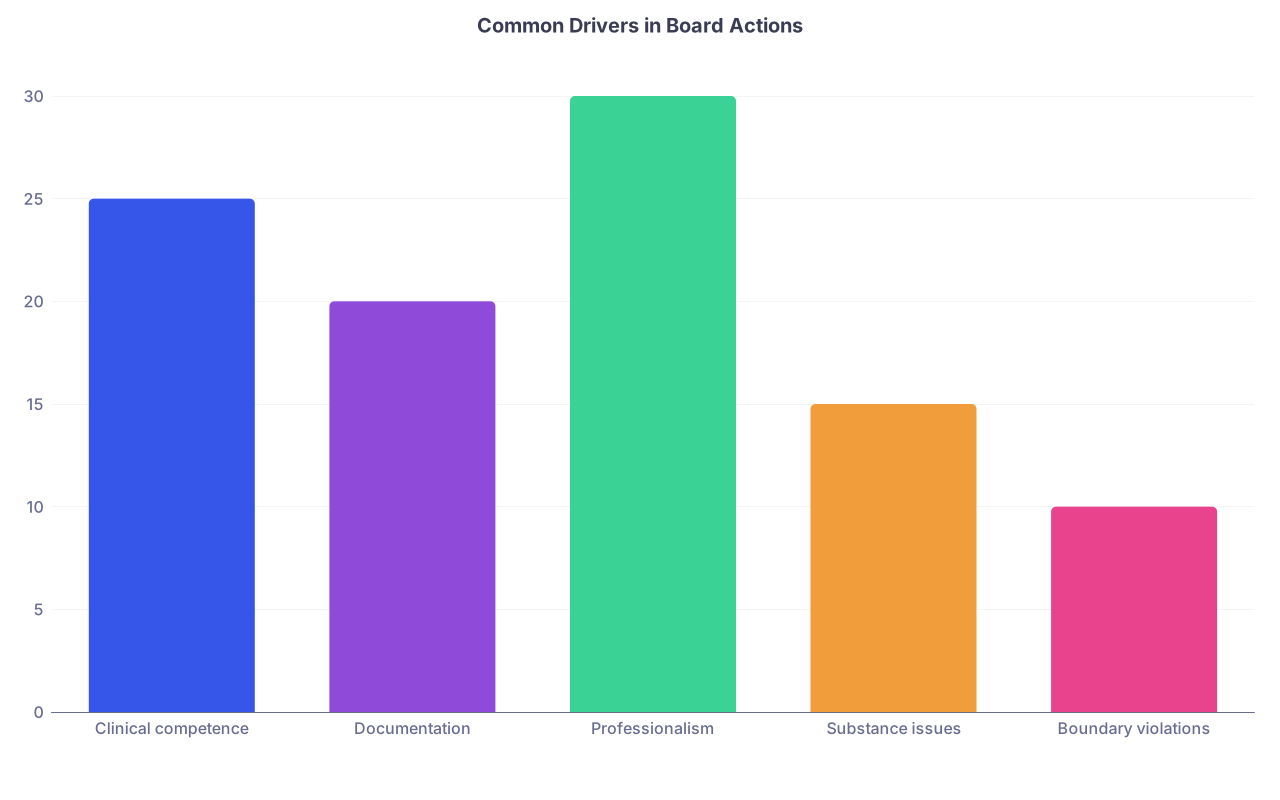
| Category | Value |
|---|---|
| Clinical competence | 25 |
| Documentation | 20 |
| Professionalism | 30 |
| Substance issues | 15 |
| Boundary violations | 10 |
Clinical care is obviously central, but look at that professionalism bar. Disrespectful behavior in the process — towards staff, patients, or the board itself — is a frequent accelerant.
Make it very easy for the board to conclude:
- This was a difficult clinical situation, not reckless practice.
- You have already put in guardrails to reduce recurrence.
- You are not hiding anything.
That usually means:
- Honest description of what you knew and did at each point.
- Clear safety-net instructions documented (or, if missing, a plan to fix that in your practice).
- Evidence of reflection: CME, QI activities, protocol revisions, or supervision improvements.
7. Parallel Obligations: Hospital, Insurers, NPDB, and Reporting
When a malpractice allegation triggers a board complaint, you end up with a tangled reporting web.
Here is the usual chain when there is money or discipline involved:

| Step | Description |
|---|---|
| Step 1 | Adverse event |
| Step 2 | Malpractice allegation |
| Step 3 | Board complaint |
| Step 4 | Malpractice claim |
| Step 5 | NPDB report |
| Step 6 | State reporting |
| Step 7 | Hospital credentialing |
| Step 8 | Insurer panel review |
Key implications for you:
- Malpractice settlement or judgment usually triggers an NPDB report.
- Certain board actions (reprimand, probation, suspension, revocation) also trigger NPDB.
- Hospitals and payers regularly query NPDB and your state board site.
What this means practically:
- You must take board outcomes seriously even if “no money is at stake.” The public and NPDB trail can be worse than the lawsuit.
- Do not agree casually to “minor discipline.” A “simple reprimand” that is public and reportable can haunt you on every credentialing form and insurer panel review for years.
- Discuss with your attorney:
- Whether a non-disciplinary outcome (e.g., confidential letter of concern, education requirements) is possible.
- Whether the proposed resolution is reportable to NPDB.
- How to answer future credentialing questions accurately but not self-sabotaging.
Some physicians lose more income from being dropped by one big insurer panel than from the malpractice settlement itself.
8. Common Mistakes That Turn a Contained Problem Into a Disaster
I have seen the same avoidable errors over and over. Learn from other people’s scars, not your own.
Altering or “updating” the chart after the complaint
- Boards and plaintiffs can see audit trails and metadata. Late additions after notice look like cover-ups. If you need to clarify, you do it as an addendum clearly dated and labeled, and you talk with your lawyer first.
Informal apologies that sound like admissions
- Saying “We really messed up your case” in a hallway or portal may feel humane, but plaintiffs’ attorneys will frame it as an admission. Use formal disclosure processes guided by risk management.
Ranting in email or texts
- “I told you this patient was crazy” in a text thread with colleagues is devastating in discovery and looks awful to a board.
Ignoring deadlines from the board
- Blow off or delay a response, and you tell the board you are disorganized or dismissive. If you need more time, your attorney requests a reasonable extension before the deadline.
Going it alone
- I see solo-drafted responses that look like manifestos: personal attacks, clinical over-explanations, no structure. They hurt more than they help.
9. Protecting Yourself Financially and Logistically
This is the “financial and legal aspects” phase. So let us talk money and future risk, not just survival.
Check what your malpractice policy actually covers
Pull your declarations page and look for:
- Administrative / board defense coverage amount (often $25k–$100k separate from indemnity).
- Whether that is per claim or aggregate.
- Exclusions — some policies exclude intentional misconduct, criminal acts, or certain board matters.
If your board case is not clearly covered, have your attorney write a coverage demand letter to the carrier. You pay for this policy. Make it work.
Track your time and expenses
Boards do not usually reimburse you for your time. But you should still treat this like a complex project:
- Keep a simple log of:
- Hours spent on board-related work.
- Time off from clinic or OR.
- Travel for hearings.
- Note any direct, out-of-pocket expenses not covered by your carrier.
Not because you can bill someone now, but because:
- You may need this later in negotiations (e.g., employment contract discussions if the case came from systemic issues).
- It forces you to see the real cost of a dysfunctional system or poor support. Which often strengthens your case for changing practice environment later.
Adjust your future risk exposure
Once you have survived one malpractice-linked board complaint, you are in a different category: you know how bad this can be. Use that experience.
Concrete changes to consider:
- Tighten documentation, especially:
- Differential diagnoses.
- Patient refusal of tests or referrals.
- Return precautions and follow-up instructions.
- Be more selective with:
- High-risk procedures if your volume is low and backup is weak.
- Practice settings with poor staffing, call coverage, or supervision structures.
- Reassess your malpractice limits and carrier:
- An underpowered or slow-responding carrier is a liability.
- Consider carriers known for strong physician support and robust risk management.
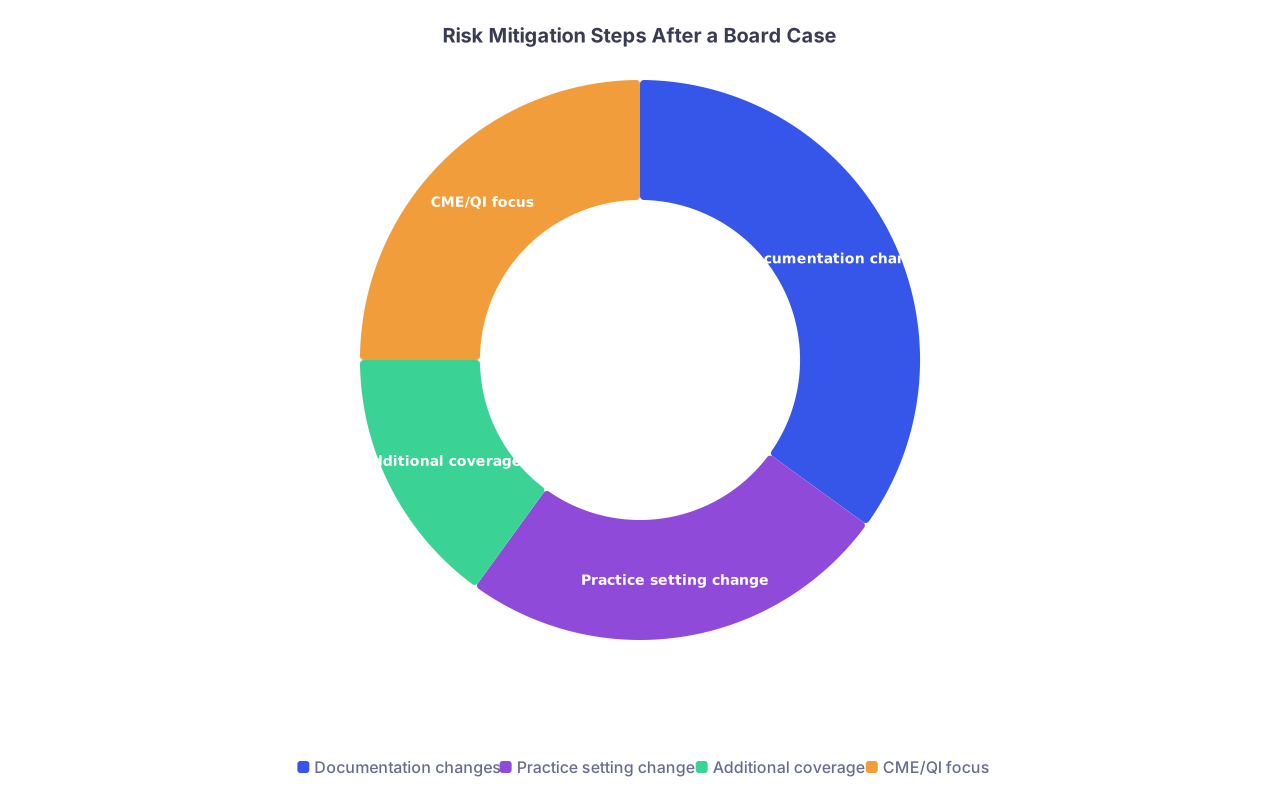
| Category | Value |
|---|---|
| Documentation changes | 35 |
| Practice setting change | 25 |
| Additional coverage | 15 |
| CME/QI focus | 25 |
You do not overreact and quit clinical care because of one case. But you do treat it as an expensive, painful course in risk management and adjust accordingly.
10. Mental and Professional Survival
One last angle most lawyers ignore but that absolutely matters: your sanity.
A malpractice allegation plus board complaint is psychologically brutal. I have seen physicians:
- Develop insomnia and panic attacks.
- Overcompensate by ordering absurd amounts of testing.
- Withdraw from colleagues, which only worsens their judgment.
Smart steps:
- Confide in 1–2 trusted colleagues who understand confidentiality and have been through similar scrutiny.
- Use your physician wellness or EAP resources if available. These are usually confidential and do not report to boards unless there is clear risk of harm.
- Avoid venting on social media or open online forums. “Anonymous” is not actually anonymous when lawyers start serving subpoenas.
You are more likely to make a serious error when you are distracted, exhausted, and scared. Protect your own functioning as aggressively as you protect your legal position.
Summary: What Actually Saves You
Three points to carry forward:
Treat a board complaint as a separate, high-stakes event, not a side-note to the malpractice case. Get license-defense counsel involved early and respond in a structured, disciplined way.
Focus your response on safety, insight, and concrete improvements, not emotion or attack. Boards want to see that your current and future patients are safe, not that you can “win” an argument.
Use the experience to upgrade your risk management across documentation, systems, and insurance coverage. Surviving one of these without changing your practice is a waste of an extremely expensive lesson.