
The biggest mistake physicians make with malpractice insurance is trying to save money in exactly the wrong place.
They cut limits. They accept scary exclusions they do not understand. They switch to the cheapest carrier with shaky claims support. Then they discover the savings were an illusion the first time a claim hits.
You do not lower malpractice premiums by gutting your coverage. You lower them by attacking the specific variables underwriters actually care about—and by structuring your policy intelligently.
This is a playbook for doing exactly that.
1. Understand What Actually Drives Your Premium
You cannot fix what you do not understand. The carrier is not pulling your rate out of thin air. There is a formula, and you can influence more of it than you think.
Core premium drivers:
- Specialty and procedure mix
- Geography (state, county, even ZIP in some states)
- Claims history (frequency and severity)
- Policy form and limits
- Practice structure and risk controls
- Carrier type (admitted vs surplus lines, occurrence vs claims‑made)
Let us untangle the big levers.
1.1 Claims-made vs occurrence: choose strategically
Most physicians vaguely know “claims‑made is cheaper at first, more later.” That is incomplete and often misused.
Basic reality:
Occurrence
- Covers incidents that happen during the policy year, regardless of when the claim is filed.
- No tail required.
- Higher annual premium, simpler long term.
Claims‑made
- Covers claims filed during the policy year, as long as the incident occurred after your retroactive date.
- Needs tail coverage if you switch carriers, retire, or change to occurrence.
- Lower early premiums, escalates over 4–5 years.
You lower premiums without losing protection by choosing claims‑made with a smart tail plan, or by locking in occurrence when you know you will have a lot of transitions.
Practical rule of thumb:
- If you are early career, expect multiple job changes, and are in a state where occurrence is reasonably priced → strongly consider occurrence if available. No tail roulette.
- If you are mid‑career, relatively stable, and your group has leverage with a carrier → claims‑made with a negotiated tail can be cheaper over 10+ years.
| Factor | Claims-Made | Occurrence |
|---|---|---|
| Year 1 cost | Lower | Higher |
| Tail needed | Yes (usually) | No |
| Admin complexity | Higher (tail, retro) | Lower |
| Best for | Stable long-term jobs | Frequent transitions |
1.2 Limits: stop overbuying by reflex
Most practices carry something like $1M/$3M or $2M/$4M (per claim / aggregate) because “that is what everyone has.” Lazy reasoning.
You need to match limits to:
- Your specialty
- Your venue (e.g., Cook County IL vs rural Iowa is not the same)
- Your hospital requirements
- Typical verdicts/settlements in your area
Here is the trap: cutting from $1M to $500k to save 8–12% on premium is often not worth the catastrophic risk increase. But going from $2M/$4M down to $1M/$3M in a lower‑risk jurisdiction sometimes is.
Action steps:
- Ask your broker for loss data or public verdict/settlement summaries in your county for your specialty.
- Confirm hospital and payor minimums. Many require $1M/$3M; dropping below is not an option.
- If you are above the local standard (for example carrying $3M/$5M when most peers carry $1M/$3M) ask for an exact quote at standard limits and model the risk vs savings.
You lower cost without hurting coverage by right‑sizing limits to local norms plus a safety margin. Not by dipping below what any credible defense attorney would call reasonable.
2. Attack the “Risk Profile” Underwriters Actually Score
Underwriters are not impressed by your personal belief that “I practice defensively.” They want evidence. Procedures. Documentation. System design.
You want to look like the least expensive kind of insured: predictable, disciplined, and boring from a claims standpoint.
2.1 Make underwriters notice your risk controls
Here is what moves the needle in real files I have seen:
- Written, consistently used informed consent processes
- Closed‑loop test result tracking (no lost labs, no orphan imaging)
- Structured follow‑up and recall protocols
- Documented incident reporting and internal review
- Regular chart audits with proof you actually did them
- Formal hand‑off protocols if multiple clinicians see the same patient
Underwriters do give credit for this. But only if they see it clearly laid out.
So build a one‑ or two‑page “Risk Management Practices Summary” for your next renewal:
- Bullet your protocols.
- Mention frequency (“Monthly random chart audits: 10 charts per provider”).
- Include any external reviews (JCAHO, AAAHC, specialty society practice assessments).
Then hand this to your broker and explicitly say: “Use this in your submission to the underwriters.”
If you do not spoon‑feed this, the submission usually just says: “Established internal medicine practice, 3 physicians, 2 NPs, no major losses.” You pay more for that laziness.
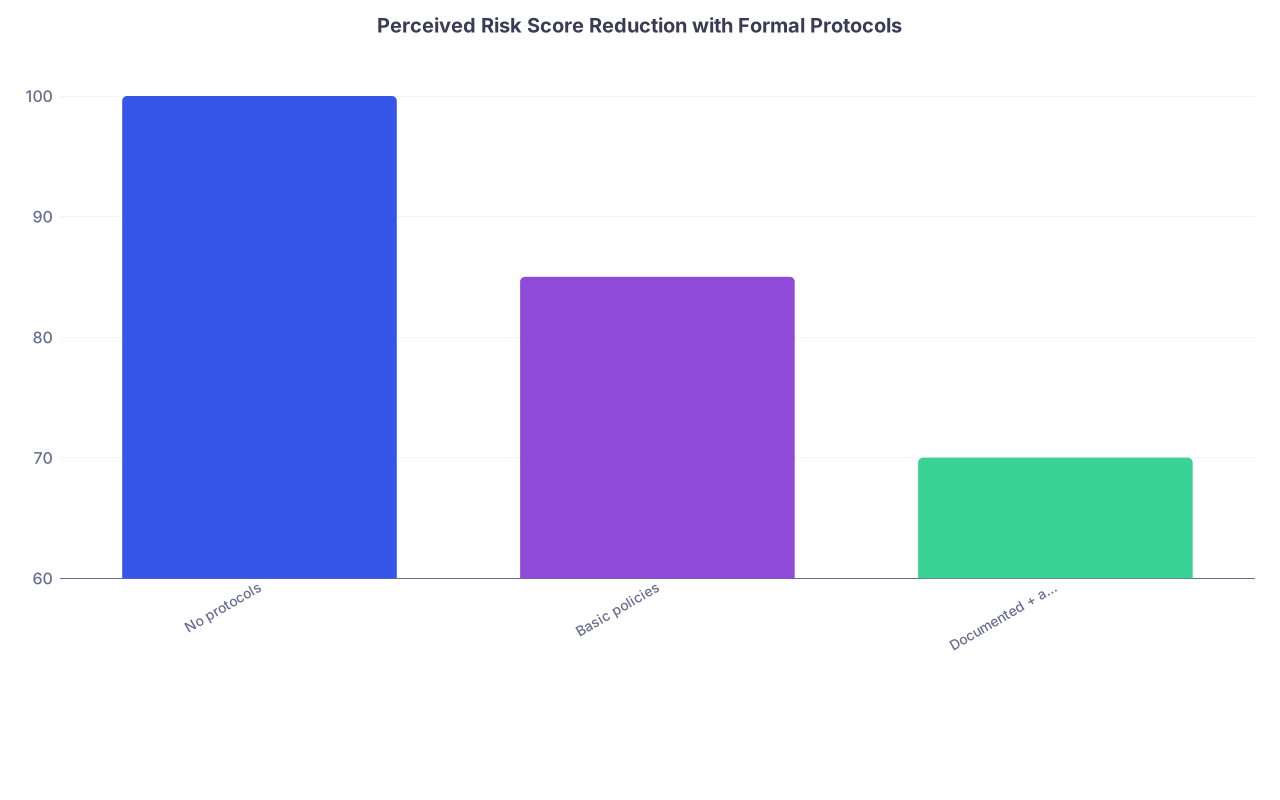
| Category | Value |
|---|---|
| No protocols | 100 |
| Basic policies | 85 |
| Documented + audited | 70 |
2.2 Optimize your scope and procedure mix
Some services are pricing landmines. Not because they are inherently bad, but because frequency × severity is ugly on the actuarial side.
High‑impact risk drivers:
- Obstetrics deliveries
- Interventional pain procedures
- Office‑based surgery with IV sedation
- Bariatric procedures
- Aesthetic procedures with high expectations and high plaintiff bar interest
You cut premiums without hurting meaningful coverage by:
Narrowing procedural exposure you rarely perform.
- If you do two advanced OB cases per year, consider abandoning them formally and removing that exposure from your rating.
- Same with rarely done aesthetic services you keep “just in case.”
Clarifying roles
- If a lower‑risk provider (e.g., hospitalist) is rated as full‑scope internal medicine with procedures they never touch, get that corrected.
Separating high‑risk lines
- For example, carve out aesthetic work into a small separate policy with targeted coverage while keeping main clinical work on a standard program. Often cheaper and better matched.
Do not lie or “forget” to list procedures. That is how you get a coverage fight at the worst possible time. But be ruthless about avoiding marginal services that push up your premium disproportionately.
3. Use Policy Structure to Your Advantage
Most physicians focus only on “premium” and ignore how the policy is built. That is a mistake. Structure is where a lot of hidden savings live.
3.1 Group vs individual: know when to consolidate
There is real money in structuring coverage at the group level rather than as fragmented solo policies.
Potential benefits of group programs:
- Volume discounts
- Shared limits (where appropriate)
- Standardized risk management oversight
- Unified claims handling narrative (carriers like organized groups)
But there are traps:
- Shared limits can mean one large claim eats most of the aggregate.
- One physician with a bad history can contaminate rates for everyone.
- Exit arrangements and tail allocation can get ugly.
Good structure for small to midsize groups:
- Same carrier and policy for all core clinicians.
- Individual physician limits with a group entity limit (stacked above or separate).
- Formal group policy on tail funding when someone leaves (more on this later).
3.2 Deductibles and self‑insured retention (SIR)
Here is where many practices leave money on the table.
Underwriters price you on the assumption they will pay from dollar one, unless you tell them otherwise. If you have a strong balance sheet and low frequency of small claims, you can accept a deductible or SIR and get significant credits.
Difference:
- Deductible – The carrier still defends from first dollar; you reimburse them up to the deductible amount for indemnity payments (and sometimes defense, depending on structure).
- Self‑insured retention – You handle and fund claims up to that amount; carrier only steps in above the SIR. Higher admin burden, bigger credit.
Practical move for many practices:
- Negotiate a modest deductible ($10k–$50k per claim) with the carrier still controlling defense.
- Ask the broker to show you quotes with several deductible levels and the corresponding premium reductions.
Typical pattern I have seen:
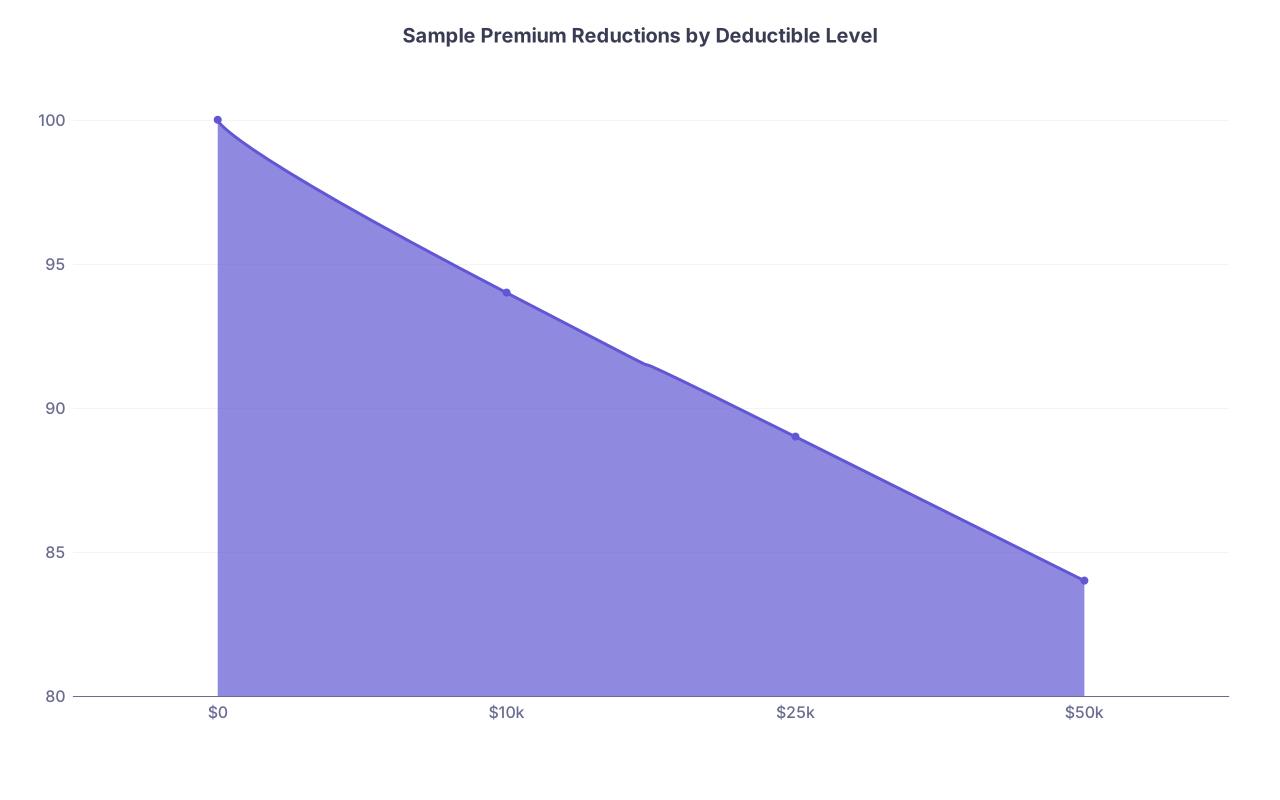
| Category | Value |
|---|---|
| $0 | 100 |
| $10k | 94 |
| $25k | 89 |
| $50k | 84 |
These are percentages of the original premium. Your mileage will vary, but the principle stands: if your average loss under $25k happens once every few years, it is probably cheaper to self‑fund that layer.
3.3 Retroactive date and tail: negotiate, do not accept
On a claims‑made policy, two key details are often ignored:
- Retroactive date – The date from which incidents are covered, regardless of when reported.
- Tail coverage terms – Cost and schedule to extend coverage after the policy ends.
You protect coverage and reduce long‑term cost by:
Locking your retro date
- Never allow a new carrier to reset this unless you are absolutely certain you have equivalent tail or prior acts coverage.
- In transitions, demand “prior acts” from the new carrier rather than separate tail if the math favors it.
Negotiating tail at the outset
- Ask for a contractual tail cap in your initial policy or group agreement.
- Example: “Tail cost for individual physicians will not exceed 150% of the mature annual premium if purchased within 30 days of policy termination.”
- Include who pays tail when a physician leaves: practice, physician, or shared formula.
Sharp move: build a tail reserve fund inside the practice. You set aside a percentage of production or payroll monthly. Then tail is not a surprise that forces you into bad insurance decisions later.
4. Clean Up Claims History the Smart Way
If you have a clean history, preserving it is half the game. If you have dings, how you handle them matters a lot.
4.1 For low- or no-history physicians: protect your record
Carriers love you if you have:
- No paid claims
- Few or no suits
- Early career with modest exposure
Your job is not to get sloppy.
Practical rules:
- Document clinical reasoning, not just actions. Jurors and experts care why you chose A over B.
- Use structured templates for high‑risk encounters: chest pain, abdominal pain, neuro changes, OB triage.
- Never ignore or “handle quietly” an adverse event without at least an internal written review. Carriers respect that, and it hardens your defense if something pops up later.
4.2 If you have prior claims: control the narrative
Many physicians with prior claims assume they are doomed to pay more forever. That is lazy thinking.
Underwriters do not just see “two paid claims”; they see:
- Timing (clustered early in career or recent?)
- Severity (nuisance settlements or large indemnity payments?)
- Pattern (same issue repeated or different circumstances?)
- Response (did you change practices or protocols?)
You need to feed them a clear narrative.
Action plan:
Prepare a Claims Summary Letter (1–2 pages) for your broker:
- Chronological list of claims with year, allegation, resolution, and your role.
- Short explanation of contributing factors (no self‑incrimination, just objective context).
- Explicit list of what changed after each event: new protocol, extra training, change in setting, dropped a high‑risk service.
Ask your broker to submit your summary with the application instead of letting the carrier guess from loss runs alone.
Target carriers that are known to be more nuanced on underwriting physicians with a history in your specialty. Your broker should know who is strict and who is flexible.
Structured this way, I have seen physicians with multiple prior claims still achieve substantial reductions compared to a “just fill out the app and see what happens” approach.
5. Use Healthy Competition and Better Market Positioning
You will not get the best pricing by blindly auto‑renewing for 20 years. But you also should not jump carriers every year. There is a balance.
5.1 Shop intelligently, not desperately
Process I recommend:
Every 3–4 years, have your broker do a formal remarketing:
- Get quotes from at least 2–3 serious alternative carriers.
- Present your risk management summary and claims narrative with each submission.
Stay with your carrier if:
- Pricing is within 5–10% of best competing offer,
- Claims handling has been solid, and
- They show ongoing risk management support.
Consider moving if:
- You are 15–20% above market with no clear added value,
- They have handled claims poorly or combatively, or
- They refuse to recognize reduced risk (you dropped OB, moved to hospitalist work, etc.).
Do not nickel‑and‑dime for 3% savings with a carrier that will throw you under the bus at deposition. But do not be a captive audience for a complacent insurer either.
5.2 Work with the right kind of broker
A weak broker is expensive, even if their commission is the same.
Good broker traits:
- Specializes in healthcare / malpractice. Not “general insurance with a few docs.”
- Knows which carriers are competitive for your specialty and state.
- Can tell you, from experience, how those carriers behave in claims.
- Will push underwriters with a story about your risk, not just a spreadsheet.
Ask specific questions:
- “Which carriers are most competitive for anesthesia in my state right now?”
- “Which carrier has recently improved or worsened rates in this specialty?”
- “Tell me about a tough claim that Carrier X handled in the last two years.”
If they cannot answer with specifics, you probably have the wrong broker.
6. Implement Practical Risk Management That Actually Lowers Premiums
Some risk management is pure compliance theater. Looks good, does nothing. Skip that. You want changes that reduce both actual risk and perceived risk.
6.1 Targeted protocols for your top three claim types
Every specialty has its greatest hits list of malpractice allegations. For example:
- Internal medicine: missed or delayed cancer diagnosis, MI, PE, stroke
- Surgery: retained foreign body, wrong site, post‑op infection, delayed recognition of complication
- OB: birth injury, failure to recognize fetal distress, delayed C‑section
Your approach:
Ask: “What are the top three allegation types in my specialty?”
- You can get this from your carrier’s risk management department, specialty societies, or public malpractice data.
For each, build a tight, boring protocol:
- Red flag symptoms that must be documented as present/absent.
- Clear thresholds for consults, imaging, admission vs discharge.
- Standardized language in notes.
Audit yourself quarterly:
- Randomly select 10–20 charts involving those risk zones.
- Check against your protocol checklist.
- Document the audit and any fixes.
Then hand this documentation to your broker for your next renewal. It signals that your future loss curve is likely lower than your past.

| Step | Description |
|---|---|
| Step 1 | Identify Top Allegations |
| Step 2 | Design Protocols |
| Step 3 | Implement in Practice |
| Step 4 | Quarterly Chart Audits |
| Step 5 | Adjust Protocols |
6.2 Training that underwriters actually respect
Mandatory generic CME about “communication skills” will not move your premium. Specific, verifiable training can.
High‑impact training examples:
- Simulation training for high‑risk procedures (OB shoulder dystocia, airway management, code situations).
- Root cause analysis training for partners or leaders who investigate incidents.
- Communication and disclosure training tied to an actual program (e.g., “communication and resolution” initiatives some carriers sponsor).
Ask your carrier:
- “Which risk management programs or courses qualify for premium credits?”
- “What documentation do you need from us to apply those credits?”
Most decent carriers have a menu: complete X hours of their approved courses, get Y% credit.
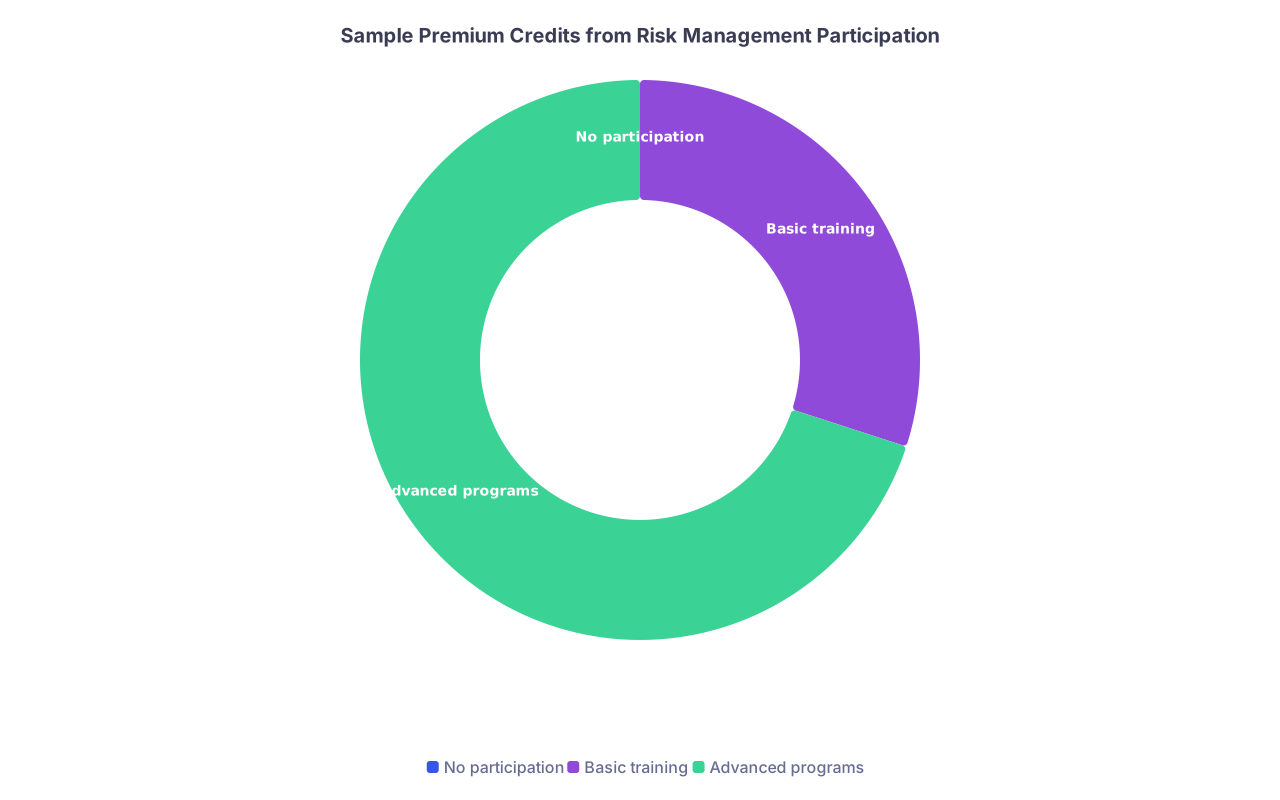
| Category | Value |
|---|---|
| No participation | 0 |
| Basic training | 3 |
| Advanced programs | 7 |
7. Do Not Sacrifice Coverage in These Key Areas
Cutting in the wrong places is how you turn a smart cost strategy into a career‑ending mistake. A few guardrails.
7.1 Never accept a policy that guts your defense
Defense is often worth more than indemnity.
Non‑negotiables:
- Consent to settle provisions – You want a real consent clause, not “hammer” terms that penalize you excessively for refusing to settle.
- Defense outside limits – Ideally, defense costs do not erode your liability limits. Especially important on lower limit policies.
- Clear coverage territory – No weird jurisdiction carve‑outs that leave you exposed for telemedicine or locums work.
Ask directly:
- “Are defense costs inside or outside my liability limits?”
- “Do I have pure consent to settle, or are there hammer clauses?”
If your broker cannot answer, get the specimen policy and have someone who knows what they are doing review it.
7.2 Do not blindly accept exclusions
Some exclusions are standard. Others are landmines.
Standard and usually fine (assuming they match your practice reality):
- Cyber/data breach (covered separately on a cyber policy)
- Professional services outside your scope or license
- Criminal acts and intentional harm
More concerning and often negotiable:
- Broad exclusions for certain procedures you perform regularly.
- Vague language around telehealth, supervision of NPs/PAs, or off‑site services.
- “Prior known incidents” language that is so expansive it could swallow a borderline situation you disclosed verbally.
Solution:
- Ask for a redline or list of changes if the carrier is modifying their standard form for you.
- Explicitly confirm that core services you actually perform are covered.
8. Concrete Action Plan: 90-Day Premium Reduction Sprint
You want steps. Here is a 90‑day protocol you can realistically execute.
Days 1–10: Gather intelligence
- Pull your current policy, endorsements, and last 5 years of loss runs.
- List: specialty, procedures, limits, retro date, tail terms, deductible (if any).
- Ask your carrier: “What risk management activities qualify for credits, and what %?”
Days 11–30: Tighten practice structure
Draft a 1–2 page Risk Management Practices Summary covering:
- Informed consent process
- Test result tracking
- Follow‑up/recall system
- Hand‑off and communication protocols
- Incident review and chart audit system
Identify 1–3 high‑risk allegation types in your specialty and draft simple protocols.
Days 31–45: Claims and procedure cleanup
- If you have prior claims, write a concise Claims Summary Letter explaining context and improvements.
- Review your procedure list:
- Remove rarely performed high‑risk services you can safely stop.
- Confirm each provider’s true scope and correct any rating mismatches.
Days 46–60: Market check and structural options
- Meet with your broker:
- Present your risk management summary and claims letter.
- Request quotes with:
- Standard vs slightly lower limits (within reason, not below norms).
- $0, $10k, $25k, maybe $50k deductibles.
- Clarified retro date and tail terms.
- Ask for 2–3 carrier options and get their claims reputation for your specialty.
Days 61–90: Decide and implement
Evaluate quotes not just on price, but on:
- Defense terms
- Exclusions
- Carrier reputation
- Risk management support and credits
Choose your structure:
- Group vs individual,
- Deductible level,
- Final limits.
Implement your high‑risk clinical protocols and start a simple quarterly chart audit log.
By day 90 you should have:
- A more competitive premium,
- Stronger documentation and risk controls,
- No meaningful loss of coverage.

Quick Comparison: Smart Savings vs Dangerous Cuts
| Approach | Smart or Dangerous | Why |
|---|---|---|
| Adding modest deductible | Smart | Aligns cost with low-frequency risk |
| Documented risk protocols | Smart | Lowers true and perceived risk |
| Dropping marginal high-risk cases | Smart | Cuts expensive exposures |
| Cutting limits below norms | Dangerous | Exposes you to catastrophic gaps |
| Accepting broad new exclusions | Dangerous | Coverage holes at claim time |
| Moving carriers every year | Risky | Tail issues, instability |

FAQs
1. Should I ever reduce my liability limits just to save money?
Short answer: only within the range of what is locally standard and professionally defensible. If most peers in your specialty and region carry $1M/$3M and you are at $2M/$4M, stepping down might be reasonable if your hospital and contracts allow it. Dropping below local norms (e.g., to $500k in a high‑verdict venue) is penny‑wise, pound‑foolish. The extra savings rarely justify the personal exposure if you get hit with a large verdict.
2. Is it worth paying more for a carrier with a better claims reputation?
Yes. Malpractice is not a commodity product. A carrier that defends aggressively but fairly, supports you through depositions, and makes rational settlement decisions is often worth a 5–10% premium over the cheapest option. One bad claim, mishandled by a cut‑rate carrier, will cost more emotionally, professionally, and financially than anything you save on the annual premium.

Key takeaways:
- Lower premiums come from smarter structure, better documented risk management, and targeted reductions in truly marginal risk—not from gutting limits or accepting dangerous exclusions.
- Underwriters respond to data and discipline. Give them a clear story about your protocols, claims improvements, and financial skin in the game.
- Shop the market strategically every few years, work with a serious healthcare broker, and never trade away high‑quality defense and solid coverage for a tiny discount.