
Most physicians give away their strongest leverage in a malpractice case the moment their insurer says, “We recommend you settle.”
You do not have to. And you should not blindly comply.
If your malpractice insurer wants to settle and you do not, you are in one of the most high‑stakes, misunderstood situations in clinical practice. This is where careers get quietly damaged, NPDB entries appear forever, and future credentialing becomes a minefield — all while you technically “won” nothing.
Let’s walk through how to fix this situation strategically instead of emotionally.
1. First Reality Check: Who Actually Controls Settlement?
Before you argue, you need to know the rules of the game. Most doctors do not.
Pull out your malpractice policy. Not the summary. The actual policy document. You care about three clauses:
- Defense and settlement authority
- Consent-to-settle language
- Hammer clause (or its modern euphemisms)
A. The three basic settlement-control models
| Policy Type | Who Controls Settlement? | Typical Consent Protection |
|---|---|---|
| Pure Consent-to-Settle | Physician must agree | Strong |
| Consent with Hammer | Physician can refuse, but pays risk | Moderate |
| No-Consent/Company Control | Insurer decides unilaterally | Weak |
Pure consent-to-settle
- Language looks like: “The Company shall not settle any claim without the written consent of the Insured.”
- If this is you, you have real veto power. Use it, but intelligently.
Consent with Hammer clause
- Language like: “If the Insured refuses to consent to any settlement recommended by the Company, the Company’s liability shall not exceed the amount for which the claim could have been settled plus defense costs incurred up to the date of refusal.”
- Translation: You can say no, but if you lose more than the recommended settlement at trial, you could be personally exposed for the difference.
No-consent policies / Company control
- Language like: “The Company may investigate and settle any claim as it deems expedient.”
- Here, they can legally settle over your objection. You still have moves, but they are different — focused on pressure, negotiation, and reputational mitigation.
If you do not know which one you have, stop reading this and find out. Everything else depends on it.
2. Immediate Triage: What To Do in the First 48 Hours
When your insurer or defense counsel says, “We think this should settle,” don’t argue in that moment. Do this instead.
Step 1: Stop talking off the cuff
Do not:
- Vent by email.
- Fire off texts stating “I refuse to settle” or “This is BS.”
- Call the plaintiff attorney’s office yourself. Ever.
Anything you write can be discoverable. Anything you say to the wrong person can undermine your defense.
Step 2: Clarify — in writing — what exactly is being proposed
Ask your defense counsel and claim adjuster for written answers to these questions:
- What is the proposed settlement amount and allocation (indemnity vs costs)?
- Will this settlement:
- Be reported to the NPDB?
- Be reported to the state medical board?
- Trigger reporting to hospital credentials committees or health plans?
- What are the insurer’s reasons for recommending settlement (medical merits, venue, jury pool, co-defendants, cost of trial, etc.)?
- What is their estimated verdict range if the case goes to trial?
- What is the probability estimate (even if rough) of:
- Defense verdict
- Plaintiff verdict below proposed settlement
- Plaintiff verdict above proposed settlement
You are forcing them to move from “soft pressure” (“we strongly recommend…”) to defensible, rational justification. That shift matters later.
Step 3: Get your own eyes on the file
Ask your attorney for:
- The full expert reports (both sides, if available)
- Deposition transcripts where your care is criticized
- Any internal evaluation memo rating liability/causation/damages (some will not share; ask anyway)
- A summary of prior rulings by the trial judge on similar cases, if they have it
You cannot make a rational decision on “fight vs settle” based on vibes. You need to see why they think you are vulnerable.
3. Diagnose Why the Insurer Wants to Settle (It May Not Be About You)
Insurers settle for reasons that have nothing to do with whether you committed malpractice.
Common behind-the-scenes drivers I have seen:
- Bad venue: Plaintiff-friendly county where defense verdicts are rare.
- Sympathetic plaintiff: Young death, child with disability, dramatic injury.
- Coverage fatigue: They have already spent six figures on defense and want to cap exposure.
- Co-defendant dynamics: Hospital or large group wants global peace; your case gets lumped in.
- Reserve management: The insurer wants the claim off the books this quarter.
Your job is to separate:
- “We think a jury might not like this outcome”
from - “You breached the standard of care and will likely lose.”
Ask your lawyer directly:
“On a 0–10 scale, where 0 is slam-dunk defense and 10 is near certain plaintiff verdict, where do you put my case on liability only, ignoring damages and venue?”
Then:
“On that same scale, rate the venue risk and jury sympathy separate from liability.”
That forces them to acknowledge what is really driving their recommendation.
4. How to Push Back Strategically (When You Truly Do Not Want to Settle)
If, after reviewing the file, you still believe settling is wrong — medically, ethically, or for your career — here is how to push back without blowing yourself up.
Step 1: Build a clear, written position memo
You are not writing a manifesto. Aim for a 1–2 page document you send to your defense counsel and adjuster.
Include:
- Your stance: “I do not consent to settlement at this time.”
- Clinical summary: Succinct timeline of key facts supporting standard of care.
- Expert support: Quote your own expert’s strongest opinions word-for-word.
- Risk framing: Acknowledge downside risk; show you understand it.
- Reputational harms of settlement:
- NPDB report will follow you permanently
- Potential credentialing/privileging issues
- MOC, payer panel, and medical staff questions
- Alternative proposal:
- Continue to prepare for trial
- Consider mediation with you present
- Reassess settlement only after key events (e.g., summary judgment, expert deposition)
This memo is not just to convince them. It is to create a record that you were thoughtful and informed. That can matter if things go sideways later.
Step 2: Leverage consent-to-settle if you have it
If your policy has a strong consent-to-settle clause, say so explicitly:
“Under Section X, this policy requires my written consent before settlement. At this stage, I do not consent. I am willing to reassess after [event].”
Do not threaten. Do not posture. Just calmly assert your contractual right.
Step 3: If you have a hammer clause, quantify the risk
You need numbers, not fear.
Ask your attorney and adjuster to walk through a simple scenario analysis:
- Recommended settlement: $400,000
- Policy limits: $1,000,000 per claim
- Defense view:
- 60% chance of defense verdict
- 25% chance of plaintiff verdict < $400k
- 15% chance of plaintiff verdict > $400k (say, $800k–$1M)
Your worst personal exposure under the hammer:
- If verdict is $800k, insurer may argue they only pay $400k (what they could have settled for), and try to push the extra $400k your way.
This is simplified, but the point is: clarify what you are actually risking personally if you refuse to settle. Many physicians overestimate this because the explanation is vague and threatening.
Once you see the numbers, you may:
- Still decide to refuse settlement and accept that quantified risk, or
- Negotiate a compromise (e.g., agree to mediation now but keep veto until a defined point).
5. When the Insurer Can Legally Settle Over Your Objection
If your policy gives the company full settlement authority, you are not powerless. You just shift strategy.
Move 1: Turn up the reputational risk dial for them
Insurers do not like angry insureds making noise in the wrong places.
Without threatening, you can signal:
- You are extremely concerned about NPDB reporting and credentialing fallout.
- You would view a settlement over your objection as contrary to your medical judgment and potentially as bad faith if not properly justified.
- You will need clear written explanations for future credentialing bodies about why the insurer settled against your wishes.
That last point hits them where it hurts: documentation.
Move 2: Demand a detailed written justification
Ask the adjuster to provide a formal letter that addresses:
- Their analysis of liability and standard of care
- Their assessment of causation and damages
- Key reasons settlement is in your “best interest” as they see it
- Why an NPDB-reportable payment is preferable to trial in your specific case
You are not likely to stop them with this alone. But you:
- Slow the process
- Push them to justify themselves
- Create a paper trail that often moderates extreme settlement impulses
Move 3: Consider independent counsel
If your stakes are high — particularly in a case alleging serious negligence, fraud, or intentional misconduct — you may want personal coverage counsel.
This is not another malpractice defense lawyer trying the case. This is a lawyer who:
- Knows insurance coverage and bad faith law in your state
- Advises you on whether the insurer is honoring its duties to you
- Helps you communicate strategically with the carrier
You are usually paying this out of pocket. But if your license and long-term credentialing are on the line, it can be money well spent.
6. NPDB, Credentialing, and the “Permanent Record” Problem
This is why many of you instinctively do not want to settle. And you are right to worry.
What triggers NPDB reporting?
A payment made for the benefit of a physician in settlement or satisfaction of a written claim for medical malpractice. Period.
Key points:
- It does not matter if you deny liability.
- It does not matter if the payment is “nuisance value.”
- It does not matter if the insurer paid and you never touched your checkbook.
If there is a payment and you are named, expect NPDB.
How settlement vs trial really looks in your record
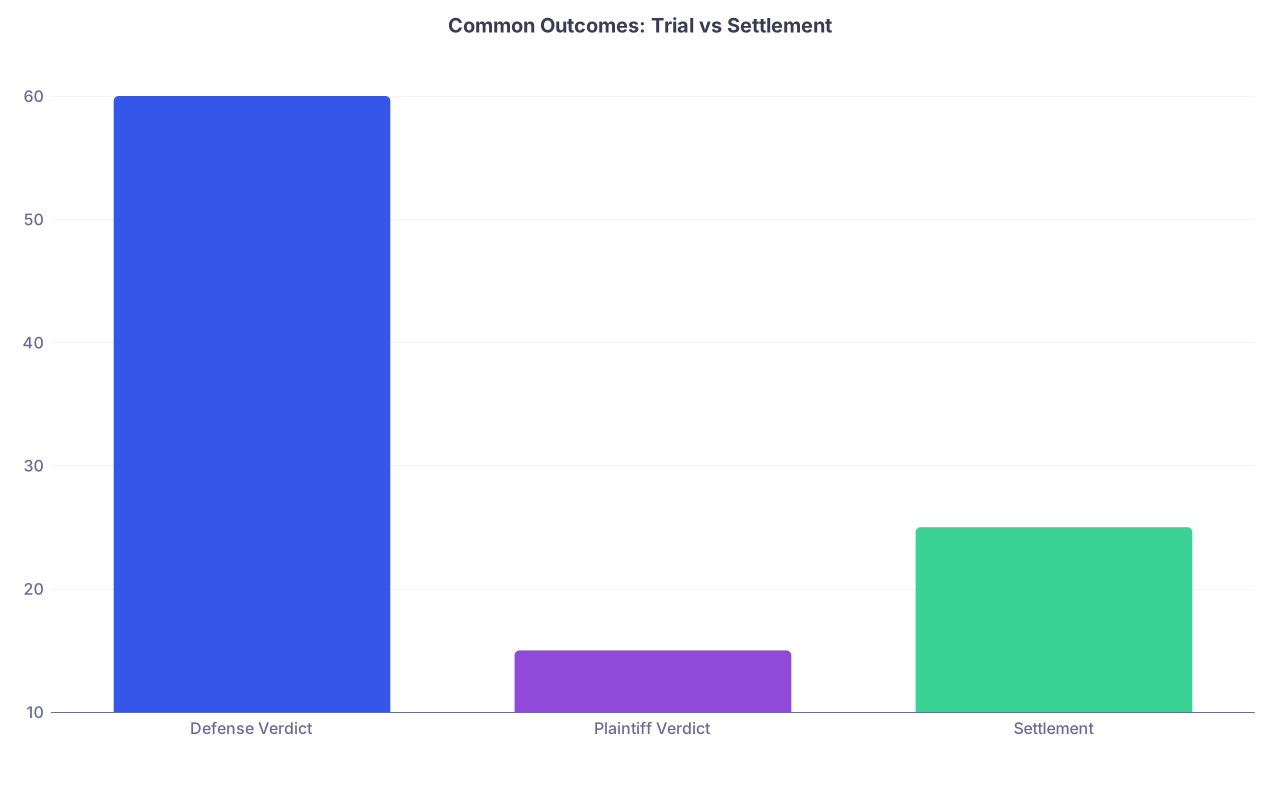
| Category | Value |
|---|---|
| Defense Verdict | 60 |
| Plaintiff Verdict | 15 |
| Settlement | 25 |
That chart is illustrative, but the reality on your record looks like this:
Defense verdict at trial
- No NPDB payment report.
- You may still have to disclose the claim itself on some applications, but you can say: “Tried to verdict – defense win.”
Plaintiff verdict at trial with payment
- NPDB report, typically more detailed, possibly larger amount.
Settlement
- NPDB report with payment amount and basic allegation summary
- On every future credentialing form, you will see: “Have any malpractice claims resulted in payment on your behalf?” You check “Yes.” Forever.
So yes — for some physicians, a defensible case with strong medicine is absolutely worth trying rather than accepting a small settlement that stains your record permanently.
7. Using Mediation and Timing to Your Advantage
Sometimes the right move is not “never settle,” but “not yet.”
A. Mediation with conditions
You can agree to mediation if:
- You are present (in person or virtually)
- You have full access to offers/demands
- Your consent is still required for any final deal (if your policy allows it)
Use mediation to:
- Test the plaintiff attorney’s real appetite for trial
- See their best and worst arguments laid out
- Gauge whether your expert and case materials are landing well
Make it clear upfront: your attendance at mediation is not pre-consent to settlement.
B. Strategic timing
Some inflection points where reassessing settlement makes sense:
- After key plaintiff expert depositions
- After Daubert/Frye or other admissibility rulings
- After the court rules on major summary judgment or motion in limine issues
- After you observe the judge’s rulings and demeanor in other similar trials
In other words, you buy time until your odds are clearer, rather than accepting a preemptive surrender.
8. Communicating With Your Group, Hospital, and Colleagues
You are not the only one with skin in the game.
A. If you are employed by a group/hospital
- Require you to cooperate with the insurer’s defense strategy
- Give the organization some say in settlement preferences
- Tie bonuses, partnership, or leadership roles to “claims history”
Practical steps:
- Notify your CMO, risk management, or legal that your insurer is pressing to settle and you are resisting.
- Express that you are protecting both your license and the institution’s reputation.
- Ask if the organization has any leverage with the insurer (many do, especially on enterprise policies).
B. What to say to colleagues
You do not owe the lounge a play-by-play. But for close partners whose coverage may be touched:
- Acknowledge that a settlement could affect the group’s loss history and premiums.
- Make clear you are not dragging them into an unwinnable war; you have reviewed the file and experts and believe the care was defensible.
- If co-defendants want global settlement, be prepared for pressure. Stay factual, not emotional.
9. If You Ultimately Lose the Fight and They Settle Anyway
Sometimes the insurer will push through a settlement despite your objections. That is not the end of your control.
Action plan after an unwanted settlement
Obtain the NPDB report draft
- Review for accuracy in dates, parties, and description
- You cannot spin it into a press release, but you can correct errors
Prepare a standard explanation statement for:
- Hospital credentialing committees
- Health plans
- Licensing boards (if asked)
- Employers and privileging bodies
That statement should:
- Acknowledge the claim and payment
- State clearly that you disputed the allegations and wished to defend the care at trial
- Note (if true) that you were advised settlement was driven by venue and economic risk, not admission of wrongdoing
- Avoid attacking the patient/plaintiff or sounding bitter
- Ask your insurer for a courtesy letter
- Request a neutral letter confirming:
- You cooperated fully in your defense
- The settlement did not include any admission of liability
- The insurer recommended settlement for risk management/economic reasons
- Request a neutral letter confirming:
Some will refuse. Some will write a short, factual note. Even a minimal letter helps when committees review your file years later.
- Track and challenge errors across systems
- Verify how the case is listed in state board sites, hospital records, public databases
- Correct anything that misstates facts (e.g., wrong specialty, incorrect injury, wrong dates)
10. Concrete Checklist: What To Do This Week
If you are in this situation now, here is your punch list.

| Step | Description |
|---|---|
| Step 1 | Insurer recommends settlement |
| Step 2 | Review policy language |
| Step 3 | Request full case evaluation |
| Step 4 | Request written justification |
| Step 5 | Write position memo |
| Step 6 | Prepare for trial |
| Step 7 | Mediation or timed settlement |
| Step 8 | Consent required? |
| Step 9 | Adjust strategy |
This week:
- Find and read your policy’s settlement and consent clauses.
- Email your defense lawyer asking for:
- The written basis for recommending settlement
- Copies of expert reports and key deposition transcripts
- Schedule a one-hour call with your attorney to walk through:
- Liability risk
- Venue/jury risk
- Verdict range estimates
- Draft your 1–2 page position memo staking out your stance.
- Ask your adjuster in writing:
- Will this proposed settlement be NPDB-reportable?
- How will it be reported to the state board and hospitals?
- If your gut still says “no,” request:
- Mediation with you present, or
- Reassessment after specific litigation milestones
FAQs
1. Can I sue my malpractice insurer if they settle over my objection?
You can, but you probably should not assume that is a viable “fix.” Bad faith claims against insurers are highly state-specific and usually turn on whether the insurer failed to protect you from excess verdict exposure, not on whether they protected your reputation. If they settled within policy limits, courts are often sympathetic to the carrier. You talk to a coverage/bad-faith lawyer in your state before threatening anything. Empty threats just make the carrier defensive and less cooperative.
2. Can I avoid NPDB reporting by having the hospital or group pay instead of the insurer?
Not reliably. NPDB cares about whether a payment was made for the benefit of an individual practitioner in settlement of a malpractice claim, not who cut the check. If the physician is named and the payment resolves those allegations, reporting is usually triggered. Schemes to route money through the hospital to “dodge NPDB” are both risky and often ineffective. You need a health law attorney to review the specifics before you assume any payment is “off the radar.”
3. How many malpractice settlements are “too many” for credentialing committees?
There is no hard number, but patterns matter more than raw count. One or two settlements over a long career, especially in high-risk fields like OB or neurosurgery, rarely end a career if your explanations are coherent and your recent practice is clean. Multiple large indemnity payments clustered in a short span, particularly in similar clinical scenarios, raise red flags. Committees look at: severity, recency, repetition, and your attitude. A physician who can clearly explain why they opposed a marginal settlement, yet accepted another when the care was truly substandard, inspires far more confidence than someone who shrugs and says “my insurer handled it.”
Open your malpractice policy today and find the exact paragraph that controls settlement. Highlight it. Then write a two-sentence email to your defense attorney asking for their written rationale for any settlement recommendation. You cannot fix this problem until you know, in writing, what game you are actually playing.