
Your documentation will protect you more than your memory, your lawyer, or your “I swear I said this to the patient.”
If you handle high‑risk encounters without a deliberate documentation strategy, you are betting your license and your financial future on luck. That is reckless. The good news: this is fixable, and it is fixable today.
This is not a theory piece. This is a survival manual for what to write, where to write it, and how to write it so that five years from now, in a conference room with a hostile plaintiff’s expert pointing at your note, you are still standing.
1. Understand What Malpractice Review Actually Looks For
If you do not understand the enemy, you will document the wrong things.
Malpractice review—whether it is your hospital, your malpractice carrier, or a courtroom—cares about three big questions:
- Did you recognize the risk?
- Did you address the risk using a reasonable standard of care?
- Did you communicate the risk and options to the patient in a way they could understand?
Nobody will care how many systems you reviewed or how pretty your physical exam template looks. They care about:
- Decision points
- Risk discussions
- Follow‑up safety nets
- Deviations from guidelines and why
Let me translate that into documentation terms:
If a reasonable clinician reading your note two years later cannot see:
- What you were afraid of
- What you ruled out (and how)
- Why you chose Plan A instead of Plan B
- How you warned the patient and arranged follow‑up
…then your note is a liability.
So that is the bar: make your reasoning, not just your results, visible.
2. High-Risk Encounters You Must Document Differently
Some visits are malpractice magnets. You know this already because you groan when you see them on the board.
| Scenario Type | Classic Malpractice Traps |
|---|---|
| Chest pain | Missed MI, atypical symptoms |
| Abdominal pain | Missed appendicitis/AAA/sepsis |
| Headache | Missed SAH/meningitis |
| Neuro deficits | Missed stroke/spinal cord lesion |
| Trauma (esp. minor) | Missed bleed, fracture, c‑spine |
| Pregnant patient | Missed ectopic, preeclampsia |
These are not the only ones, but they are the core. Any time you see a patient with:
- Potential for death, disability, or permanent loss of function
- Time‑sensitive diagnosis where “early” looks benign
- High variability in presentation (atypical MI, elderly sepsis, etc.)
…you switch into “defensive documentation mode” deliberately.
Defensive documentation does not mean padding your note with fluff. It means targeted, high‑yield phrases that answer the three questions from above: recognition, action, communication.
3. The Core Formula: How to Structure a Defensible Note
You need a repeatable checklist for high‑risk notes. Use this structure every time:
- Chief complaint + context
- Targeted risk-focused HPI
- Focused exam that matches the concern
- Clear differential with explicitly considered “can’t miss” diagnoses
- Rationale for your decisions and deviations
- Specific risk/benefit and return precautions documented as statements, not vague phrases
- Disposition and follow‑up with timeframes
If your note is missing #4–#6, you are exposed.
Let’s break down the parts that matter for legal survival.
4. Documenting the “Can’t-Miss” Diagnoses
If a diagnosis is a classic board question or is in every malpractice lecture—write it down. Even if you are convinced the patient does not have it.
That does two things:
- Shows you recognized the risk.
- Shows you consciously decided the risk was low and why.
How to do it without wasting time
In your Medical Decision Making / Assessment & Plan, build a habit line:
“Differential includes: ACS, PE, aortic dissection, pneumothorax, pneumonia, GERD, MSK pain. Based on history, exam, and diagnostics below, ACS, PE, and dissection are considered low risk today.”
That is one line. But it is gold in a review.
Then add one sentence per “can’t miss” explaining your reasoning. Not a novel. A sentence.
Example for chest pain:
- “ACS: No exertional component, no radiation, no associated diaphoresis, normal serial ECGs and troponin x2. HEART score 2 – low risk.”
- “PE: No dyspnea, hemoptysis, unilateral leg swelling, or recent immobility. PERC negative.”
- “Aortic dissection: No tearing pain, radiation to back, neurologic deficit, or pulse/blood pressure differential.”
You are not bulletproof, but you have turned an “I did not think of it” chart into “I thought of it, applied validated tools, and found low risk.” That is a very different posture in court.
5. Make Your Clinical Reasoning Visible
The worst note in litigation is the “perfect” template with no thought in it. Every line auto‑generated. Zero insight into your brain.
You win not by length, but by selective detail in three spots:
- Why you did not order a test
- Why you discharged or admitted
- Why you chose one management path over another
Short, explicit reasoning beats silence every time.
Examples
Headache, no CT ordered:
“Concern for SAH is low: onset gradual over several days (not thunderclap), no exertional trigger, neuro exam normal, no meningismus, no anticoagulant use. Shared decision‑making with patient: we discussed CT vs observation; patient prefers observation with strict return precautions.”
Abdominal pain, no CT for possible appendicitis:
“RLQ tenderness minimal, no rebound/guarding, afebrile, WBC normal, pain improves with PO intake and GI cocktail. Appendicitis risk estimated low; discussed option of CT vs serial exams and close follow‑up. Patient chooses outpatient observation with clear return instructions.”
You can hear the difference between that and “Abdominal pain, likely gastritis. Discharged with PPI.”
One sounds ignorant. The other sounds like a professional who sees the risk and manages it.
6. The Risk Discussion: Stop Using Lazy Phrases
If you ever write “risks and benefits discussed” with no specifics, understand this: in review, that line is almost worthless.
You need content, not clichés.
What to document in risk conversations
Hit three elements:
- Key risks you specifically mentioned
- Options you offered
- What the patient chose and why
Example, chest pain, negative workup:
“Discussed with patient that while today’s ECG, troponins, and exam are reassuring, no testing can completely rule out future cardiac events. We reviewed options: admission for observation vs discharge with close outpatient follow‑up. Patient prefers discharge. I explained warning signs: worsening or recurrent chest pain (especially with exertion), shortness of breath, diaphoresis, syncope. Patient verbalizes understanding and agrees to return immediately if symptoms recur or worsen.”
That reads very differently than “patient understands and agrees with plan.”
Refusal of tests or admission
If the patient refuses something important (CT head, admission, labs) and your documentation is weak, you are walking into a buzzsaw.
You must:
- Document what you recommended and why
- Document what they refused and why
- Document that they understood the potential consequences
- Document that they had capacity
Example:
“I recommended hospital admission for further evaluation for possible TIA given transient unilateral weakness. I explained potential risks of refusing admission including stroke, permanent disability, or death. Patient is alert, oriented, able to restate information and consequences in their own words, and demonstrates understanding. Patient declines admission, stating need to care for spouse at home. Offered alternative: expedited neurology follow‑up within 24–48 hours and return for any recurrent symptoms. Patient accepts this plan. AMA form signed.”
That paragraph is heavy‑weight protection.
7. Capacity and AMA: Stop Hand‑Waving
Leaving AMA or refusing care is a litigation honey pot. You need a tight protocol.
Capacity is not just “A&O x3”
Capacity is task‑specific. For a high‑risk decision, write something like:
“Patient demonstrates decision‑making capacity:
– Understands diagnosis and uncertainty: restated that we are concerned about possible MI.
– Understands risks of refusing care: stated back he could have a heart attack and die.
– Able to compare options: inpatient monitoring vs going home, and described pros/cons.
– Communicates a consistent choice without coercion.”
No, you will not write that for every URI. You will write it for the 45‑year‑old with chest pain and 2 elevated troponins who insists on going home.
AMA / refusal checklist
When a patient leaves AMA or refuses key diagnostics, you should be able to say yes to:
- Did I clearly recommend what I thought was safest?
- Did I explicitly state the serious risks in the note?
- Did I document that the patient demonstrated understanding, not just nodded?
- Did I document witnesses if the conversation was tense or complex?
If the answer to any of these is no, fix your note before they leave.
8. Use Templates Without Letting Them Kill You
EMR templates can either save your time or destroy you in court.
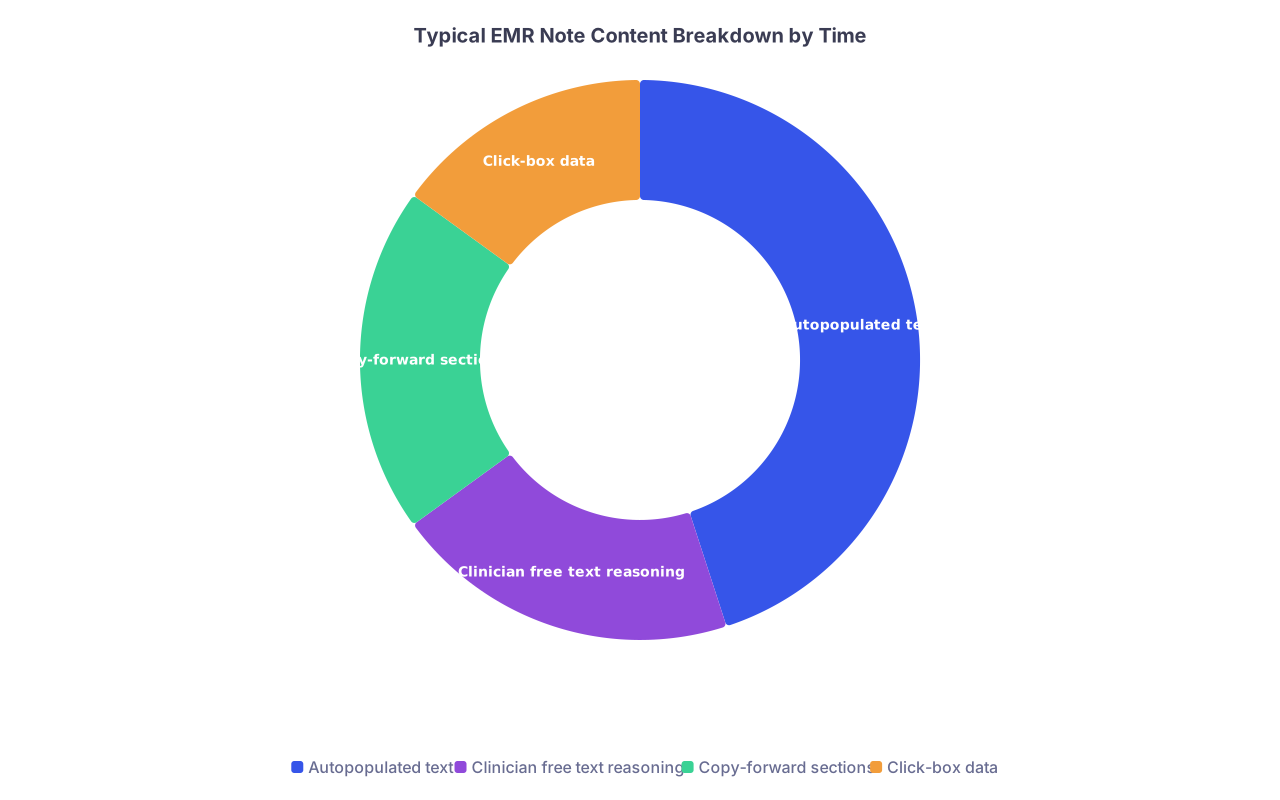
| Category | Value |
|---|---|
| Autopopulated text | 45 |
| Clinician free text reasoning | 20 |
| Copy-forward sections | 20 |
| Click-box data | 15 |
Lawyers love attacking contradictions between your auto‑filled text vs reality. “Doctor, your note says ‘no distress’ but the triage nurse documented 10/10 pain and patient crying. Which is true?”
Rules for safe template use
Turn off nonsense defaults
If your template auto‑checks “no chest pain” in ROS for every patient, but you see lots of chest pain? Change the template.Review and correct auto‑populated text on high‑risk visits
You will not do this for every rash. But for high‑risk, spend 30 seconds scanning auto‑text and delete contradictions.Add a “high‑risk reasoning” section
Create a quick text macro like.HRISKthat expands to:- “Key risks considered:”
- “Tests ordered / not ordered and rationale:”
- “Shared decision‑making summary:”
- “Specific return precautions given:”
Then fill it in with 3–6 short lines. That is your malpractice shield.
Do not copy forward old assessments for new high‑risk complaints
That lazy habit is how you end up with “headache resolved” in a chart where the patient came back with a SAH two days later. Write fresh reasoning for fresh risk.
9. Tailored Strategies for Common High-Risk Scenarios
You want concrete, not abstract. Let’s walk through some scenarios and how to document them correctly.
A. Chest Pain – Going Home
Core problems in lawsuits: missed MI, lack of risk stratification, poor return precautions.
You want to show:
- You used a validated tool (HEART, EDACS, etc.)
- You addressed atypical features
- You discussed residual risk and follow‑up
Sample key lines:
“HEART score 2 (History: slight suspicion, ECG normal, Age 45, Risk factors: HTN only, Troponin negative x2). Risk of MACE estimated low based on HEART study data.”
“Pain non‑exertional, present x3 days, not associated with SOB, diaphoresis, or nausea. No prior CAD.”
“Discussed option of observation vs outpatient follow‑up; patient chooses outpatient path. Instructed to return immediately for chest pain that is exertional, associated with SOB, nausea, sweating, or feeling like prior cardiac event.”
B. Abdominal Pain – Possible Appendicitis
Risk: delayed diagnosis, “benign” early exam.
Key documentation points:
- Location and evolution of pain
- Serial exams (if applicable)
- Why you judged low vs high risk
“Pain predominantly epigastric, nonmigratory, present x24 hours, improved with PO intake. Abdomen soft, nondistended, no RLQ rebound/guarding, able to jump without pain. WBC 7.8, afebrile.”
“Discussed that early appendicitis can present with nonspecific findings. Offered CT vs observation and return for worsening. Patient prefers to avoid CT today. Given strict return precautions: worsening or localized RLQ pain, fever, vomiting, inability to tolerate PO; instructed to return immediately if these occur.”
C. Headache – Ruling Out SAH
Risk: missed sentinel bleed, “worst headache” charted wrong, no documentation of onset pattern.
Key lines:
“Headache gradual onset over 2 days, not thunderclap, no single moment of maximal intensity. No exertional trigger, no syncope, no neck stiffness, photophobia only.”
“Neuro exam normal: CN II–XII intact, strength 5/5 all extremities, sensation intact, normal gait. No meningismus.”
“Risk of SAH considered low given non‑sudden onset and normal exam. Discussed option of CT vs observation. Patient prefers observation; understands small residual risk and will return if headache suddenly worsens, develops neck stiffness, fever, confusion, or neuro changes.”
Now imagine explaining this note to a jury vs a template that says “headache – likely migraine. Discharge.”
10. Time-Stamps, Phone Calls, and “Negative Events”
The chart is not just your note. It is also:
- Nursing notes
- Phone call logs
- Orders and time stamps
- “Critical value” notifications
You can weaponize those in your favor by documenting your actions when something concerning happens.
Critical lab / imaging callbacks
When radiology calls you with an unexpected finding, write:
“At 21:14, radiology called with CT result: small intracranial hemorrhage. I immediately notified patient and family at bedside, initiated neurosurgery consult at 21:18, blood pressure control started with nicardipine, head of bed elevated. Patient transferred to ICU at 22:05.”
That is a timeline. It shows you acted, fast.
Phone calls after discharge
If you call a patient to instruct them to return, document it:
“22:30 – Called patient at listed number after re‑reviewing labs showing elevated D‑dimer. Instructed patient to return to ED tonight for further testing for possible blood clot. Patient states they will arrange transport and return. Advised to call 911 for worsening symptoms.”
Now if they delay and things go badly, you have clear evidence you tried.
11. What Not to Write: Landmines in Your Note
Some documentation mistakes practically write the plaintiff’s opening statement for them.
Avoid:
Casual derogatory language
- “Drug seeker,” “frequent flyer,” “noncompliant,” “hysterical”
These make you look biased and uncaring. Use neutral language: “history of opioid use disorder,” “multiple prior ED visits for similar pain,” “declines recommended treatment.”
- “Drug seeker,” “frequent flyer,” “noncompliant,” “hysterical”
Admitting uncertainty the wrong way
“I have no idea what is going on” is a gift to the other side. You can acknowledge uncertainty without sounding incompetent:- “Etiology unclear; serious causes considered and felt unlikely based on current evaluation. Plan for close outpatient follow‑up with PCP within 24–48 hours.”
Contradictions between sections
- HPI: “Severe pain, worst of life”
- MDM: “Mild pain, likely benign”
You look sloppy or dishonest. Fix contradictions before you sign.
Copying and pasting obviously wrong data
- Normal pelvic exam documented on a male
- “No acute distress” while patient is intubated
These destroy your credibility completely. If they can prove you copied once, they will argue you copied your “normal neuro exam” too.
12. Build a Personal High-Risk Documentation Checklist
You are not going to reinvent the wheel at 3 a.m. You need a micro‑checklist in your head (or in a macro) for any high-risk case.
Here is a simple pattern you can adapt:
- What are the three worst things I am worried about?
- Did I name them explicitly in the MDM?
- Did I document why I think each is low/moderate/high risk?
- Did I document the conversation about risk and options?
- Did I give very specific return precautions and write them down?
- If patient refused tests/admission, did I document capacity and refusal details?
Turn this into an EMR macro or a physical checklist near your workstation.

| Step | Description |
|---|---|
| Step 1 | Identify high risk complaint |
| Step 2 | List 2-3 worst diagnoses |
| Step 3 | Order targeted tests |
| Step 4 | Evaluate results and exam |
| Step 5 | Document risk level for each worst diagnosis |
| Step 6 | Discuss risks and options with patient |
| Step 7 | Document follow up and return precautions |
| Step 8 | Document refusal and capacity |
| Step 9 | Sign complete note |
| Step 10 | Patient accepts plan? |
Stick to this mentally, and your notes will become systematically safer.
13. Work With Your Malpractice Carrier, Not Against Them
Your malpractice insurer does not want to deny your claim. They want to win or settle cheaply. Your documentation decides which.
Many carriers offer:
- Risk‑management webinars and CME
- Sample documentation phrases and templates
- Closed‑claim reviews with redacted charts
Use them. Ask your risk manager or carrier:
- “Do you have examples of strong documentation for chest pain / headache / abdominal pain?”
- “What phrases do your defense attorneys like seeing in charts?”
Then steal shamelessly and build those into your macros.
Also, know what triggers red flags for insurers. A pattern of:
- High rate of AMA departures without good documentation
- Repeated “no show” follow‑ups without clear instructions
- Sloppy or contradictory notes on high‑risk cases
…will make them nervous about defending you. Do not be that clinician.
14. Protect Your Future Self: Practical Daily Habits
Let me end with the boring truth. Malpractice survival is not one heroic note. It is a hundred small habits repeated.
Here are practical habits that actually stick in real practice:
Always pause before discharging a high‑risk patient and ask: “If this goes bad, will future me know what I was thinking?” If the answer is no, add 3–4 sentences to your MDM.
Use disease-specific macros for chest pain, headache, abdominal pain, etc., that prompt you for:
- “Worst‑case diagnoses considered”
- “Decision rule used (if any)”
- “Risk discussion summary”
- “Explicit return precautions”
Do not let the patient leave before you finish the key parts of the note for the highest‑risk ones. You can fill in vitals/meds later, but the risk reasoning and conversation details are freshest in the moment.
Read one closed‑claim summary per month. Many carriers and societies publish them. You will see the same documentation failures on repeat. Adjust your habits accordingly.
Discuss borderline cases with a colleague and document it:
- “Case discussed with Dr. Smith (ED attending). Agrees with low risk of ACS and discharge with outpatient follow‑up.”
Shared decision‑making with another clinician is a powerful defense.
- “Case discussed with Dr. Smith (ED attending). Agrees with low risk of ACS and discharge with outpatient follow‑up.”
Key Takeaways
- High‑risk encounters require a different level of documentation: name the worst‑case diagnoses, show your reasoning, and capture the risk discussion in specific language.
- Templates will not save you; short, targeted free‑text in the MDM—especially around tests not ordered, decisions made, and patient refusals—will.
- If a future reviewer cannot see what you were afraid of, why you were reassured, and how you warned the patient, your documentation has already failed—even if your medicine did not.