
You have just signed your new contract. Great job, new salary, new city or state, maybe a better schedule. Then someone casually says during onboarding: “By the way, are you covered for your old cases?”
Your stomach drops.
You realize you do not fully understand how your current malpractice policy ends, how the new one starts, or what happens to those thousands of patients you saw in between. You have heard the words “tail coverage” and “prior acts,” but no one has ever really walked you through how not to get burned.
This guide fixes that. Step-by-step. No fluff.
Step 1: Get Crystal Clear on What You Have Right Now
Before you can fix coverage gaps, you need to know exactly what you are working with. Most physicians skip this and just ask, “Do I have tail?” and accept a yes/no answer. That is how people get sued personally.
Do this in writing and keep copies (email is fine).
1. Collect the hard data
Ask your current employer’s HR/administrator or broker for:
- A copy of your current malpractice declarations page (“dec page”)
- Any endorsements related to:
- Tail coverage
- Nose/prior acts coverage
- Extended reporting periods
- The full policy if you can get it (PDF)
From those documents, answer these questions:
Is it occurrence or claims-made coverage?
- Look at the dec page. It will literally say:
- “Type of coverage: Occurrence”
or - “Type of coverage: Claims-made”
- “Type of coverage: Occurrence”
If you cannot find it, ask directly:
“Please confirm in writing whether my malpractice policy is occurrence or claims-made.”- Look at the dec page. It will literally say:
What are the key dates?
- Retroactive date (claims-made only):
The date from which your prior acts are covered. Might read like:
“Retroactive date: 07/01/2018” - Policy effective date and expiration date
- Employment end date (does NOT always equal policy end date)
- Retroactive date (claims-made only):
Who is actually insured?
- Named insured: “XYZ Medical Group”
- Are you listed individually as:
- Named insured, or
- Additional insured under the group policy?
What limits do you have?
- Typical example: $1M / $3M
That means:- $1,000,000 per claim
- $3,000,000 aggregate per policy year
- Typical example: $1M / $3M
You cannot fix coverage gaps if you do not know these four things.
Step 2: Diagnose Your Gap Risk Based on Policy Type
Once you know if you have occurrence or claims-made, the game changes.

Occurrence coverage – the easy one
If your current coverage is occurrence, you are in better shape.
- Every incident that occurs during the policy period is covered forever.
- Even if a claim is filed years after you leave.
- You do not need tail for those years.
Your main job when switching:
- Make sure the new job’s coverage start date lines up with your first day seeing patients there.
- Confirm the new coverage is adequate for that state and specialty.
Claims-made coverage – where most gaps happen
If your current coverage is claims-made, you need to pay attention. Here is how it works, simply:
You are covered only if:
- The incident occurred on or after the retroactive date, and
- The claim is reported while a valid policy (or tail) is in force
That means when you leave:
- Once the policy ends, you lose the ability to report new claims under that policy.
- All those past cases are now sitting out there, potentially uncovered, unless:
- Someone provides tail coverage, or
- Your new policy picks up prior acts (nose coverage) back to your old retro date.
If you have claims-made and no tail or prior acts, you have a giant exposure hole. Personally.
Step 3: Map Your Coverage Timeline to Find Actual Gaps
Now we turn this into a visual problem you can solve.
Take a piece of paper. Draw a horizontal line across the middle. This is your career timeline.
Then mark:
- Old practice start date
- Old policy retroactive date (if later than your start)
- Old practice end date
- Old policy end date
- Any tail coverage start/end (if specified)
- New practice start date
- New policy effective date
- New policy retroactive date
Now ask yourself two questions for every point after you leave the old job:
If a claim arises from care I provided at my old job on date X, is there any active policy that:
- Has a retroactive date earlier than or equal to X, and
- Is in force on the day the claim is made?
If I am seeing patients at the new job on date Y, is there any active policy that covers:
- That location
- That employer/structure
- That scope of practice (procedures, telemedicine, moonlighting)
Where the answer is no, you have a gap.
Step 4: Understand the Three Main Fixes: Tail, Nose, and Occurrence Switch
This is where people get confused, and brokers make it sound mystical. It is not.
| Strategy | Who Pays Typically | Protects Which Past Work | Risk of Gap |
|---|---|---|---|
| Tail Coverage | Old or new employer, or you | Work at old job only | Low if correctly written |
| Nose/Prior Acts | New employer/you | Work at old and new jobs under one policy | Low if retro date matches |
| Occurrence at New Job | New employer | Only incidents at new job | Does not fix old-job exposure |
1. Tail coverage (Extended Reporting Endorsement)
- Attaches to the old claims-made policy
- Lets you report claims in the future for events that happened during that policy period
- It does not cover new incidents after you leave, only past work
Key variables:
- Cost: Often 150–250% of your annual premium
Example: If premium was $18,000/year, tail might be $27,000–45,000 one-time. - Length:
- Some carriers offer 3-, 5-, or 7-year tails
- Some offer “unlimited” tail (often best for peace of mind)
- Who pays:
- Determined by your employment contract
- Could be:
- Employer pays 100%
- You pay 100%
- Cost shared
- Employer pays only if you stay X years
If you have claims-made and no tail and no nose, you are exposed. Full stop.
2. Nose coverage (prior acts coverage)
Nose coverage means your new policy picks up coverage for your old acts by:
- Adopting your old retroactive date
Example: Old retro: 07/01/2018 → New policy retro: 07/01/2018
This way:
- One policy (the new one) covers:
- Old work (at old job)
- New work (at new job)
- You do not need to buy tail from the old carrier.
Common issues:
- New carrier may:
- Decline prior acts (especially if you have claims)
- Charge a higher premium
- Limit prior acts to certain years
3. Moving from claims-made to occurrence
Sometimes your old job had claims-made and your new job uses occurrence policies only.
- The new occurrence policy:
- Covers only events occurring during its policy period (at the new job)
- It does not solve your old-job exposure.
- You still need:
- Tail from the old policy
or - A standalone prior acts policy (rare, specialty product)
- Tail from the old policy
This is where many physicians get blindsided. They assume “I have coverage at the new job, so I am good.” You are not, for old work, unless tail or nose exists.
Step 5: Job Change Scenarios and How to Fix Each One
Let us go through the most common real-world situations.
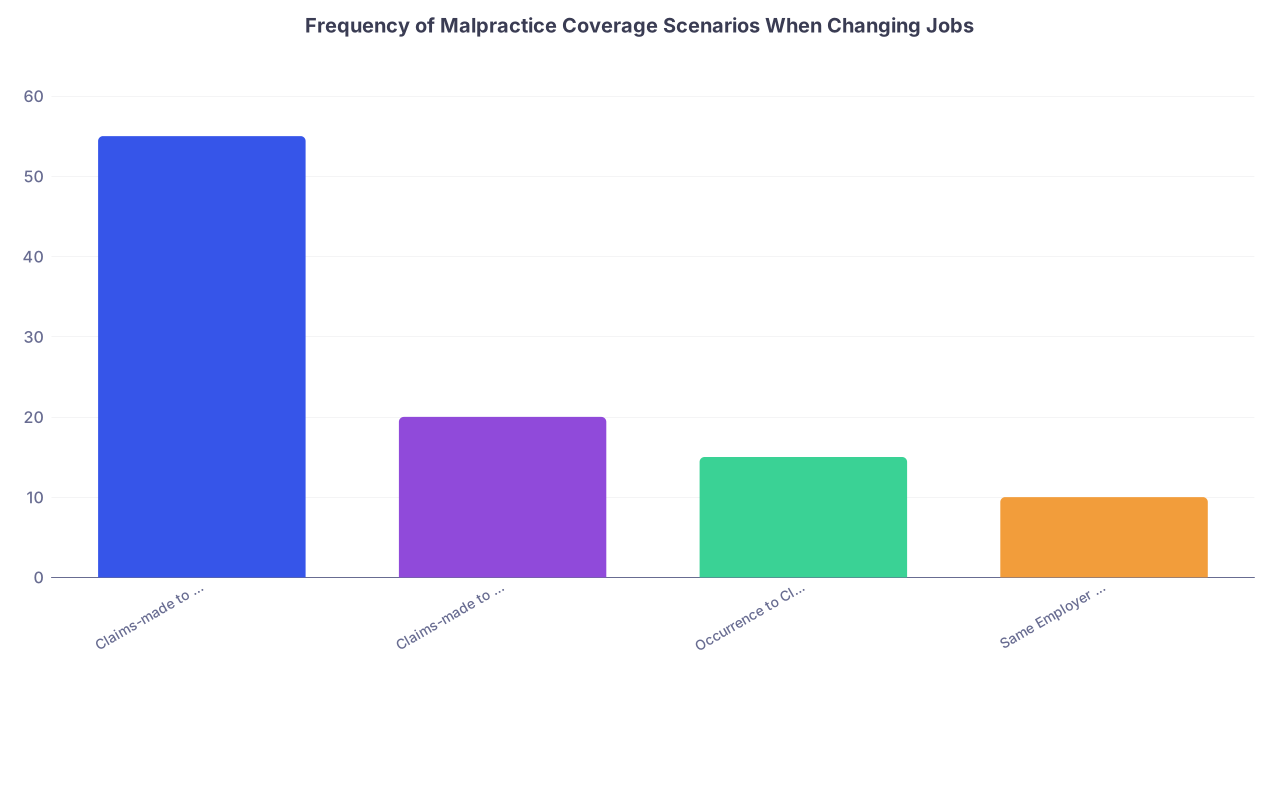
| Category | Value |
|---|---|
| Claims-made to Claims-made | 55 |
| Claims-made to Occurrence | 20 |
| Occurrence to Claims-made | 15 |
| Same Employer Different State | 10 |
Scenario A: Claims-made → Claims-made, same state
You are leaving a hospital-employed position in State A, going to a group practice in the same state. Both use large national carriers with claims-made policies.
Your action plan:
- Confirm your current retro date from your old dec page.
- Ask your new employer and/or their broker:
- “Will my new policy include prior acts coverage back to [retro date]?”
- “Will the new carrier match my current retro date of [MM/DD/YYYY]?”
- “Please send written confirmation of the retro date that will appear on my new dec page.”
- If the answer is yes, and you see the retro date match in writing:
- You generally do not need tail from the old employer (unless contract says otherwise for their own risk reasons).
- If the answer is no:
- You must arrange tail coverage on the old policy.
- Negotiate:
- Old employer paying all or part
- A signing bonus from new employer earmarked for tail
- A tail payment plan with the carrier, if available
Scenario B: Claims-made → Occurrence (common when moving to large academic centers)
You are leaving a private group (claims-made) to join a big academic center that offers occurrence coverage only.
Your action plan:
- Accept that the new occurrence policy cannot cover your old acts.
- Your only real protection for past work:
- Tail coverage from the old carrier.
- Read your departing contract:
- Does it say “physician responsible for tail coverage upon termination”?
- Any exceptions (retirement, death, disability, without-cause termination)?
- If you are stuck with tail:
- Get actual quotes from the carrier before your last 60 days.
- If it is $40,000 and you do not have it:
- Negotiate with your old employer:
- “If I extend my departure by 6 months, will you split the tail?”
- “Can we structure a final bonus or payout that helps cover tail?”
- Negotiate with your new employer:
- “I have an unavoidable tail obligation of $X. Can you provide a signing bonus structured to cover that?”
- Negotiate with your old employer:
- Whatever you do, do not walk away without tail or nose. That is how six-figure personal judgments happen.
Scenario C: Occurrence → Claims-made
You had occurrence coverage at your old job. You are now switching to a claims-made policy at the new job.
Good news:
- You do not need tail from the old job.
- Your only focus is getting proper coverage going forward at the new job.
Still, verify:
- New policy effective date matches your first clinical day.
- You understand:
- How many years to first become “mature” premium (claims-made often ramps over 3–5 years)
- Who will pay for tail if you leave this new job in the future
Scenario D: Same employer, new state
You are with a large national system (e.g., HCA, Kaiser, Optum). You are moving from one state to another, same umbrella employer.
Do not assume “corporate has it covered.”
Your action plan:
- Ask risk management or the malpractice administrator:
- “Is my retroactive date preserved when I move from State A to State B?”
- “Is it the same carrier and master policy, or a different one?”
- Ask to see:
- Your current dec page
- Your new dec page once issued, confirming the same or earlier retro date
- Ask explicitly:
- “If a claim is filed two years from now for care I provided in State A, under what policy and limits will that claim be handled?”
If the move is within the same master claims-made program, they often carry your retro date forward. But I have seen messy transitions where a system changed carriers mid-career and failed to align retro dates properly. You want that checked.
Step 6: Crossing State Lines – Legal and Regulatory Landmines
Moving states adds extra friction:
- Different minimum coverage limits may be required by:
- State law
- Hospitals
- Health plans
- Different statutes of limitations and discovery rules:
- Some states have 2-year limits
- Others allow up to 4+ years for certain claims or for minors

| Category | Value |
|---|---|
| State A | 1000000 |
| State B | 1000000 |
| State C | 2000000 |
| State D | 500000 |
When you move:
Confirm with the new hospital or credentialing office:
- “What minimum malpractice limits are required here?”
Ask your new carrier:
- If your prior acts coverage (nose) will respond to claims filed in the new state for old-state care
- They usually will, but:
- Venue
- Choice of law
- Defense counsel networks
can complicate how the claim is handled.
Telemedicine twist:
- If you will keep seeing patients by telemedicine in your old state while physically living in the new one:
- You may need malpractice coverage that lists both states.
- You may need dual licensure.
- Do not assume your new policy automatically covers prior telemedicine in another state. Ask.
- If you will keep seeing patients by telemedicine in your old state while physically living in the new one:
Step 7: Contract Language – Fix It Before You Sign
Most of your leverage is before you sign a new job contract or before you notify your current employer you are leaving.

| Step | Description |
|---|---|
| Step 1 | Current Policy Type |
| Step 2 | No Tail Needed for Old Work |
| Step 3 | Match Retro Date on New Policy |
| Step 4 | Negotiate or Buy Tail |
| Step 5 | Confirm in Contract |
| Step 6 | Budget and Get Quote |
| Step 7 | Verify Retro Date in Writing |
| Step 8 | Align Start Date at New Job |
| Step 9 | Occurrence? |
| Step 10 | New Policy Offers Nose? |
| Step 11 | Who Pays Tail? |
Here is the contract language you care about:
1. Who pays tail?
Look for a section titled something like “Professional Liability Insurance” or “Malpractice Coverage.”
Common formulations:
- “Employer shall provide and pay for claims-made malpractice insurance, including any tail coverage upon termination of employment.”
- “Employer shall provide claims-made coverage. Physician shall be responsible for purchasing tail coverage upon termination for any reason.”
- “If Physician is terminated for cause or resigns within two years, Physician shall be responsible for tail coverage; if Physician completes at least two years of service or is terminated without cause, Employer shall pay for tail coverage.”
What to push for:
- Best-case:
- Employer pays tail in all scenarios except maybe “for cause” termination.
- Reasonable compromise:
- Employer pays tail after X years of service.
- Tail cost shared on a sliding scale (e.g., 25% if <1 year, 50% if 1–3 years, 100% if >3 years).
2. Nose coverage obligations
Ask to include:
- “Employer shall obtain malpractice insurance for Physician, including prior acts coverage back to [retro date], such that Physician is continuously covered for professional services rendered since [retro date].”
Get the retro date written into:
- The contract
and - The actual dec page later.
3. Survival of coverage obligations
Make sure language like:
- “Employer’s obligation to provide tail coverage shall survive termination of this Agreement.”
No survival language = more room for games later.
Step 8: Personal Financial Protection if Things Still Go Sideways
Even if you do everything right, mistakes and disputes happen.

Here is how to reduce the personal financial risk if a coverage gap or policy dispute shows up:
1. Use proper asset titling and protection
- Consider:
- Maxing out retirement accounts (often protected from creditors)
- Titling your home as:
- Tenancy by the entirety (in some states)
- Homestead protections where available
- Avoid:
- Large personal assets in your name alone that are easy targets
Talk to an asset-protection attorney in your state. Not a random blog.
2. Maintain documentation
Keep:
- Copies of:
- All dec pages from every job
- All tail and prior acts endorsements
- Email confirmations about retro dates, coverage obligations, and tail
- Store them:
- In a secure digital folder
- Backed up, ideally offsite
If a coverage dispute arises 6 years from now, you will not remember what HR said on the phone. But the PDFs and emails will.
3. Understand your risk tolerance
If you are in:
- High-risk specialties (OB, surgery, EM, anesthesia, neurosurgery)
- Plaintiff-friendly jurisdictions
Then cutting corners on tail or prior acts is not “saving money.” It is gambling with your house.
Step 9: A Simple Checklist You Can Actually Use
Print this or save it in your notes app. Use it every time you switch jobs or states.

Before you resign
- Get your current dec page
- Confirm policy type (occurrence vs claims-made)
- Identify your retroactive date (if claims-made)
- Read your contract’s tail coverage clause
- Ask risk/HR in writing:
- Who pays for tail coverage when I leave?
- Do we have any automatic tail in case of retirement, disability, or death?
Before you sign new job contract
- Confirm whether new coverage is claims-made or occurrence
- If claims-made:
- Confirm if they will match your retro date (nose coverage)
- Get written confirmation of the retro date that will appear on new dec page
- Negotiate:
- Tail obligations
- Nose coverage inclusion
- Any signing bonus to offset tail if needed
During transition
- Align dates:
- Old job last clinical day
- Old policy end date
- Tail or nose effective date
- New job first clinical day
- New policy effective date
- Verify:
- New dec page has correct retro date
- State-specific limit requirements are met
After move
- Store all:
- Old dec pages
- New dec pages
- Tail endorsements
- Prior acts endorsements
- Key coverage confirmation emails
Your Next Action Today
Do not wait until you are 30 days from leaving to figure this out. That is how people get cornered into writing a $40,000 tail check on a week’s notice.
Your move right now:
Open your email and send one message to your current practice administrator or HR:
“Could you please send me a copy of my current malpractice insurance declarations page and confirm whether our policy is occurrence or claims-made, and what my retroactive date is? I am updating my records.”
Once you have that dec page in front of you, the rest of this guide becomes a simple series of fixes rather than an anxiety spiral.