
What exactly is your plan if a 2 a.m. moonlighting shift turns into a lawsuit and your program’s malpractice says, “Not our problem”?
You would be shocked how often I have watched residents and young attendings assume they are “probably covered” for moonlighting. They sign up for extra shifts, chase the pay, and only later discover a brutal truth: nobody insured what they actually did.
Let me be blunt. Moonlighting without clearly verified malpractice coverage is one of the fastest ways to blow up your finances, your license, and your career. And it is entirely preventable.
The Core Mistake: Assuming Coverage Instead of Proving It
The classic story goes like this.
A PGY‑3 internal medicine resident picks up hospitalist moonlighting at a community hospital. The pay is great. The credentialing packet is 50 pages of garbage nobody wants to read. Someone in medical staff office casually says, “Yes, we cover you under our policy.” The resident signs, starts working.
Six months later, a bad outcome. Sepsis patient decompensates, ends up in the ICU, codes, dies. Family sues. The lawsuit names:
- The community hospital
- The attending of record (you, the moonlighter)
- Several nurses
- The resident’s training hospital
Now the finger-pointing starts.
- Training hospital: “Moonlighting is outside the scope of our coverage.”
- Moonlighting site: “Our policy excludes residents not employed directly by us” or “This locums agency was the employer, not us.”
- Locums agency (if involved): “You signed an independent contractor agreement; you were supposed to carry your own malpractice.”
And you discover something horrifying: there is no clear, written policy anywhere showing that you personally are covered for that shift.
That is not a rare hypothetical. I have seen versions of this problem across specialties: EM moonlighting at rural sites, OB coverage shifts, telemedicine side gigs, aesthetics clinics.
The mistake is always the same:
You “felt reassured” instead of getting documentation.
Why Moonlighting Malpractice Is Not Automatically Covered
Here is the trap: many residents believe one (or more) of these things:
- “My residency program malpractice covers any clinical work I do.”
- “If the hospital let me work, they must have insured me.”
- “The locums group / urgent care said I was covered, so I’m good.”
- “I’m working under someone else’s supervision; their policy covers me.”
All four are dangerous half-truths.
Your residency program’s coverage has limits
Most GME malpractice policies are:
- Limited to work done for the sponsoring institution
- Limited to specific sites listed in the affiliation agreements
- Limited to educational activities, not independent practice
Moonlighting, especially external moonlighting, is often explicitly excluded. Internal moonlighting may or may not be included. You do not get credit for “they knew I was doing it.” The policy language controls.
The hospital’s policy may not include you personally
Even if a hospital has malpractice coverage, that does not mean:
- Every contractor is named as an insured
- Every resident from another institution is automatically included
- Every type of work (ED coverage, OB call, ICU shifts) is within scope
I have seen hospital credentialing packets say “Physician responsible for maintaining own malpractice” on page 23, while the recruiter told the doctor verbally, “We’ve got you covered.”
Guess which one the court will care about.
Locums / staffing agencies are notorious for this
Many locums agencies do provide malpractice. Some do not. Some provide only claims-made coverage with minimal tail. Some only cover you when you are working through them, not side gigs you independently arrange at the same facility.
You cannot assume anything from the size of the company or how polished their recruiter sounds.
The Financial Reality: What You Are Putting at Risk
You are not just risking “a lawsuit” in the abstract. You are risking:
- Legal defense costs (which can reach six figures before trial)
- Settlements or judgments (which can reach seven figures, even eight)
- Your personal assets (savings, home equity in some states, future earnings)
- License investigations and board actions
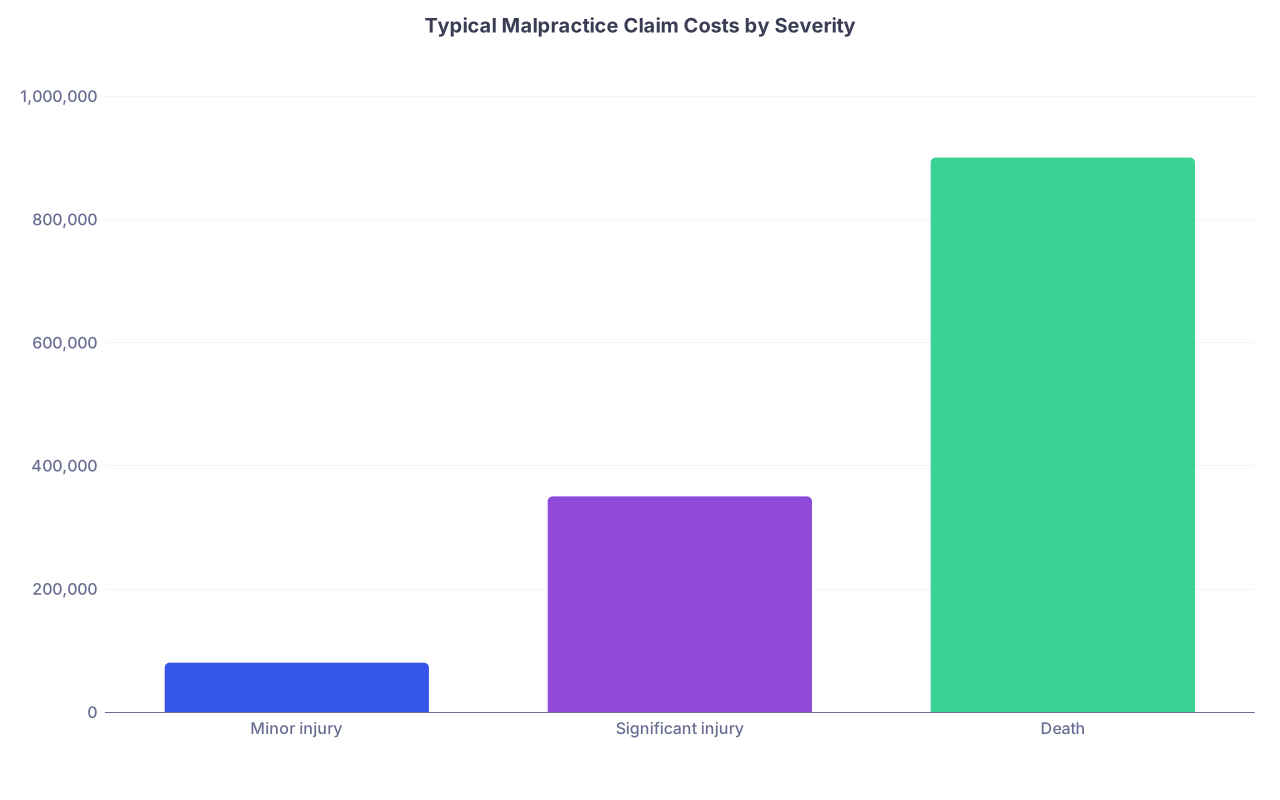
| Category | Value |
|---|---|
| Minor injury | 80000 |
| Significant injury | 350000 |
| Death | 900000 |
Even if the claim is not “frivolous,” you still need a legal team. That is exactly what malpractice insurance buys: a defense plus indemnity.
Going into moonlighting uninsured or ambiguously insured is basically saying, “I will self-insure a catastrophic risk I cannot afford.”
That is not bold. It is reckless.
Key Coverage Concepts You Cannot Ignore
You do not need to become an insurance lawyer. But you must understand a few basics or you will walk into traps.
1. Occurrence vs claims-made
- Occurrence: Covers incidents that occur during the policy period, regardless of when the claim is filed. Good for moonlighting, simpler, usually more expensive.
- Claims-made: Covers claims reported while the policy is active and continuous. When you leave a job or stop the policy, you may need tail coverage.
If your moonlighting coverage is claims-made and you do not secure tail when you leave, any later lawsuit from those shifts is your problem.
2. Limits of liability
Common per-claim / aggregate limits:
- $1M / $3M
- $2M / $4M
You must make sure:
- The limits are at least what your specialty and state typically use
- You are not sharing a tiny per-claim sublimit as “additional insured” buried under an organization’s umbrella policy
3. Named insured vs additional insured
Being the named insured is clean. The policy is clearly yours.
Being an additional insured can be fine, but you want explicit language that:
- Lists you by name or by clear category (e.g., “All contracted ED physicians with current privileges are covered”)
- Covers the type of clinical activity you will perform
“I think I’m covered under their group” is not a category.
Specific Situations Where People Get Burned
I will walk through a few common moonlighting scenarios where residents and junior attendings get burned because they do not verify coverage.
1. External moonlighting as a resident
You are a PGY‑2 EM resident working weekend shifts at a rural ED.
Typical landmines:
- Your residency GME office states: “No liability coverage for external moonlighting.”
- The rural hospital HR packet says, in small print: “Physician required to carry own professional liability coverage with limits of $1M/$3M.”
- No one provided you a certificate of insurance (COI) with your name on it.
If a claim arises, the hospital’s carrier might defend the hospital and throw you under the bus as an uninsured contractor. Your residency’s coverage will almost certainly deny.
Your responsibility: Either obtain your own individual malpractice policy or get, in writing, confirmation that the hospital’s policy names you as insured (with a COI to prove it).
2. “Internal” moonlighting within your training hospital
Here is the sneaky version. You are an IM resident at Big Academic Hospital. You moonlight as a nocturnist on the med floors in the same system.
You assume: same badge, same EMR, same building = same coverage. Maybe. Maybe not.
Red flags I have personally seen:
- The GME malpractice only covers “duties assigned as part of the residency program”
- Internal moonlighting is treated as separate employment under a different entity
- The hospital’s payroll and HR treat you as a per-diem “attending” for those shifts
Result: Those moonlighting shifts could technically fall outside GME coverage. If the hospital does not clearly include all employed docs in its malpractice program, you may have a gap. You need to see that “clearly include” in writing.
3. Telemedicine and side gigs
Telemedicine moonlighting is a coverage minefield:
- Multiple states
- Patients in states where you barely remember getting licensed
- Independent contractor agreements that say “you shall maintain malpractice coverage at your own expense” while the recruiter says “we have a group policy”
I have seen physicians discover mid-investigation that:
- The telemedicine company’s policy excludes certain high-risk areas (e.g., psychiatry prescriptions in some settings, OB advice)
- The policy only covers specific states, and your license state is not listed
- They never received a COI and their name is nowhere in the policy documentation
Telemedicine is not “less real” medicine. The liability is real.
4. Aesthetic / medspa / “cash” moonlighting
Medspas love to say, “You are just doing Botox, don’t worry, we have coverage.” Then their policy turns out to:
- Be a general liability business policy, not professional malpractice
- Only cover the LLC as an entity, not the individual injector
- Exclude “independent contractor physicians”
Cosmetic complications absolutely lead to lawsuits. In some markets, patients are even more lawsuit-happy because they see it as consumer service gone wrong.
How to Verify Coverage Properly (Without Getting Stonewalled)
You do not avoid this mistake by “asking if I am covered.” That is too vague.
You avoid it by getting the right documents and asking very specific questions.
Documents you should insist on
At minimum:
- A Certificate of Insurance (COI) listing:
- Your full name
- Policy limits
- Effective and expiration dates
- Named insured entity and your status (named or additional insured)
- A copy of the relevant section of the malpractice policy or endorsement that explains who is covered under the policy
If an employer, hospital, or locums group refuses to provide this or delays indefinitely, that is a bright red warning sign.
| Document | What You Need To See |
|---|---|
| COI (Certificate) | Your name, limits, dates |
| Policy declarations | Occurrence vs claims-made, limits |
| Endorsement/addendum | You listed as insured |
| Contract language | Who is responsible for coverage |
Questions you must get answered, in writing
You can send these to HR, medical staff office, or the recruiter. Do not rely on hallway conversations.
- “Am I covered under your professional liability policy for all clinical services I perform at your facility in this role?”
- “Is the coverage occurrence or claims-made? If claims-made, who provides tail when I leave?”
- “What are the limits of liability for my coverage?”
- “Will you provide a certificate of insurance listing me as insured?”
If they respond vaguely, keep pressing until you get crisp answers. If their written answer contradicts what someone told you verbally, believe the writing.
The Hidden Trap: Tail Coverage on Moonlighting Gigs
One of the nastiest financial bombs is tail coverage for claims-made moonlighting policies.
Here is the setup:
- You get a cheap claims-made policy for moonlighting
- You stop moonlighting there after a year or two
- The insurer or employer does not provide tail
- Three years later, you get sued for a patient seen during that moonlighting period
No tail = no coverage.
Tail premiums can be 150–250% of the annual premium. For a low-volume moonlighting gig, that can feel outrageous. Many doctors simply skip it, hoping nothing happens.
That is like cancelling your fire insurance because you have not had a fire in five years.
When evaluating a moonlighting opportunity, you must know:
- Is the malpractice claims-made?
- If yes, who is contractually responsible for tail coverage when the relationship ends?
If the answer is “you are,” then you factor that cost and risk into your decision. Or you walk away.
Quick Red Flags You Should Never Ignore
Some signs you are about to step into malpractice quicksand:
- The contract says “physician responsible for own malpractice coverage” but nobody has discussed what that means.
- HR or recruiter says, “We cannot send you the actual policy, but trust me, we cover you.”
- They refuse to list you as additional insured or provide a COI.
- They pressure you to start before the credentialing / insurance paperwork is finalized.
- They describe you as an “independent contractor” but offer no guidance on how to obtain your own insurance.
If you see two or more of these, you should assume: you are not covered until proven otherwise.
How to Buy Your Own Policy (If You Need To)
Sometimes the only safe option is to get your own malpractice coverage for moonlighting. That is not the end of the world. It is actually straightforward if you stop procrastinating.
Basic steps:
Contact a malpractice insurance broker that works with physicians. Tell them:
- Your specialty
- Your training level (resident, fellow, attending)
- The moonlighting setting (ED, inpatient, urgent care, telemed, aesthetics)
- Expected volume and hours
Ask for quotes for:
- Occurrence coverage (ideal if available and affordable)
- Claims-made with tail quote or guaranteed tail through a program
Confirm:
- Policy limits (often $1M/$3M or higher depending on state)
- Whether the policy allows you to work at multiple similar sites
- Any exclusions that might apply to your planned work
Cost varies dramatically by specialty and state. Residents can sometimes get heavily discounted rates. The premium will almost always be cheaper than one hour of a competent defense attorney.
A Simple Decision Framework Before You Say “Yes” To Moonlighting
You should run every moonlighting opportunity through a ruthless filter. Something like this:

| Step | Description |
|---|---|
| Step 1 | Moonlighting Offer |
| Step 2 | Request COI with your name |
| Step 3 | Contact broker for quotes |
| Step 4 | Review tail obligations |
| Step 5 | Do not start |
| Step 6 | Buy policy before first shift |
| Step 7 | Accept only after written confirmation |
| Step 8 | Decide if risk is worth cost |
| Step 9 | Who provides malpractice? |
| Step 10 | COI lists you and limits ok? |
| Step 11 | Premium and tail reasonable? |
| Step 12 | Tail covered by employer? |
If at any point the answer is unclear or documentation is missing, your default should be:
Do. Not. Start. Work.
FAQs
1. Does my residency program’s malpractice usually cover internal moonlighting?
Sometimes, but not automatically. Internal moonlighting lives in a gray zone. Some programs explicitly include it under their malpractice as long as it is on-site and approved. Others treat it as separate employment that is not covered. You cannot rely on tradition or what senior residents believe. You must get a written statement from GME or risk management that specifically addresses internal moonlighting coverage.
2. I am just doing “low-risk” urgent care moonlighting. Do I really need to worry this much?
Yes. “Low-risk” is a marketing phrase, not a legal category. Urgent care lawsuits happen over missed MIs, subtle strokes, delayed sepsis, pediatric emergencies sent home. The standard of care is the standard of care. Plaintiff attorneys do not care that you thought the gig was minor. If you are seeing patients, prescribing, or making diagnostic decisions, you need documented malpractice coverage.
3. If I am covered under the hospital’s policy, do I still need my own individual policy?
Not necessarily, but you must be sure their coverage is solid. If the hospital’s policy clearly lists you as insured (or includes your category of provider), carries adequate limits, and addresses tail coverage, then a separate individual policy may be redundant. However, some physicians choose their own policy anyway to avoid conflicts of interest and to ensure personal control over defense. What you must avoid is assuming their policy covers you when nobody will put that in writing.
4. What should I do if a moonlighting site refuses to give me a certificate of insurance?
Treat that as a major warning. Push back once, clearly: explain that your legal counsel (even if that “counsel” is common sense) requires documentation of coverage before you can safely practice. If they still refuse, walk away. A facility that will not prove you are insured is telling you something: either you are not covered, or they are so disorganized that you cannot rely on them when trouble hits. Neither is acceptable.
Key points, distilled:
- Never moonlight based on verbal reassurances; demand written proof of malpractice coverage with your name on it.
- Understand who buys tail and whether your coverage is occurrence or claims-made before your first shift.
- If coverage is unclear, incomplete, or undocumented, the safest move is simple: do not work there.