
What actually happens if your malpractice policy quietly lapses the same month you change jobs?
Let me be blunt: physicians do not lose their homes and retirement because they are bad clinicians. They lose them because they are sloppy with coverage during transitions.
You think you will “be fine for a month or two.” The group says, “Don’t worry, our new policy starts when you start.” HR waves a packet at you. Meanwhile, your old claims-made policy expires on June 30, your first day seeing patients at the new job is July 15, and there is a 2‑week gap where no one actually covers your tail.
Fast forward three years. A letter arrives. A chart you touched during that gap is now Exhibit A in a lawsuit. The carrier that used to insure you? “No coverage. The claim was reported after policy expiration, and no tail was purchased.” The new carrier? “No coverage. Incident occurred before our retroactive date.” You are now the insurer of last resort: yourself.
Do not make this mistake.
The trap: thinking “I have a new job, so I must be covered”
This is the first and most common misunderstanding.
You change jobs, residency to fellowship, fellowship to attending, private group to hospital employment, or you cut back to locums / part‑time. Everyone talks about salary, signing bonus, and RVUs. Almost nobody forces you to read the actual malpractice declarations page.
Here is where physicians get burned:
- Assuming employer coverage is automatically continuous
- Not checking who is responsible for tail (you vs outgoing vs incoming group)
- Letting a personal policy lapse while waiting for group coverage paperwork
- Going “bare” for a short period during a move or sabbatical
- Not understanding that claims-made and occurrence are not interchangeable
I have watched people sign contracts where the malpractice paragraph is a single vague sentence: “Employer shall provide malpractice coverage.” No mention of limits. No mention of tail. No mention of retroactive date. Then they are shocked when the gaps show up years later.
You cannot outsource this to HR. If your name is on the chart, you must personally confirm, in writing, that you are covered every single day you are practicing or generating orders.
Claims-made vs occurrence: where “lapse” becomes lethal
If you do not understand this distinction, you are walking blind into a minefield.

Occurrence coverage
Occurrence policies cover you for any incident that occurs during the policy period, regardless of when the claim is reported. That means:
- You worked under an occurrence policy from 2019–2021.
- A 2020 case becomes a lawsuit in 2025.
- The 2019–2021 insurer is still on the hook, even though the policy ended years ago.
If you had pure occurrence coverage for your entire career and never went bare, transition is simpler. Lapses are still unwise, but less catastrophic as long as you literally do not practice during the lapse.
Claims-made coverage
Claims-made is where people get destroyed.
Claims-made coverage requires:
- The incident occurred on or after the retroactive date, and
- The claim is reported while the policy (or tail) is in force.
If the policy terminates and no tail is purchased, and the claim comes in after that termination date, you are uninsured. Even if you paid premiums for ten years and the event clearly happened while the policy was active.
Let me repeat that because physicians repeatedly miss it:
A single day of exposure plus failure to buy tail can erase an entire decade of protection.
This is why letting a claims-made policy lapse “just for a bit” during transition is financial malpractice against yourself.
The quiet assassin: the retroactive date
Most people have never actually looked at the retroactive date on their declarations page. You need to.
The retro date is the earliest date from which claims will be covered. If your new employer’s policy has a retro date of “your start date,” every chart you touched before that is not their problem.
| Scenario | Retroactive Date | Covered Period For Claims |
|---|---|---|
| Old job, no tail, new job retro = start date | New job start | Only work at new job |
| Old job, tail purchased | Original start date | All work since original coverage start |
| New job negotiates nose coverage | Original start date | Prior acts plus new work |
| Lapse with no coverage | None | You personally exposed |
Where people get ambushed:
You leave a group where you had claims-made coverage from 2019–2024. You do not buy tail (too expensive). Your new employer in 2024 gives you coverage with retro date = 2024. All care from 2019–2024 is now floating in limbo. If any of those patients sue after your departure, you are on your own.
That retro date is a loaded weapon pointed at your past.
“Letting it lapse” during transition: the real-world scenarios
This is what it actually looks like when physicians let policies lapse. None of these are hypothetical; I have seen versions of all of them.
Scenario 1: The residency-to-fellowship gap
You finish residency on June 30. Your residency program’s malpractice ends that day. Fellowship does not start until August 1. You do a few locums shifts in July because the money looks good.
Your residency policy does not cover outside moonlighting (or covers only if pre-approved and documented). Your fellowship policy starts August 1, retro date August 1. The locums group assumes you are covered under “your own policy.”
You have no policy.
One bad outcome from those July shifts, reported 18 months later, and every entity in the chain will point somewhere else. The malpractice carrier who insured your residency will deny. The fellowship insurer will deny. The locums group’s insurer may deny if they structured you as an independent contractor requiring your own coverage.
You will wish you had bought a short-term individual policy for that one-month gap.
Scenario 2: The “I thought employer pays tail” fantasy
You sign with a private group. Contract says, vaguely: “Group will maintain malpractice coverage.” No specific language about tail responsibilities on termination.
Three years later you leave. They cancel your claims-made policy effective your last day. They do not buy tail. You assume the new hospital position “picks everything up.” Except their retro date is your hospital start date. When a prior patient sues three years later, your new hospital carrier gives you a one-sentence response: “Not our problem.”
You call the prior group. They say, “We never promised tail in your contract.”
That sentence you skimmed across a coffee shop table just cost you six figures in potential exposure.
Scenario 3: The part-time / sabbatical blind spot
You step away for six months for parental leave, travel, or burnout. You are claims-made in your old job. The group cancels your policy when you stop working. You do not buy tail because “I am not seeing patients now, so why would I need it?” You may even feel proud that you are “saving money.”
Except claims-made coverage is about when claims are reported, not when you are actively working.
If during those six months a lawyer notifies you about a case from two years ago, you will find out the hard way that your “time off” erased your safety net.
You can step away from clinical work. Your liability cannot.
The real consequences: it is not just about losing a lawsuit
Physicians think in extremes – “either I lose a multimillion-dollar judgment or I do not.” There are many other ways a lapse will punish you long before a jury hears your name.
Personal financial risk
Obvious but worth spelling out: with no carrier on the hook, your personal assets are exposed.
- Home equity (in most states beyond homestead protections)
- Bank accounts and investments
- Future earnings (garnishment, structured payments)
You will burn through savings just paying for defense counsel, even if you win. Malpractice defense is not cheap. Carriers can spend six figures on legal fees before trial. You will not negotiate that rate down by using a family friend who does real estate law.
Licensing, credentialing, and NPDB fallout
Even if the lapse does not lead to a judgment, it can poison your paper trail.
- Hospitals ask for continuous coverage history on credentialing applications. Gaps trigger questions, additional documentation, sometimes outright denials.
- State medical boards may investigate patterns of claims without carrier involvement, which looks worse.
- Settlements paid personally, or out of court without an insurer, can still intersect with National Practitioner Data Bank (NPDB) reporting requirements, depending on how they are structured.
Think about how ugly it looks to a future employer when you list “uninsured personal payment of claim” on your application. Yes, they sometimes ask.
Contract leverage and future premiums
Carriers price risk. If you have a history that includes uncovered claims, disputed responsibilities, or self-funded settlements, expect:
- Higher premiums
- Fewer carriers willing to write you
- More restrictive policy terms
Future employers will see you as a problem they might inherit. That weakens your bargaining power in every future negotiation.
How lapses actually sneak in: the operational failures
No one intentionally decides, “I want to be uninsured for a month while continuing to practice.” It happens through basic process failures.
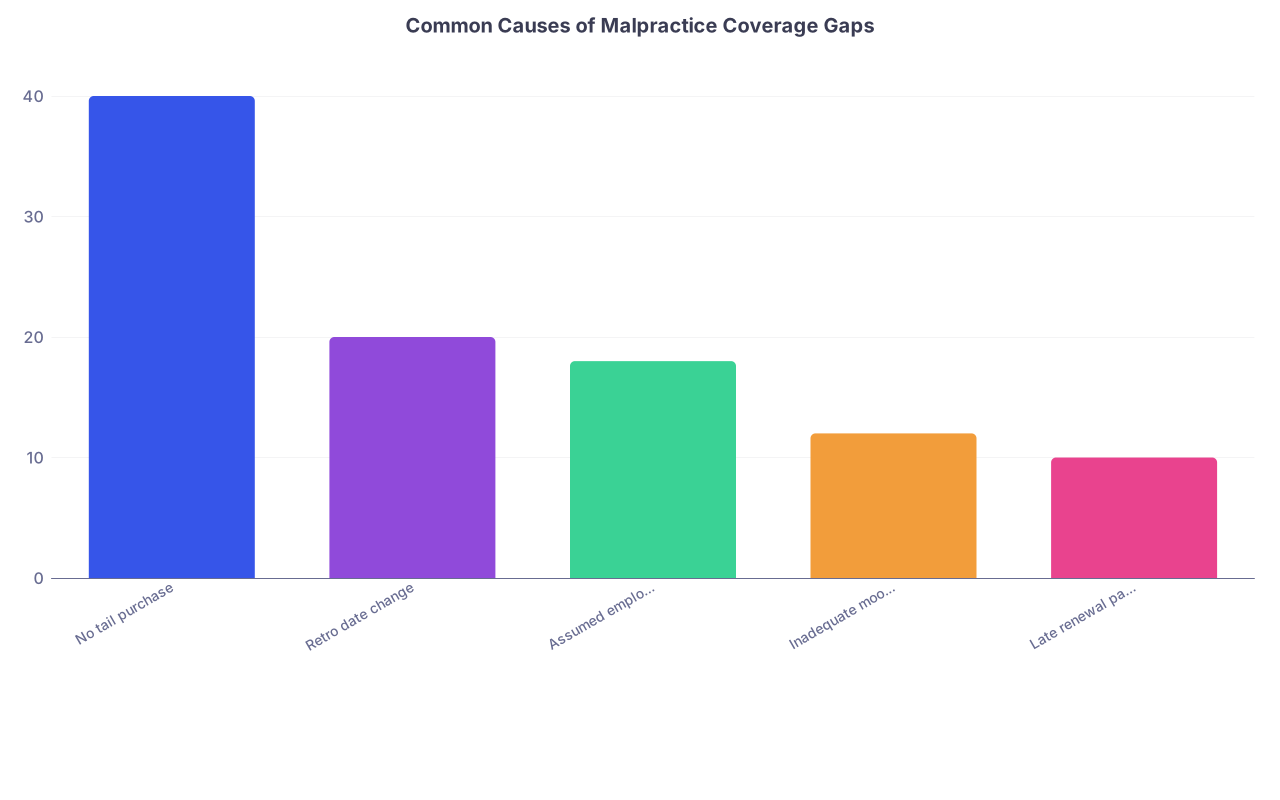
| Category | Value |
|---|---|
| No tail purchase | 40 |
| Retro date change | 20 |
| Assumed employer coverage | 18 |
| Inadequate moonlighting policy | 12 |
| Late renewal payment | 10 |
Relying on verbal assurances
HR: “Yes, you are covered from your start date.”
Recruiter: “Our system handles the malpractice.”
Partner: “We have always taken care of everyone’s tail.”
None of that is binding. Ask for:
- The actual declarations page showing limits and retro date
- Written confirmation who is responsible for tail on termination
- The exact dates coverage begins and ends
If they will not provide it, treat that as a major red flag. Programs and groups that care about liability will give you documentation. The ones who are fuzzy here are often messy in everything else.
Not reading the fine print on moonlighting
Residents and fellows often assume the training program’s malpractice extends to every shift they pick up. That assumption has ruined careers.
Typical patterns:
- Policy covers only “approved program activities” – moonlighting must be explicitly pre-approved and documented.
- Coverage excludes practice at non-affiliated sites.
- Coverage excludes private billing or independent contractor roles.
If you are doing moonlighting, ask for the actual policy language or a written summary from risk management. If they hedge, get your own separate moonlighting coverage. The cost is trivial compared to the upside protection.
Auto-renewal and late premium payments
For individual policies, you can be terminated for non-payment. People in transition – moving, changing banks, changing addresses – miss renewal notices. Carriers send a lapse notice. It goes to the old address. Coverage terminates.
Months later, you realize the auto-pay was failing because your card expired. You think you just “restart” coverage. But that gap exists. And anything that happened during that gap may not be covered.
Never assume “they would not let my coverage just stop.” They will. It is written into every policy.
How to protect yourself during transitions: what you should actually do
Let me give you a simple, disciplined approach. Boring, but it works.

| Step | Description |
|---|---|
| Step 1 | Plan to change or pause jobs |
| Step 2 | Gather current policy documents |
| Step 3 | Confirm policy type and retro date |
| Step 4 | Clarify who pays for tail |
| Step 5 | Confirm last day of coverage |
| Step 6 | Negotiate tail or nose coverage in new contract |
| Step 7 | Match coverage start and end dates |
| Step 8 | Get written proof of new policy and retro date |
| Step 9 | Do not practice a single day uninsured |
| Step 10 | Claims made or occurrence |
Step 1: Before you sign any new contract, pull your current policy
Not a summary. The actual declarations page and endorsements. You are looking for:
- Type: claims-made vs occurrence
- Limits: e.g., $1M / $3M
- Retroactive date
- Termination conditions and tail options/costs
If you cannot find it, call the carrier and ask them to email it. Ten minutes now saves years of misery later.
Step 2: In the new contract, make malpractice explicit
Do not accept generic language. You want clauses that clearly state:
- Who provides coverage (employer, group, or you)
- Policy type (claims-made vs occurrence)
- Responsibility for tail coverage and under what circumstances
- Commitments around retroactive date if they are picking up your prior acts
If you are leaving a claims-made policy, you have three real options:
- Old employer buys tail
- You buy tail yourself
- New employer provides “nose” coverage (covers prior acts back to your original retro date)
Option 3 must be formalized and confirmed by the new carrier in writing. Otherwise, assume you have no past coverage from them.
Step 3: Line up dates with zero coverage gap
Your calendar should have:
- Last day covered under old policy (including how long claims can be reported if tail is purchased)
- First day covered under new policy and its retro date
There should be no single day during which you are seeing patients, giving orders, or prescribing without a policy in force. If there is, solve it:
- Push back start date of clinical work until coverage starts
- Start new malpractice earlier (carriers will do this)
- Buy short-term individual coverage for any gap
Practicing while “credentialing is still pending” is another subtle trap. Make sure coverage is actually active, not merely promised.
Step 4: Do not skimp on tail because “it is expensive”
Tail is expensive. That is exactly why skipping it is so tempting – and so dangerous.
Rules of thumb:
- Tail often costs 150–250% of your annual premium.
- You pay once, and it covers an unlimited future reporting period for events that happened during the policy term.
- If you change states or specialties, old patients can still sue you years later.
I have heard too many physicians say, “I will take my chances; I have never been sued.” That is just survivorship bias. The first lawsuit does not care about your past luck.
Press your employer to pay tail as part of your exit or negotiation. If they will not, run the numbers with a sober mind. A $40,000 tail is painful. A $1 million personal judgment is intolerable.
Special minefields: residents, fellows, locums, and part‑timers
Some groups are structurally more vulnerable to lapses.
Trainees
Residents and fellows:
- Clarify in writing whether program malpractice covers moonlighting, and under what conditions.
- When transitioning (residency → fellowship, fellowship → attending), do not assume the next step automatically covers the last. Ask explicitly about retro dates and tail.
- If you have any independent contractor work (locums, telemedicine, urgent care), you almost certainly need separate coverage.
Locums and 1099 work
Locums companies often say, “We provide malpractice.” That may be true, but:
- Coverage may be site-limited and end as soon as the assignment ends.
- Some provide only claims-made coverage without tail.
- You can end up with a mosaic of policies, each with separate retro dates and no continuity.
If you do locums frequently, consider an individual policy that covers all your work, and understand how it interacts with any site-specific policies.
Part-time and multiple employers
If you work at more than one institution:
- Do not assume employer A’s policy covers work at employer B. It almost never does.
- Make sure each organization has its own malpractice for your work there, or that you have a single policy explicitly covering all sites.
The worst combination I see is a physician with three part-time roles, each assuming someone else is the primary carrier. That is how true uninsured exposure builds silently.
FAQs
1. Is a short coverage gap really that dangerous if I had no complications during that time?
Yes. You are thinking like a clinician, not like a plaintiff’s attorney. “No complications” is your subjective sense now. Many malpractice cases arise from outcomes that did not look like disasters at the time. Legal causation is often argued years later with expert witnesses combing through old notes. A one‑month period of bare exposure can still generate a multi-year lawsuit.
2. If I move to a state with strong asset protection, can I worry less about lapses?
That is a dangerous way to think. State protections like homestead exemptions help, but they do not erase risk. You can still face wage garnishment, professional discipline, NPDB reporting, and devastating legal costs. Also, courts and creditors know the asset protection games. Relying on legal loopholes instead of having proper coverage is reckless.
3. My group says their policy covers me for all “acts performed on their behalf.” Does that mean I do not need tail?
Not necessarily. That language often applies only while you are actively employed and while the policy stays in force. If they cancel the policy when you leave and do not purchase tail, there may be no way to report new claims for past incidents. Ask the carrier directly: “If I leave the group, and a claim is reported two years later for care I provided while employed, will you cover it if no tail is purchased?” Get the answer in writing.
4. Can I buy tail years after my policy has already lapsed?
Usually not. Most carriers require tail to be purchased within a very narrow window after policy termination (often 30–60 days). Once that window closes, the door is effectively locked. That is why “I will decide about tail later” is such a nasty trap. You do not get a second chance once the deadline passes.
5. If my new employer’s policy has a retroactive date that matches my original start date, am I fully safe?
You are safer, but you still need to confirm the details. Make sure:
- The new carrier’s retro date truly matches your original prior‑acts date, not just your last employer’s start date.
- The limits and scope of coverage (occurrence vs claims‑made, exclusions, etc.) are adequate.
- There is no dispute between carriers about who is primary if a claim spans both periods. The safest configuration is a formally endorsed nose coverage explicitly stating that prior acts are covered as of the earlier retro date.
Key points:
Do not ever assume you are covered during transitions; verify policy type, retro date, and tail responsibilities in writing.
Never practice a single day without active malpractice coverage, and do not let claims-made policies lapse without securing tail or nose coverage.