
23% of physicians account for 100% of paid malpractice claims over a 15‑year period. The other 77% never had a single paid claim.
That statistic, from a major analysis in the New England Journal of Medicine, breaks a myth. The risk of malpractice is not evenly spread. It clusters. By specialty. By practice pattern. And by a relatively small subset of doctors.
Let us quantify what is actually happening.
The Big Picture: How Often Physicians Get Sued
The most useful way to think about malpractice exposure is not “Will I ever be sued?” but “How often will I face a claim, and how often will it cost money?”
Two key metrics matter:
- Annual incidence of malpractice claims (paid or not)
- Annual incidence of paid claims (indemnity payments)
National data from large liability insurers and the NEJM / JAMA datasets show consistent patterns.
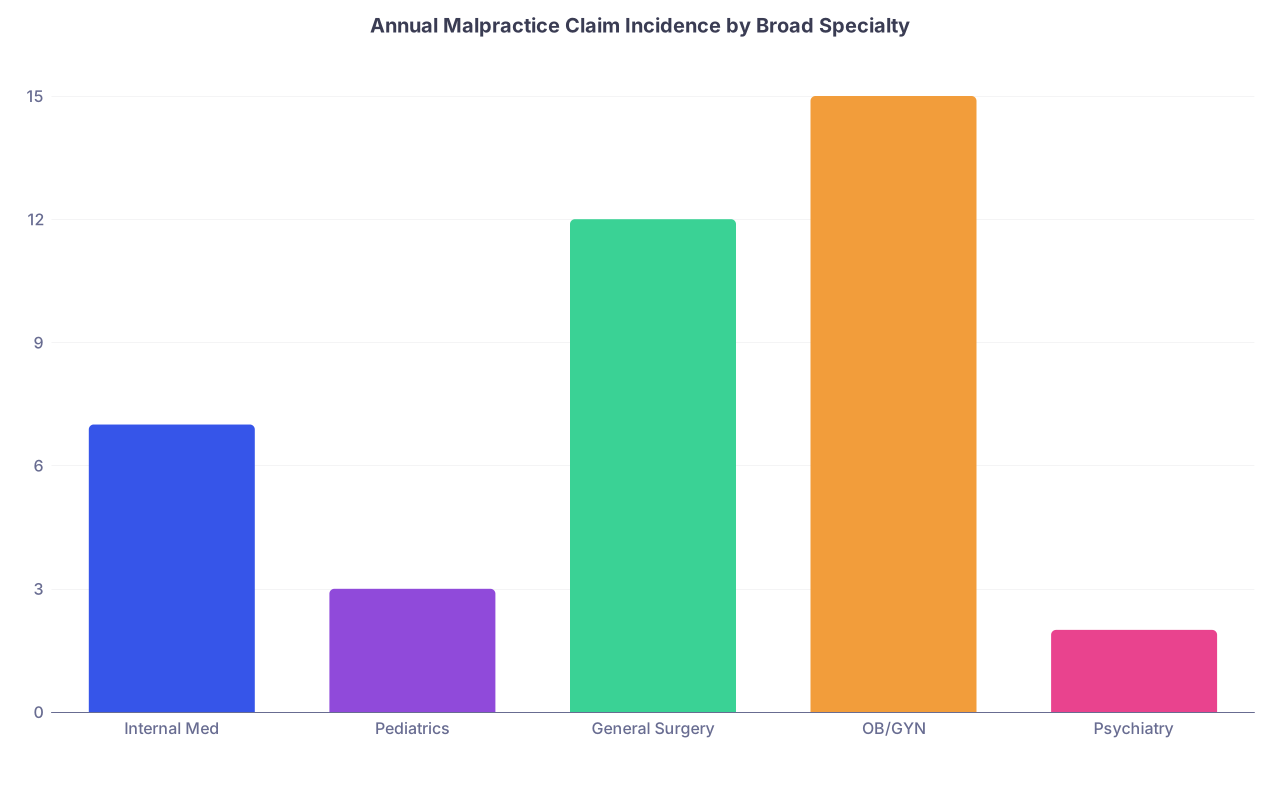
| Category | Value |
|---|---|
| Internal Med | 7 |
| Pediatrics | 3 |
| General Surgery | 12 |
| OB/GYN | 15 |
| Psychiatry | 2 |
Interpretation (approximate numbers per 100 physicians per year):
- Internal medicine: ~7 claims / 100 physicians / year
- Pediatrics: ~3 claims / 100 physicians / year
- General surgery: ~12 claims / 100 physicians / year
- OB/GYN: ~15 claims / 100 physicians / year
- Psychiatry: ~2 claims / 100 physicians / year
So OB/GYN physicians see about 5 times the claim frequency of psychiatrists. Surgeons are around 4–5 times as exposed as pediatricians.
But “claim” does not equal “payout.” Most claims close without payment. The data typically show:
- Only about 20–30% of filed claims result in a payment.
- Median time to resolution: ~1–2 years, whether paid or not.
The financial and career impact, however, is driven heavily by specialty. Some specialties are litigation magnets.
Claim Rates by Specialty: Who Gets Sued the Most?
The NEJM malpractice risk study (covering thousands of physicians over more than a decade) and insurer actuarial filings tell the same story: procedure‑heavy, high‑stakes specialties carry the highest claim rates.
Let us put some reference numbers on the table.
| Specialty | Paid Claims / 100 Physicians / Year | Approx. Chance of ≥1 Paid Claim by Age 65* | Relative Risk vs Pediatrics |
|---|---|---|---|
| OB/GYN | ~5 | ~74% | ~5x |
| General Surgery | ~4 | ~66% | ~4x |
| Internal Med | ~2 | ~55% | ~2x |
| Pediatrics | ~1 | ~30% | baseline |
| Psychiatry | ~0.7 | ~20–25% | ~0.7x |
*Lifetime risk figures approximate across multiple large studies.
Three clear conclusions:
- OB/GYN sits at the top. By a wide margin in most datasets.
- General surgery and other invasive surgical fields are close behind.
- Pediatrics and psychiatry are consistently at the bottom.
If you choose OB/GYN, the data say you are more likely than not to experience at least one paid malpractice claim over a normal career. In some geographic regions, the probability approaches three‑quarters.
If you choose pediatrics, the probability of at least one paid claim drops closer to one in three.
That is a structural difference, and insurers price it accordingly.
Severity: How Much Money Is at Stake?
Frequency is only half the picture. The other half is severity: how much gets paid when you lose.
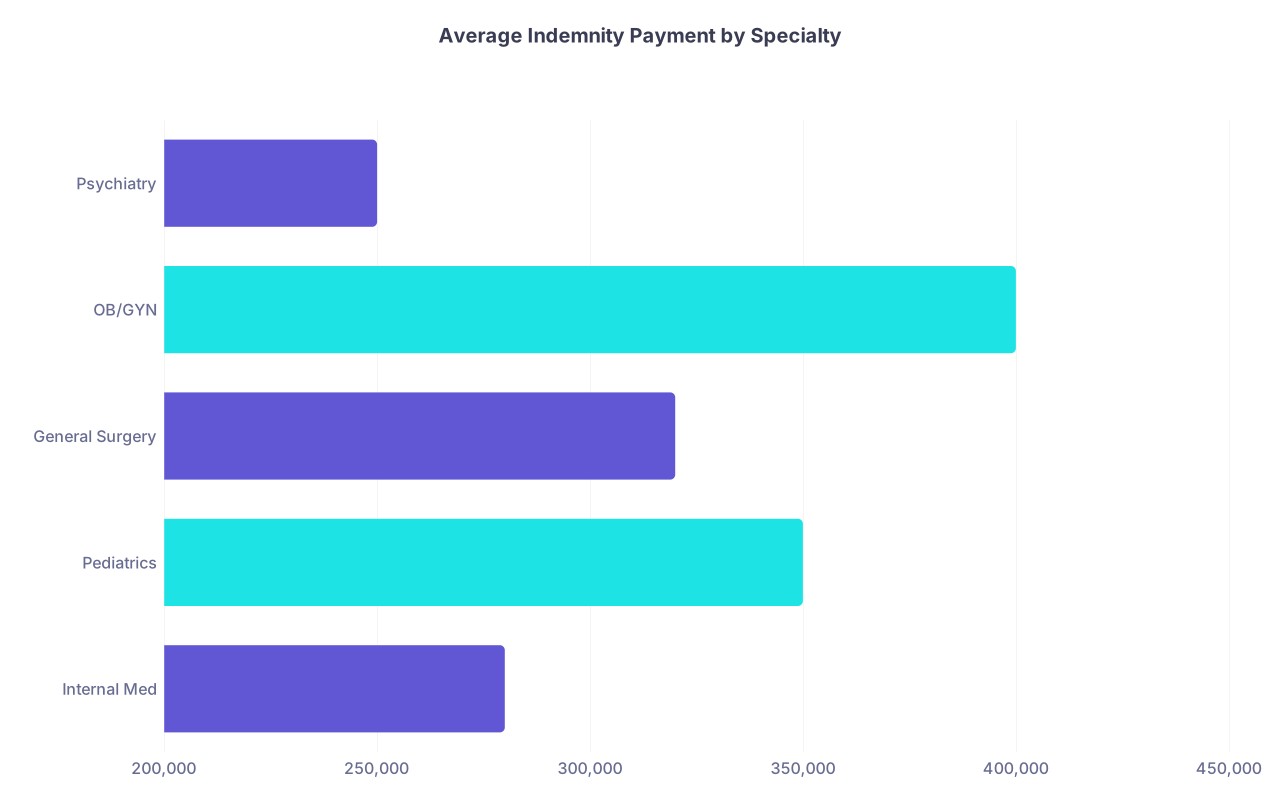
Average indemnity payments (very rough national figures, acknowledging insurer and region variation):
| Category | Value |
|---|---|
| Internal Med | 280000 |
| Pediatrics | 350000 |
| General Surgery | 320000 |
| OB/GYN | 400000 |
| Psychiatry | 250000 |
Interpretation (approximate mean payout per paid claim):
- OB/GYN: ~$400,000
- Pediatrics: ~$350,000 (often involving severe, lifelong harm)
- General surgery: ~$320,000
- Internal medicine: ~$280,000
- Psychiatry: ~$250,000
Two things jump out:
- OB/GYN is both high frequency and high severity. That is the worst possible combination for malpractice risk.
- Pediatrics looks “low frequency” but is not low severity. When something goes wrong in pediatrics—especially birth‑related or early‑childhood injury—lifelong care costs drive awards upward.
This is why you see some of the highest individual verdicts tied to obstetrics and pediatrics, even though pediatricians in general have fewer claims.
Why Certain Specialties Carry Higher Malpractice Risk
The data line up with common sense, but let us be explicit.
The main drivers:
Invasiveness and immediacy of harm
Surgeons and proceduralists can cause immediate, undeniable physical injury: hemorrhage, organ damage, loss of function. Causation is easier to argue, juries understand it, and the damages are obvious.High‑stakes outcomes
OB/GYN and pediatrics are dominated by events with intense emotional salience: childbirth, neonatal injury, delayed cancer diagnosis, missed sepsis. A jury is far more likely to punish a perceived error leading to a disabled child than a marginally delayed diagnosis in a 78‑year‑old with multiple comorbidities.Diagnostic ambiguity vs. clear standards
Some fields, like psychiatry, deal with outcomes that are multifactorial and often linked to patient behavior or underlying disease. Establishing a direct causal link to the psychiatrist’s actions is harder.
By contrast, there are well‑defined timelines and algorithmic expectations in trauma surgery or obstetrics. Miss an emergent cesarean window or delay a compartment syndrome diagnosis, and plaintiff attorneys have a cleaner narrative.Patient volume and contact frequency
More encounters = more opportunities for allegations. A high‑volume emergency physician or hospitalist interacts with far more patients annually than, say, a dermatologist. That sheer contact volume raises exposure, even when per‑encounter risk is modest.Documentation and handoff complexity
Multi‑team care (inpatient medicine, surgery, ICU) increases the potential for gaps in documentation and miscommunication. Claims often hinge on those gaps. Outpatient specialties with simpler continuity have fewer such failure points.
When you line up specialties by all five factors, the ranking looks almost exactly like the malpractice claim data. The insurance actuaries are not guessing; the numbers are consistent across insurers and across decades.
Malpractice Premiums: How Insurers Translate Risk into Dollars
Now we move from theoretical risk to your actual cost.
Malpractice insurers care about two things:
- Expected frequency of claims
- Expected severity (average payout when you lose)
Premiums are essentially:
Premium = (Expected losses) + (Expenses) + (Profit / risk load)
Where expected losses are “probability of a claim × expected payout.”
That is why OB/GYN premiums can be several times those of relatively low‑risk specialties in the same state.
To make this concrete, here is a stylized snapshot of annual mature‑claims‑made premiums in a medium‑risk state:
| Specialty | Approx. Annual Premium (USD) |
|---|---|
| OB/GYN | $80,000 – $120,000 |
| General Surgery | $40,000 – $70,000 |
| Internal Med | $15,000 – $25,000 |
| Pediatrics | $12,000 – $20,000 |
| Psychiatry | $7,000 – $15,000 |
In high‑risk states (historically places like New York, Florida, parts of Pennsylvania), the upper range can be substantially worse:
- OB/GYN: $150,000+ in some environments
- General surgery: $90,000+
- Even “low‑risk” specialties can feel the drag
This is where the financial side bites: those premiums are paid regardless of whether you are ever personally sued. They reflect pooled risk across the specialty.
Over a 30‑year career:
- Difference between psychiatry at, say, $10,000/year and OB/GYN at $100,000/year is potentially $2.7 million in cumulative premiums, ignoring inflation.
- That cost either comes out of your pocket (if independent) or out of the compensation pool your employer can offer.
People hand‑wave this away early in training. They should not. Over decades, malpractice premiums are one of the largest specialty‑linked fixed costs in a physician’s financial life.
How Prior Claims Change Your Individual Risk Profile
So far, we have talked about specialty‑level risk. But the most uncomfortable finding from several major analyses is how prior paid claims predict future claims.
Key data point:
Physicians with two prior paid claims had roughly double the risk of another paid claim compared with those with only one. Those with three or more prior claims had three‑fold to four‑fold higher risk than those with none.
In plain terms:
- Most doctors never have a paid claim.
- A small minority accumulate multiple paid claims.
- That minority drives a disproportionate share of total malpractice cost.
Insurers respond rationally:
- Premium surcharges after a paid claim can be significant (commonly 25–100% increases depending on severity and number of claims).
- Multiple claims can lead to non‑renewal or forced placement into higher‑cost “surplus lines” / high‑risk pools.
- Credentialing and hospital privileging become much more difficult with serial claims and payouts.
If you are in a high‑risk specialty and accumulate two or three major payouts, your future professional options narrow sharply. The numbers support that, and I have seen real‑world examples where a surgeon with three large paid claims essentially could not find standard coverage in certain regions.
Geographic Variation: Same Specialty, Different Risk
Another pattern the data reveal: location dramatically modifies malpractice economics, even when specialty risk ranks remain similar.
What changes by state or region?
Claim frequency: Cultural and legal norms affect how quickly patients sue. Some states see more “frivolous” claims filed, even if they do not all result in payment.
Payout size: States with no caps on non‑economic damages (or with very high caps) show higher average and maximum payouts, especially in cases of severe disability.
Legal environment: Attorney fee structures, expert witness rules, and the burden of proof standards can make a jurisdiction more or less favorable for plaintiffs.
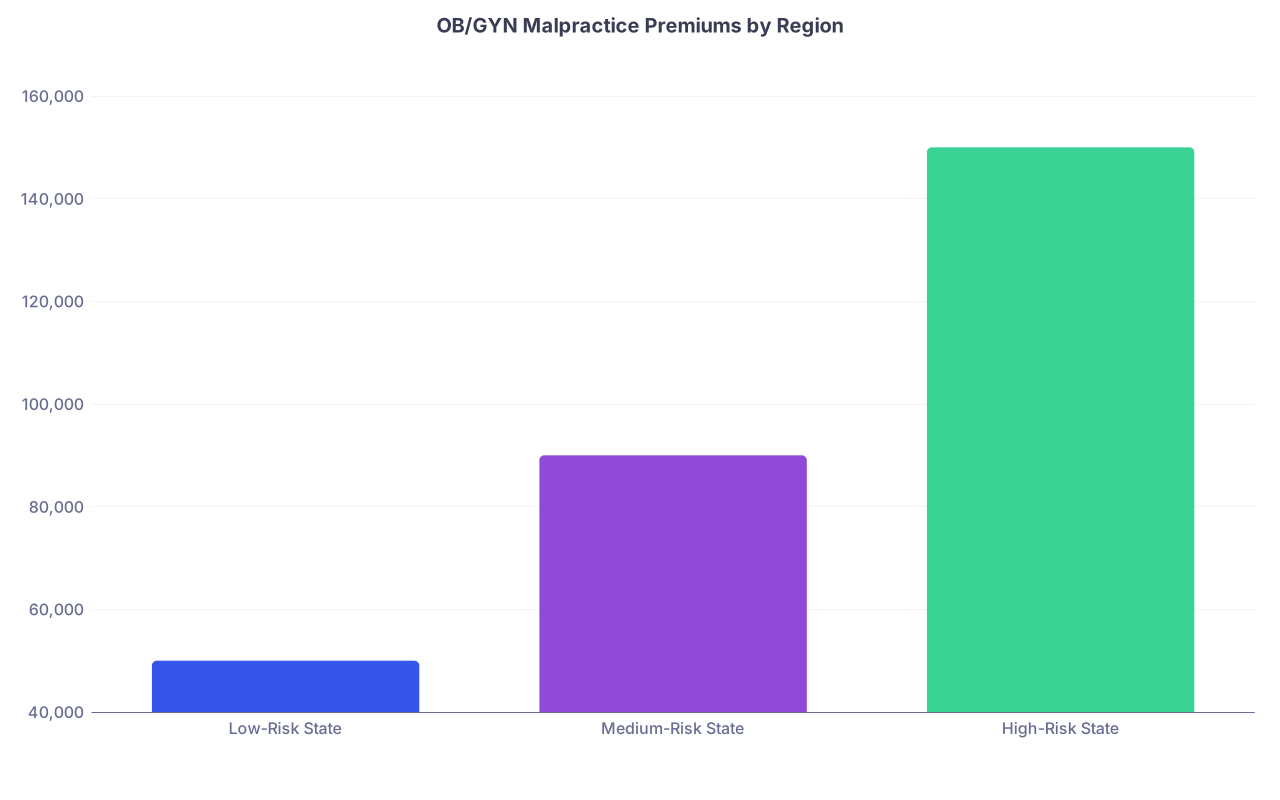
To illustrate the regional effect on OB/GYN (numbers illustrative, but directionally accurate):
| Category | Value |
|---|---|
| Low-Risk State | 50000 |
| Medium-Risk State | 90000 |
| High-Risk State | 150000 |
Same specialty, similar underlying medical risk. Triple the premium between a low‑risk and a high‑risk state.
From a data perspective, specialty choice interacts with geography:
- OB/GYN in a low‑risk state might face total career premiums similar to general surgery in a high‑risk state.
- Internal medicine in a high‑risk state can end up costing more in malpractice premiums than general surgery in a low‑risk state.
For anyone seriously planning a long career in a high‑risk specialty, where you practice is almost as decisive for malpractice cost as what you practice.
Practical Implications for Physicians and Trainees
All of this can sound abstract until you map it onto actual decisions.
Specialty choice
You should not choose psychiatry solely because the premiums are lower, or avoid OB/GYN solely because the claim rate is higher. That would be shallow and, frankly, a recipe for burnout.
But you should be numerate about the tradeoffs.
Two data‑driven truths:
- A career in OB/GYN, neurosurgery, or orthopedics almost certainly comes with higher litigation exposure and higher fixed practice costs.
- A career in psychiatry, pathology, or dermatology comes with lower exposure and lower fixed costs, but often lower reimbursement per procedure and different competitive pressures.
You weigh these factors the same way you weigh call schedules or training length. Rationally, using numbers, not myths.
Contract negotiation
If you are an employed physician, malpractice coverage is typically part of the compensation package. The data‑minded questions to ask:
- Is coverage occurrence‑based or claims‑made?
- If claims‑made, who pays for tail coverage when you leave?
- What are the policy limits (e.g., $1M / $3M)? Are they standard for your specialty and region?
- Do prior acts coverage and retroactive dates line up with your previous employment?
In high‑risk specialties, the tail on a claims‑made policy can easily be 1.5–2.0 times the annual premium. For an OB/GYN paying $100,000/year in a high‑risk state, that is a $150,000–$200,000 liability when changing jobs—unless the contract explicitly assigns that cost to the employer.
I have seen attending physicians discover this the hard way, at the exact moment they wanted to leave a toxic practice.
Risk management and documentation
The data on which cases actually result in paid claims tend to highlight repeat themes:
- Missed or delayed diagnoses of time‑sensitive conditions (MI, stroke, sepsis, ectopic pregnancy)
- Communication failures (test results not conveyed, unclear follow‑up)
- Poor documentation, especially around informed consent and differential diagnoses
- Inadequate follow‑up systems (patients “lost” after abnormal labs or imaging)
You cannot eliminate risk, but you can press it down. Well‑structured documentation, clear informed consent processes, and deliberate follow‑up systems all show up, indirectly, in lower claim rates for practices that implement them rigorously.
Insurers know this and often discount premiums for physicians or groups that participate in verified risk‑management programs.
Key Takeaways
Malpractice risk is highly specialty‑dependent, with OB/GYN and surgical fields facing several‑fold higher claim rates and premiums than pediatrics, psychiatry, or dermatology.
Severe, emotionally charged outcomes (especially involving childbirth or children) drive both higher claim frequency and higher payouts, making obstetrics and some pediatric scenarios the most financially punishing when litigation occurs.
Your lifetime malpractice cost is a function of specialty, geography, and personal claim history—and the gap between a high‑risk and low‑risk path can reach several million dollars over a full career.