
The most expensive malpractice cases rarely come from “bad medicine.” They come from bad documentation.
Year after year, loss data from major malpractice carriers shows the same pattern: when documentation is weak, defense options collapse, indemnity payments climb, and claim duration drags out. The care might have been reasonable. But if it is not in the chart, you effectively did not do it.
Let us quantify that.
What the Numbers Say About Documentation and Malpractice Losses
When carriers dissect malpractice losses, they do not just ask, “Was there an error?” They segment by:
- Alleged clinical issue
- Documentation quality
- Outcome severity
- Indemnity paid and defense cost
Across multiple closed-claim studies (from large U.S. carriers and specialty societies), a consistent pattern emerges: cases with significant documentation failures are more expensive, harder to defend, and more likely to end in payment.
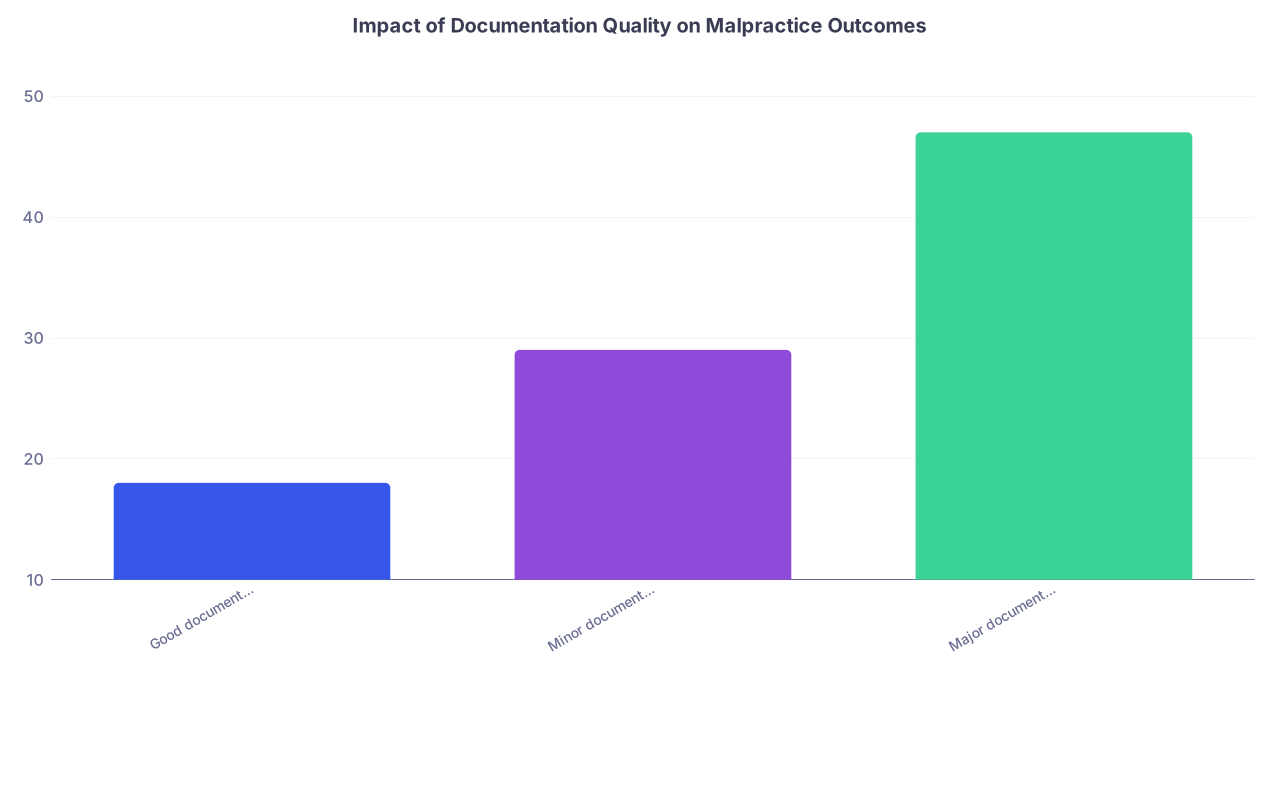
| Category | Value |
|---|---|
| Good documentation | 18 |
| Minor documentation gaps | 29 |
| Major documentation failures | 47 |
The chart reflects a common pattern in large carrier datasets:
- Well-documented care → ~15–20% of claims end in indemnity payment
- Minor gaps → often ~25–30% payment rate
- Major documentation failures → payment rates frequently exceed 40–50%
Even more striking: median indemnity payments are often 1.5–2.0x higher when documentation is clearly deficient compared to similar clinical scenarios with robust records. I have seen orthopedic and OB cases where the medicine looked defendable, but crucial missing notes pushed a likely defense verdict into a seven-figure settlement.
So, which documentation failures drive those losses? Not in theory. In actual dollars.
The High-Cost Failures: Ranked by Financial Impact
Let us group the main failure modes by their observed impact on loss cost. Not every carrier uses the same labels, but the patterns line up.
| Rank | Documentation Failure Type | Typical Impact on Indemnity |
|---|---|---|
| 1 | Missing / inadequate informed consent | Very high |
| 2 | Lack of diagnostic reasoning / differential | Very high |
| 3 | Poor follow-up and test result tracking | High |
| 4 | Incomplete medication and allergy records | High |
| 5 | Copy-paste / cloned and conflicting notes | Moderate–High |
These five categories do not cause every claim. But when they are present, they disproportionally drive the big payouts.
I will walk through each with actual risk mechanics: how they turn a defensible case into a costly one.
#1: Missing or Inadequate Informed Consent
This is the king of preventable documentation-driven losses.
Most carriers can show you a subset of surgical, procedural, and interventional radiology cases where:
- The complication was a known, low-frequency risk
- The clinical workup and treatment met standard of care
- But the consent form was missing, vague, unsigned, or generic
And that combination usually ends badly.
How consent failures translate into high losses
Here is the typical pattern I see in loss data:
- In procedural specialties, informed consent issues appear in perhaps 10–20% of claims, but account for 25–35% of total indemnity paid.
- In some OB/GYN datasets, cases with disputed consent can have median indemnity payments 1.5–2.5x higher than similar complication cases with clear, specific consent documentation.
Common consent documentation failures:
- No signed consent scanned or uploaded
- “Snowstorm” forms listing 20 complications, none tied clearly to the specific procedure
- No documentation of the actual discussion: alternatives, risks, patient questions
- Consent obtained minutes before sedation without any note showing prior conversation
Plaintiff attorneys know exactly how to weaponize this. The narrative becomes: “My client never knew this was a real risk. No one told her. They shoved a form at her when she was vulnerable.”
If the chart has nothing to rebut that story, your defense position is weak.
Where the data bites hardest
High-severity specialties (as measured by average paid claim): neurosurgery, orthopedics, OB, cardiology, and interventional pain. These specialties already carry high indemnity severity. Missing or generic consent amplifies that baseline risk.
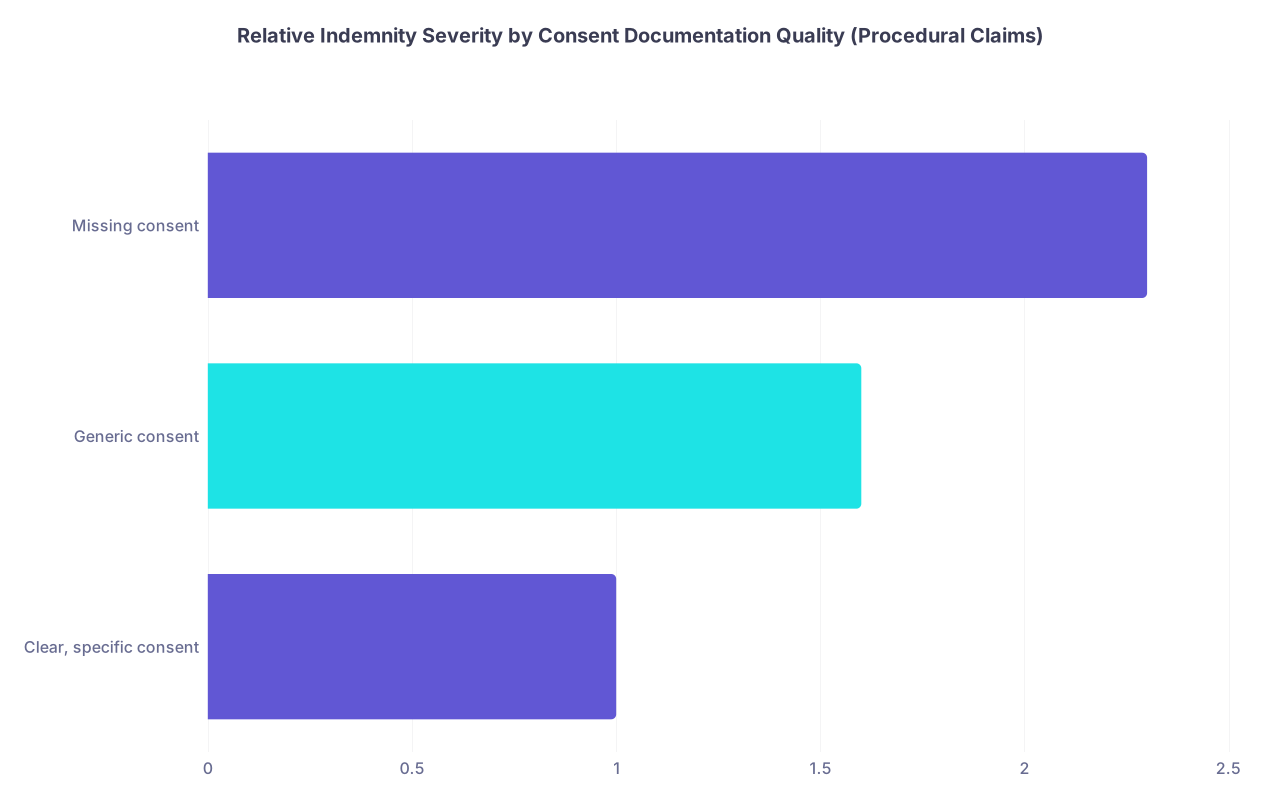
| Category | Value |
|---|---|
| Clear, specific consent | 1 |
| Generic consent | 1.6 |
| Missing consent | 2.3 |
Think of that chart as a multiplier on whatever your “normal” indemnity would have been.
#2: Absent Diagnostic Reasoning and Differential Diagnosis
Next: the empty assessment.
Plenty of charts still look like this:
“Assessment: abdominal pain.”
“Plan: CT, labs, pain control, f/u with PCP.”
No differential. No reasoning. No explicit discussion of red flags considered and ruled out.
When the ultimate allegation is “failure to diagnose X,” this kind of documentation is a gift to the plaintiff. It lets them argue that the condition was never considered. And the data shows that in failure-to-diagnose litigation, documentation of diagnostic reasoning is one of the strongest predictors of a defendable outcome.
Why missing reasoning is so expensive
Across multiple closed-claim series focused on diagnostic error (especially in ED, primary care, and internal medicine):
- Claims where the suspected diagnosis appeared in a documented differential had noticeably lower payment rates than those without any documented differential.
- Cases with concise but explicit reasoning (“less likely appendicitis because …, more likely viral gastroenteritis because …”) were substantially easier to resolve without payment or with smaller settlements.
Failure to document reasoning causes three financial problems:
- It looks like you never considered the serious diagnosis.
- It makes any “I was thinking of X” testimony at deposition look like after-the-fact rationalization.
- It narrows your experts’ ability to defend decision-making.
Specialties where this hurts the most
- Emergency medicine: chest pain, abdominal pain, headache, neurologic deficits
- Primary care: cancer misdiagnosis, delayed referral, atypical presentations
- Pediatrics: infectious disease, sepsis, meningitis
In one internal medicine carrier report, cases with no documented differential had roughly double the odds of payment compared with cases where a plausible differential was clearly stated, even when the clinical misstep was similar.
This is not just academic. I have read a case where a 48-year-old woman with atypical chest pain was discharged, later coded at home, and died. The ED physician said he considered ACS but thought it unlikely after a negative workup. The chart? “Assessment: chest pain. Plan: discharge. Return precautions given.” That omission alone cost the carrier a mid–six figure settlement it probably could have avoided.
#3: Poor Follow-Up and Test Result Tracking
Test result follow-up is the silent killer of malpractice defenses. No drama. Just an abnormal report, sitting in the inbox, never addressed.
Data from ambulatory and hospital settings tells a similar story:
- A significant fraction of high-indemnity diagnostic-delay claims involve tests that were ordered correctly and resulted in time, but where follow-up was undocumented or absent.
- When carriers categorize root causes, “failure to follow up on test results” routinely appears as a top system and documentation factor, especially in primary care, internal medicine, oncology, and pediatrics.
Where documentation fails
The failures are not usually in ordering the test. They cluster around documentation of:
- Receipt and review of the result (“I saw it and here is what I concluded”)
- Communication to the patient and / or family
- Clear instructions on next steps (repeat labs, imaging, consult, sooner follow-up)
Here is how that plays out financially:
Take cancer misdiagnosis. In many datasets, these are among the highest severity claims by indemnity:
- Median paid claims for cancer diagnosis delays are often in the mid–six figure range, sometimes much higher.
- When the chart lacks evidence that an abnormal test result was acknowledged and acted on, the probability of payment skyrockets.
Even a short note like “Reviewed abnormal mammogram; message sent via portal to schedule biopsy; patient notified” can shift a case from “indefensible” to “complex but defensible.”
The EMR trap
Many clinicians assume the EMR audit trail will save them. It will not. Carriers have learned the hard way:
- “Result was in the inbox” does not prove you saw or interpreted it.
- Generic EMR messages with no content (“Call patient”) are nearly worthless in court.
What reduces loss? Explicit documentation that you:
- Saw the result
- Understood its implications
- Communicated a plan to the patient
The claims where nothing is documented about that chain of events are the ones that blow up.
#4: Incomplete Medication and Allergy Documentation
Medication-related malpractice claims are not always the most frequent. But they are ugly. There is usually a clear causal line and a simple story a jury can understand.
And a painful amount of that risk comes from incomplete or inconsistent documentation around:
- Medication list accuracy
- Allergy history (especially antibiotics, contrast, anesthesia)
- Reconciliation during transitions of care
Consider a typical scenario:
- A patient is labeled as having a “mild rash” with amoxicillin ten years ago.
- The allergy field is blank or vaguely documented.
- The clinician prescribes a beta-lactam, patient develops anaphylaxis, ends up in ICU, partially recovers with deficits.
Now imagine the chart is thin:
- No documentation clarifying the prior reaction
- No discussion of risk / benefit or alternatives
- No observed period post-administration noted
Carriers see this pattern repeatedly. And the financial impact is disproportionate because:
- The causal chain is obvious to non-clinicians.
- The defense looks negligent when the allergy field is blank or obviously wrong.
In one multi-specialty report, drug-related claims made up a modest percentage of total claims but a much higher share of high-severity payouts, especially where:
- There was a known or recorded allergy
- Or there was a high-risk medication prescribed without clear documentation of monitoring or counseling
Chronic disease and polypharmacy
Primary care, cardiology, psychiatry, and geriatrics see another pattern:
- Polypharmacy with incomplete reconciliation
- Contradictory med lists from different visits or different providers
- No documentation that interactions or duplicate therapies were reviewed
If a patient ends up hospitalized from a medication interaction, the chart is often the only evidence that you attempted risk management. Or that you did not.
Again, “I reviewed meds” with no supporting detail does not carry much weight when reviewed by plaintiff experts and juries.
#5: Copy-Paste, Cloned Notes, and Conflicting Records
The EMR has created a new class of documentation failure: quantity over quality.
Copy-paste and template abuse show up in loss data as “credibility killers.” They do not always cause the underlying clinical problem. But they erode the defense’s narrative and give plaintiff attorneys ammunition.
Common patterns:
- Allergies or problems that disappear and reappear across notes
- Physical exams identical visit after visit, even when complaints change
- Internal contradictions in a single note (for example, “no distress” next to “10/10 pain, crying”)
- Copy-forward of old vitals or findings that are clearly implausible in a new context
From a carrier’s perspective, these are toxic. They:
- Undermine expert testimony (“Doctor says they did X, but the note is clearly boilerplate”)
- Make deposition cross-examination brutal
- Encourage juries to discount the accuracy of the entire record

Financial signal in the data
I have seen defense counsel flatly say: “If the chart is full of obvious copy-paste errors, we are settling.” Why? Because juries dislike sloppy records. Even if the care was reasonable, you have lost credibility.
In carrier analytics, cases with clear evidence of cloned documentation are:
- More likely to be settled rather than tried
- More likely to involve higher defense costs (experts spend time untangling nonsense)
- More likely to see higher indemnity where there is any plausible harm
Is copy-paste itself the primary cause of claims? Usually not. But it is a consistent loss multiplier.
Hidden but Costly: Communication and “Thin” Notes
Some failures cut across categories and do not always show up as a neatly coded “documentation” issue. But they matter financially.
Lack of documentation of patient communication
When a patient says, “No one told me that,” and the chart is silent, you have a problem. This shows up in:
- Discharge instructions (ED and inpatient)
- Telephone and portal encounters
- Refusal of care, missed appointments, nonadherence
Carriers repeatedly find in adverse outcome cases:
- No documentation that key warnings or instructions were given
- No record of attempts to reach the patient for urgent issues
- No note of a patient refusing recommended care
Subjective? Yes. But juries side with the paper trail. Or the lack of it. Thin notes tilt settlements upward.
The “drive-by” progress note
This is particularly visible in inpatient and ICU settings:
- Short, generic daily notes with no real assessment of change in status
- Minimal reflection of nursing concerns or overnight events
- No documentation of why a concerning lab, vital, or nursing note did not trigger action
Then a deterioration or unexpected event happens.
In large inpatient datasets, “failure to recognize and respond to deterioration” is a common allegation. Thin, formulaic notes make it hard to defend that you were actually monitoring and actively managing risk.
How Documentation Failures Multiply Risk and Cost
Step back and look at why these specific failures are so destructive financially. You see a pattern.
They all:
- Attack the credibility of the clinician and the record.
- Obscure the clinical reasoning that might justify the decisions.
- Limit the defense expert’s ability to reconstruct a rational, standard-of-care narrative.
From a numbers perspective, major documentation failures:
- Increase the probability of a payment outcome.
- Increase median indemnity in similar clinical scenarios.
- Increase defense costs (more depositions, more experts, more time).
- Increase time to closure (poorly documented cases drag out).
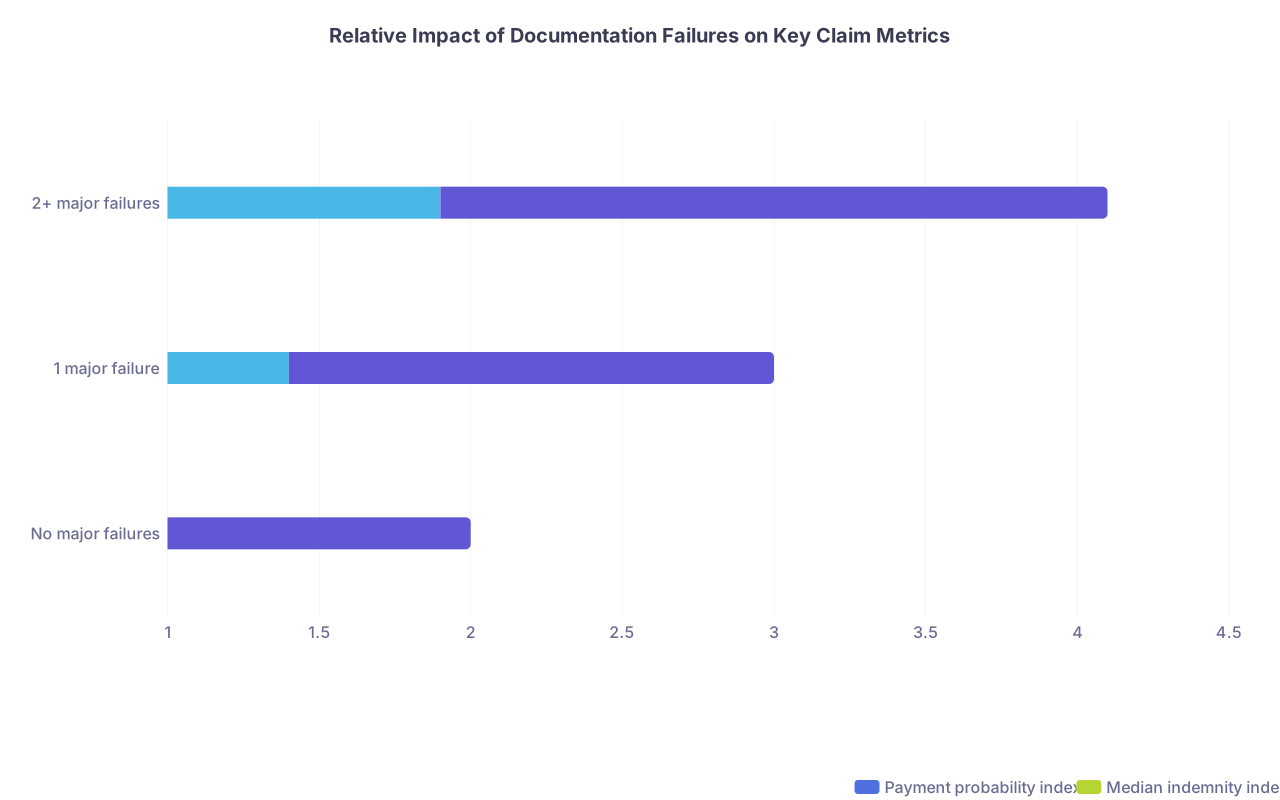
| Category | Payment probability index | Median indemnity index |
|---|---|---|
| No major failures | 1 | 1 |
| 1 major failure | 1.4 | 1.6 |
| 2+ major failures | 1.9 | 2.2 |
You can read those indices simply:
- One major documentation failure (for example, no consent documentation or no differential) pushes both payment probability and indemnity clearly above baseline.
- Two or more failures in the same case (for example, missing consent and poor follow-up documentation, plus copy-paste nonsense) put you in a very expensive neighborhood.
Process View: Where Documentation Risk Actually Enters Care
This is not about one-off “bad notes.” It is about system points where documentation failures are common and high-impact.

| Step | Description |
|---|---|
| Step 1 | Patient intake |
| Step 2 | History and meds |
| Step 3 | Diagnostic workup |
| Step 4 | Informed consent |
| Step 5 | Procedure or treatment |
| Step 6 | Test results returned |
| Step 7 | Follow up and communication |
| Step 8 | Discharge or transition |
| Step 9 | Long term follow up |
| Step 10 | Allergy and med list accuracy |
| Step 11 | Diagnostic reasoning documented |
| Step 12 | Specific risks and alternatives |
| Step 13 | Result review and action |
| Step 14 | Patient notified and instructed |
| Step 15 | Clear discharge instructions |
Every node in that diagram is a common origin point for the failure types we just covered.

What the Data Actually Favors: High-Yield Documentation Habits
You do not need to write novels. The loss data does not reward volume. It rewards clarity at specific moments.
From a purely financial-risk standpoint, the highest-yield documentation behaviors look like this:
- Consent: A brief free-text line documenting the real conversation. “Discussed risk of bleeding, infection, nerve injury, and failure to relieve symptoms. Patient voiced understanding and agreed to proceed.”
- Differential: Two to four diagnoses with one line of reasoning each. “Less likely PE given normal vitals, no risk factors; more likely musculoskeletal strain due to localized tenderness and onset after lifting.”
- Test follow-up: A direct note that you saw and acted. “Reviewed CT result showing 4 mm pulmonary nodule. Messaged patient to arrange pulmonology referral; return if symptoms develop.”
- Meds/allergies: One line clarifying history. “Prior rash with amoxicillin only, no respiratory compromise; patient has tolerated cephalosporins in past.”
- Transitions: Explicit discharge or handoff instructions. “Discharge with written instructions, discussed red flag symptoms including fever, worsening pain, dyspnea, and when to return to ED.”
From an insurer’s view, those 10–20 seconds of typing are some of the best risk-reduction investments you can make.
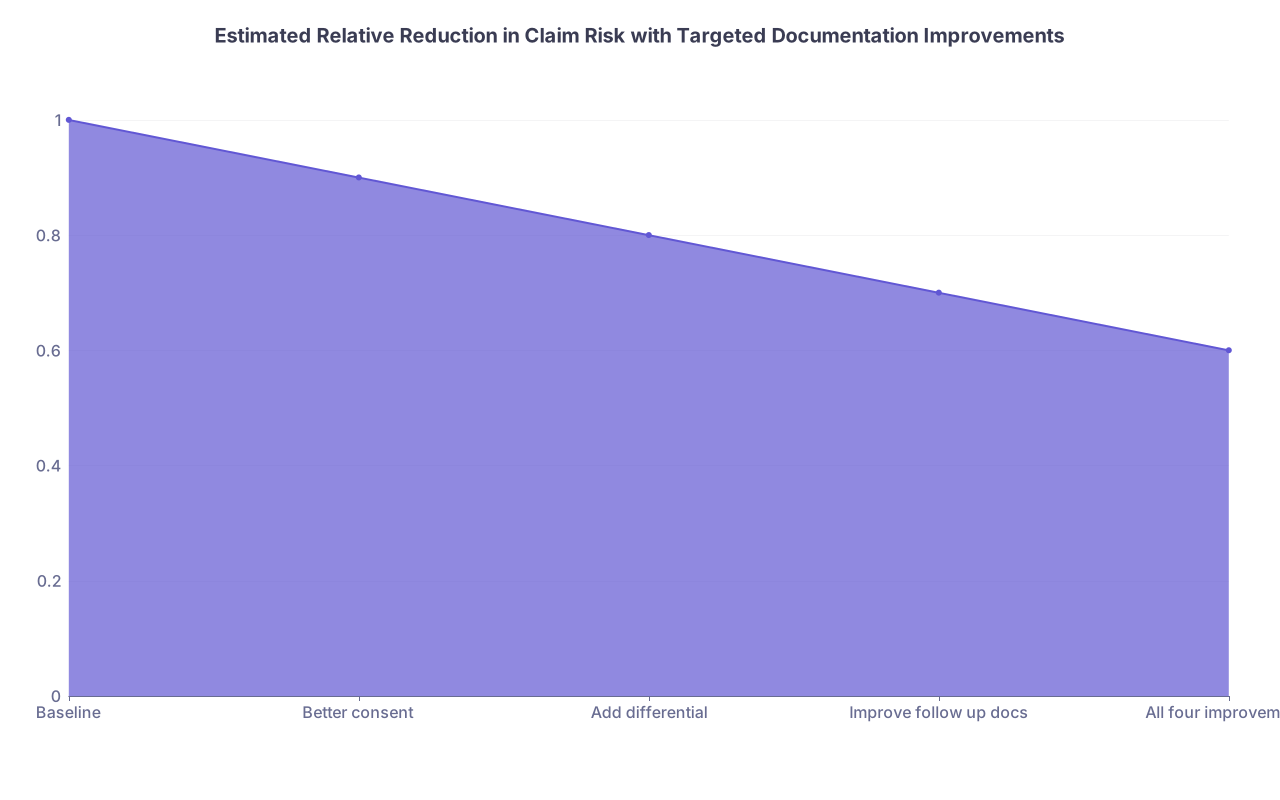
| Category | Value |
|---|---|
| Baseline | 1 |
| Better consent | 0.9 |
| Add differential | 0.8 |
| Improve follow up docs | 0.7 |
| All four improvements | 0.6 |
Is that numeric curve exact for every setting? No. But the direction is real. Carriers that run risk programs focusing on exactly these areas see lower frequency of paid claims and lower severity over time.

Key Takeaways
- The data is blunt: missing or weak documentation around informed consent, diagnostic reasoning, test follow-up, and medications is strongly associated with higher payment rates and larger malpractice payouts.
- You do not need longer notes; you need targeted clarity at a few high-risk points—consent, differential, follow-up, allergies/meds, and transitions.
- From an insurer’s perspective, a handful of consistent, concise documentation habits can cut both the likelihood and the financial severity of malpractice losses in a way that few other individual behaviors can match.