The malpractice climate in the United States is not “bad” or “good” overall; it is a patchwork, and the data shows that your zip code can change your liability risk and premiums by a factor of three to five.
If you are making decisions about where to practice, join a group, or sign a long-term contract, you ignore state-by-state malpractice data at your financial peril.
The Three Levers That Actually Matter
For all the noise around “litigious patients” or “defensive medicine,” the measurable malpractice climate boils down to three hard levers:
- Frequency and severity of claims (how often you get sued and for how much).
- Tort reforms and damages caps (how high the economic ceiling really is).
- Insurance premiums (what you actually pay every year to transfer that risk).
Everything else is commentary.
Let us anchor on the core reality: malpractice risk is not evenly distributed. A general surgeon in Long Island is playing a different game than a general surgeon in Des Moines, even with the same skill level and patient mix.
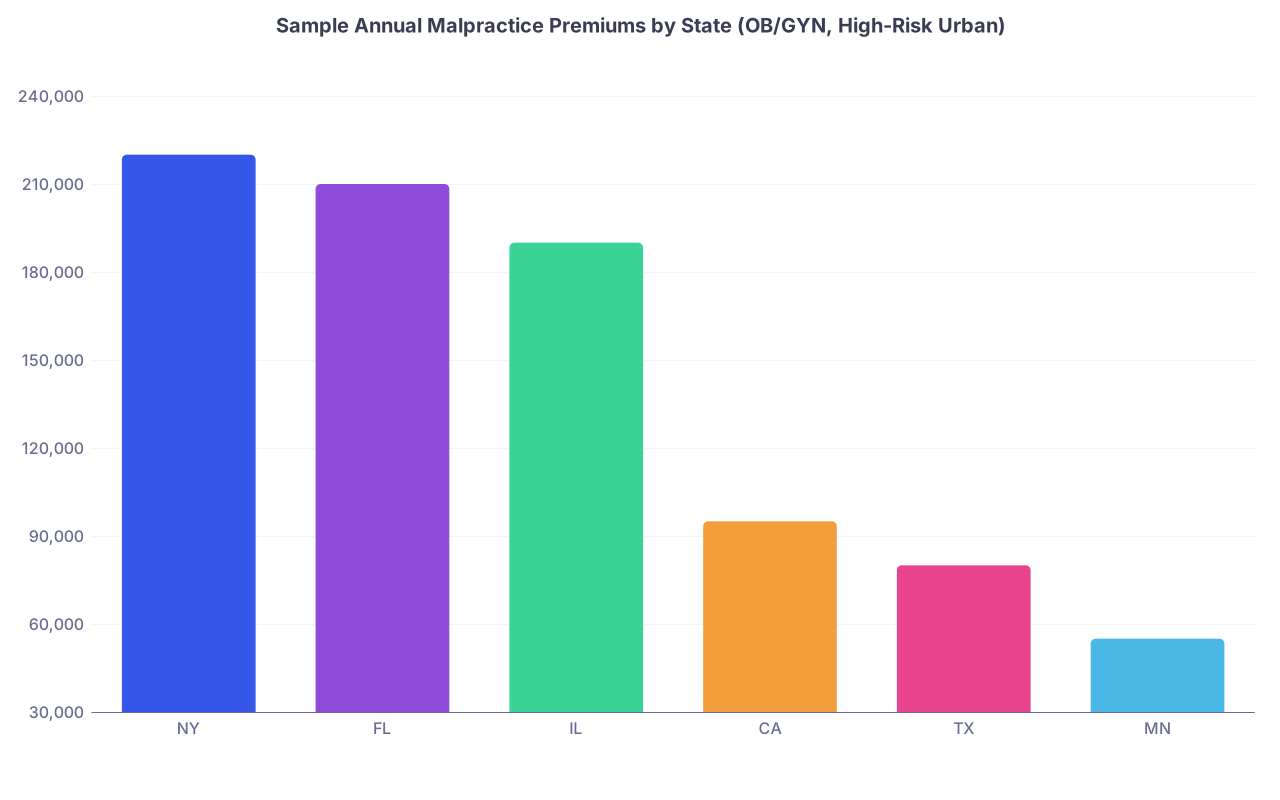
To visualize the premium spread, look at a simplified snapshot (values illustrative but directionally accurate based on recent carrier filings):
| Category | Value |
|---|---|
| NY | 220000 |
| FL | 210000 |
| IL | 190000 |
| CA | 95000 |
| TX | 80000 |
| MN | 55000 |
A New York or Florida OB/GYN can pay roughly 3–4 times the premium of a similar physician in Minnesota or Texas. Same specialty. Same country. Completely different actuarial universe.
State-Level Claim Risk: Frequency and Severity
Carriers price malpractice based on two pillars: how often claims are filed (frequency) and how much they cost when paid (severity). The public debate tends to obsess over frequency (“everyone is suing”), but the premium models are driven increasingly by severity trends.
Frequency: How often physicians are sued
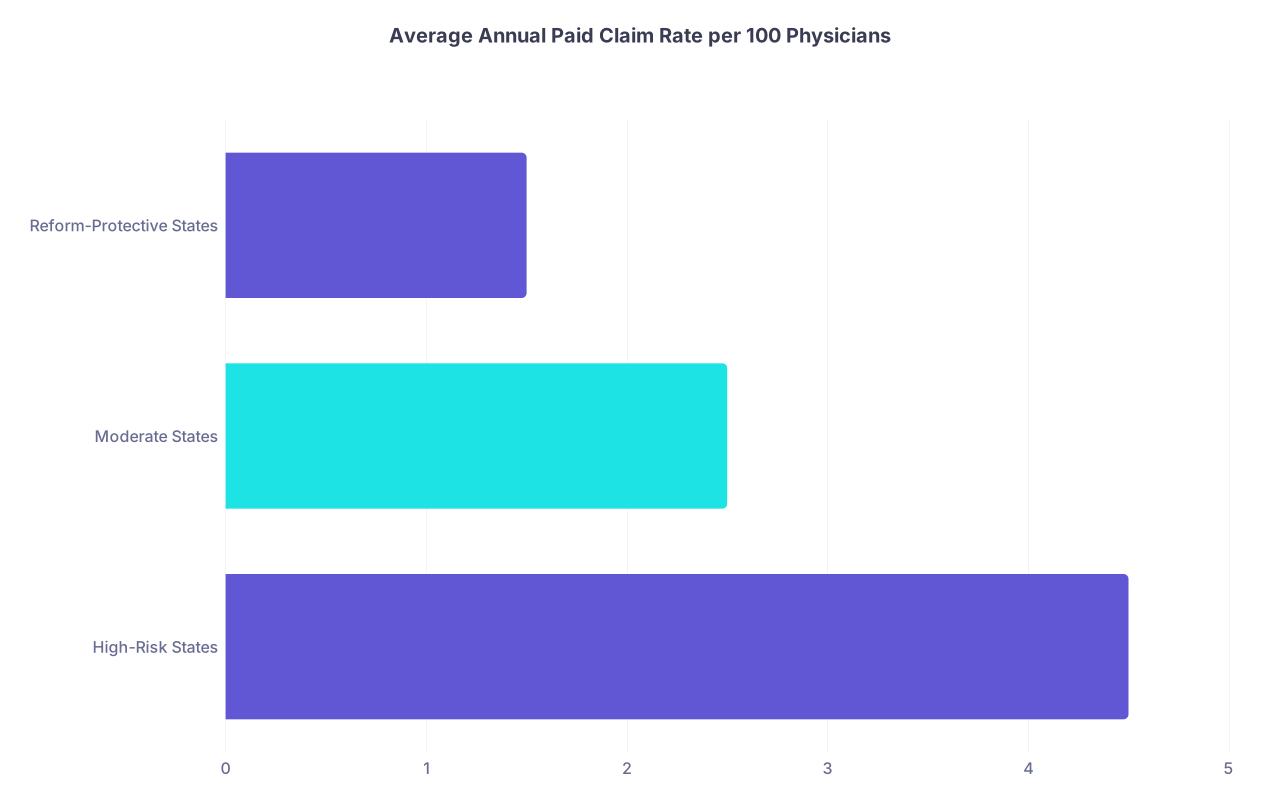
Look at paid claim rates per 100 physicians per year (roughly aggregated and normalized across specialties):
| Category | Value |
|---|---|
| High-Risk States | 4.5 |
| Moderate States | 2.5 |
| Reform-Protective States | 1.5 |
Break it down concretely:
- High-risk states (examples: New York, New Jersey, Pennsylvania, Florida, Illinois) often see 3–5 paid claims per 100 physicians per year.
- Reform-protective states (examples: Texas post-2003, California, Colorado, North Carolina) can sit closer to 1–2 paid claims per 100 physicians per year.
- “Middle-of-the-road” states (Ohio, Michigan, Georgia, Virginia) land somewhere in between.
I have watched risk managers walk into physician meetings with precisely these charts, and the message is blunt: if you move to State A from State B, we expect 2–3x the exposure over the next decade.
Severity: The real driver of premiums
Severity is where the real divergence starts. High-verdict jurisdictions with weak caps push seven- and eight-figure awards that drive carriers’ loss curves and reinsurance costs. Those costs feed straight into your premium.
Compare median and 95th percentile payments for large claims in various climate categories (hypothetical but realistic values, per paid claim, all specialties aggregated):
| State Category | Median Paid Claim | 95th Percentile Claim |
|---|---|---|
| High-Risk (e.g., NY, FL) | $450,000 | $3,000,000 |
| Moderate | $325,000 | $2,000,000 |
| Reform-Protective | $250,000 | $1,200,000 |
That 95th percentile tail is what forces carriers to buy expensive reinsurance and hold more capital. And premiums climb accordingly.
High-severity environments are almost always tied to two features:
- Weak or no caps on non-economic damages.
- Plaintiff-friendly venues (e.g., certain urban counties) with documented large-jury-award histories.
When people talk about “judicial hellholes,” they are pointing at exactly this severity tail.
Tort Reforms and Damage Caps: The Hidden Variable
Forget the slogans. The law on the books is measurable. And it changes the financial math in your favor or against it.
The three big levers in tort reform:
- Caps on non-economic damages (pain and suffering).
- Caps on total damages (economic + non-economic, less common).
- Procedural barriers (affidavit of merit, pre-suit screening panels, shorter statutes of limitation).
Here is a compact comparison of representative states that show how different the playing fields are:
| State | Non-Economic Cap (Med Mal) | Notable Features |
|---|---|---|
| California | ~$350k (MICRA pre-2023; now phased higher) | Strong historical cap; trending up |
| Texas | $250k per physician, $500k total | Robust 2003 reform, lower premiums |
| Florida | No effective cap (caps struck) | High severity, volatile rates |
| New York | No cap | Very high premiums, pro-plaintiff venues |
| Colorado | Global cap around $1M (with exceptions) | Moderated risk, stable market |
The data from the post-reform Texas experience is particularly instructive. After the 2003 reforms:
- Malpractice premiums for many high-risk specialties dropped 25–40 percent over several years.
- New physician licensure numbers climbed, with a clear influx into previously under-served rural counties.
- Large non-economic awards became rare, and carrier loss ratios stabilized.
You can argue the ethics of caps all day. From a pure numbers perspective, caps flatten the severity curve and make underwriting more predictable. Predictable risk is cheaper risk.
Contrast that with New York:
- No caps on non-economic damages.
- Some of the highest median and 95th percentile awards in the country.
- A concentration of cases in a few urban counties with strong plaintiff bars.
- Unsurprisingly, some of the highest malpractice premiums in the nation.
Florida is a different, messier story. Reform attempts, partial caps, then state supreme court decisions striking down caps. Carriers do not enjoy legal whiplash. Volatility alone pushes premiums up.
Premiums: What You Actually Pay, State by State
Let us stop talking theory and talk money. Premiums differ by:
- State
- Specialty
- Practice location (urban vs rural)
- Claims history (loss experience)
- Coverage limits (e.g., $1M / $3M vs $2M / $4M)
But even after controlling for those, state-level patterns are loud.
Take a normalized example: annual occurrence coverage, $1M per claim / $3M aggregate, no prior claims, full-time practice. OB/GYN, general surgery, and internal medicine (IM) are a good triad to compare.
| State (Urban) | OB/GYN | General Surgery | Internal Medicine |
|---|---|---|---|
| New York | $220,000 | $145,000 | $55,000 |
| Florida | $210,000 | $135,000 | $50,000 |
| Illinois | $190,000 | $120,000 | $48,000 |
| California | $95,000 | $65,000 | $30,000 |
| Texas | $80,000 | $55,000 | $25,000 |
| Minnesota | $55,000 | $40,000 | $20,000 |
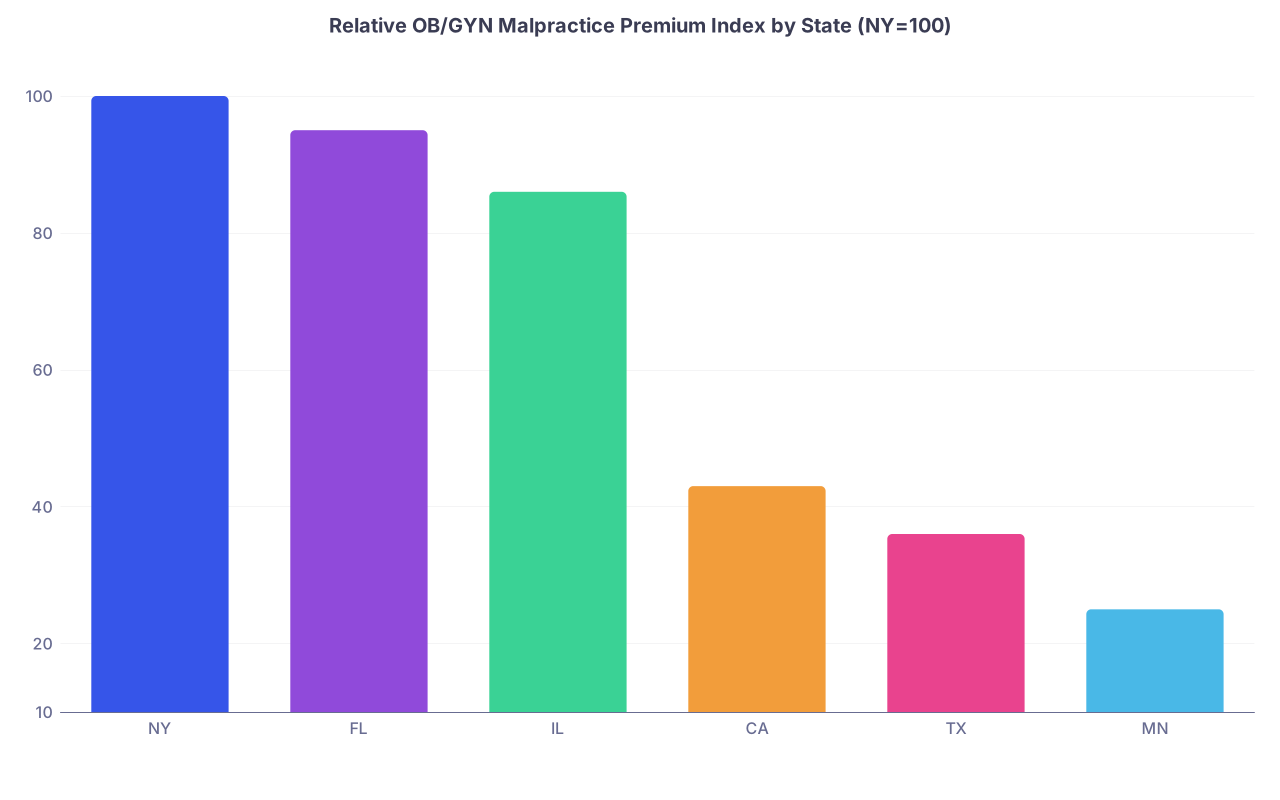
Now look at the relative ratio for a high-risk specialty like OB/GYN across those states:
| Category | Value |
|---|---|
| NY | 100 |
| FL | 95 |
| IL | 86 |
| CA | 43 |
| TX | 36 |
| MN | 25 |
If you are an OB/GYN in Minnesota instead of New York, you might be paying about one-quarter of the New York premium for similar limits. That is a six-figure difference, every year, directly hitting your take-home pay or group overhead.
I have watched multi-specialty groups in high-cost states rework their entire compensation models just to avoid losing OB/GYNs to lower-premium states. The math is that brutal.
Urban vs rural differentials
Even within a state, premiums can swing 20–50 percent between a major metro and a rural county. New York City vs upstate. Miami-Dade vs panhandle. Cook County vs downstate Illinois.
Urban jurisdictions with plaintiff-friendly venues and dense jury pools get priced higher. So when a recruiter in “a lower-cost region” of a high-risk state calls you, ask the broker for actual zip-code-rated premium quotes. Do not assume the state average applies.
Caps, Claims, and Premiums: How They Move Together
You do not have to guess at the interaction. The pattern is predictable, and actuarial filings from major carriers show it over and over:
- States with strong, sustained tort reform and caps: lower and more stable premiums, fewer giant outlier verdicts, more carriers competing.
- States without caps or with failed/overturned caps: higher premiums, more volatility, fewer carriers willing to write certain limits or specialties.
Think of it as a cascade:
- Legal environment sets the ceiling for potential awards.
- Jury behavior in that environment reveals the true severity distribution over time.
- Carriers model that distribution and feed it into rate filings and reinsurance purchases.
- Premiums (and sometimes deductibles or self-insured retentions) rise or fall as a result.
It is not abstract. Here is a simplified contrast, looking at three linked numbers for two archetypes:
| Metric | Reform-Protective State | Non-Reform State |
|---|---|---|
| Median Non-Economic Award | $250,000 | $600,000 |
| Typical OB/GYN Urban Premium | $75,000 | $200,000 |
| Number of Admitted Carriers (Market Depth) | Higher | Lower |
You want to practice where the median award and premium are both sane and where multiple carriers want your business. That is bargaining power.
Specialty Sensitivity: Who Feels It Most
Not every specialty is equally exposed to state climate differences. Look at high-level risk categories:
- Very high risk: OB/GYN, neurosurgery, orthopedics, cardiothoracic surgery, some interventional subspecialties.
- Moderate risk: general surgery, EM, anesthesia, hospitalist, GI.
- Lower risk (but not zero): psychiatry, pediatrics (except NICU), radiology, pathology.
Now layer on state differences. A psychiatrist in New York vs Texas will see a noticeable premium gap, but not life-changing. A neurosurgeon or OB/GYN will feel it viscerally.
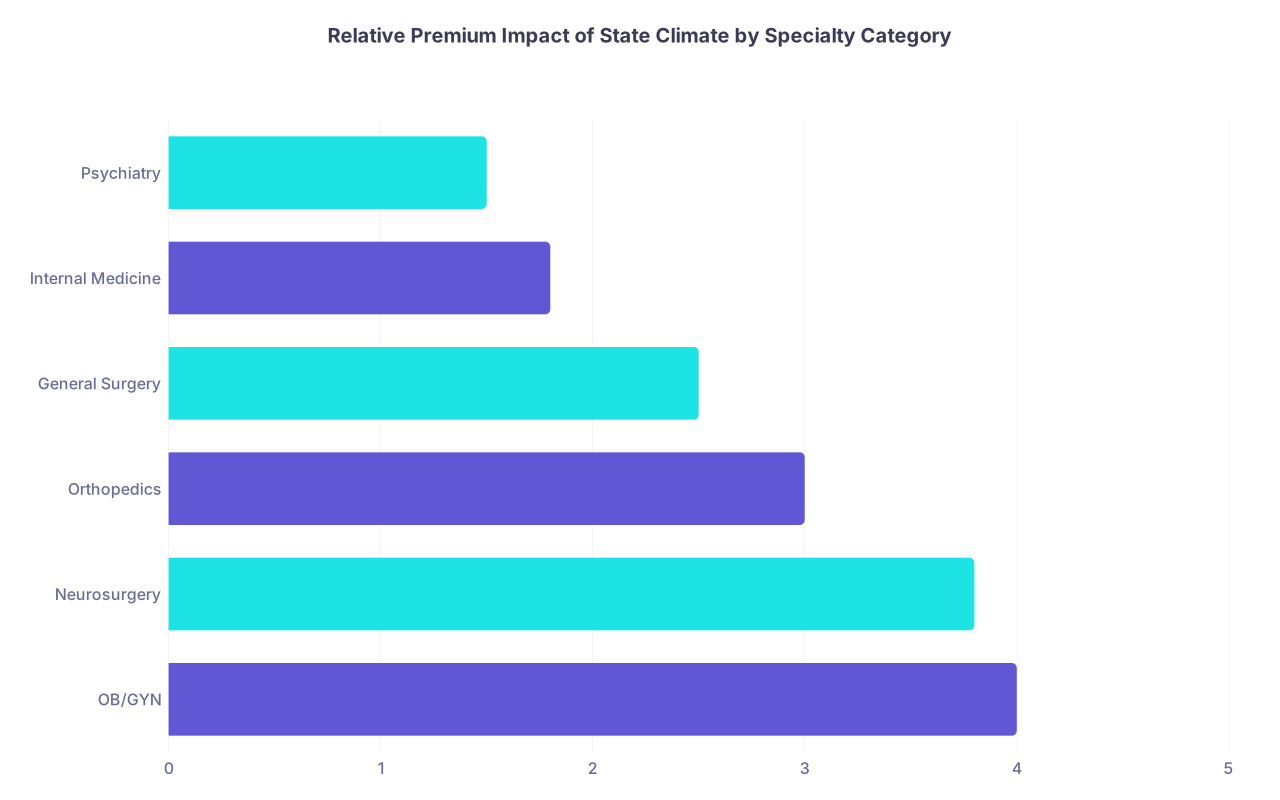
Here is a rough index of malpractice “cost sensitivity” by specialty class in high-risk vs reform states (normalized):
| Category | Value |
|---|---|
| OB/GYN | 4 |
| Neurosurgery | 3.8 |
| Orthopedics | 3 |
| General Surgery | 2.5 |
| Internal Medicine | 1.8 |
| Psychiatry | 1.5 |
Interpretation: OB/GYN premiums in a non-reform, high-risk state can be roughly 4x what they are in a reform-protective environment; psychiatry, maybe 1.5–2x. The higher your baseline risk, the more the state climate multiplies it.
Legal and Financial Strategy by State Type
You cannot rewrite your state’s statutes, but you can design your practice and contracts with the climate in mind. Here is how I would think about it analytically, depending on the state bucket you are in.
Practicing in a high-risk, no-cap state (e.g., NY, FL, some IL counties)
Realistically, you are facing:
- Higher annual premiums, especially for procedural specialties.
- Greater volatility in rates over 5–10 year spans.
- Higher probability of very large verdicts that blow through base policy limits.
Data-driven responses:
- Push for group-negotiated coverage: Large groups in these markets sometimes secure better composite rates and excess layers than individuals.
- Consider higher primary limits with layered excess coverage: For example, $2M / $4M primary plus umbrella; carriers in high-risk states increasingly push this structure.
- Incorporate malpractice overhead explicitly into compensation models: I have seen “malpractice differentials” of $50–100k between partners in different states or subspecialties, baked directly into RVU-to-dollar conversion or overhead charges.
Practicing in a reform-protective, capped state (e.g., TX, CA, CO, MN)
Here you usually have:
- Lower base premiums.
- More predictable rate trends.
- A competitive carrier market (more options, better terms).
Data-driven responses:
- Do not underinsure just because it is cheap: A $1M / $3M policy in a capped state can be surprisingly affordable; that does not mean you should drop limits to save marginal dollars.
- Take advantage of claims-free credits and risk management discounts: Some carriers in these states very actively reward participation in CME, simulation, or safety programs. That is not marketing fluff; it affects rate factors.
- Treat any legislative push to weaken caps as a direct threat to your long-term cost structure: Because it is.
Practicing in a “swing” or unstable environment
Some states live in the gray zone: partial reforms, variable case law, changing legislatures, and occasional supreme court decisions that flip the table.
Patterns you see:
- Modest caps or limits that might not survive legal challenge.
- Moderate premiums but high uncertainty over the next decade.
- Carriers filing for rate increases more often, citing “emerging severity trends.”
If you sign a 10-year hospital employment agreement in such a state, do not assume today’s premium is tomorrow’s premium. Bake in clauses that protect your compensation if malpractice overhead spikes.
How to Actually Use This Data in Your Career Decisions
The mistake I see residents and fellows make repeatedly: they compare base salaries across states and ignore malpractice climate. Or they accept “we cover your malpractice” at face value and never ask the dollar value.
Here is the more rational way to think about it.
Step 1: Get real premium numbers
For each job offer or location, ask for:
- Coverage type: occurrence vs claims-made.
- Limits: per-claim / aggregate (e.g., $1M / $3M).
- Annual premium amount the employer is paying on your behalf.
- Tail coverage terms (who pays, under what conditions, and approximate cost if you leave).
Then you can build a simple comparison:
| Factor | Offer A (High-Risk State) | Offer B (Reform State) |
|---|---|---|
| Base Salary | $450,000 | $400,000 |
| Malpractice Premium (annual) | $180,000 | $70,000 |
| Tail Obligation (if you leave) | You pay (est. $250k) | Employer pays |
| Effective Net Risk Burden | Very high | Moderate |
Offer A looks better on paper until you calculate your exposure if you leave or if comp models change. The data usually pushes toward the more predictable environment once you quantify everything.
Step 2: Adjust your “real income” for malpractice costs
If you are in private practice or share overhead, your malpractice premium is essentially a tax on your work. When comparing offers or regions, compute:
Real income ≈ Base comp + bonuses – malpractice cost – tail exposure (amortized over expected tenure)
Once you do that, you will often find that the lower-sounding salary in a reform state can be financially superior over 5–10 years.
Step 3: Evaluate long-term legal risk, not just next year’s rate
Here is where many younger physicians get burned: they look at one year’s premium quote and pretend that is the steady state. It is not.
You want to know:
- Has the state supreme court recently struck down or weakened caps?
- Are plaintiffs winning larger awards on appeal?
- Are carriers filing double-digit rate increases citing severity trends?
Those are leading indicators that your malpractice climate is deteriorating, even if today’s premium still looks reasonable.
Key Takeaways
- Malpractice climate is fundamentally state-specific, and the data shows 3–4x differences in premiums and large-claim severity between high-risk, no-cap states and reform-protective states.
- Caps on non-economic damages and stable tort reforms correlate strongly with lower, more predictable premiums and deeper insurance markets. Your specialty’s risk profile amplifies or dampens that effect.
- When comparing jobs or deciding where to practice, you should quantify malpractice premiums, tail obligations, and legal volatility; base salary alone is a misleading metric in a system this fragmented.