
Only about 1–2% of U.S. physicians face a paid malpractice claim in any given year, yet roughly 1 in 3 will be sued at least once over their career. That gap between annual payouts and lifetime exposure is where most people misjudge the risk.
The data show a simple truth: malpractice risk is less about daily catastrophe and more about long-term probability, severity skew, and career drag. If you look only at “How many doctors are sued each year?” you will miss the real financial and professional impact.
Let’s quantify it properly.
The Big Picture: How Often, How Large, Who Gets Hit
Start with aggregate numbers.
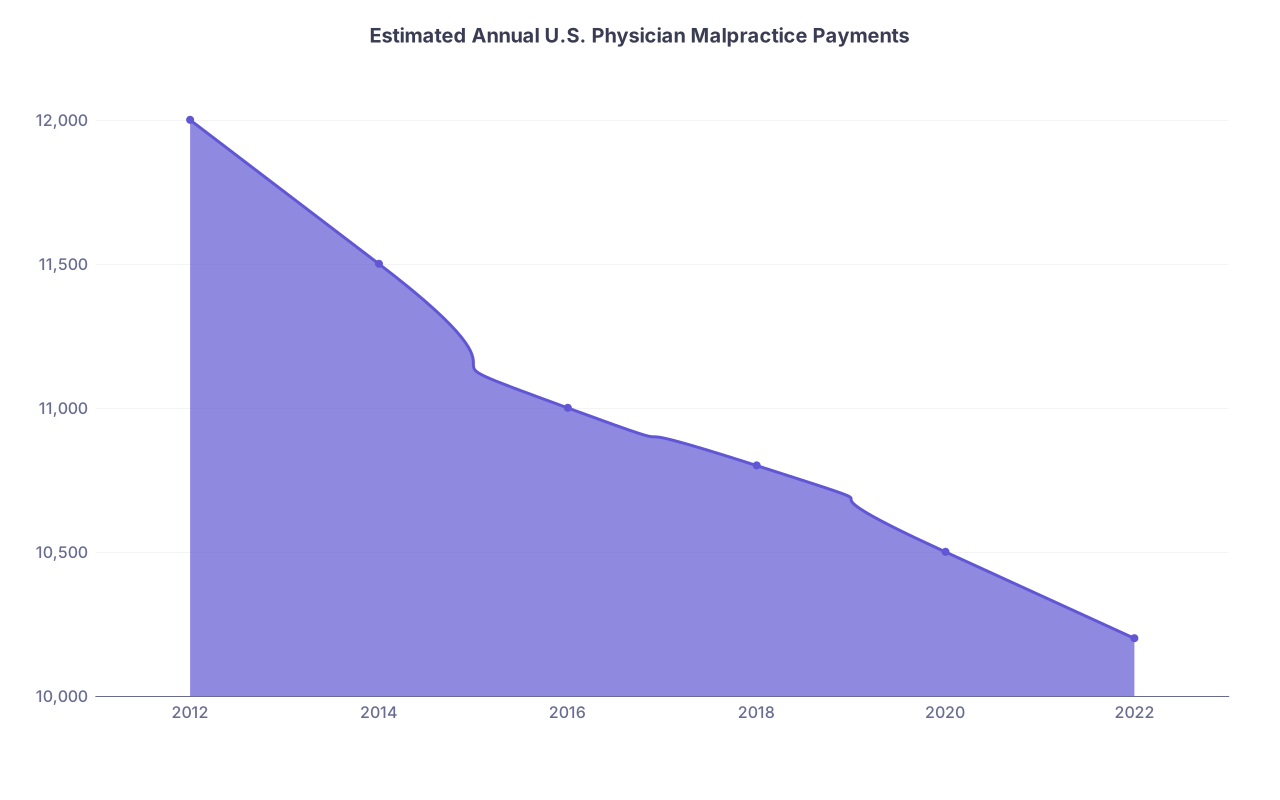
Across the 2010s, the U.S. National Practitioner Data Bank (NPDB) has consistently recorded on the order of 10,000–12,000 malpractice payments against physicians per year. The U.S. has roughly 1 million practicing physicians. That puts the annual paid claim rate in the low single digits of a percent.
But that is the tip of the iceberg.
Studies in NEJM and AMA Liability Surveys repeatedly show that by age 55:
- Approximately 75% of physicians in high-risk specialties (neurosurgery, thoracic surgery, OB/GYN, orthopedics) have faced at least one malpractice claim (paid or not).
- Approximately 36–40% of physicians in lower-risk fields (family medicine, pediatrics, psychiatry) have been sued at least once.
Most of those claims do not result in payment. That is the key split: frequency of claims vs frequency of payouts.
| Category | Value |
|---|---|
| 2012 | 12000 |
| 2014 | 11500 |
| 2016 | 11000 |
| 2018 | 10800 |
| 2020 | 10500 |
| 2022 | 10200 |
The trend line is slightly downward, helped by tort reforms in some states, better risk management, and perhaps more aggressive defense strategies. But payouts remain large when they occur.
Median payment for physician malpractice (NPDB, across recent years) sits roughly in the $200,000–$300,000 range. The mean (average) is substantially higher—often $350,000–$450,000—because a relatively small number of catastrophic cases drag the average up.
That skew matters. One $5 million birth injury award can offset hundreds of small claim closures with no payment.
Severity: How Big Are Malpractice Payouts Really?
Do not look at “average payout” alone. The distribution is long-tailed and ugly.
We can break typical physician malpractice payments into rough bands:
- Under $100,000: large number of small-to-moderate injury settlements.
- $100,000–$500,000: the bulk of serious but not catastrophic cases.
- $500,000–$1,000,000: more severe injury or clear liability.
- Above $1,000,000: catastrophic or wrongful death cases, especially involving young patients or permanent disability.
A reasonable national-level approximation looks like this:
| Payment Range | Share of Paid Claims | Share of Total Dollars Paid |
|---|---|---|
| < $100,000 | 35–40% | ~10–15% |
| $100,000–$249,999 | 25–30% | ~20–25% |
| $250,000–$499,999 | 15–20% | ~25–30% |
| $500,000–$999,999 | 8–12% | ~20–25% |
| ≥ $1,000,000 | 5–8% | ~15–20% |
The data show two important patterns:
- Most cases are in the sub-$500,000 range.
- A disproportionate share of total dollars sit in the ≥$500,000 group.
In other words: frequent small settlements plus rare large catastrophes. Classic insurance problem. From a career perspective, the six- and seven‑figure payouts are what underwriters and credentialing committees care about.
Severity by Injury Type
NPDB and specialty claims studies consistently rank severity by injury category:
- Wrongful death and permanent major disability cases have the highest median and mean payouts.
- Temporary injuries, emotional harm without clear physical injury, or “loss of chance” cases cluster in lower payout bands.
Some rough national median payout guideposts:
- Death: often $250,000–$400,000 median, with heavy tail above $1–3 million.
- Major permanent injury (e.g., severe neurologic injury, quadriplegia): median often similar to or higher than death, due to lifetime care costs.
- Minor or temporary injury: median more in the $50,000–$150,000 range.
The insurance pricing reflects this. Specialty premiums track the probability of those catastrophic injuries, not the volume of minor nicks and scrapes.
Frequency: Specialty, State, and Practice Environment
You cannot talk about malpractice without stratifying by specialty. The risk profile for a neurosurgeon and a dermatologist is not comparable.
By Specialty
AMA and NEJM data give clear patterns.
Across large datasets:
- Neurosurgery, cardiothoracic surgery, general surgery, OB/GYN, and orthopedics sit at the top for both claim frequency and payout severity.
- Internal medicine, family medicine, emergency medicine, and anesthesiology sit in the mid‑range.
- Psychiatry, dermatology, pathology, and allergy/immunology are consistently lower risk.
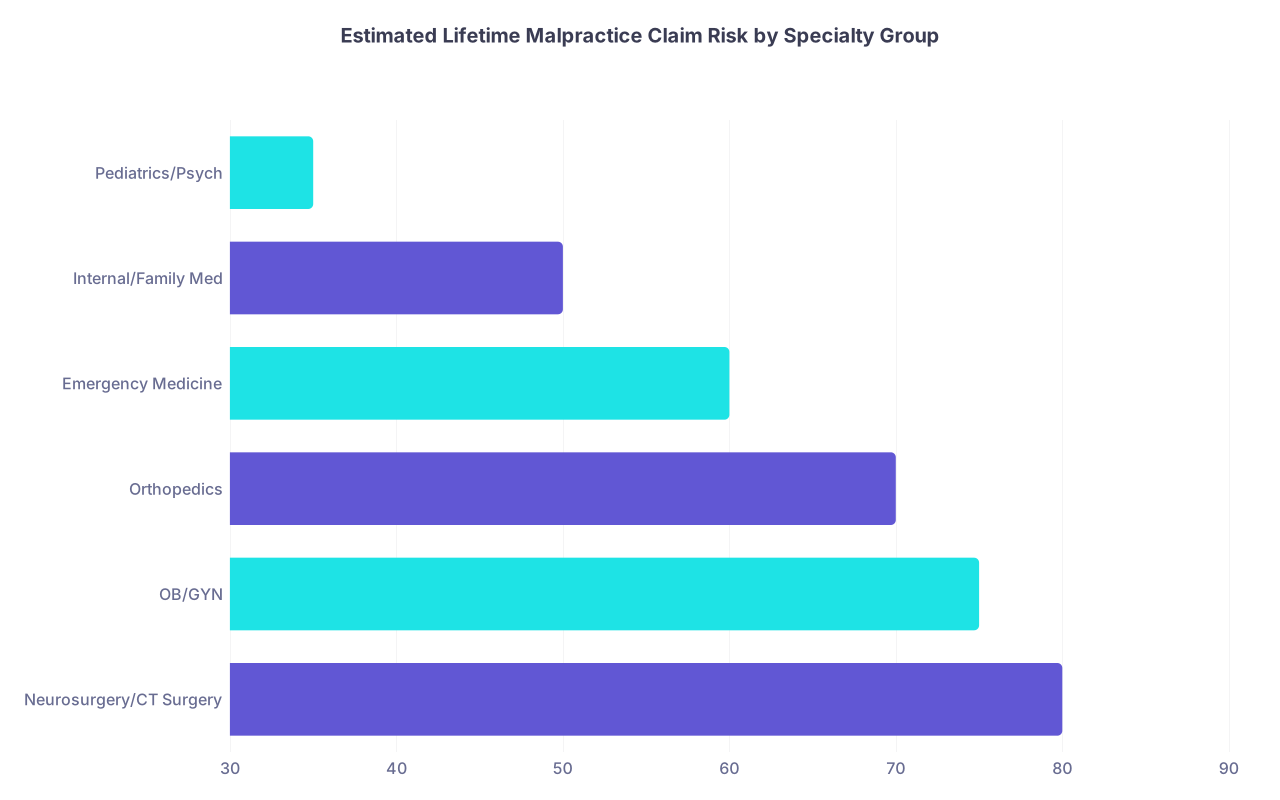
For lifetime being sued at least once:
- Neurosurgery, thoracic surgery, orthopedic surgery, and OB/GYN: 70–80%+ by age 55.
- Internal medicine, family medicine, emergency: roughly 45–60%.
- Psychiatry, pediatrics, dermatology: often under 40%.
| Category | Value |
|---|---|
| Neurosurgery/CT Surgery | 80 |
| OB/GYN | 75 |
| Orthopedics | 70 |
| Emergency Medicine | 60 |
| Internal/Family Med | 50 |
| Pediatrics/Psych | 35 |
Notice how even the “low‑risk” bucket still shows around one‑third probability of being sued by mid‑career. Low risk is not no risk. It just means fewer and usually smaller events.
By State and Legal Climate
Where you practice matters almost as much as what you practice.
States with strong tort reforms—caps on non‑economic damages, shorter statutes of limitations, pre‑suit screening panels—tend to see:
- Fewer filed claims per 100 physicians.
- Lower average payout sizes.
- More predictable insurance premiums.
Classic examples: Texas after its 2003 reforms, California with MICRA (though MICRA has been recently modified), and some Midwestern states with caps.
Contrast that with historically high‑risk venues—certain counties in New York, New Jersey, Pennsylvania, Florida, Illinois—where both claim frequency and severity run higher. If you talk to physicians in those markets, you will hear the same stories: “We pay double what my friend in Texas pays for the same specialty.”
The data back that up. It is not subtle.
Time and Stress: The Hidden Cost Behind the Numbers
The numbers in NPDB only track paid claims. They say nothing about the time, stress, and opportunity cost of defending a case that never pays a cent.
Here is what multiple insurer reports show:
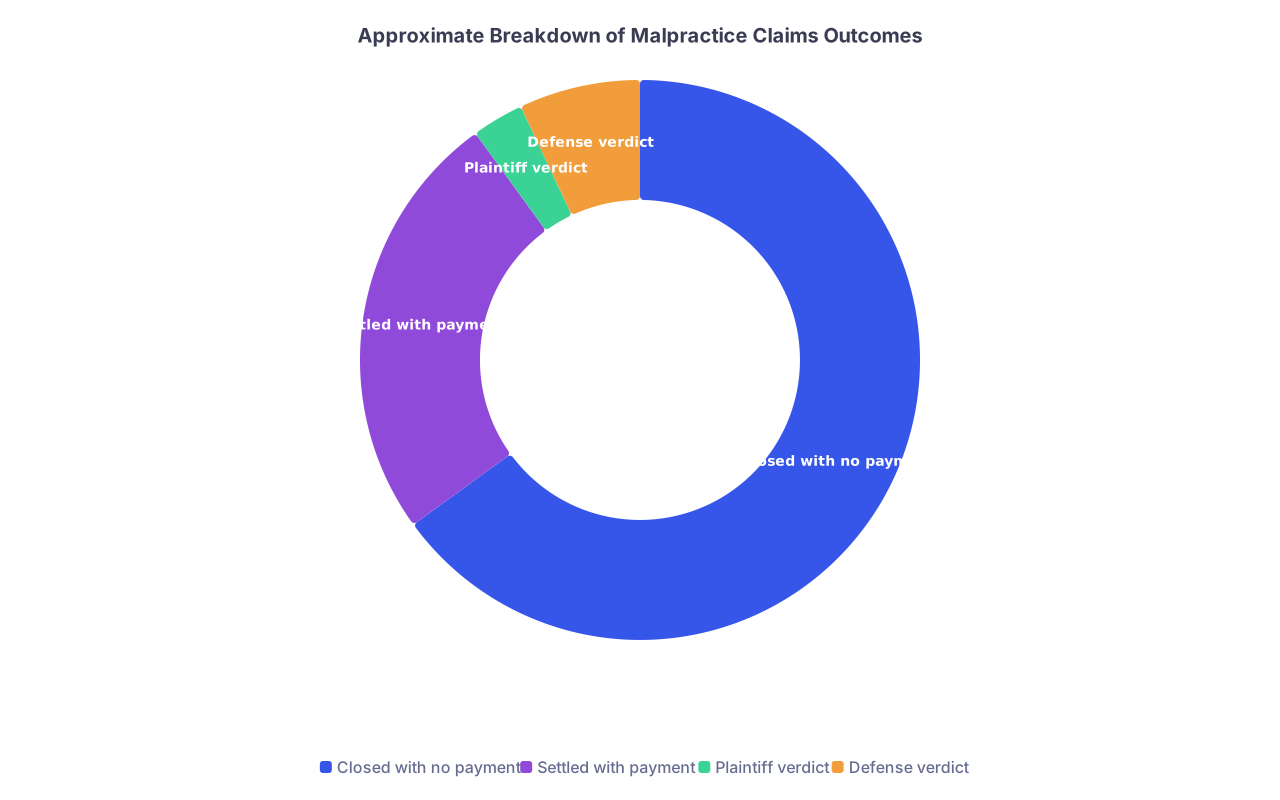
- Roughly 60–70% of claims close with no indemnity payment.
- Many still consume 1–3 years from filing to resolution.
- Physicians often spend 20–50 hours directly engaged per case (meetings, depositions, document review), plus the constant cognitive overhead.
A simple mental model:
- Assume a physician faces 2 claims in a 30‑year career, each taking 2 years to resolve.
- Those 4 calendar years may include dozens of nights thinking about testimony, worrying about licensure, or second‑guessing your notes from a case 5 years ago.
- Zero NPDB entry if both closed without payment. Yet the emotional and productivity cost is real.
This is why, even in “low‑payout” environments, malpractice risk is not trivial. The payout statistics understate the total burden.
Career Impact: Premiums, Jobs, and Reputation
The obvious career effect is on your malpractice insurance bill. Less obvious but more consequential: job mobility, hospital privileges, and credentialing.
Premiums: How Payouts Hit Your Wallet
Malpractice insurance underwriting is backward looking. Carriers care about:
- Your specialty.
- Your practice setting (hospital employed vs solo, high-acuity vs office based).
- Your state / region.
- Your individual claims history.
One paid claim, especially if small, does not necessarily double your premium. But the pattern, severity, and recency matter.
A very rough heuristic from insurer data and broker experience:
- 1 small paid claim (<$100k), years ago, in a high‑risk specialty: may have minor or no premium impact if well defended and explained.
- Multiple paid claims in a short window, or a single very large (> $1M) payout: often triggers a noticeable premium jump, restricted policy terms, higher deductibles, or difficulty finding coverage at all.
Think of your claims history as a credit score. One late payment is survivable. A foreclosure or string of defaults changes your options.
| Specialty Group | Lower-Risk State | Higher-Risk State |
|---|---|---|
| Family Medicine | $8k–$15k | $15k–$30k |
| Internal Medicine/Hosp | $10k–$20k | $20k–$40k |
| General Surgery | $25k–$60k | $60k–$120k |
| OB/GYN | $40k–$90k | $100k–$220k |
| Neurosurgery | $50k–$100k+ | $120k–250k+ |
Those are ballpark. I have seen OB/GYN attending quotes north of $200k/year in certain East Coast markets for physicians with prior paid claims.
Credentialing: Jobs and Privileges
Every hospital privilege application, every large group hiring packet, every health plan credentialing form asks some variation of:
- Have you ever been involved in a malpractice claim or lawsuit?
- Were any of those cases resolved with payment on your behalf?
- Please list dates, allegations, outcomes.
You cannot hide a paid claim; NPDB records are queryable by hospitals and insurers. Patterns get attention:
- Multiple large payouts.
- Very recent high‑dollar award.
- Claims involving egregious care issues (wrong‑site surgery, gross oversights, etc.).
I have sat in credentialing meetings where the phrase is literally: “We like this candidate, but this claim history is a problem. Can we live with this risk?” That is the level of scrutiny.
From a pure data standpoint, two physicians with identical CVs but different claims histories are not equal risks from the institution’s perspective. One NPDB entry does not end a career. Three major ones can. Or at minimum, they narrow your job options to less desirable settings.
Long-Term Earnings
Combine premium load plus maybe constrained job options and the cumulative earnings impact becomes nontrivial.
A simplified 20‑year example:
- Baseline surgeon in a moderate-risk state with clean record: premium $50k/year.
- Similar surgeon with 1–2 significant paid claims leading to $30k/year higher premium and slightly reduced average compensation due to fewer premium job options, say $50k/year less salary.
Over 20 years, ignoring inflation and compounding:
- Extra premiums: $30k × 20 = $600k.
- Lost salary: $50k × 20 = $1 million.
- Total financial drag: ≈ $1.6 million.
Is that exact? No. But it accurately reflects scale. The headline “$800k malpractice settlement” is only part of the cost story.
Defensive Medicine: Cost to the System and to You
Malpractice payout statistics drive behavior even when no one is being sued.
Multiple surveys show:
- 75–90% of physicians report engaging in some form of defensive medicine.
- This includes ordering imaging, labs, or consults primarily to document “we checked,” not because probability of benefit is high.
- Conservative estimates put the national cost of defensive medicine in the tens of billions annually. Some estimates go over $50–$100 billion.
From the individual physician standpoint:
- You spend more time documenting, hedging, and ordering low-yield tests.
- Fee-for-service productivity may partially offset that.
- In capitated or value-based systems, defensive behavior can directly erode practice margins and your bonus pool.
It comes back to the skewed tail risk. Even if the actual probability of a catastrophic lawsuit on any given day is tiny, the downside is so painful—professionally and financially—that many physicians act as if it is near-constant.
That is rational behavior under uncertainty. But it distorts resource use.
What The Data Say About Reducing Risk (Beyond Platitudes)
You will often hear hand-waving slogans about “good communication” and “thorough documentation.” Those are not wrong. But the data show some more concrete levers.

High-Risk Clinical Scenarios
Insurer claim analyses repeatedly flag certain scenarios that disproportionately lead to severe payouts:
- Missed or delayed diagnosis of cancer, myocardial infarction, stroke, sepsis.
- Obstetric catastrophes: shoulder dystocia with hypoxic injury, failure to respond to fetal distress, delayed C-section.
- Surgical errors: wrong-site surgery, retained foreign bodies, major vascular injuries, post-op hemorrhage not recognized.
- Emergency medicine misses: discharged patient with evolving catastrophic condition.
If you want to reduce your personal tail risk, you focus relentlessly on these nodes. Not by ordering every test for every minor complaint, but by systematizing:
- Clear follow-up and closed-loop communication on critical tests.
- Robust escalation protocols when vital signs or labs deteriorate.
- Explicit team communication at handoffs and sign-outs.
The malpractice data show: system failures and communication breakdowns generate lawsuits as much as, or more than, individual cognitive errors.
Communication and Disclosure
There is actually decent evidence that honest, timely disclosure programs with early offers can reduce both claim frequency and severity. Institutions that adopted formal “disclose-and-offer” models have reported:
- Lower number of lawsuits per 100 adverse events.
- Comparable or even reduced total indemnity outlay.
- Better patient satisfaction even after real harm.
Physicians tend to fear that saying “we made a mistake” guarantees a lawsuit. The data are more nuanced. A defensive, opaque, or dismissive response to harm often pushes patients to call a lawyer. A transparent, empathetic response with a credible plan to address the harm frequently diffuses that impulse.
Reading Malpractice Payout Statistics Like an Analyst
Most discussions of malpractice swing between two unhelpful extremes: “The system is broken and predatory” vs “It is overblown; almost no one actually pays.” The data show something more precise.
| Category | Value |
|---|---|
| Closed with no payment | 65 |
| Settled with payment | 25 |
| Plaintiff verdict | 3 |
| Defense verdict | 7 |
Roughly:
- About two-thirds of claims close with no payment.
- Around one-quarter end in settlement.
- Plaintiff verdicts at trial are a small single-digit percentage.
- Defense wins most trials.
So yes, the majority of claims do not generate an indemnity payment. Yet a nontrivial minority do, and those events cluster in the upper six and seven figures. That is enough to drive insurance pricing, physician anxiety, and defensive medicine.
From an analytic standpoint, if you are thinking about your career:
- Annual probability of a paid claim for an average physician: low (1–2% range).
- Lifetime probability of at least one claim: high (30–70% depending on specialty).
- Fraction of claims that pay: modest (about one-third).
- Financial magnitude when they do pay: skewed, with a meaningful tail above $1 million.

If you ignore malpractice completely, you are being naïve. If you obsess over it daily, you are wasting cognitive bandwidth. You aim for calibrated awareness:
- Choose specialty and geography with eyes open about risk and premiums.
- Treat documentation, communication, and follow-up systems as part of your risk portfolio, not mere bureaucracy.
- Treat your claims history like a credit score that you want to protect over decades.
Practical Takeaways for Physicians and Trainees
You do not control the legal climate, plaintiffs’ bar behavior, or NPDB reporting rules. You do control how you internalize the statistics.
For a resident or fellow picking a specialty:
- Understand that high-acuity procedural fields come with both higher potential earnings and higher malpractice tail risk.
- Look at state-level premium data and tort reform status before signing long-term contracts.
For an attending planning a 20–30 year career:
- Think in terms of total risk cost: premiums + litigation time + job/credentialing friction, not just “average payout.”
- View each claim event as something that must be tightly managed: timely reporting to your carrier, disciplined communication, and consistent documentation.
For someone who already has a paid claim (or two):
- Do not assume your career is over. Many physicians with NPDB entries work full, productive careers.
- Do assume that future employers and underwriters will read those entries closely. Your best response is a clean subsequent track record and visible engagement in quality/risk efforts.

| Step | Description |
|---|---|
| Step 1 | Adverse Clinical Event |
| Step 2 | No Legal Impact |
| Step 3 | Insurer Defense |
| Step 4 | Closed No Payment |
| Step 5 | NPDB Report |
| Step 6 | Premium Increase |
| Step 7 | Credentialing Scrutiny |
| Step 8 | Career Options Adjusted |
| Step 9 | Claim Filed? |
| Step 10 | Payment Made? |
That flow is what you are really managing across a 30‑year practice life.
Key Points
- Malpractice payouts are rare in any single year but common over a career, with heavy concentration of dollars in a small fraction of catastrophic cases.
- Specialty, state, and individual claims history jointly determine your real malpractice burden: premium levels, job mobility, and long-term earnings.
- Treat malpractice risk like a long-horizon portfolio problem: understand the tail risks, manage the controllable drivers (systems, communication, documentation), and avoid patterns that tarnish your “risk profile” over decades.