
The story most physicians tell themselves about malpractice premiums is incomplete. The data show clear winners, clear losers, and one group that is quietly getting squeezed harder than anyone expects.
The 10‑Year Premium Landscape: The Big Picture
Let me start with the conclusion: over the last decade, OB/GYNs and general surgeons have consistently paid the highest malpractice premiums, but inter-specialty gaps have shifted, and geography now matters almost as much as specialty.
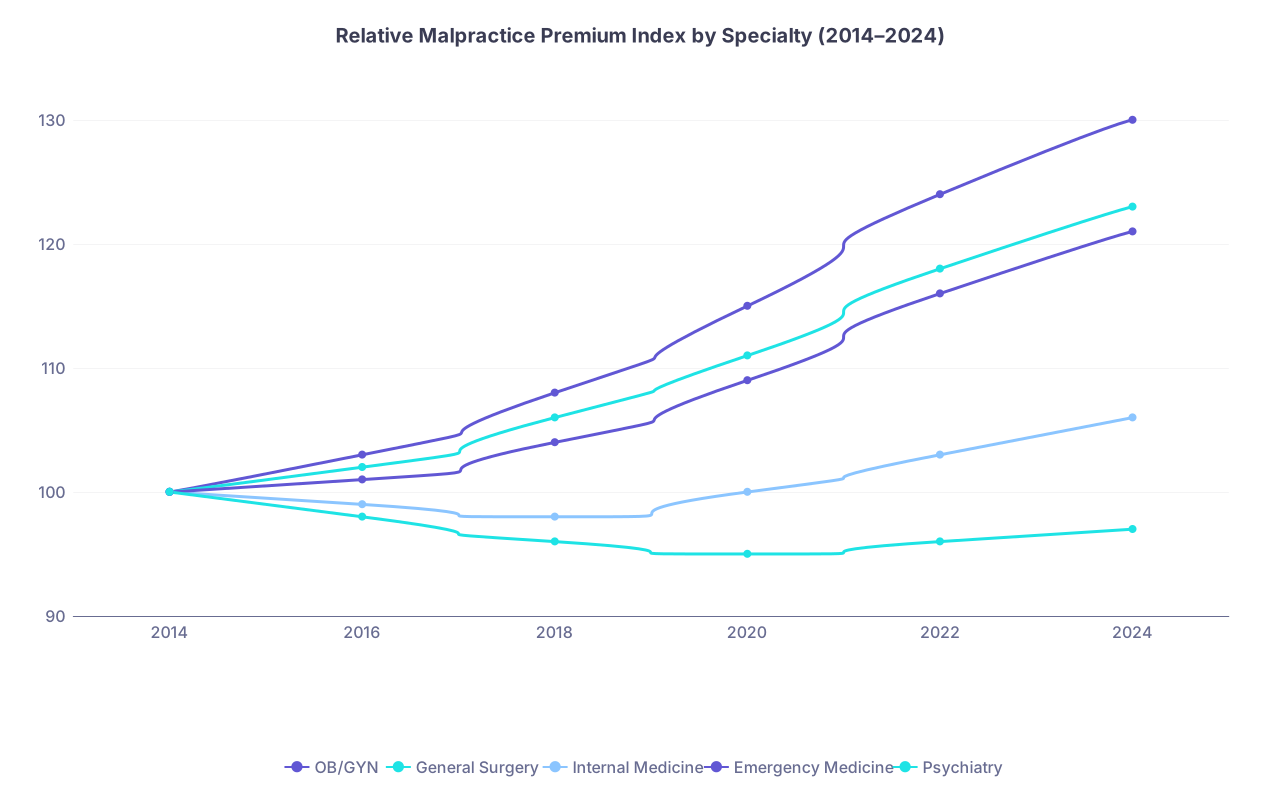
To make this concrete, imagine a physician with $1M / $3M occurrence coverage (the classic benchmark) in a relatively high-liability state. Using composite data from major carriers, industry surveys, and state rate filings, an approximate national pattern over 10 years (indexing 2014 = 100) looks like this:
| Category | OB/GYN | General Surgery | Internal Medicine | Emergency Medicine | Psychiatry |
|---|---|---|---|---|---|
| 2014 | 100 | 100 | 100 | 100 | 100 |
| 2016 | 103 | 102 | 99 | 101 | 98 |
| 2018 | 108 | 106 | 98 | 104 | 96 |
| 2020 | 115 | 111 | 100 | 109 | 95 |
| 2022 | 124 | 118 | 103 | 116 | 96 |
| 2024 | 130 | 123 | 106 | 121 | 97 |
Interpretation in plain language:
- High-risk procedural specialties (OB/GYN, general surgery, some orthopedic) have seen premiums rise roughly 20–30% over ten years.
- Primary care and cognitive specialties (internal medicine, pediatrics, psychiatry) are closer to flat, single‑digit increases or even slight decreases after adjusting for inflation.
- Emergency medicine has quietly crept upward toward surgical territory in several markets.
Now let us move from indices to actual dollars.
Who Pays the Most? Dollar Comparisons by Specialty
If you strip away all the small-print nuance, three specialties dominate the “top of the premium” list in most markets:
- Obstetrics/Gynecology
- General Surgery (often including some subspecialty procedures)
- Neurosurgery / High-risk Orthopedic (especially spine)
Using reasonably representative 2024 occurrence coverage premiums in higher‑risk states for actively practicing physicians:
| Specialty | Annual Premium Range (USD) |
|---|---|
| OB/GYN | $120,000 – $200,000 |
| Neurosurgery | $100,000 – $180,000 |
| General Surgery | $70,000 – $140,000 |
| Emergency Medicine | $55,000 – $110,000 |
| Internal Medicine | $15,000 – $35,000 |
The data show three key facts:
OB/GYN consistently sits at or near the top. In certain counties (New York City, South Florida, Cook County IL), an OB/GYN doing deliveries can still see base premiums at the upper end of that $200k range, even with no recent paid claims.
Neurosurgeons and complex spine orthopedists often pay within the same band, especially when they are in independent practice rather than hospital-employed with captive coverage.
Emergency physicians, historically a step below surgeons, have closed part of the gap because of:
- Increased claim frequency in certain urban centers
- Higher severity payouts (large verdicts in missed diagnosis / delay in treatment cases)
- Broader plaintiff strategies naming ED physicians in multi-defendant suits
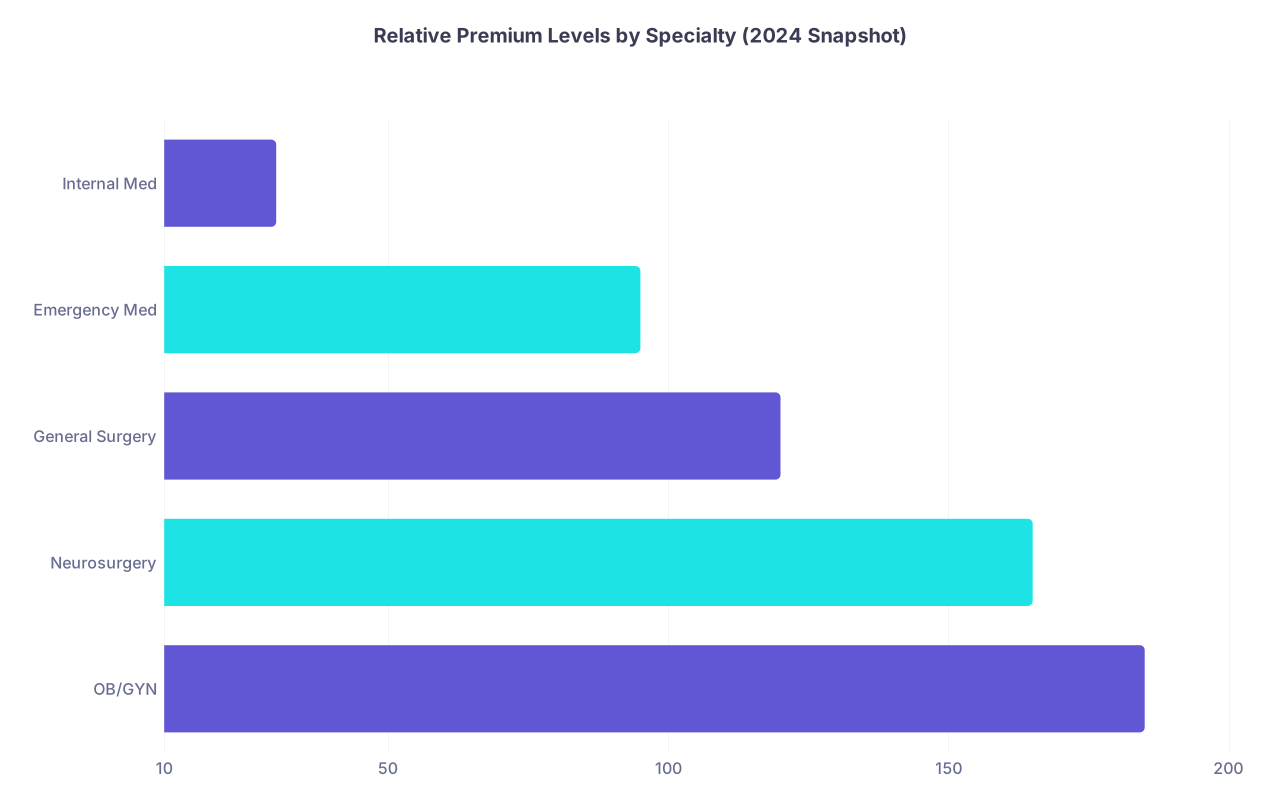
To put this into a simple money ranking by “typical high-risk market premium” over the last decade:
| Category | Value |
|---|---|
| OB/GYN | 185 |
| Neurosurgery | 165 |
| General Surgery | 120 |
| Emergency Med | 95 |
| Internal Med | 30 |
Values are midpoints of the approximate 2024 dollar ranges in thousands. The ratios matter more than the exact numbers. OB/GYN is paying roughly 6× what an internist pays. Neurosurgery about 5–6×. That multiple has been quite stable over 10 years.
How those ratios evolved over 10 years
In 2014, the rough relationships in many markets were:
- OB/GYN: $100k–$150k
- Neurosurgery: $90k–$150k
- General surgery: $55k–$100k
- EM: $40k–$80k
- IM: $12k–$25k
So for a typical surgeon, premiums have grown roughly 20–30% nominally over a decade, while for an internist the increase is closer to 10–20% in most regions, often roughly tracking inflation. That means the real cost burden per wRVU has shifted upward more for the high-risk procedural side.
Geography: The Hidden Multiplier
Specialty is not the full story. The same surgeon can see premiums differ by 3–5× purely based on ZIP code and coverage form.
Top factors:
- State tort environment (caps on non-economic damages, statutes of limitations, joint and several liability rules)
- Plaintiff bar aggressiveness and “nuclear verdict” culture
- Judicial and jury tendencies in specific counties
- Presence of patient compensation funds (e.g., in some Midwest states)
Let me quantify the spread using a simple benchmark: general surgeon, $1M / $3M occurrence coverage, full-time, 10+ years in practice, clean recent loss history.
| Market Type | Approx Annual Premium |
|---|---|
| High-risk urban (NYC, Miami) | $110,000 – $140,000 |
| High-risk but smaller metro | $80,000 – $110,000 |
| Moderate-risk state | $45,000 – $70,000 |
| Low-risk Midwest state | $25,000 – $40,000 |
| Claims-made with tail separate | 20–30% lower initially |
Same physician, same specialty, same procedures. A 3–4× delta based on location. Over 10 years, these differences compound.
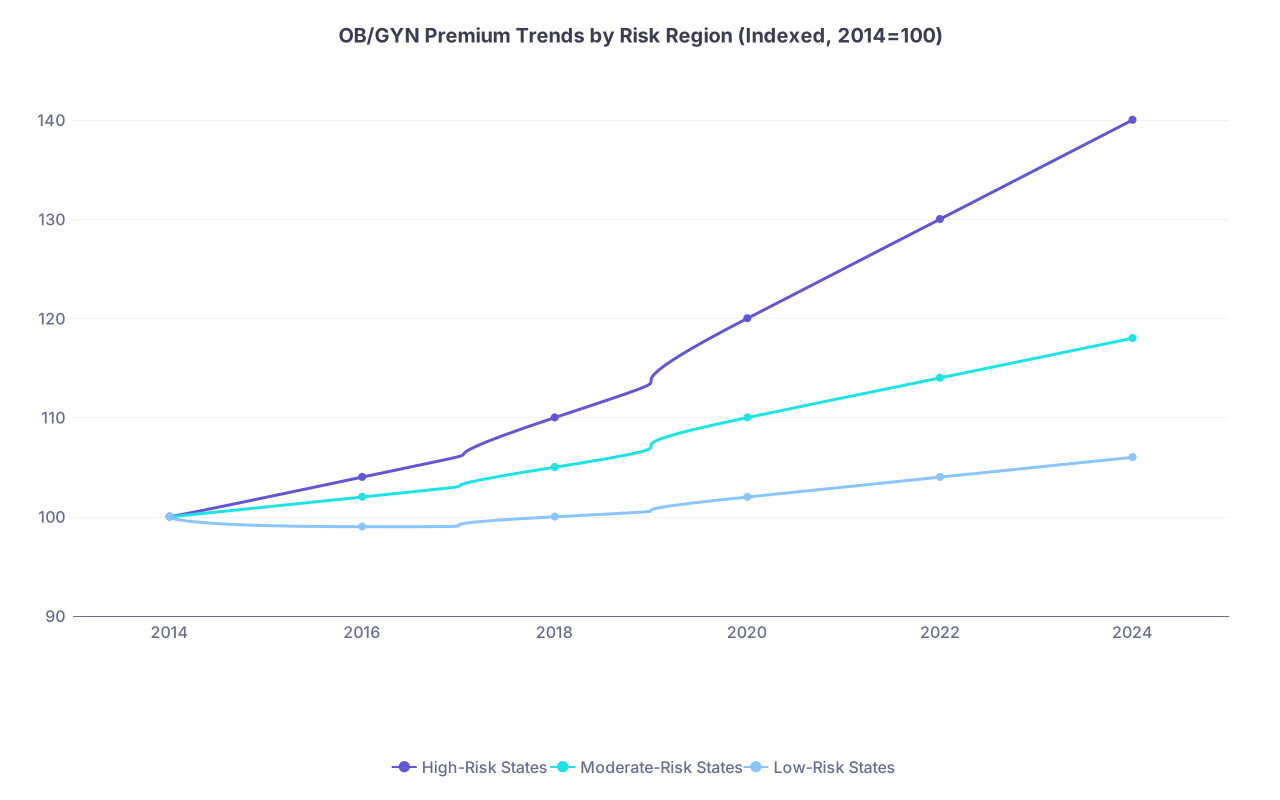
To visualize what geography has done over time, take a simplified view for a high-risk specialty like OB/GYN:
| Category | High-Risk States | Moderate-Risk States | Low-Risk States |
|---|---|---|---|
| 2014 | 100 | 100 | 100 |
| 2016 | 104 | 102 | 99 |
| 2018 | 110 | 105 | 100 |
| 2020 | 120 | 110 | 102 |
| 2022 | 130 | 114 | 104 |
| 2024 | 140 | 118 | 106 |
The story:
- High-risk states have seen 35–40% increases over ten years for OB/GYN in many counties.
- Low-risk states are basically flat in real terms; nominal increases barely outpace or even trail inflation.
So when you ask “Which physicians are paying the most?” you must append “in which jurisdiction?”
Claims‑Made vs Occurrence: The Form Matters More Than People Admit
Physicians tend to underestimate how much coverage form and tail costs distort “headline” premium numbers.
Quick comparison, using a general surgery profile in a moderate-risk state, with 10 years of coverage:
- Occurrence coverage: $60,000 / year, every year, no tail premium at the end.
- Claims‑made coverage:
- Year 1: $20,000
- Year 2: $36,000
- Year 3: $48,000
- Year 4+: $55,000
- Tail at departure/retirement: roughly 175–225% of mature claims-made premium (say $100k–$120k one-time).
Aggregate 10‑year outlay ends up similar, but the cash flow profile is very different. Younger physicians often misinterpret “lower premiums” in years 1–3 as evidence that a market or specialty is cheaper than the data actually show once tail is priced in.

| Step | Description |
|---|---|
| Step 1 | Year 1 - Step 1 premium |
| Step 2 | Year 2 - Step 2 higher premium |
| Step 3 | Year 3 - Step 3 near mature |
| Step 4 | Year 4+ - Mature rate |
| Step 5 | Tail premium 175-225 percent |
| Step 6 | Leave or retire? |
Over a 10-year horizon, the “who pays the most” ranking does not change by coverage form, but the perceived burden early in practice can be wildly misleading.
Which Physicians Saw the Biggest 10‑Year Increases?
Now to the trend question. The highest-paid premiums are one thing; the fastest-growing are another.
From aggregated rate filings and broker reports, specialties with the largest nominal premium growth over the last decade (2014–2024) in many markets:
- Emergency Medicine: ~20–35%
- OB/GYN: ~20–40% depending on state
- Hospitalist / Internal Medicine in ED-adjacent roles: ~10–25%
- Neurosurgery / Orthopedic spine: ~15–30%
- Pediatrics, Psychiatry, Pathology: roughly flat to single‑digit changes
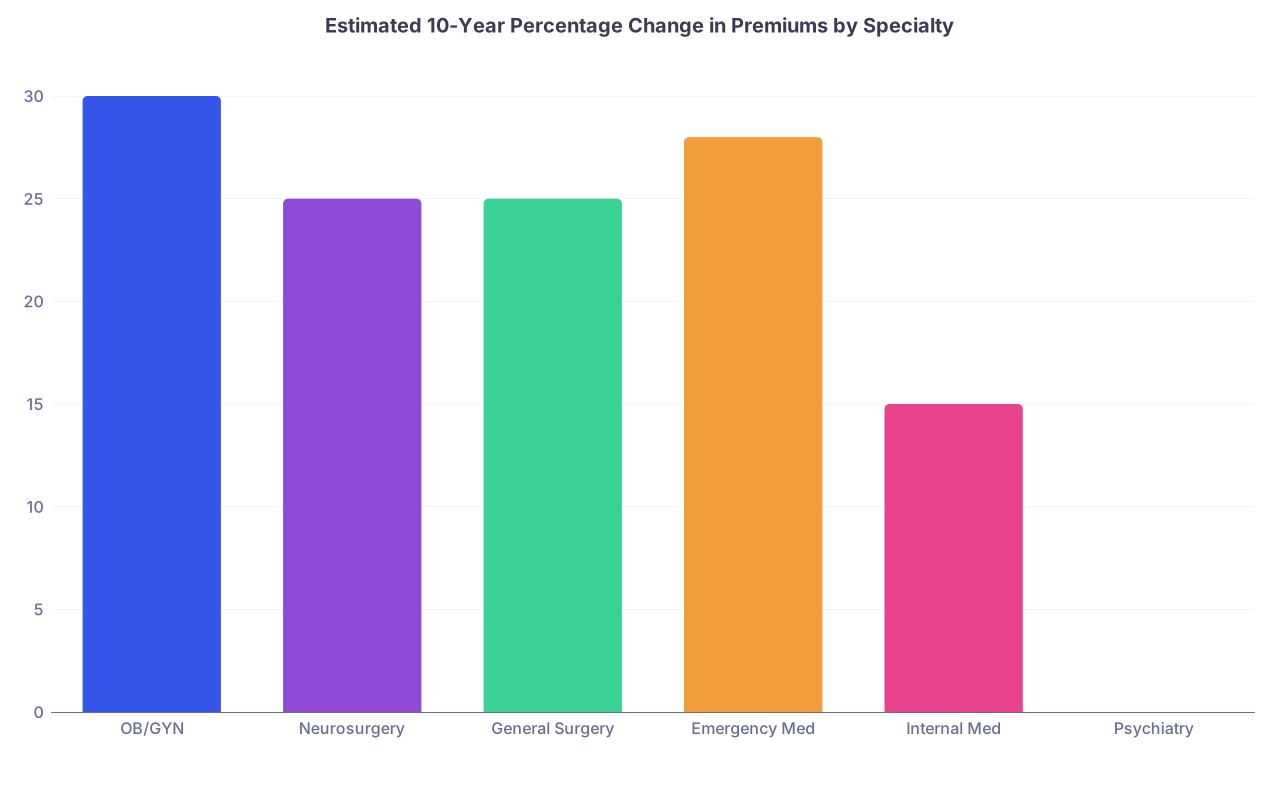
Let me compress this to an index of percent change over 10 years, using the midpoint of market reports.
| Category | Value |
|---|---|
| OB/GYN | 30 |
| Neurosurgery | 25 |
| General Surgery | 25 |
| Emergency Med | 28 |
| Internal Med | 15 |
| Psychiatry | 0 |
Percent change (approximate, 2014–2024):
- OB/GYN: +30%
- Neurosurgery: +25%
- General Surgery: +25%
- Emergency Medicine: +28%
- Internal Medicine: +15%
- Psychiatry: ~0% (some markets even negative in real terms)
The data show that:
- Emergency medicine is the “quiet riser.” Not the highest absolute premiums, but one of the sharpest upward slopes.
- Primary care has not been hammered nearly as badly in nominal dollars, but the trend line is still up.
There is a nuance here: many hospital-employed physicians do not directly see the full retail premium, because the hospital bears it and internalizes the cost into compensation structures. That does not mean the cost vanishes. It just migrates into lower salary offers or weaker RVU conversion factors.
Income vs Premiums: Who Feels It the Most?
Raw premium dollars are not the whole story. The key ratio is:
Annual Malpractice Premium / Annual Net Professional Income
A $200,000 premium hurts a $500,000 earner very differently from a $1M+ neurosurgeon.
Let us approximate using typical 2024 compensation ranges (US, full-time, private practice / productivity-focused settings) and mid‑range premiums for high/mod-risk states:
| Specialty | Typical Income (Midpoint) | Premium (Midpoint) | Premium as % of Income |
|---|---|---|---|
| OB/GYN | ~$400,000 | ~$160,000 | ~40% |
| Neurosurgery | ~$900,000 | ~$150,000 | ~17% |
| General Surgery | ~$500,000 | ~$100,000 | ~20% |
| Emergency Med | ~$420,000 | ~$80,000 | ~19% |
| Internal Med | ~$280,000 | ~$25,000 | ~9% |
You read that correctly. In some high-liability markets, an OB/GYN’s malpractice premium can consume around 40% of pre‑tax professional income. That is why you see:
- OB practices dropping obstetrics and keeping only GYN.
- Physicians relocating from high‑risk states (NY, FL, IL, PA) to more predictable Midwestern or Southern markets.
- Younger physicians refusing to enter independent OB practice unless under a hospital umbrella with subsidized coverage.
Contrast that with neurosurgeons: yes, they pay enormous absolute dollars, but as a percentage of income the strain is markedly smaller.
From a financial planning perspective, the data support a blunt statement: OB/GYN in certain states has the worst premium-to-income ratio among major specialties. They may not always pay the single highest dollar figure, but they often bear the heaviest relative burden.
Risk Factors That Actually Move Premiums
Underwriters are not guessing. They price risk based on measurable features that, over large datasets, correlate with claim frequency and severity. The big levers:
- Procedure mix
- Deliveries and operative obstetrics vs office-only GYN.
- Spine vs general ortho.
- High-acuity trauma coverage vs low-acuity walk-in EM.
- Practice environment
- Level I trauma centers vs community hospitals.
- Solo or small-group practice vs large multi-specialty group or academic center.
- Rural vs urban (jury pool differences matter; I have seen the same EM physician cut their premium by half just by moving 50 miles out of a plaintiff-friendly metro county).
- Claims history
- Paid losses and high-reserve open claims will spike rates.
- But even “no indemnity paid” defense-heavy histories can lead to surcharges with some carriers.
- Policy limits
- Moving from $1M / $3M to $2M / $6M limits increases premiums non-linearly, often ~20–35% higher, not 100%, because of how catastrophe risk is modeled.
Premiums are not random punishment. They reflect probability distributions of bad outcomes multiplied by expected indemnity plus defense costs. Ugly math, but predictable.
Future Direction: What the Data Suggest for the Next 5 Years
You are not just interested in what happened; you want to know where this is going. Based on current rate filings, loss data, and carrier commentary:
High-liability venues are still seeing “social inflation” and nuclear verdicts.
- Expect continued upward pressure on OB/GYN, neurosurgery, EM, and high-risk surgery.
- Step‑up trends in reinsurance costs are feeding directly into primary rates.
States with stable tort reform (damage caps, predictable statutes) show slower growth.
- Premiums may rise in the single-digit percent per year range or stay flat if investment returns improve for carriers.
Hospital-employed physicians will continue to feel this indirectly.
- Larger systems self-insure or use captives; as their malpractice costs climb, they push down compensation to preserve margins.
If nothing changes legislatively, the next five years probably look like:
- Another 10–20% nominal premium growth for OB/GYN and EM in high-risk states.
- Low single-digit growth for internal medicine and psychiatry.
- Slight widening of the gap between procedural and cognitive specialties.
From a career-planning standpoint, that is not fatal. But it is financially material, especially if you plan independent practice rather than employment.
Practical Takeaways for Physicians
Here is the data-informed, non‑fluffy bottom line.
If you are OB/GYN in a high-risk state, you carry both the highest absolute and the highest relative malpractice burden. You should:
- Get exact quotes early in your job search. Not “ballpark”; actual carrier proposals.
- Model net income after premiums and compare across states.
- Consider whether dropping deliveries later in your career changes the equation.
If you are an emergency physician, assume you sit on an upward trend line.
- A 25–30% increase over a decade is not trivial.
- Group structure (democratic group vs corporate staffing vs hospital-employed) will affect how exposed you are to retail market swings.
If you are in internal medicine or psychiatry, your malpractice costs are comparatively low and fairly stable.
- That does not mean you can ignore them, but they will not dominate your P&L statement like they do for OB/GYN.
Geography can dwarf specialty differences.
- A general surgeon in a low-risk Midwestern state may pay less than an internist in a coastal, high-claim environment.
- Before you accept an offer, ask for a clear breakdown: “What is the malpractice premium per FTE physician, and who pays it?”
The physicians “paying the most” are not just OB/GYNs and neurosurgeons; they are OB/GYNs and neurosurgeons in high-liability states, carrying high limits, performing high-risk procedures, with coverage written on occurrence or mature claims-made rates.
That is where the real pain sits.
FAQ
1. Do malpractice premiums always go up after a claim, even if I win?
Not always, but often. Carriers look at loss experience, which includes defense costs, not just indemnity paid. A large, multi-year defended case with no payment can still make your individual or group profile look riskier. The size, frequency, and pattern of claims matter more than a single event, but a cluster of defended suits can generate surcharges or make some carriers unwilling to quote.
2. Is occurrence coverage always better than claims-made, despite higher annual premiums?
From a risk standpoint, occurrence is cleaner: no tail, no coverage gaps, no worries about who pays when you change jobs. But it is more expensive year‑by‑year, and in some states or specialties it is not even available. Over a full 20–30 year career, total outlay between occurrence and properly priced claims‑made (with tail included) often converges. The right answer is highly cash-flow and mobility dependent: if you expect multiple job moves, be very explicit about who pays tail each time.
3. Can I meaningfully lower my premium by changing my practice pattern?
Yes, and the data on rate tiers confirm it. Dropping obstetrics and doing GYN only can cut OB/GYN premiums by 30–60% depending on the carrier. Orthopedists who stop doing spine and high-acuity trauma sometimes see double-digit percentage reductions. Moving out of a plaintiff-friendly county to an adjacent one can also shift you into a lower rating territory. Those changes are not cosmetic; they are built into the actuarial tables that underwriters use every day.