
You’re a practicing clinician. You’ve got a full-time job at a hospital, group, or clinic. And you keep seeing telemedicine ads offering $30–$50 per quick consult, or you’re thinking about opening your own niche virtual clinic—weight loss, ADHD, sleep, hormone therapy, second opinions, urgent care evenings.
You run some numbers and realize: a half-day of telemedicine per week could meaningfully move the needle on your income or give you more control over your schedule.
Then you hit the wall: malpractice.
Your employer’s coverage won’t clearly extend to your side LLC. The telemedicine platform says “we provide coverage,” but the language is vague and the policy limits look thin. Someone in a Facebook physician group posts, “Make sure you have your own occurrence policy!” Another says, “Just rely on the platform coverage, you’ll be fine.” Your risk-averse colleague mutters, “One lawsuit will wipe you out.”
You’re stuck between: “I don’t want to get sued into oblivion” and “I don’t want to waste money on redundant coverage.”
Here’s how to handle this situation like an adult professional, not a clueless side-gig tourist.
1. Start With Reality: What Exactly Are You Doing and Where?
Before you touch insurance, you need a crisp picture of your side telemedicine setup. Malpractice policies are built around:
- What you do
- Where you do it
- Who you do it for
If you’re fuzzy on those, every quote will be half-useless.
Ask and actually write down answers to:
What type of care am I providing?
“General tele-urgent care” is very different from “testosterone replacement + controlled substances” or “psychiatric medication management” or “post-op ortho follow-ups.”Which states will I be licensed and actively seeing patients in?
This is not theoretical “maybe someday,” but where you’ll actually practice in the first 12–24 months.Who owns the relationship?
- Are you:
- W-2 employee for a telehealth company?
- 1099 independent contractor for a platform?
- Running your own PLLC/PC/LLC, billing patients directly?
- Are you:
What is your current malpractice coverage setup at your main job?
- Claims-made vs occurrence
- Limits (probably something like $1M / $3M or $2M / $4M)
- Any specific exclusions (cosmetics, telemedicine, out-of-state, etc.)
Is your side work explicitly included or explicitly excluded in your current policy?
You probably do not know. That’s the problem.
If you can’t answer those, you’re not ready for quotes. You’re just going to confuse a broker and get a junk policy.
2. Your Employer’s Policy: Stop Assuming You’re Covered
Let me be blunt: your hospital/clinic policy nearly always covers you only for work you do as part of that job, under that entity, in those locations.
Typical patterns I’ve seen:
- Policy covers:
- In-person and telemedicine visits done for the employer, under their tax ID, often within a certain network or state.
- Policy does not cover:
- Side LLC work
- Moonlighting at unrelated entities
- Paid expert witness work
- Out-of-state work beyond the employer’s footprint
- Cosmetic/“concierge”/wellness side businesses
What to do this week:
Email or call your hospital risk management/HR/credentialing office. Ask directly:
- “Does my current malpractice coverage extend to telemedicine services I provide through my own business entity or as a 1099 contractor for other organizations?”
Expect the answer to be “No” or “Only if we are the contracting entity.”
- “Does my current malpractice coverage extend to telemedicine services I provide through my own business entity or as a 1099 contractor for other organizations?”
Ask for it in writing. Not just a casual “probably not.”
A short email from risk management is enough.
Once you accept that your employer’s policy is basically irrelevant to your side gig, the path becomes simpler. You need your own plan.
3. Understand the Coverage Pieces: What You Actually Need
You are not just buying “malpractice.” You’re assembling a package. For a side telemedicine business, you’re looking at:
- Professional liability (medical malpractice) – non-negotiable
- General liability – less central, but important if you have a physical office or clear business presence
- Cyber/privacy coverage – highly relevant for telehealth
- Entity coverage – if you have an LLC/PLLC/PC
- Tail coverage – depending on whether you go claims-made or occurrence
Let’s cut the theory and get specific.
Claims-made vs Occurrence for a Telemedicine Side Gig
You will see these two words everywhere. Here’s the short version in side-gig terms:
Claims-made:
Covers you for claims made while the policy is in force about care you provided while it was in force.
When you stop the policy, you need “tail” to cover future claims about past care.Occurrence:
Covers you for incidents that occurred during the policy period, no matter when the claim is made.
When you stop the policy, your prior years are still covered. No tail needed.
For a side telemedicine business that might change shape (different states, different niche, maybe sold later), occurrence is often the cleaner choice, even if it’s a bit more expensive yearly. It prevents the “I forgot to buy tail and now it’s $50K” disaster.
Is claims-made always bad? No. If:
- You have a stable, long-term arrangement, and
- The policy is provided (and tail guaranteed) by a large telehealth employer,
then a claims-made policy can be fine. For your own LLC, though, I usually push people toward occurrence if it’s reasonably priced.
Limits: How Much Is Enough?
Usual telemedicine side gig numbers:
- Per claim (per incident): $1,000,000
- Aggregate per year: $3,000,000
In some states or for certain specialties (OB, surgery), you might see higher recommended limits. For general adult tele-urgent care, psych med management, primary care-style telemedicine, $1M/$3M is standard and acceptable.
Going much lower to “save money” is dumb. Plaintiffs’ attorneys read policy limits like you read lab values.
4. Platform Coverage: When (and How) to Rely on It
If you’re planning to work with an existing telehealth platform (e.g., Teladoc, Amwell, MDLive, niche startup), they’ll tell you something like:
“We provide malpractice coverage for all clinical services delivered on our platform.”
That could mean any of these:
- Good: They provide robust coverage, name you as an insured, with sensible limits, including telemedicine, across all your practice states.
- Mediocre: They have a basic claims-made policy that only covers you actually while contracted, with minimal limits and huge exclusions.
- Useless: They cover the entity primarily, and you are basically hanging out as an afterthought.
What to request (not optional):
Ask for:
- Certificate of Insurance (COI) naming you as an individual provider
- Summary or excerpts of:
- Policy limits
- Policy type (claims-made vs occurrence)
- Covered services
- Exclusions that matter for telehealth (prescribing controlled substances, remote prescribing without exam, asynchronous care, etc.)

Then match that against your actual practice:
- If the platform coverage:
- Is at least $1M/$3M
- Clearly lists telemedicine
- Covers you personally (not just the entity)
- Covers all your licensed states
- Provides tail or equivalent if you leave
Then for work strictly done on that platform, you may reasonably rely on their coverage only, especially as a W-2.
However, three common situations make that inadequate:
- You also see patients through your own site or other platforms.
- You plan to expand services beyond what the platform explicitly allows.
- You do high-risk things (controlled substances, off-label meds, chronic management) that may be carved out.
If any of those are you, you need your own policy in your name and (ideally) covering your entity.
5. Setting Up Your Entity and Matching the Policy
If you’re launching your own side telemedicine business (your own URL, your own scheduling, your own Stripe account), treat it like a business, not a hobby.
Steps that actually matter for malpractice alignment:
Form a professional entity
- PLLC/PC/PA where required (e.g., many states for physicians) or
- Regular LLC where allowed and compliant with corporate practice of medicine rules.
Make sure your malpractice policy covers:
- You personally (your license, NPI)
- Your entity name (ABC Telehealth PLLC)
You want both “individual professional” and “entity” coverage. Plaintiffs’ lawyers name everyone and everything they can find on the website footer.
Align states and scope
Every state in which you’ll see patients must be listed on the policy. Telemedicine across state lines without matching coverage is asking for a regulatory and legal mess.Make sure “telemedicine” and your modality are explicitly allowed
- Video-only?
- Phone-only sometimes?
- Asynchronous message-based care?
- Remote prescribing of meds? (esp. controlled substances, weight-loss meds, psych meds)
Spell it out with your broker: “I will do X, Y, Z. Is that covered?”
6. Finding and Negotiating the Right Policy
You are not going to go to a random insurer website and click “Buy Now” like it’s car insurance. You need a specialized med-mal broker who understands telemedicine.
Where to look:
- State medical society preferred vendors (often have vetted brokers)
- Colleagues who actually run telemedicine side gigs and like their agent
- National med-mal brokers that list telemedicine expertise
What to tell them (be specific):
Specialty and scope:
- Example: “Board-certified family medicine doing adult tele-urgent care and chronic disease management, no OB, no procedures.”
- Or: “Psychiatrist doing med management only, no inpatient work, no ECT.”
Volume:
- Realistic number of patient visits per week or year for the first year.
States:
- “Starting with Texas and Florida, expecting to add Colorado in year 2.”
Business model:
- Own PLLC, cash-pay or insurance-billing, maybe some contracts with employers.
Then ask brokers for at least 2–3 options with:
- Policy type (claims-made vs occurrence)
- Limits ($1M/$3M at minimum)
- Premium cost
- Whether entity coverage is included
- Whether telemedicine/remote prescribing is explicitly included
| Option | Policy Type | Limits | Annual Premium | Entity Included |
|---|---|---|---|---|
| A | Occurrence | $1M / $3M | $4,200 | Yes |
| B | Claims-made | $1M / $3M | $3,100 | Yes |
| C | Claims-made | $500k / $1M | $2,100 | No |
What I usually tell people:
- If you’re serious about this side business for 3+ years and can afford it, pick the occurrence policy with entity coverage, even if it’s $1,000 more per year. The simplicity later is worth it.
- Avoid low-limit or “no entity” policies unless you understand you are self-insuring part of the risk.
7. Cyber, Privacy, and Regulatory Risks: Don’t Ignore the Non-Clinical Landmines
Telemedicine = data. Lots of it. Stored somewhere. Vulnerable.
A classic mistake: someone buys professional liability but ignores data breach, HIPAA issues, or ransomware. Then the malpractice carrier happily says, “We don’t cover that.”
At minimum, for a real telemedicine business you need:
- Business Associate Agreement (BAA) with your EHR/platform
- Reasonable cyber coverage that includes:
- Data breach response costs
- Notification costs
- Regulatory investigations
- Some level of cyber extortion / ransomware support
These might be:
- Bundled into a “tech/cyber + med-mal” policy package
- Purchased separately as a small-business cyber policy
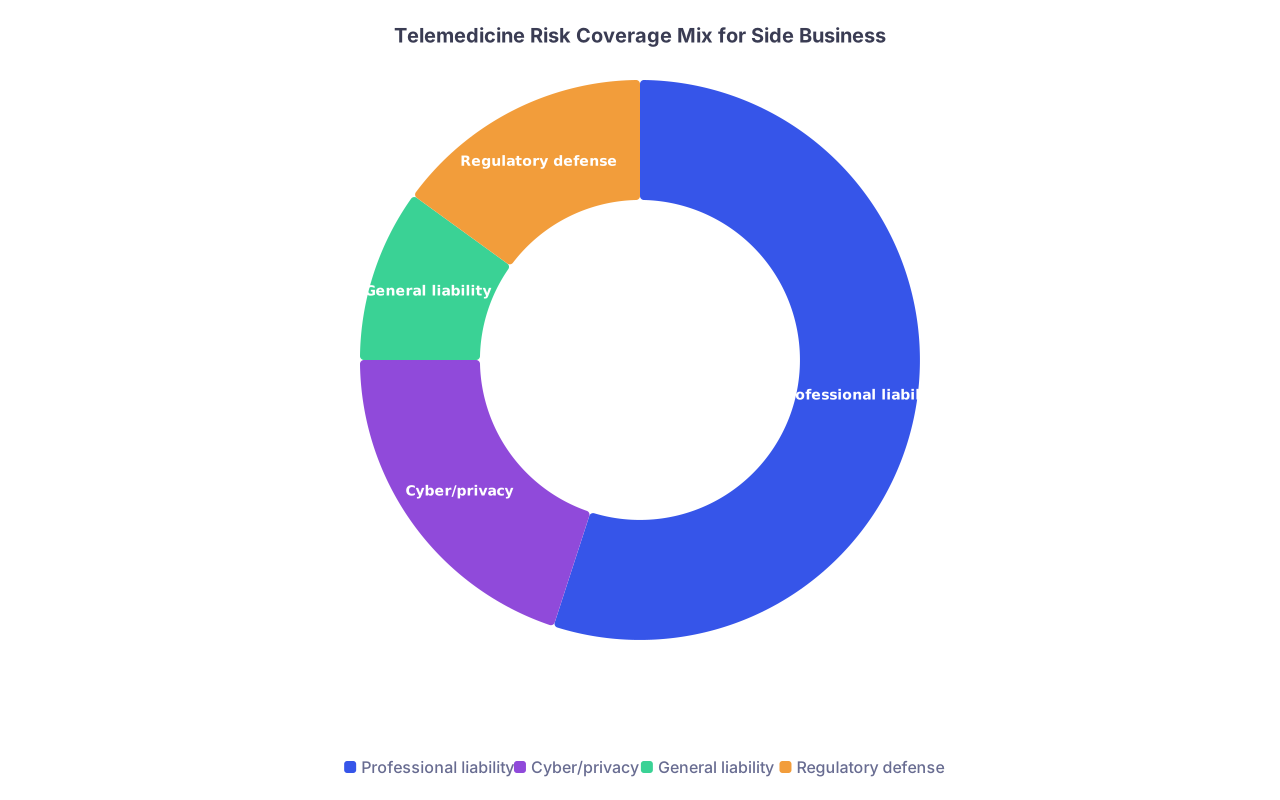
| Category | Value |
|---|---|
| Professional liability | 55 |
| Cyber/privacy | 20 |
| General liability | 10 |
| Regulatory defense | 15 |
If your “telemedicine platform” is basically Zoom + Stripe + Gmail, you have bigger issues than malpractice. Use a real telehealth/EHR platform that is explicitly HIPAA-compliant and willing to sign a BAA.
8. Multi-State Telemedicine: Licenses vs Insurance vs Regulations
You get licensed in 4–5 states through the IMLC. Great. Now what?
Each state cares about:
- Where the patient is physically located
- Whether you’re licensed there
- Whether your malpractice coverage actually applies there
You want all three boxes checked every time you see a patient.
Create a simple table in your planning doc:
| State | License Active | Malpractice Covers State | Telehealth Rules Reviewed |
|---|---|---|---|
| TX | Yes | Yes | Yes |
| FL | Yes | Yes | Yes |
| CO | Pending | No | No |
| CA | No | No | No |
Before you flip on telehealth ads or accept patients in a new state, confirm:
- Your license is active
- Your policy lists that state
- You’ve at least skimmed that state’s telehealth rules:
- E-prescribing requirements
- Whether phone-only is allowed
- Informed consent requirements
- Special rules for controlled substances
You do not want to discover during a board investigation that your malpractice carrier sees that state as “out of territory.”
9. Side Gig Scheduling and Documentation: Don’t Create Coverage Gaps
Two subtle but real issues:
1. Mixing employer time and side-business time
If you’re using your hospital EHR, hospital time, hospital devices, but billing through your LLC… you’re building a mess.
Clarify:
- Side gig visits are:
- On your own time
- Through your own platform
- Documented in your own charting system
So if something goes wrong, you can legitimately say: “This visit was under my side entity; this is the policy that applies.”

| Step | Description |
|---|---|
| Step 1 | Plan Telemedicine Visit |
| Step 2 | Use Employer EHR and Coverage |
| Step 3 | Use Side Business Platform |
| Step 4 | Document in Own EHR |
| Step 5 | Covered by Own Malpractice |
| Step 6 | Employer Time or Personal Time |
2. Documentation quality
Telemedicine makes lazy documentation tempting. Short visits. Fewer vitals. Copy-paste templates.
If you’re going to run a side telehealth business, your notes must show:
- Clear identification of telehealth modality (video/phone)
- Where the patient was located
- Your license in that state (at least implied by context)
- Informed consent for telehealth (state-required language where applicable)
- Clinical reasoning, not just checkboxes
Your future self (and your defense attorney) will thank you.
10. Cost Reality Check: What This Actually Runs Per Year
People wildly overestimate or underestimate what a solid malpractice setup costs.
Typical ballpark for a low-risk specialty (FM, IM, psych) doing modest-volume telemedicine, 1–2 states:
- Standalone occurrence med-mal with entity coverage: $3,000–$6,000/year
- Claims-made med-mal (first-year, stepping up over time): $2,000–$4,000/year
- Cyber add-on or separate policy: $500–$1,500/year
If you’re a higher-risk specialty or writing controlled substances heavily, bump those ranges upward.
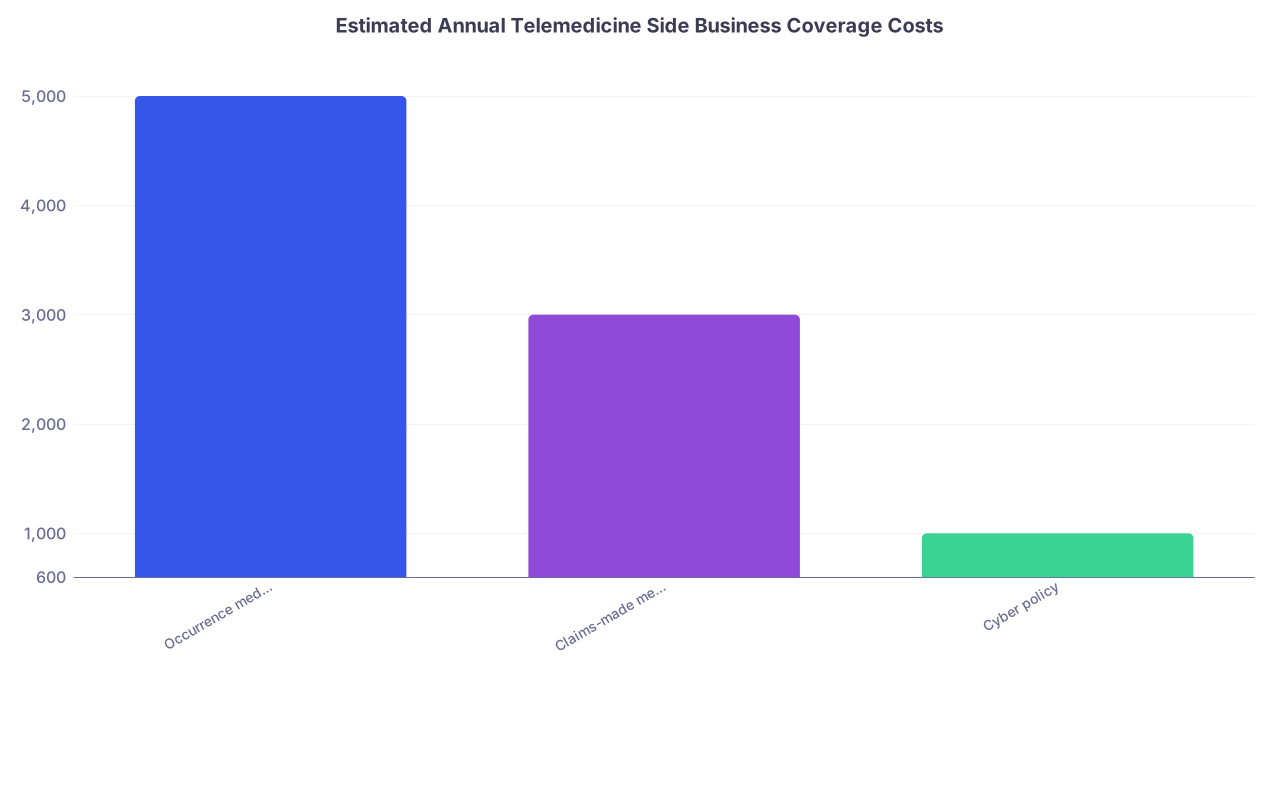
| Category | Value |
|---|---|
| Occurrence med-mal | 5000 |
| Claims-made med-mal (year 1) | 3000 |
| Cyber policy | 1000 |
Run that against your revenue targets:
- If your side telemedicine work is projected to bring in $40,000/year, and coverage costs $6,000–$7,000, that’s still a very reasonable ratio.
- If you’re planning to do “a few visits a month” and bring in $5,000/year gross, a full-blown insurance stack doesn’t make financial sense. Either scale up or abandon it.
A side business that cannot support basic risk management is not a business. It’s a liability hobby.
11. Red Flags and Dumb Moves to Avoid
Let me be blunt about what I’ve seen blow up:
Relying solely on a platform’s vague promise:
“Yeah yeah, we cover you, don’t worry about it.” No COI, no details. That’s not risk management, that’s wishful thinking.Practicing in a state not listed on your policy:
Happens constantly with IMLC. License first, forget to tell insurer. Then get investigated in that state. Ugly.Thinking an umbrella personal liability policy covers clinical work:
It doesn’t. Stop asking your home/auto agent about med-mal.Letting your claims-made policy lapse without tail when you pivot:
You switch to a new job or close your side practice, forget tail, think you’re fine. Two years later, a claim hits for old care. You are naked legally.Using sketchy telehealth practices (rubber-stamp controlled substances, minimal documentation) under the assumption that “everyone’s doing it.”
Boards and plaintiffs’ attorneys love these cases.
12. What To Do Today: A Concrete Next Step
You don’t need to solve everything in one afternoon. But you do need to move the ball.
Do this today:
Open your email.
Send two messages:
To your current employer’s risk/HR:
- “I’m considering doing part-time telemedicine outside of my work here, through my own business entity or as a 1099 contractor. Can you confirm whether my current malpractice coverage extends to these outside activities? If not, is there any option to add coverage for external telemedicine work? Please reply in writing so I can plan appropriately.”
To a med-mal broker that handles telehealth (find one through your state med society or colleague recommendation):
- “I’m a [specialty] physician working full-time at [employer], planning to start a side telemedicine business seeing [type of patients] in [states] for approximately [X] visits per week. I will be doing this through my own [LLC/PLLC/PC]. I need quotes for individual and entity coverage for telemedicine, ideally occurrence-form, with at least $1M/$3M limits, and I also want to understand options for cyber/privacy coverage. Can we schedule a 20-minute call this week?”
Once those two emails are out, you’ve moved from “thinking about” a side telemedicine business to actually building one with proper malpractice in place.
Then, when a patient complaint inevitably arrives someday—because it will—you’ll at least know you weren’t improvising your risk management on the fly.