
Last month, a hospitalist texted me a photo of his new locums contract: “Looks good, right?” Buried on page 7 was a one-line malpractice clause that, if he signed it, would’ve left him personally exposed for any claim filed after the assignment ended. His recruiter said, “Don’t worry, our doctors are covered.” That phrase has burned more physicians than I can count.
You’re about to join a locums agency. They promise “full malpractice coverage.” Here’s what that actually needs to mean—and how to check it before you put your license, your house, and your future earnings on the line.
First, know what you’re actually trying to protect
You’re not just protecting “against lawsuits.” You’re protecting:
- Your personal assets (house, savings, future wages).
- Your license and NPDB record.
- Your insurability with future employers/hospitals.
- Your sanity, if something goes sideways.
Lawsuits do not care that you were “just covering a shift.” Plaintiff attorneys sue:
- You (individually),
- The facility,
- The locums agency,
- Whoever else was in the room and has a license.
If your malpractice coverage is thin, unclear, or time-limited, you can end up as the easiest pocket to reach. That’s what you’re preventing here.
Step 1: Get the actual malpractice details in writing
Do not rely on recruiter talk. Do not rely on “we always cover that.”
What you need, in writing:
- The insurance certificate of coverage (COI), or at least:
- Name of carrier
- Policy type (claims-made vs occurrence)
- Per-claim limit / aggregate limit
- The exact contract clause(s) that describe:
- Who is the insured
- Limits
- Tail or occurrence
- Any cost-sharing or self-insured retention
If they hesitate to provide a COI or concrete details, that’s a yellow-to-red flag.
Ask specifically, in email:
“Please send the malpractice insurance certificate and confirm in writing: carrier, limits, policy type (claims-made vs occurrence), and whether tail coverage is provided for all assignments.”
If the answer is vague (e.g., “We cover you fully, no worries”), reply with:
“For my records, I need the above details spelled out. I can’t sign until that’s clarified.”
You’re setting the tone that you’re not the easy-target physician who just signs whatever.
Step 2: Claims-made vs occurrence – this is where people get burned
Most locums docs don’t get screwed on limits; they get screwed on tail.
There are two main structures:
| Policy Type | Coverage Trigger | Tail Needed? | Common in Locums? |
|---|---|---|---|
| Occurrence | Date care was provided | No | Less common |
| Claims-made | Date claim is filed | Yes | Very common |
| Claims-made with tail included | Claim filed, after policy ends | No extra cost to you | Best scenario |
If it’s occurrence
Good. Occurrence means if you saw the patient in 2025 during a covered assignment, and they sue you in 2028, you’re still covered—because the event happened during the policy period.
Questions to confirm:
- “Is the malpractice coverage for my shifts occurrence-based?”
- “Does the occurrence coverage apply even if I’m no longer working with your agency when the claim is filed?”
Ideally the answer is just “Yes, it’s occurrence, and yes, coverage remains.”
If it’s claims-made
Fine—if there is guaranteed tail that you do not have to pay for.
You need to know:
- Who buys the tail (you, the agency, the client hospital)?
- Is tail automatic and included after each assignment or only after a specific term?
- Is tail contingent on you not breaching the contract or leaving “early”?
Ask bluntly:
- “If the malpractice is claims-made, who is contractually responsible for purchasing tail coverage?”
- “Is tail coverage provided at no cost to me after I stop working with your agency?”
- “Is tail coverage contingent on any conditions (e.g., minimum shift count, minimum notice)?”
If they say you may need to buy your own tail if you “leave early,” that’s a huge liability. A serious tail can easily be $20k–$60k for some specialties.
Step 3: Confirm the limits—and who you’re sharing them with
Most locums agency policies will be something like:
“$1 million per claim / $3 million aggregate per year.” Sometimes it’s higher; occasionally it’s lower.
Typical numbers by region:

| Category | Value |
|---|---|
| Northeast | 1000000 |
| Midwest | 1000000 |
| South | 1000000 |
| West | 1000000 |
(The bar heights are the “per-claim” limit; aggregate is usually 3x that.)
You need clarity on two things:
Is that limit per provider, or shared?
If the policy is a big “blanket” policy for hundreds of locums, you want to know whether there’s any realistic risk of the aggregate being exhausted.Does that limit satisfy the states and facilities you’ll work in?
Some states or hospitals require specific minimums (e.g., $1M/$3M or $2M/$4M).
Ask:
- “Are the $X/$Y limits specific to me per claim / per year, or shared across multiple providers?”
- “Have these limits ever caused credentialing/privileging issues with your client hospitals?”
If you’re in a high-liability specialty (OB, neurosurgery, emergency with procedures), you want at least standard or above-standard limits. If they’re offering $500k/$1.5M in a litigious state, I’d think twice.
Step 4: Who is actually the ‘named insured’—you, the agency, or both?
Look at the contract wording.
You want something like:
“Agency shall provide professional liability insurance with limits of $1,000,000 per claim and $3,000,000 aggregate, naming Physician as an additional insured for services rendered under this Agreement.”
Key things to check:
- Are you at least an additional insured?
- Are acts “within the scope of assignment” clearly covered?
- Any exclusions for locums-style work (multiple facilities, telemedicine, procedures)?
If the policy only names the agency or hospital, and you’re not mentioned at all, ask:
- “Am I individually listed as an insured provider under the policy?”
- “Can you provide a certificate of insurance listing me as covered?”
Some agencies auto-add each provider; others just have a blanket. Blanket can be fine, but then the contract language needs to clearly extend coverage to you.
Step 5: Check the carve-outs and exclusions that matter for locums
This is where the ugly surprises live. I’ve seen policies that technically “cover” a surgeon but exclude:
- Pain management procedures,
- Spine surgery,
- Telemedicine,
- Supervisory duties over APPs.
If you do any of these, you need to be sure they’re not excluded.
Look for (or ask about):
- Procedural exclusions: central lines, sedation, OB deliveries, ED procedures.
- Scope of practice limits: supervising NPs/PAs, reading imaging, telehealth visits.
- Geographic limits: does the policy cover you in all states you’re licensed in through the agency, or only specific ones?
Ask in writing:
“Please confirm that the malpractice policy covers all clinical services I’m credentialed to perform at your client facilities, including [list the higher-risk things you actually do].”
If they respond with “you’re covered for your typical practice” and won’t detail it, push back. Malpractice carriers are very specific about risk; if there’s a gray area, clarify it now.
Step 6: Understand defenses, settlements, and who calls the shots
Coverage isn’t just about paying judgments. It’s about who defends you, who decides whether to settle, and who controls your story.
Look for answers to:
- “Does the policy provide legal defense from day one of a claim or board complaint?”
- “Does defense cost erode the policy limits?”
(Ideally: No. You want “defense outside the limits.”) - “Can the carrier settle a claim in my name without my consent?”
Why this matters:
A cheap settlement with your name on it can haunt your NPDB record and future credentialing, even if you’re convinced you did nothing wrong.
Call the agency out directly:
“If a claim is filed, will legal defense be provided for me personally, and will I have input into settlements that affect my record and future employability?”
If they have no idea, ask to talk to their risk manager or whoever manages malpractice day-to-day. If there is no such person, that tells you something.
Step 7: License defense and board actions—often ignored, often crucial
Locums work can trigger complaints to:
- State medical boards
- Nursing boards
- Credentialing committees
Sometimes before a lawsuit ever appears.
Does the agency’s policy include:
- Board investigation / license defense coverage?
- Coverage for administrative hearings related to your practice at their sites?
If not, you should seriously consider separate license defense coverage or an endorsement on your own policy, especially if you work in more “complaint-heavy” settings (ED, psych, corrections).
Ask:
- “Does your malpractice coverage include state medical board or hospital privileging defense if a complaint arises from my locums work for you?”
If no, fine—but at least you’re making that a conscious risk decision, not an accidental one.
Step 8: How coverage ends when the assignment or contract ends
This catches physicians who bounce between agencies.
You work one assignment in 2025, you’re gone by 2026, and your first notice of a potential claim is a letter in 2028.
You must know:
- Does coverage attach per assignment or per employment/contract period?
- If you stop working with the agency altogether, does coverage for prior acts remain?
- Are there notice requirements for claims or incidents?
Look for this sentence (or ask for it):
“Coverage for services rendered during the term of this Agreement shall continue for such services following termination of this Agreement, subject to the policy terms.”
If the contract instead says something like:
“Coverage will only be maintained while Physician is actively providing services under this Agreement,”
That’s a problem. You need post-termination protection for prior acts.
Step 9: What if you also carry your own policy?
Some physicians—especially in high-risk fields—have their own personal malpractice (or are required to maintain it).
If that’s you, you’re dealing with multiple policies.
Possible problems:
- Finger-pointing between carriers: “Other policy should pay first.”
- Conflicts about defense strategy.
- You accidentally overpay for coverage you don’t need.
Ask both sides (your personal carrier and the locums agency) about:
- Primary vs excess positioning: Which policy responds first?
- “Other insurance” clauses: do they try to duck if another policy exists?
- Any reasons the agency’s carrier would refuse coverage because you have your own policy.
You want clarity like: “The agency’s policy is primary for all services provided under their contracts; your personal policy is excess.” Or the reverse. Just not “we’ll see what happens.”
Step 10: Red flags that should make you walk away
Some agencies are excellent about malpractice. Others…not so much. Here are the things that make me tell physicians: find a different shop.
Big red flags:
- They will not provide written details or a COI.
- They say you might have to buy your own tail “depending on circumstances.”
- The malpractice clause is one vague sentence with no numbers, no type, no mention of tail.
- They refuse to confirm coverage for specific procedures you perform all the time.
- They cannot tell you the carrier’s name or AM Best rating (or it’s a weak/unrated carrier).
- They tell you, “No one else asks this stuff.”
(Translation: we’re used to doctors who don’t read contracts.)
If two similar agencies are offering comparable pay and one is transparent about malpractice while the other dodges your questions, that’s an easy choice.
Practical sequence: What to actually do before you sign
Here’s the straightforward flow you can follow.

| Step | Description |
|---|---|
| Step 1 | Get Draft Contract |
| Step 2 | Request Malpractice Details in Writing |
| Step 3 | Confirm Policy Type and Tail |
| Step 4 | Verify Limits and Named Insured |
| Step 5 | Check Exclusions and Procedures |
| Step 6 | Clarify Defense and Settlement Terms |
| Step 7 | Negotiate or Walk Away |
| Step 8 | Sign Contract Confidently |
| Step 9 | Anything Red Flag? |
If you want it as a checklist, here’s a tight version you can literally run down in 5–10 minutes:
| Item | Covered? (Yes/No) |
|---|---|
| Policy type & tail clarified | |
| Limits meet state/facility | |
| You named or clearly insured | |
| Procedures you do covered | |
| Defense provided for you | |
| Settlement consent addressed |
Fill that mentally or on paper. Any “No” is a negotiation item.
Don’t forget the financial angle
You’re in the “financial and legal” part of planning, so let’s tie this to money and not just risk.
Malpractice structure affects your real income:
- If you have to buy your own tail later, that can wipe out months of locums earnings.
- If coverage is weak and you’re sued personally, your defense costs and any uncovered judgment are on you.
- A bad NPDB hit or board action can shrink your future earning potential more than any hourly rate increase.
Sometimes Agency A pays $10 more per hour than Agency B, but Agency B has:
- Occurrence coverage
- Ironclad tail
- Clear defense language
That’s the better financial deal over a career, even if the hourly math says otherwise on paper.
A quick mental comparison:
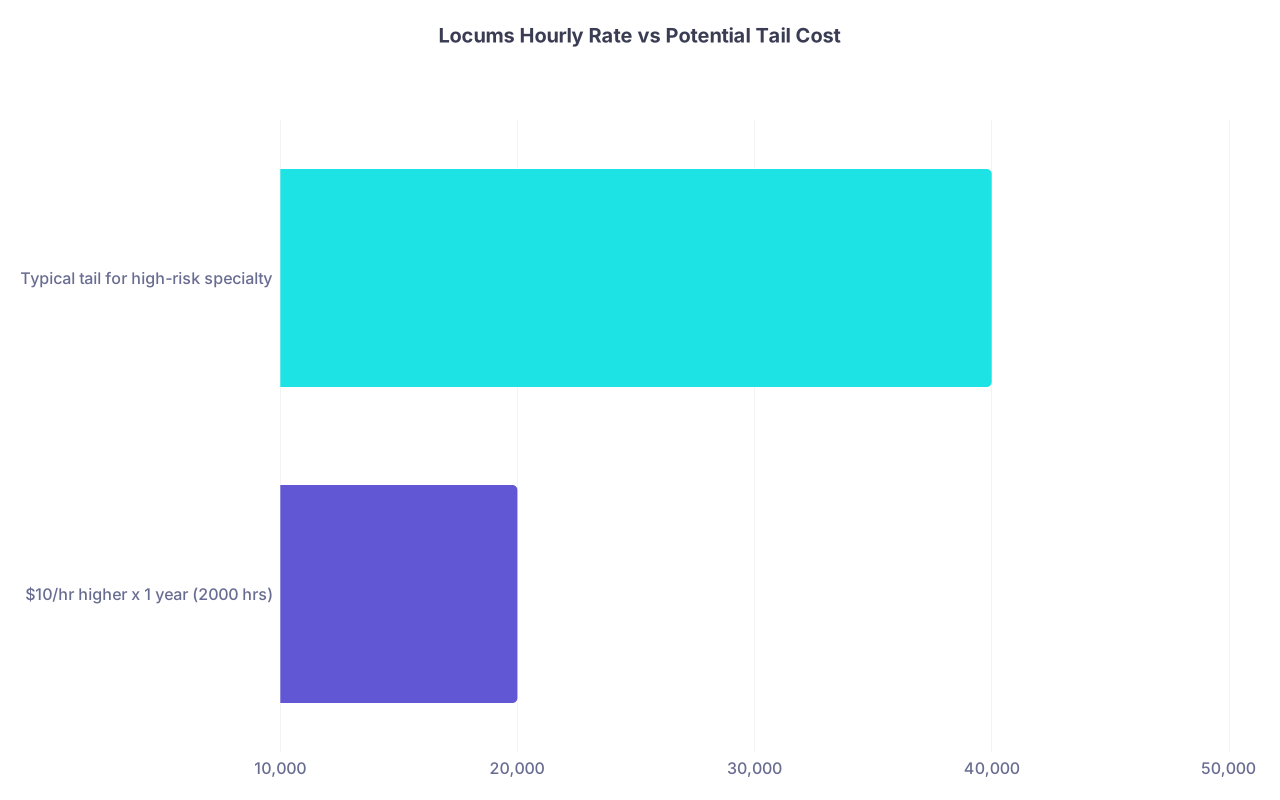
| Category | Value |
|---|---|
| $10/hr higher x 1 year (2000 hrs) | 20000 |
| Typical tail for high-risk specialty | 40000 |
Plenty of docs chase the extra $20k and then get stuck with a $40k tail when they leave. Do not be that case study.
FAQ (exactly 4 questions)
1. Should I ever agree to buy my own tail for locums work?
I’d avoid it whenever possible. For short-term, intermittent work, requiring you to fund a full tail is disproportionate. The only time I’d even consider it is if the pay is significantly higher, the assignment is time-limited and clearly worth the financial trade, and you’ve priced out the actual tail cost in advance (with it essentially built into your rate). Even then, I’d try to negotiate at least shared responsibility for tail or a completion bonus that realistically covers it.
2. Do I need my own personal malpractice policy if the locums agency covers me?
Not necessarily. Plenty of physicians rely entirely on agency-provided malpractice for locums work. You consider your own policy if: you do clinical work outside the agency, you want licensure/board defense coverage the agency policy doesn’t provide, or you just don’t trust the agency’s carrier or contract language. If you do get your own, make sure you and the agency understand which policy is primary.
3. Can I trust the recruiter’s verbal assurance about malpractice details?
No. Verbal assurances are worthless if a claim hits. You’re not being paranoid; you’re being professional. The only things that matter are: the actual insurance policy, the certificate of coverage, and the contract language. If a recruiter gets irritated that you’re asking for this, that’s a sign of a bad culture, not that you’re being difficult.
4. What if I already signed with weak malpractice terms—am I stuck?
You’re not totally stuck, but your leverage is lower. You can still: ask for an amendment clarifying tail coverage, request a written confirmation of how they’ll handle prior acts when you stop, or decide to finish a minimal number of shifts and then stop taking new assignments while you line up a better agency. If the risk looks truly unacceptable, you can consult an attorney about exit options; sometimes paying a small early-termination penalty beats staying in a structurally dangerous setup.
Key points: Do not sign a locums contract until you know the policy type and who pays for tail. Make sure the limits, exclusions, and defense terms actually match what you do in real life. And if an agency cannot or will not explain their malpractice coverage clearly, pick a different agency—no hourly rate is high enough to compensate for a bad lawsuit with no real protection behind you.