
It’s 10:30 p.m. You’re on your third straight 12-hour shift, scrolling an email from your group: “We can move you to 0.6 FTE or per diem starting next month. Please make sure to update your malpractice arrangements.”
You know you want fewer hours. You’re less sure what happens to your malpractice coverage when you stop being full-time. You’re vaguely terrified of “gaps” and “tail.” And you absolutely do not have time to become a pseudo-insurance expert tonight.
This is where you are: shifting to part-time or per diem and trying not to screw up your malpractice.
Let’s fix that.
Step 1: Get Clear on Your Exact Situation
Do not start by Googling random articles. Start with what’s actually happening to you.
Here are the main scenarios I see all the time:
- You’re staying with the same employer, just cutting FTE (full-time → part-time).
- You’re leaving a W-2 job and going 1099 per diem somewhere else.
- You’re piecing together multiple PRN/per diem gigs and maybe telemed on top.
- You’re stepping back (part-time or PRN) now, but may leave entirely next year.
Each of those changes how your malpractice needs to be handled.
So first, define your scenario clearly in one sentence, like:
- “I’m going from 1.0 FTE hospitalist employed by BigHealth to 0.6 FTE with the same group.”
- “I’m leaving my employed urgent care job and doing per diem at three different clinics as an independent contractor.”
- “I’m cutting back to 0.5 FTE now and probably stopping clinical work in 2–3 years.”
Write it down. Then build from there.
Step 2: Understand How Your Current Coverage Actually Works
You cannot adjust what you don’t understand.
Ask your HR/credentialing or practice manager for:
- A copy of your current malpractice policy or certificate of insurance.
- The contact info for the carrier rep or broker.
- A clear answer: “Is this claims-made or occurrence coverage?”
If they say, “We’re self-insured,” or “It’s through the hospital,” that’s not enough. Push for details. I’ve seen people get burned because they assumed “the hospital handles it” meant they didn’t need tail. Wrong. Sometimes they’re covered, sometimes they’re not, depending on the structure.
Here’s the quick version:
| Type | Covers What | Tail Needed When You Leave? |
|---|---|---|
| Claims-made | Claims filed while policy is active | Usually yes |
| Occurrence | Events that occurred during policy | No |
If your coverage is claims-made and you’re leaving that employer or losing that policy, the “tail” question becomes non-negotiable. You deal with it, or you walk around with a giant liability hole trailing behind you.
Step 3: Staying with Same Employer but Going Part-Time
This is the simplest version, and people still mess it up.
You’re going from, say, 1.0 FTE to 0.5 FTE but staying employed by the same hospital or group, same tax ID, same malpractice carrier.
Here’s what to do:
- Confirm that your malpractice is employer-provided and stays in place as long as you’re employed, regardless of FTE.
- Ask in writing: “If I drop from full-time to 0.5 FTE, will:
- my per-incident and aggregate limits change?
- there be any impact on tail coverage if/when I leave later?”
- Ask if your change triggers a new policy or is just a modification of the existing one.
Most of the time, if you’re staying on payroll, this is what happens:
- Same limits, no gap, no immediate tail required.
- Your “retro date” (start of your coverage) stays the same. That’s good.
The one place people get screwed is when the entity changes. Example: You were employed by “Metro Hospitalists, PLLC” and now the hospital dissolves that entity and hires you as “Metro Health System, Inc.”
If that happens, ask bluntly: “Does my retro date transfer seamlessly, or do I need tail for my time under the old entity?”
If your employer shrugs and says “legal handles that,” you email the malpractice broker directly and get it in writing.
Step 4: Going Per Diem as an Employee vs Per Diem as 1099
These are not the same thing, legally or for malpractice.
Per diem employee (W-2)
Examples: Hospital PRN pool, employed urgent care per diem, health system telemed as W-2.
Usually:
- The hospital/group provides malpractice.
- You’re covered only for work at that site, for that employer.
- Coverage may be occurrence or claims-made, but you’re not paying the premium.
What to do:
- Get proof in writing that you’re covered as a per diem:
- Policy type (claims-made vs occurrence)
- Limits (per incident / aggregate)
- Who pays tail if they terminate you or you leave
- Check if there’s any minimum shift requirement to maintain coverage.
You do not need to buy your own separate policy for that work if you’re fully covered by the employer’s policy.
Per diem 1099 / independent contractor
Example: Per diem at a surgery center “as an independent,” telemed as a contractor, locums assignments.
Here, there are usually three options:
- They provide malpractice and tail (best).
- They provide malpractice but you are responsible for tail (common in shady contracts).
- You must carry your own malpractice policy and list them as an additional insured (very common for telemed, small groups).
You read the contract, not the email thread. The contract should literally say who pays for:
- Current coverage
- Tail if/when the relationship ends
If it doesn’t say, you assume it’s you. Then you negotiate.
Step 5: Avoiding Gaps When You Leave a Full-Time Job
This is where most of the malpractice disasters happen:
You leave a full-time gig with claims-made coverage on June 30. You start per diem somewhere else on July 1. You don’t deal with tail for six months because “I’m planning to go back later” or “It’s so expensive.”
Then:
- A patient from 18 months ago files a claim.
- The claim is denied.
- You discover you have no coverage for that time because your old policy is dead and you didn’t buy tail or get prior-acts coverage.
To avoid that, here’s the sequence:
Confirm:
- Type of policy at your current job (claims-made? occurrence?)
- Who owns the policy (you? the employer?)
- Who is contractually responsible for tail.
If you have claims-made and you are responsible for tail, get a quote from the carrier before you give notice. Tail can be 150–250% of the annual premium. It’s painful.
Decide how you’ll handle past exposure:
- Employer-paid tail? Great. Get proof in writing and keep it forever.
- You purchase your own tail from the existing carrier.
- A new employer or personal policy provides “prior acts” coverage back to your retro date.
That last option is where people get confused.
“Prior acts” (or “nose” coverage) means your new policy picks up claims arising from past work, not just new work. But it must be structured correctly.
You ask any new carrier or broker:
- “Can you cover my prior acts back to [retro date] for my work at [old employer/tax ID]?”
- “If so, is there any gap between when my old policy ends and the new one starts?”
- “Will the limits be shared between old claims and new claims or separate?”
If they can’t clearly explain it, walk away or get someone else involved.
Step 6: Moving to Multiple Part-Time / Per Diem Gigs
You’re cobbling together:
- 0.4 FTE at a clinic
- PRN shifts at an ED
- Telemed 1–2 days a week
This is now a malpractice jigsaw puzzle.
You make a table. Literally.
| Job / Site | Status | Who Covers? | Type | Tail? |
|---|---|---|---|---|
| Clinic A (0.4 FTE) | W-2 | Employer | Claims-made | Employer pays? |
| ED PRN (casual) | 1099 | My own policy | Claims-made | Me |
| Telemed Company B | 1099 | Company policy | Occurrence | Not needed |
You fill this out for yourself. For each role, you must know:
- Am I W-2 or 1099?
- Who is providing malpractice?
- Policy type?
- Tail responsibility?
If you’re 1099 in more than one setting, it’s often cheaper and cleaner to carry a single personal policy that covers all your independent work, with all your sites listed. But you don’t assume that—you confirm with the broker that every practice setting is included.
Step 7: Adjusting Limits When You Cut Back
When you go part-time, some doctors think, “I’m seeing fewer patients, I’ll just slash my limits and save a ton.”
Not always smart.
You have two separate issues:
- Frequency exposure – less volume usually means fewer potential claims.
- Severity exposure – the type of work you do (trauma surgery vs telemed UTI) drives how big a claim can be.
If you’re going from full-time trauma surgeon to a few telemed shifts a month, yeah, your needed limits and premium structure could genuinely change.
But if you’re still doing the same procedures, same ED shifts, same OB call, just fewer hours? I’d be cautious about cutting limits just to save a few thousand.
Ask your broker directly:
- “If I drop from full-time to 0.5 FTE with similar case mix, what’s a reasonable set of limits for my specialty and state?”
- “What are the typical minimums hospitals and payors want to see for credentialing?”
You do not want to show up to credentialing with $500k/$1M limits in a market where everyone expects $1M/$3M or $2M/$4M.
Step 8: Concrete Steps to Keep Coverage Continuous
Let’s walk it like a checklist.
If you’re staying with the same employer part-time
- Get written confirmation:
- Coverage continues uninterrupted.
- Same retro date.
- Same or acceptable limits.
- Tail still employer’s responsibility when/if you fully separate.
- Keep a copy of your updated certificate of insurance.
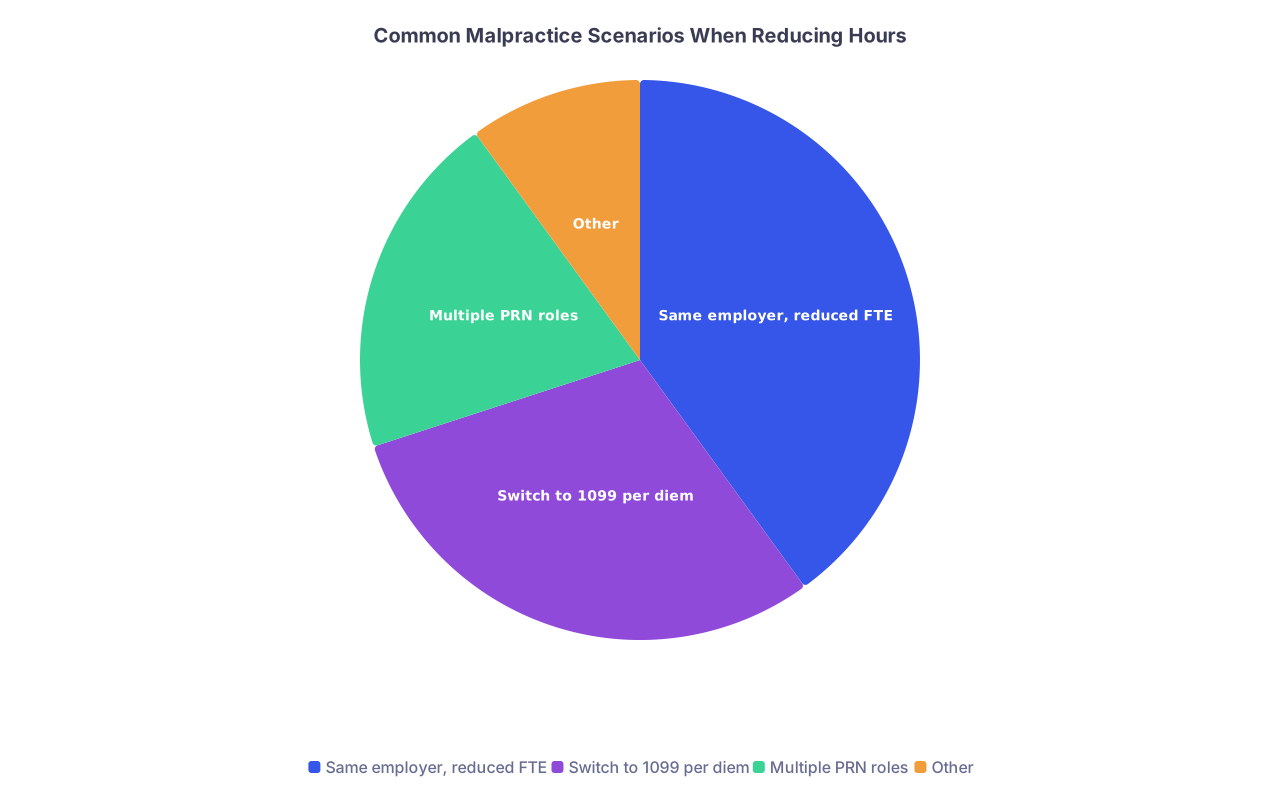
| Category | Value |
|---|---|
| Same employer, reduced FTE | 40 |
| Switch to 1099 per diem | 30 |
| Multiple PRN roles | 20 |
| Other | 10 |
If you’re leaving one job and going per diem elsewhere
Nail down your old coverage:
- Claims-made vs occurrence?
- Exact retro date?
- Who pays tail (per contract, not assumptions)?
If tail is on you:
- Get tail quote from existing carrier.
- Get quote from a new carrier that includes prior-acts back to your old retro date.
- Compare costs and coverage. Sometimes nose (prior-acts) is cheaper than tail, sometimes not.
Time your policies:
- Old policy ends: last day of employment or contract.
- New policy effective date: same day or earlier, including prior acts. No gap.
Confirm new per diem or locums roles either:
- Accept your personal policy and list them as additional insured,
- Or provide you coverage that doesn’t exclude your own policy.
You want overlap, not gaps. Redundant coverage for a month is fine. Missing coverage for even a day is not.
Step 9: Telemedicine, Side Gigs, and “Oh It’s Just a Couple Patients”
Telemed is sneaky. A lot of people say:
“It’s only one afternoon a week, just urgent care stuff, I’m sure their policy covers me.”
Maybe. Maybe not.
Telemed risk has more jurisdiction mess than traditional clinics. You can see patients in multiple states. You can be sued in multiple states. The telemed company might have a policy that mainly protects them, not you, or it might have low limits.
You ask the telemed company for:
- Complete malpractice policy details in writing:
- Are you a named insured or just a “covered provider”?
- What are the limits?
- Is the policy claims-made or occurrence?
- Who pays tail if they change carriers or terminate you?
- Any exclusions (OB, psych, controlled substances, cross-state issues).
If it looks weak or they hesitate to share details, you get your own policy that fully covers telemed in every state where you’re licensed.
Same thing applies to:
- Concierge side practice
- Aesthetic or cosmetic side gig
- Procedures at a med spa
Do not assume your main employer’s malpractice magically follows you. It almost never does.
Step 10: Talking to Brokers and Not Getting Steamrolled
People get intimidated by insurance people. You don’t need to.
Here’s the script you can adapt when you call or email a malpractice broker:
“I’m a [specialty] in [state]. I’m going from full-time employed to part-time / multiple per diem roles. I need:
- To confirm coverage for prior acts back to [month/year] with [old employer or retro date].
- A policy that covers:
- [type of work: hospitalist inpatient, ED, urgent care, telemed, procedures, etc.]
- At these sites: [describe briefly]
- Continuous coverage without any gaps as I reduce my hours.
Tell me what you recommend, the limits, and whether prior acts will be included or I need tail from my previous carrier.”
Then you listen. If they can’t explain it in simple English, that’s a red flag. A good broker can walk you through:
- Retro date
- Tail vs prior acts
- Limit options
- Cost impact of part-time/prorated coverage
And yes, you ask about part-time rating. Many carriers offer a reduced premium if:
- You work under a certain number of hours per week, or
- Below a certain number of weeks per year
Don’t expect a 70% discount for working half-time. But you should see some reduction.
Visual: How Timeline and Coverage Should Line Up
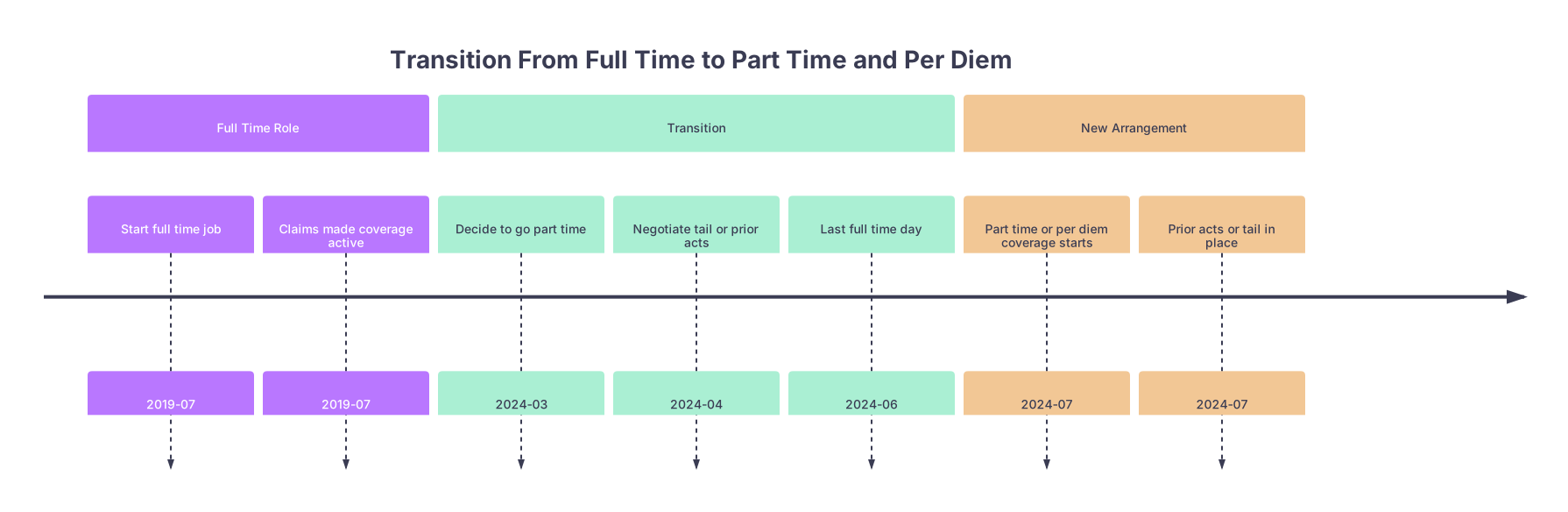
| Period | Event |
|---|---|
| Full Time Role - Start full time job | 2019-07 |
| Full Time Role - Claims made coverage active | 2019-07 |
| Transition - Decide to go part time | 2024-03 |
| Transition - Negotiate tail or prior acts | 2024-04 |
| Transition - Last full time day | 2024-06 |
| New Arrangement - Part time or per diem coverage starts | 2024-07 |
| New Arrangement - Prior acts or tail in place | 2024-07 |
You want that line of coverage to be unbroken, even as your hours and roles change.
Common Pitfalls I See Over and Over
I’m just going to list these because I’ve watched people learn them the hard way:
- Assuming “self-insured” means you’re set forever. It doesn’t. If the hospital changes structure or coverage, you can still be left exposed.
- Not reading the section of the contract that says “Professional liability insurance.” It’s usually 2–4 sentences that determine whether you’re paying a $50,000 tail later.
- Thinking that cutting hours automatically cuts risk. OB, surgery, ED: one bad case is all it takes.
- Forgetting about a moonlighting or locums gig from a few years ago that was never properly covered or tailed.
- Leaving a job with claims-made coverage and planning to “buy tail later.” You usually have a limited window at a decent rate from that carrier. Miss it, and you’re in trouble.
Quick Reference: What to Ask, Who to Ask

Here’s a tight list of questions to send to three people: your old employer, any new employer, and your malpractice broker.
To old employer:
- “What type of malpractice policy covers my work (claims-made vs occurrence)?”
- “What is my retro date?”
- “Per my contract, who pays for tail if I leave?”
- “If I reduce to part-time or per diem, does my coverage change in any way?”
To new employer (or per diem group):
- “Do you provide malpractice coverage for my work with you?”
- “If yes, what are the limits and policy type?”
- “Am I responsible for any tail coverage when this relationship ends?”
- “Does your policy cover only work done for your entity, or also other independent work?” (usually: only them)
To broker (if you’re buying your own policy):
- “Can you cover prior acts back to [retro date] with [old employer]?”
- “What limits do you recommend for my specialty and state?”
- “Is there a part-time rating for my expected hours?”
- “Will this policy cover all my independent work: [list roles and locations]?”
When You’re Planning to Fully Retire Soon
Different scenario, same principle.
You might be going 0.5 FTE now, then 0.2, then off the grid in three years. You want your malpractice exit strategy baked in now.
Your options:
- You fully retire from clinical practice and buy one permanent tail that covers everything up to that date.
- Or you keep a policy with prior acts until your very last clinical day, then tail that.
Ask for a quote on “retirement tail.” Some carriers have favorable terms if you’ve been with them a certain number of years and are over a certain age. This can be significantly cheaper or even free in some cases.
Tie your hours reduction to a clear exit plan for malpractice. Don’t just “see what happens.”
One More Thing: Document Everything
Every email from HR, from the carrier, from the broker—save them as PDFs in a folder labeled:
“MALPRACTICE – [Your Name] – DO NOT DELETE”
If anyone ever tries to argue later that you weren’t covered, you’ll be very glad you have:
- Certificates of insurance for each role and year
- Written statements about who pays tail
- Policy documents with retro dates and limits
It’s boring. It matters.
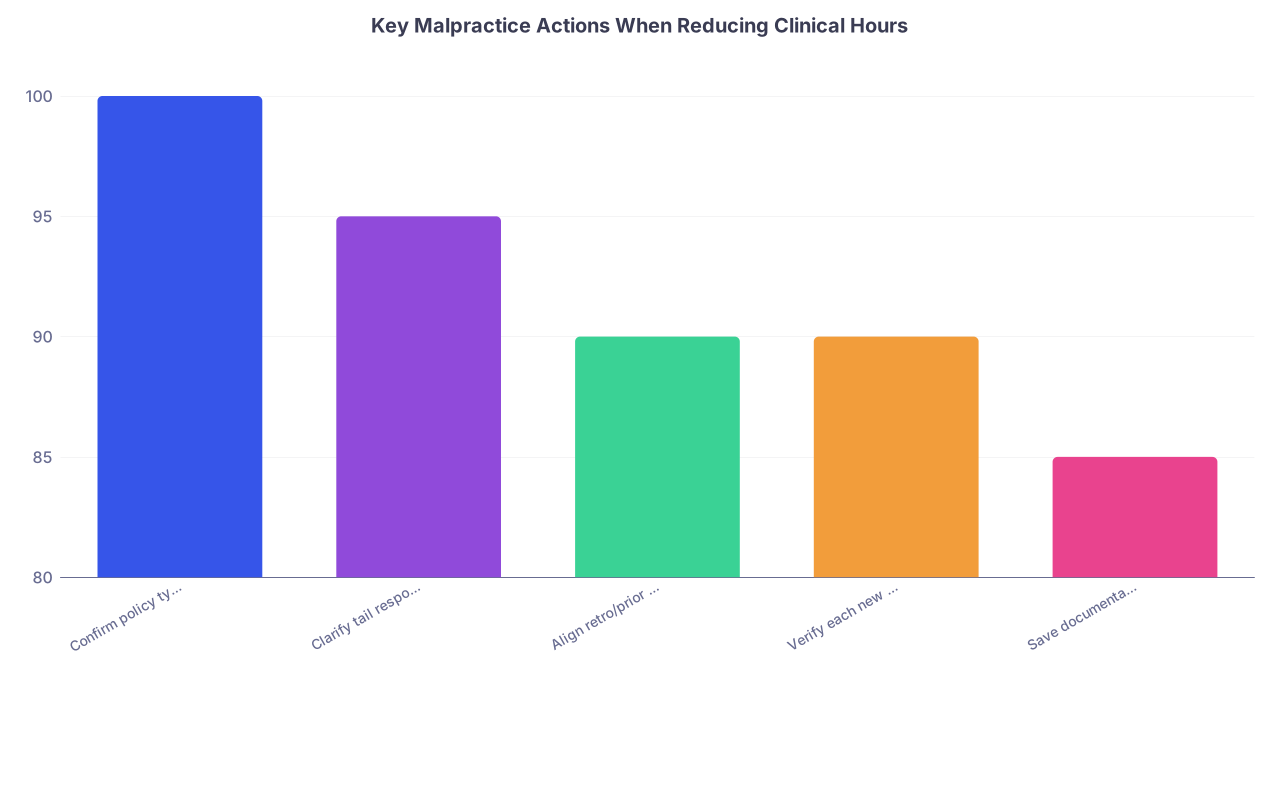
| Category | Value |
|---|---|
| Confirm policy type | 100 |
| Clarify tail responsibility | 95 |
| Align retro/prior acts | 90 |
| Verify each new role | 90 |
| Save documentation | 85 |


| Step | Description |
|---|---|
| Step 1 | Going part time or per diem |
| Step 2 | Confirm coverage unchanged and tail responsibility |
| Step 3 | Identify old policy type and retro date |
| Step 4 | Decide between tail or prior acts |
| Step 5 | No tail needed for old work |
| Step 6 | Align new policy start date with old end date |
| Step 7 | Verify each new role has coverage |
| Step 8 | Staying with same employer |
| Step 9 | Claims made or occurrence |

FAQ (Exactly 3 Questions)
1. If I’m only working 4–6 shifts a month, can I just rely on the per diem site’s malpractice and skip my own policy?
Maybe, but only if you’re a W-2 employee and the site provides solid occurrence or claims-made coverage and you aren’t doing any other independent clinical work. If you’re 1099 at multiple places or doing telemed, procedures, or side gigs, a single personal policy that covers all independent work is usually safer. You need to see the actual policy details from each site before you decide.
2. Is tail coverage always required when I go part-time or leave a job?
No. Tail is only an issue with claims-made policies, and only when you’re ending that policy and not rolling your retro date into a new one via prior-acts coverage. If your old job has occurrence coverage or your new policy includes prior acts back to your old retro date, you may not need to buy a separate tail. The key is: your past work must be covered either by tail from the old policy or by prior acts on the new one—one or the other, not neither.
3. How far back should my malpractice coverage go if I’ve switched jobs a few times?
All the way back to the earliest date you started practicing in that specialty (or earlier, if you did high-risk work before that). In practice, that means your current policy’s retro date should go back to your first claims-made policy that hasn’t been fully tailed. If you bought a valid tail that permanently covers a previous period, you don’t need prior acts for that portion. What you can’t have is any period of clinical work where neither a live policy nor a tail/prior-acts arrangement is protecting you today.
Key points to walk away with:
- You can absolutely go part-time or per diem without malpractice gaps—but only if you deliberately line up retro dates, tail, and prior acts.
- Every role (W-2, 1099, telemed, side gig) needs a clear answer on who covers you, what type of policy it is, and who pays tail.
- Write it all down, get it all in writing, and do not assume anything just because “the hospital handles it.”