The most dangerous part of moonlighting is not the shift itself. It is assuming your malpractice coverage is “probably fine.”
If you’re starting to moonlight as a resident and will have a separate malpractice policy (or you’re not sure), you’re in that exact danger zone. Let’s fix that.
1. First Reality Check: Your Residency Coverage Does NOT Follow You
Most residents I’ve seen get this wrong the first time.
Your GME program’s malpractice policy almost always:
- Covers you only when you’re working:
- For your hospital or affiliated sites
- Within the scope of your training program
- Under their billing and supervision structure
It usually does not cover:
- Independent contractor moonlighting at another hospital or urgent care
- Telemedicine shifts you pick up on your own
- Locums work
- Side gig clinic or ED shifts outside your residency agreement
The dangerous assumption is: “I’m a resident here, I’m just picking up extra shifts there, but I’m still the same doctor, so I must be covered.”
Wrong. Malpractice doesn’t cover you generically. It covers you in specific roles and locations under specific contracts.
So before you pick up a single moonlighting shift, do this:
- Pull your residency contract (GME agreement).
- Pull the malpractice coverage summary from GME/HR or the GME handbook.
- Look for language like:
- “Coverage applies to activities related to the training program”
- “Coverage does not extend to outside employment or moonlighting”
- If it’s vague, email GME in writing:
- “Does my residency malpractice coverage apply to moonlighting shifts at [hospital/clinic name] if I am paid directly by that entity?”
If the answer isn’t a clear “Yes, and here’s the written policy,” you should assume you need separate coverage.
2. The Three Coverage Sources You Need to Line Up
When you moonlight as a resident, your malpractice coverage might come from:
| Source | Who Buys It | Typical Status |
|---|---|---|
| Residency program | Institution | Covers training only |
| Moonlighting site | Hospital/clinic | Often provided, varies |
| Your own policy | You | Fills gaps/extra roles |
You need to pin down which of these applies to each moonlighting job. Here is the sequence I recommend.
Step 1: Ask the Moonlighting Site — In Writing
Phrase it this way (do not be vague):
“For my moonlighting shifts at your facility, will I be covered under your malpractice policy?
If yes:
• Is it occurrence or claims-made?
• What are the limits (per claim / aggregate)?
• Is tail coverage included for my work there?
• Am I a named insured, or covered under a shared policy as an employed physician or independent contractor?”
You want a written answer from either:
- Their credentialing office
- Risk management
- Or the group that bills for your services (e.g., ER group, hospitalist group)
If they say, “Yes, we cover everyone, don’t worry,” that is not an answer. Ask for:
- A copy of the certificate of insurance (COI), or
- A brief written summary from risk management
Step 2: Clarify Your Status There
This isn’t just HR trivia. Your legal and malpractice position depends on it.
Ask specifically:
- “Will I be:
- An employee of the hospital or group?
- An independent contractor?
- Covered under the hospital’s self-insured trust?”
Why you care:
- Employees are often covered under the institution’s policy, and the employer handles tail.
- Independent contractors often need their own malpractice or get group coverage that may end when the contract ends (and tail becomes your problem).
- Self-insured trust means the hospital pays claims directly, sometimes with excess insurance. That can be fine, but you want that in writing.
3. Claims-Made vs Occurrence: Where the Tail Risk Hides
This is where residents often get burned later.
You will hear these two phrases:
- Occurrence policy – covers incidents that occur during the policy period, no matter when the claim is filed.
- Claims-made policy – covers claims filed while the policy is active, for incidents after a certain “retro date.” When you leave, if no tail coverage is purchased, future claims are not covered.
For each moonlighting role, you must know:
- Is the coverage occurrence or claims-made?
- If claims-made:
- Who is responsible for tail coverage when you leave?
Here’s the problem:
Many moonlighting contracts are claims-made and quietly say something like:
“Contractor shall be responsible for procuring and paying for tail coverage upon termination of this agreement.”
So you work a handful of shifts as a PGY-3, leave for fellowship, and 3 years later a lawyer sends a letter. No tail. No coverage. Now what?
You want the contract to say something closer to:
“Group shall maintain malpractice coverage for Physician during the term of this Agreement and shall be solely responsible for the cost of any tail coverage arising out of Physician’s services under this Agreement.”
If they will not budge on tail coverage and it’s claims-made, you need to talk to:
- The group’s broker, or
- Your own broker
about an individual tail or a personal policy that can respond.
4. When You Need Your Own Separate Malpractice Policy
Sometimes the moonlighting site flat out tells you:
- “We don’t provide malpractice; you must have your own coverage.”
- Or they require extra coverage (e.g., telemedicine, procedures) that’s not clearly covered by their policy.
In those cases, you go shopping for your own malpractice policy.
You’re usually looking for:
- A part-time policy (cheaper than full-time)
- Covering the exact scope of your moonlighting work
- In the state(s) where you’ll be practicing
The broker or company will ask:
- Specialty (e.g., EM, internal medicine, hospitalist)
- Hours per week or per month
- Procedures you do (intubations, central lines, LP, sedation, OB, etc.)
- Locations (hospital-based vs clinic)
- Any prior claims or board actions
You must answer honestly. If you say “no procedures” but you’re dropping central lines in a community ED, that can absolutely come back to bite you.
Typical Limits
Common limits for moonlighting as a resident:
- $1M per claim / $3M aggregate per year
- Or in some markets: $2M / $4M
Many hospitals have minimum limits written into credentialing requirements. Always ask:
“What is the minimum liability limit required for credentialing (per occurrence and aggregate)?”
If your personal policy is lower, you may not even get credentialed.
5. Coordinating Multiple Policies Without Creating a Mess
Sometimes you’ll technically be covered by two policies for the same moonlighting work:
- The moonlighting site’s policy
- Your own personal policy (if you bought one that’s broader)
That’s not always a problem, but you want to understand:
- Which is primary?
Many personal policies say they are excess over any employer coverage. - Scope of coverage
- The site’s policy might cover bedside care but not telemedicine you do from home for them.
- Your personal policy might cover a wider or narrower scope depending on how it was written.
- Defense and settlement authority
Two insurers can argue about who pays what. You don’t want multiple attorneys fighting over your case strategy.
When you buy your own policy, be explicit with the broker:
- “I am a resident at [program].
- I do moonlighting at [site A] where they say they cover me.
- I also may pick up future moonlighting at other sites.
- I want coverage that:
- Doesn’t conflict with employer coverage
- Clearly covers any gaps, including tail if I stop moonlighting.”
Get their explanation in writing.
6. Red Flags in Moonlighting Contracts and Policies
There are a few patterns that make me tell residents: “Either fix this or walk away.”
Watch for:
- No written confirmation of malpractice coverage
- “We cover you, don’t worry about it” with no email / contract language.
- Claims-made policy with you paying tail
- Especially for a short-term, low-paid moonlighting gig. The economics are stupid.
- Ridiculously low limits
- Example: $100k / $300k in a high-risk specialty or litigious state.
- Weird exclusions
- No coverage for certain procedures that are actually routine at that site.
- Exclusions for telemedicine if some shifts are remote.
- You’re misclassified
- They call you an “independent contractor” but treat you like an employee AND require you to carry your own coverage. They’re shifting risk to you with none of the benefits.
If you see any of this, you do not just “hope it’s okay.” You send it back and say:
“Before I can accept shifts, I need clarification and updated language on malpractice coverage, including tail. Can we adjust section [X] to specify that the group provides and pays for malpractice and tail coverage for work performed under this agreement?”
If they say no, you decide: are the dollars worth the risk? Often, they are not.
7. How This Plays Out in Real Situations
Let me walk you through two very typical scenarios.
Scenario A: Community ED Moonlighting, Hospital-Provided Coverage
You’re a PGY-3 in EM. You moonlight at a small community ED.
- The hospital classifies you as an employee for moonlighting only.
- They provide malpractice: occurrence policy, $1M / $3M, no cost to you.
- Contract clearly states: “Hospital shall provide and pay for malpractice coverage, including any necessary tail, for services rendered by Physician under this Agreement.”
What you do:
- Get a copy of the COI showing your name and limits.
- Confirm with risk management that credentialing and coverage are linked.
- You probably do not need your own separate policy just for those shifts.
Risk level: Reasonable, as long as you have documentation.
Scenario B: Independent Contractor Hospitalist Moonlighting, Claims-Made
You’re an IM PGY-2. Local private group offers inpatient hospitalist shifts.
- Status: Independent contractor
- They provide claims-made coverage while you’re there but contract says:
- “Physician shall be responsible for the cost of tail upon termination.”
- You plan to moonlight 1 year, then move out of state for fellowship.
What you do:
- Ask what tail typically costs. Sometimes: 150–250% of the annual premium.
- For part-time work, that could be several thousand dollars you’re on the hook for after you leave.
- Negotiate:
- Ask for the group to cover tail if you work a minimum amount (e.g., 12 months, X shifts).
- Or ask for an occurrence policy instead.
- If they refuse, factor tail into your financial decision. A $12k moonlighting year can turn into $8k after you buy tail. Worth it?
If you can’t get acceptable terms, walk away. There will be other gigs.
8. Tracking Your Coverage Over Time (So You Don’t Get Lost Later)
This part is boring. Do it anyway. Future you will be grateful.
Make a simple one-page cheat sheet for each role (residency, each moonlighting site, telemedicine, etc.):
| Role | Policy Type | Limits | Tail Responsibility |
|---|---|---|---|
| Residency | Claims-made | $1M / $3M | Institution |
| Community ED | Occurrence | $1M / $3M | Not needed |
| Telemed shifts | Claims-made | $1M / $3M | You |
For each, note:
- Employer/contracting entity
- Policy type: occurrence vs claims-made
- Retro date (for claims-made)
- Limits
- Who pays tail
- Contact person at risk management or the insurer
Store:
- PDFs of contracts
- COIs
- Any tail policy documents
In a single cloud folder with clear names, e.g.:
2025_Moonlighting_CommunityED_contract.pdf2025_Moonlighting_CommunityED_COI.pdf
Years later, if a claim pops up, you will not be scrambling to remember who covered what.
9. Quick Visual: Decision Flow Before You Say Yes to a Moonlighting Gig

| Step | Description |
|---|---|
| Step 1 | Moonlighting offer |
| Step 2 | You must buy your own policy |
| Step 3 | Confirm limits and get COI |
| Step 4 | Negotiate or price tail |
| Step 5 | Decline gig |
| Step 6 | Get quotes and confirm scope |
| Step 7 | Accept shifts with documentation |
| Step 8 | Does site provide malpractice? |
| Step 9 | Occurrence or claims-made |
| Step 10 | Who pays tail? |
| Step 11 | Still worth it? |
10. How Much Moonlighting Is Financially Worth It After Coverage Costs?
If you’re trying to figure out whether separate malpractice (or tail) is worth it for a particular gig, do crude math.
Assume:
- Rate: $130/hour
- Shifts: 4 per month, 10 hours each → 40 hours/month
- Duration: 12 months → 480 hours total
- Gross moonlighting income: 480 × 130 = $62,400
Now factor:
- Federal + state taxes: say ~30% effective → you net ~70% = ~$43,680
- If you must buy your own part-time malpractice or tail: maybe $4,000–$8,000 over that year depending on specialty/state
Net after malpractice costs: roughly $35k–40k.
Now compare that to:
- The extra sleep you’ll lose
- The impact on your residency performance
- Any risk of claims (especially in high-risk EM/OB/urgent care settings)
Sometimes the math still works. Sometimes it doesn’t.
A quick way to compare scenarios visually:
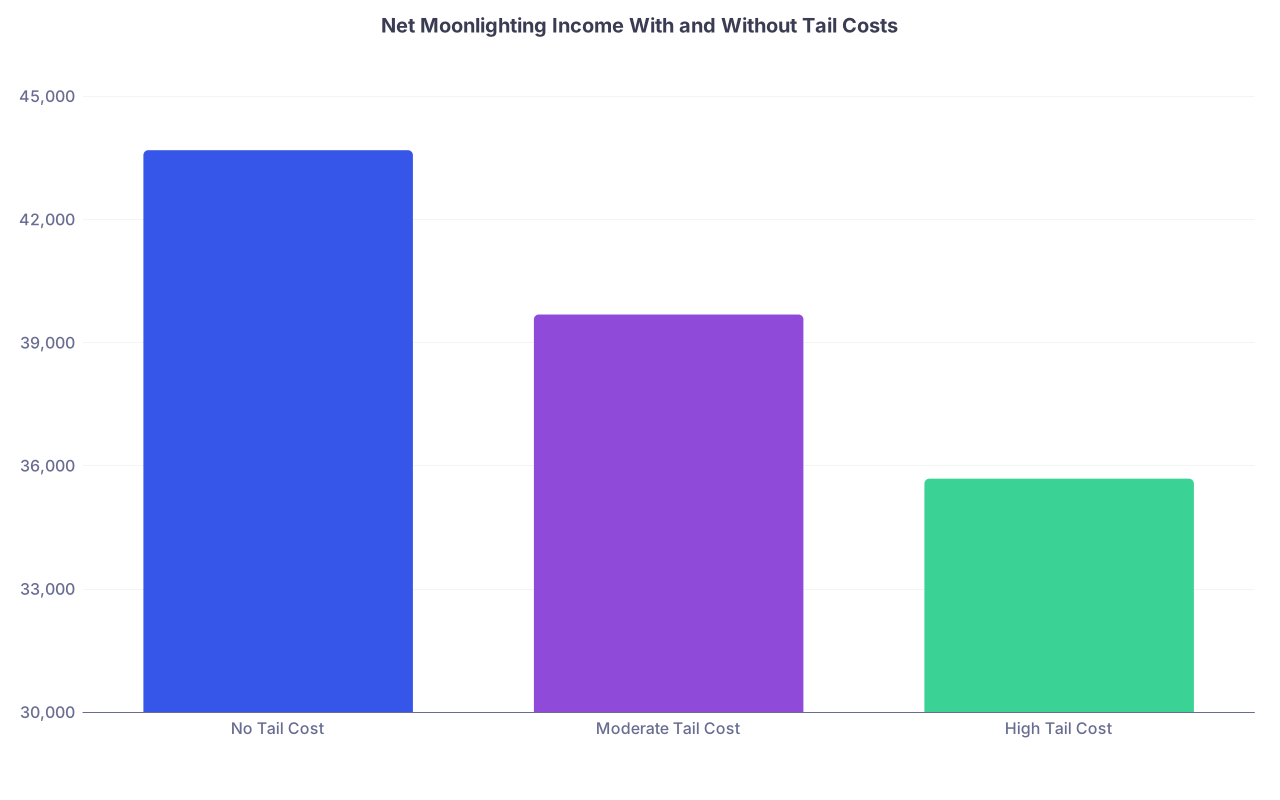
| Category | Value |
|---|---|
| No Tail Cost | 43680 |
| Moderate Tail Cost | 39680 |
| High Tail Cost | 35680 |
If a gig is:
- Low pay
- High risk
- Claims-made with you paying tail
You are subsidizing someone else’s business model with your license.
11. Telemedicine and Remote Moonlighting: Special Malpractice Traps
Telemed moonlighting looks easy. It isn’t, from a malpractice standpoint.
Unique problems:
- Licensure and coverage must match the patient’s location, not yours.
- Some policies exclude telemedicine by default or require a special rider.
- Some telemed companies provide bare-bones coverage, sometimes with low limits or lots of exclusions.
If you’re moonlighting via telemed:
- Get the company’s malpractice policy summary.
- Confirm:
- Which states’ patients you’ll see
- Whether their policy covers all those states
- Whether you’re a named insured or part of a group policy
- If they tell you to bring your own malpractice:
- You must tell your insurer explicitly that you’re doing telemedicine in X states
- Get that in writing in the policy declarations or endorsements
And do not ever assume your residency policy stretches to cover telemedicine done from your couch. It almost never does.
12. What To Do Today (Before Your Next Moonlighting Shift)
Do this as a concrete checklist.
- Pull your residency GME contract and malpractice summary.
- Pull any moonlighting contracts or offer emails you have.
- For each moonlighting site, email:
- Credentialing or risk management asking for:
- Type of malpractice coverage
- Limits
- Who pays tail
- Credentialing or risk management asking for:
- If any site says you must provide malpractice:
- Contact a broker who handles physician malpractice in your state.
- Tell them: “I’m a resident, I need part-time coverage for moonlighting at X doing Y.”
- Create your simple one-page coverage tracker and a folder for docs.
- Re-read your contracts for a clause about tail coverage and highlight it.
FAQ (Exactly 4 Questions)
1. Do I really need my own malpractice policy if the moonlighting site says they cover me?
Not always, but you do need proof. If the site provides written confirmation and/or a COI showing you as covered, with reasonable limits, and they handle tail, then a separate policy may be redundant. What you cannot rely on is a verbal “we’ve got you covered.” You want documents. If you’re doing other side work (telemed, one-off clinics) that isn’t under that policy, then your own policy might still be necessary.
2. Is it okay to moonlight without malpractice if the shifts are low-risk and mostly observation?
No. That is exactly how people “accidentally” practice without coverage. If you’re in a clinical role with any patient interaction that could be construed as medical decision-making, you need malpractice coverage. “Low-risk” doesn’t mean “no risk.” Plaintiffs’ attorneys don’t grade your risk; they file if there’s a bad outcome and a plausible argument.
3. Can my personal moonlighting policy also cover my residency work?
Usually not, and usually you don’t want it to. Your residency institution typically covers you for training activities, and their policy is primary. If you try to add residency work to your own policy, you can create conflicts about who’s primary and how claims are handled. The cleaner setup is: residency work → residency policy; moonlighting roles → site policy and/or your personal moonlighting policy for those specific roles.
4. What happens if I leave a moonlighting job and forget to get tail coverage on a claims-made policy?
If a claim is filed after the policy is no longer active and there’s no tail, you are essentially uninsured for that claim. Your former group might have some institutional coverage, but do not count on it. This is why you must know, before you ever start, who’s responsible for tail. If it’s you, and you leave without buying tail, you’re gambling your future earnings and your sanity on nobody ever filing a delayed claim. That’s a bad bet.
Open your current or planned moonlighting contract right now and find the malpractice section. Highlight every sentence that mentions “claims-made,” “tail coverage,” or “contractor shall be responsible.” If what you see makes your stomach tighten even a little, send an email today to get it clarified or changed—before you work another shift.