
The biggest mistake new academic faculty make is assuming “the university covers me” means you are actually protected.
You are not. Not automatically. And if you treat this casually, the first time you really understand your malpractice coverage will be after you’ve been served.
Let’s walk through this like you’re about to sign an academic offer—hospital-employed, university-employed, or jointly appointed—and you want to know, very specifically: Do I have enough malpractice coverage, and where are the traps?
Step 1: Get Clear on What You Actually Do—Not Just Your Job Title
Coverage follows activities, not your vague sense of being “on faculty.”
Before you even look at policy documents, write down what you actually do or will do:
- Clinical care in the main teaching hospital
- Clinics at satellite sites or outreach locations
- Telemedicine (in-state? multi-state?)
- Moonlighting (in-house? outside system?)
- Locums work
- Medicolegal consulting / expert witness work
- Volunteer free clinic
- Research with clinical procedures (e.g., biopsies in a trial)
- Industry work (device development, advisory boards)
- Side-gig stuff: aesthetics, concierge practice, online consults, etc.
Now divide that into two buckets:
- Things the institution thinks you do (what’s in your job description or contract)
- Things you actually do or plan to do
The gap between those two lists is where faculty get burned.
Step 2: Understand Institutional Coverage (What the University/Hospital Really Covers)
Institutional coverage is not magic. It’s just an insurance policy with boundaries.
Here’s what you need to find out—specifically—and not accept hand-wavy answers about.
Ask for the actual policy summary (or at least the certificate) for the malpractice coverage that will apply to you. Then clarify:
| Question Area | What You Need to Know |
|---|---|
| Policy Type | Claims-made or occurrence? |
| Limits | Per-claim and aggregate limits (e.g., $1M/$3M) |
| Tail | Who pays for tail if you leave? |
| Covered Activities | Where and what kinds of practice are covered |
| Employment Status | Are you named individually or only as “employee”? |
Claims-made vs. Occurrence
You absolutely have to understand this one.
- Occurrence: Covers incidents that happen during the policy period, no matter when they’re reported. You leave in 2028 and get sued in 2030 for care in 2027—still covered.
- Claims-made: Covers claims that are made (reported) while the policy is active. If you leave and don’t have tail coverage, you’re naked for prior acts.
Most academic centers in the U.S. use claims-made. Many have a self-insured trust with excess commercial coverage.
Your questions:
- Is my coverage claims-made or occurrence?
- If claims-made, does the institution provide tail if I leave voluntarily? If I’m fired? If the program closes?
- Is tail automatic, or “at the institution’s discretion”? If it’s discretionary, that’s lawyer language for “maybe not.”
If HR or the chair says “Oh, we don’t really do tail, it’s not needed,” that’s your red flag to slow down and get it in writing or walk away.
Policy Limits
Typical academic coverage might be something like $1M/$3M or $3M/$5M. Some hospitals have higher internal limits through captive/self-insured structures.
You want to know:
- What are the per-claim and aggregate limits that apply to me?
- Are those my limits alone, or a shared pool for a large group?
In a bad outcome with multiple defendants (institution, you, residents, nurses), you don’t want to discover you’re sharing one pot that gets used up fast.
If it’s a self-insured trust, ask: Is there excess commercial coverage on top of the trust? At what level?
Step 3: Identify the Gaps Between Institutional Coverage and Your Real Life
This is where institutional and personal coverage have to be balanced. The institution is insuring its risk. Not your entire professional life.
You need to systematically check what’s not covered.
Off-site and Multi-entity Work
Ask specifically:
- Am I covered when I practice at:
- Affiliated community hospitals
- VA hospital
- Private practice sites where faculty rotate
- Regional outreach clinics
- Do I need separate privileges-based coverage at each site?
And here’s one that gets people: “Joint appointments.”
You might be:
- Employed by a university practice plan
- Clinically working at a separate hospital corporation
- Doing outreach with a third entity
Each entity may assume the other is covering you. I’ve seen this. The hospital thought the university’s plan covered the outreach site; the university thought the hospital’s network did. Nobody checked. That physician only found the hole during a claim investigation.
You don’t want to find your gap during discovery.
Telemedicine and Multi-state Practice
Telehealth is a quiet malpractice nightmare if you don’t ask the right questions.
Ask:
- What states am I licensed in?
- In which states does the institutional policy provide coverage?
- Are telehealth visits with out-of-state patients covered under the same limits?
- Does coverage follow me when I’m physically in another state (e.g., home, conference) but seeing patients located in the home state?
If you’re doing telehealth to patients in multiple states and your coverage only clearly applies in the home state, that’s a problem.
Step 4: Decide If and Where You Need Personal Coverage
Once you’ve mapped your work and interrogated the institutional coverage, you’ll usually have one of three situations:
- Institutional coverage fully and clearly covers all your professional activities
- Institutional coverage covers your academic/clinical role, but you have side work that needs separate coverage
- Institutional coverage is partial or ambiguous—even for your main job—and you need to protect yourself with an additional layer
Let’s break these down.
Scenario 1: Fully Covered In-System, No Side Work… For Now
You’re full-time faculty, all clinical work is in-system, no moonlighting, no consulting. In that situation, if the institutional coverage is:
- Claims-made with guaranteed tail
- Reasonable limits (e.g., $1M/$3M or higher)
- Clearly written to cover all your in-system clinical sites and telemedicine
You might not need personal malpractice for your core job.
What you do need in this case:
- A copy of the policy summary and your coverage letter for your files
- Written confirmation that tail is provided for all voluntary and involuntary departures
- Clarity on whether administrative roles (e.g., committee work, quality review, peer review) are covered
Then you build a habit:
- Every year or two, ask: Has the institutional policy changed? Has your job changed? Have you quietly added risk (telemed, new site, new procedure)?
Scenario 2: Academic Job + Side Gigs (Moonlighting, Locums, Private Patients)
This is where personal policies become non-negotiable.
You need separate personal malpractice coverage when:
- You moonlight outside your primary system (e.g., local community ED, urgent care, SNF coverage)
- You have a small private panel, concierge patients, or a cash-based aesthetic practice
- You do locums work—even if just one weekend a month
- You’re providing informal “curbside” help that looks suspiciously like actual care (e.g., ongoing care to friends-of-friends)
Here’s the trap: Your institutional policy will not cover these activities. And if there’s overlap—like you see one of your academic patients privately at an outside site—you can create a situation where both carriers point at each other and delay or deny.
You handle this by:
- Getting a separately underwritten policy (usually occurrence) that names:
- Exactly where you’re working
- What you’re doing (procedural vs non-procedural, inpatient, outpatient)
- Disclosing to both the institution and the personal carrier that the other exists
- Keeping clean boundaries: academic work on academic systems, side work on side systems
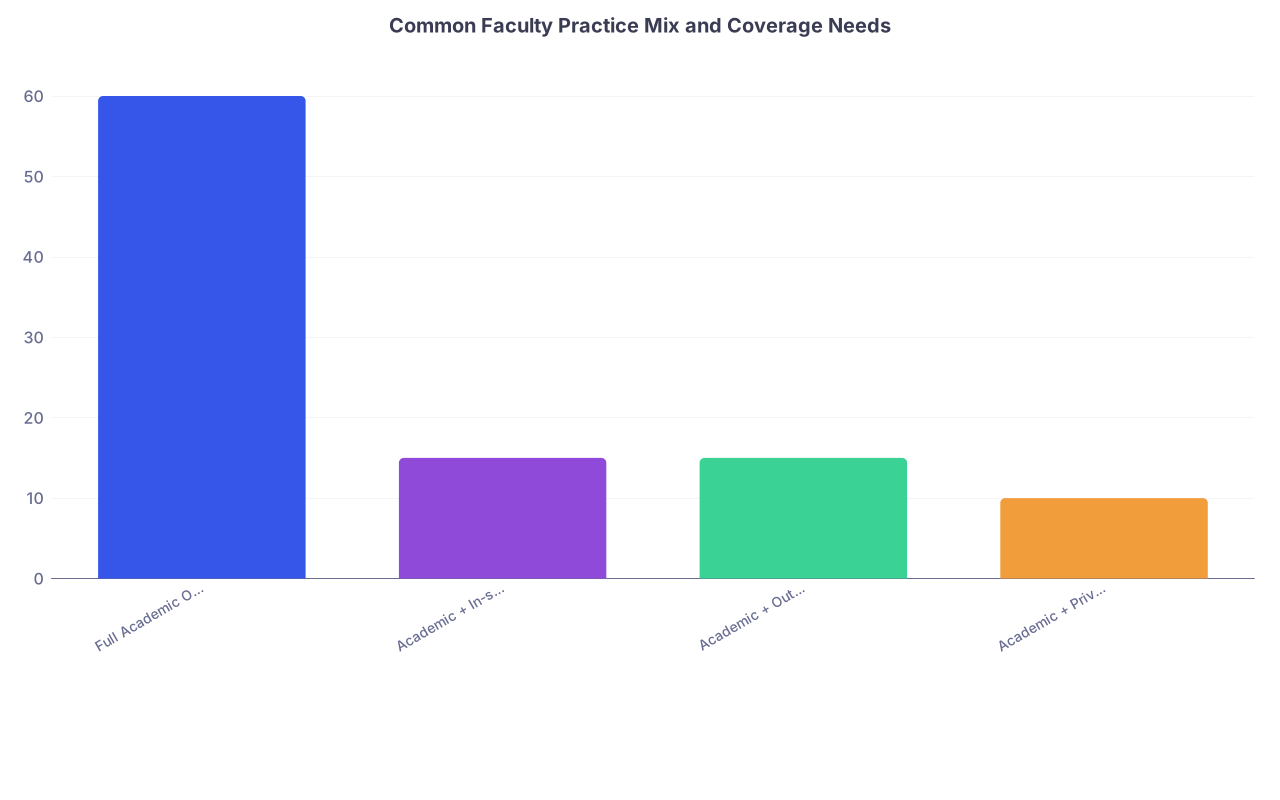
| Category | Value |
|---|---|
| Full Academic Only | 60 |
| Academic + In-system Moonlighting | 15 |
| Academic + Outside Moonlighting | 15 |
| Academic + Private Clinic | 10 |
Scenario 3: Institutional Coverage is Thin or Politically Vulnerable
Sometimes the university technically covers you, but:
- Tail isn’t guaranteed
- The institution is in financial trouble
- There’s been talk of cutting costs in the captive/self-insured pool
- Policy limits haven’t been updated in 10–15 years despite rising verdicts
In those cases, you may want a personal “excess layer” or separate policy as a backstop.
You won’t always find a carrier eager to write excess over a self-insured trust, but some do. At minimum, a personal policy for any non-core work keeps something under your own control.
This is more art than science and is worth an hour with a malpractice-focused attorney or broker, especially in high-liability fields (OB, neurosurgery, EM, GI procedures).
Step 5: Get Smart About Tail Coverage When You Leave
Joining faculty is easy. Leaving is where people get wrecked.
Tail coverage becomes an issue when:
- The institutional coverage is claims-made (which it usually is)
- You’ve been there years, building up “prior acts” exposure
- You move to another job or stop practicing entirely
Here’s what you want to lock down before you accept the job:
- Does the institution pay for tail if I leave voluntarily?
- Is there a minimum years-of-service requirement for them to pay tail?
- Do I lose tail if I’m terminated “for cause”? (and how is “cause” defined?)
- If the institution doesn’t pay tail, can I buy individual tail on my own policy number? At what estimated cost?
Typical tail cost can be 150–250% of your last year’s premium if you had an individual policy. For big academic self-insured models, it may be a negotiated internal decision—and that’s worse; there’s no guarantee.
Your contract should say something like:
“Upon termination of employment for any reason, the Employer shall purchase and maintain professional liability tail coverage for Provider for all acts performed within the scope of employment.”
If instead you see:
“Employer may, in its sole discretion, purchase tail coverage…”
That’s a problem. I’d push back before signing.
Step 6: Watch the Non-Clinical Exposure: Committees, Leadership, and Peer Review
As you grow in academic medicine, your risk shifts. It’s not just about your own patients anymore.
You start doing:
- Peer review
- Quality/improvement work
- Chairing committees
- Making credentialing or disciplinary decisions about colleagues
You want to know:
- Does the institutional malpractice or a separate professional liability/D&O policy cover me for:
- Peer review actions
- Testifying in internal hearings
- Administrative decisions in leadership roles
- Is there any separate indemnification document for faculty and leaders?
Ask for the institution’s indemnification policy. It should spell out when they defend and indemnify you, and when they might not (e.g., fraud, criminal acts, gross misconduct).

| Step | Description |
|---|---|
| Step 1 | Academic Job Offer |
| Step 2 | Map All Clinical and Side Activities |
| Step 3 | Review Institutional Policy |
| Step 4 | Confirm Tail and Limits in Writing |
| Step 5 | Identify Uncovered Activities |
| Step 6 | Obtain Personal Policy for Gaps |
| Step 7 | Recheck Coverage When Role Changes |
| Step 8 | All Activities Clearly Covered? |
Step 7: Dealing With Mixed Roles: Teaching, Research, and Clinical Trials
If you’re doing research that involves actual patient contact—especially clinical trials—do not assume your regular malpractice automatically applies.
You need to ask:
- Are research-related injuries and adverse events covered under the standard malpractice policy, or a separate clinical trial policy?
- Who is the insured on the trial policy? Institution only, or you personally named?
- If a subject sues both the sponsor and you, who defends you?
Sometimes industry-funded trials are covered by a sponsor’s policy that’s more interested in protecting the company than you. Make sure:
- The institution’s research office can show you how you’re covered
- Your name/role is explicitly within the scope of the trial insurance
- You’re not signing anything personally (like investigator agreements) that shift liability to you without institutional backing
Step 8: How to Actually Verify This Stuff Without Being “That Difficult Candidate”
You do not have to turn this into a fight. But you do have to be firm.
Here’s a script that works:
“Before I sign, I’d like to understand how malpractice coverage and tail are handled for faculty. Could I see a summary of the coverage and any standard language about tail in the contract or policy manual?”
Then, with HR or the chair:
- Ask direct questions, in writing when possible
- Take notes and repeat back: “So just to confirm, the institution provides tail coverage for any departure, including if I choose to leave?”
- Save their emails. If they misstate but it’s in writing, your lawyer has something to work with later.
If they can’t produce any documentation, or they keep saying “Don’t worry, everyone’s covered,” that’s not comforting. That’s lazy.
Step 9: When You Absolutely Need a Lawyer or Malpractice-Savvy Broker
There are a few situations where trying to DIY this is dumb:
- You’re joining as section chief/division head with a big administrative and clinical footprint
- You’re in a high-risk specialty (OB, neurosurg, spine, interventional, EM) in a litigious state
- The institution uses a complex captive/self-insured arrangement and nobody can explain tail clearly
- You’re moving from private practice with your own mature claims-made policy and need to decide: buy tail or rely on new employer’s nose coverage
In those cases, pay for:
- 1–2 hours with a healthcare attorney who actually deals with malpractice policies
- Or a seasoned malpractice broker who can walk you through your options
The couple hundred or thousand dollars up front is cheap compared to a lifetime of liability plus sleepless nights.
Step 10: Personal Rules to Keep You Out of Preventable Trouble
Coverage is one thing. How you practice under that coverage still matters.
A few rules I’ve seen smart faculty follow:
- Never assume institutional coverage extends to favors: prescribing for your neighbor, texting advice across state lines, “quick looks” on non-system charts
- If you start a new side gig, your first email is to:
- Your institutional risk/med staff office: “Is this covered?”
- A malpractice broker: “Quote me coverage for X”
- If your role changes (hospitalist to proceduralist, new telemed program, new outreach site), treat it like a new job from a coverage standpoint
- Keep your own folder: policies, coverage letters, indemnification statements, key emails. If you’re ever sued, that folder is gold for your defense team.
Joining an academic faculty can be the best professional move you make—intellectually, clinically, lifestyle-wise. But the system is built to protect institutions first, individuals second. If you don’t actively balance institutional and personal coverage, you’re trusting that everyone else has thought through risks that land squarely on your nameplate.
You’ve now got the framework: map what you actually do, interrogate what the institution really covers, plug the gaps with your own policy when needed, and lock down tail before you ever sign. Get those pieces right, and you can move on to the more interesting problems of academic life—building programs, mentoring residents, getting promoted—without wondering if one bad outcome could take you down personally.
With your malpractice groundwork in place, the next challenge is using that faculty seat wisely—negotiating time, building leverage, and setting yourself up for long-term academic success. But that’s a different battle, for a different day.