
The biggest malpractice risk when you move to a new state is not a bad lawsuit. It is the quiet coverage gap you do not notice until it is too late.
You’re changing jobs, changing states, maybe changing practice types. HR is waving a shiny “we provide malpractice” line in your contract. Your old group is stalling on tail. The state board has a backlog. In that mess, it’s very easy to leave yourself naked for a few months—or for your past 10 years of practice.
Let’s walk straight through what to do if you’re moving to a new state and do not want your malpractice coverage blown up during the transition.
Step 1: Get brutally clear on your current malpractice coverage
Before you even think about the new state, you need to know exactly what you have today. Not “I think it’s occurrence” or “our group handles that.” I mean the actual policy details.
Pull your current declarations page and, if possible, the full policy. Then answer these questions in writing:
- Is your policy claims-made or occurrence?
- Who owns the policy?
You personally? Your old employer? A locums agency? A hospital system? - What’s the retroactive date (for claims-made)?
- What’s the policy end date?
- Who is contractually responsible for tail coverage if you leave? You or the employer?
If you do not know the answer to any one of those, you’re not ready to move yet.
Quick refresher, because this part is non‑negotiable:
- Occurrence policy: Covers incidents that occurred during the policy period, no matter when the claim is filed. If you had an occurrence policy in State A from 2019–2024 and move away in 2025, anything that happened 2019–2024 is still covered. No tail required for that period.
- Claims-made policy: Covers claims that are made (i.e., reported) while the policy is active, for incidents after the retroactive date. Once the policy ends, unless there’s tail or a new policy that picks up your retro date, you’re uncovered for your prior work.
If you’re on a claims-made policy and moving states, you are in the danger zone. The move itself doesn’t create the risk. The policy transition does.
To make this concrete, lay out your current situation:
| Item | Your Info (fill in) |
|---|---|
| Policy Type | Claims-made / Occurrence |
| Carrier | |
| Retroactive Date | |
| Limits | e.g., $1M / $3M |
| Policy End Date | |
| Tail Responsibility | You / Employer / Split |
If this table has blanks, fix that now. Email your practice manager, risk management, or your broker and get the missing details in writing.
Step 2: Map out the timeline of your move (this matters more than you think)
Malpractice risk loves ambiguity. And the licensure transition is nothing but ambiguity if you let it be.
You need three dates on paper:
- Last day of clinical work in the old state
- Policy termination date for your current malpractice
- First day you’ll see patients in the new state
Then layer on:
- Your old state license expiration date
- Your new state license approval date (or realistic estimate)
- Contract start dates for new employer(s)
Here’s why: your coverage must continuously protect:
- All care you delivered in the old state (past acts)
- Any care you’ll deliver in the new state (future acts)
- Any telemedicine or cross‑state care you’re doing during the overlap
You don’t get credit for “almost continuous.” A 24‑hour uncovered gap can be enough if a claim pops during that window and no policy is legally on the hook.
To visualize the risk points:
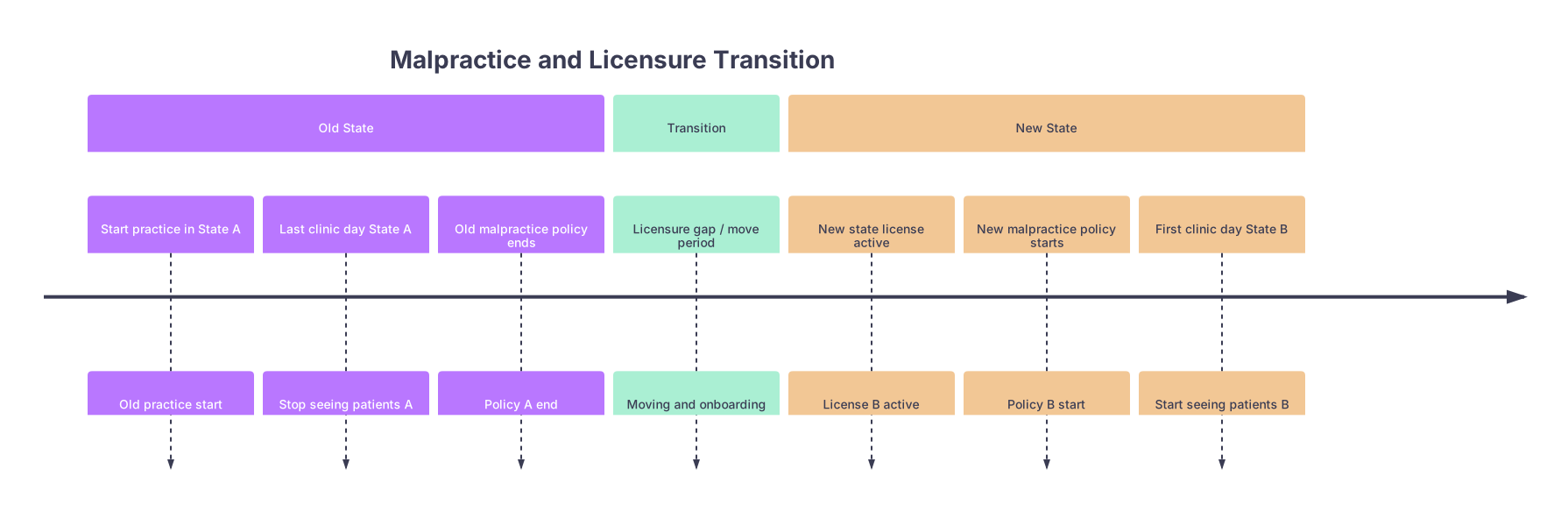
| Period | Event |
|---|---|
| Old State - Start practice in State A | Old practice start |
| Old State - Last clinic day State A | Stop seeing patients A |
| Old State - Old malpractice policy ends | Policy A end |
| Transition - Licensure gap / move period | Moving and onboarding |
| New State - New state license active | License B active |
| New State - New malpractice policy starts | Policy B start |
| New State - First clinic day State B | Start seeing patients B |
You want your malpractice coverage timeline to have:
- No gap between Policy A end and either:
- Tail coverage start, or
- New Policy B start that honors your retroactive date
If your HR team can’t articulate how that continuity is handled when you move, that’s a red flag.
Step 3: Decide how to handle “past acts” when leaving your old state
When you move, there are really two malpractice problems:
- Coverage for what you did before the move (past acts in State A)
- Coverage for what you’ll do after the move (future acts in State B)
Most physicians focus only on #2 and accidentally abandon #1.
If you had a claims-made policy in the old state, you have two main options:
- Buy tail from the old carrier
- Get prior acts coverage from the new carrier (nose coverage)
Option 1: Tail coverage from old carrier
The pain point: cost. You’ll often see quotes of 150–250% of your last annual premium.
So if your premium was $20,000/year in your old state:

| Category | Value |
|---|---|
| Annual Premium | 20000 |
| Tail (150%) | 30000 |
| Tail (200%) | 40000 |
| Tail (250%) | 50000 |
That’s a car. Sometimes a small house down payment.
Here’s where people get burned:
- They assume their new employer will “take care of it.”
- The old contract actually said they are responsible for tail.
- They resign, policy ends, they move, claims pop up 3 years later. Surprise: no coverage, no one is eager to pay $40k retroactively.
Your steps:
- Read your old contract line that mentions “professional liability” or “malpractice.”
- Find the specific clause about tail coverage responsibility upon termination.
- Get an actual tail quote from your current carrier before giving notice.
- If it’s expensive, try to negotiate:
- Cost‑sharing with your old group
- A payment plan with the carrier
- A “step-down” tail if available (shorter duration, lower cost) if your risk profile allows
You do not want to rely on “we’ll see what we can do” from some administrator while you’re driving a moving truck across state lines.
Option 2: Prior acts (nose) coverage from new carrier
Sometimes your new employer’s malpractice carrier will:
- Start your new policy in State B
- Honor your retroactive date from State A
- Cover claims for incidents that happened back then (even in a different state) as long as they fit their underwriting rules
This is called prior acts coverage or “nose coverage.” When it works, it can be cheaper than tail and keeps everything under one policy.
Catches:
- Not all carriers will pick up prior acts from another carrier.
- Some will refuse if the old state is much higher risk than the new one.
- Some will require a “gap-free” history—any prior uninsured period can blow this up.
- Your limits and policy language may differ from what you had before.
You need to ask the new employer’s risk manager or broker directly:
- “Will your carrier provide prior acts coverage back to my original retro date of [date] from my old policy with [carrier]?”
- “Will that prior acts coverage follow me across state lines for my work in State A?”
Get the answer in writing. Not “should,” not “probably.” A yes/no answer from the actual broker or carrier.
If they will not provide prior acts coverage, you are back to tail.
Step 4: Understand how your new state and new job type change the malpractice picture
Moving from New York hospital employment to a Texas private group is not the same as moving from Minnesota outpatient primary care to California academic medicine.
The mix of:
- State malpractice climate
- Caps on non-economic damages (or lack thereof)
- Venue rules
- Statutes of limitation
- Vicarious liability structure
…all change how nervous you should be and how much you’re going to pay.
Quick comparison to show why this matters:
| State | Non-Economic Damage Caps | Typical Limits (physician) | Premium Trend |
|---|---|---|---|
| Texas | Yes, capped | $200k / $600k or $1M / $3M | Stable/Lower |
| California | Yes (but complex, changing) | $1M / $3M | Moderate |
| New York | No cap | $1.3M / $3.9M or higher | High |
| Florida | No current cap | $1M / $3M+ | High/Volatile |
If you’re moving from a high-premium, high-risk state to a more “tort‑reformed” state, your new carrier may be more relaxed about picking up prior acts. Sometimes the opposite.
Also, your job structure matters for how coverage works:
- Large hospital system: usually institutional policy; you’re an additional insured. Good for defense resources, but check what happens after you leave.
- Private group: group policies that might or might not name each physician separately, with varying tail arrangements.
- Locums/1099 in the new state: now you might be buying your own malpractice, and you have full control—but also full responsibility.
Locums and multi‑state telehealth can get especially messy. If you’re doing any of that while moving, you need a broker who actually handles multi‑state physician policies routinely, not the random agent who mostly writes auto insurance.
Step 5: Align licensure, start dates, and coverage so you are never practicing “naked”
There are three things that must align on your first patient encounter in the new state:
- You have an active state license in that state.
- You have an active malpractice policy that:
- Covers that state
- Covers your specialty and practice setting
- You understand whether that new policy does or does not cover past acts in your old state.
Do not let an administrator pressure you into seeing “just a few” patients before your malpractice confirmation is in hand. I’ve seen onboarding coordinators say things like:
- “Oh, everyone starts seeing patients once the license posts. Insurance always catches up.”
- “Legal said we’re covered under the hospital policy from day one.”
Maybe they’re right. Maybe not. If they’re wrong, you are the one named individually in the lawsuit.
You need:
- A certificate of insurance (COI) from the new carrier listing:
- Effective date
- Covered states or practice location
- Limits (e.g., $1M/$3M)
- Confirmation from HR or legal that you are explicitly covered under that policy from day one.
If the COI start date is later than your planned first clinic day, push the start date back. Yes, even if that means delaying onboarding by a week. One uninsured day is a very bad trade.
To visualize practice vs coverage:
| Category | Value |
|---|---|
| Month -2 | 1 |
| Month -1 | 1 |
| Move Month | 1 |
| Month +1 | 1 |
| Month +2 | 1 |
Think of that “1” line as “fully covered.” You never want a segment dropping to 0 between old and new policies.
Step 6: Handle telemedicine and cross‑state care intelligently
Here’s where many people screw up without noticing.
Scenario I’ve seen:
You’re licensed in State A. You move physically to State B. You keep doing telehealth follow‑ups for patients in State A while waiting for your State B job to fully ramp up.
Questions you must answer:
- Where are your patients physically located during the visit? That’s usually the jurisdiction that matters.
- Does your old malpractice policy still cover you now that:
- You’re living in a different state
- Your employer relationship may have changed
- Does your new malpractice policy cover telemedicine for out‑of‑state patients?
If you left the employment where your old malpractice lived, but you’re still seeing those patients under some “informal” arrangement, you may be practicing with zero coverage.
You have a few ways to do this safely:
- Keep your old employment active (even part time) with the malpractice policy fully intact until all follow‑ups are handed off.
- Arrange a separate telemedicine malpractice policy that:
- Lists both states you’re working with
- Matches the license status in each state
- Make sure your new employer’s policy explicitly covers:
- Telehealth
- Patients located in your old state, if you’re planning to keep them temporarily
This is not something to “assume” is fine. Pick up the phone and ask the broker or risk manager.
Step 7: Coordinate malpractice with your financial and legal plan
Malpractice is not just a “work thing.” It bleeds straight into your personal risk and financial life:
- Are you moving from a state with strong asset protection laws to one that’s weaker?
- Do you have a spouse who’s staying behind temporarily, with shared property in two states?
- Are you changing from W‑2 employee to 1099 or forming your own PLLC/PC?
This is where you want a short, focused meeting with:
- A malpractice‑savvy insurance broker, and
- A physician‑focused attorney or financial advisor who actually understands state differences
Your goals during that conversation:
- Confirm there is no coverage gap in the move.
- Decide what policy limits make sense in the new state.
- Decide whether you also need:
- An umbrella policy (note: this is not malpractice, but might protect personal assets)
- Entity‑level coverage if you’re forming your own practice.
If you’re going from employed to self‑employed in the new state, build malpractice premiums into your startup financial plan for Year 1–3. Do not let the first $30k malpractice bill hit you as a surprise after you’ve signed a lease and hired staff.
To keep your brain clear, separate:
| Category | Responsibility |
|---|---|
| Old state past acts | Tail or prior acts coverage |
| New state future acts | New malpractice policy |
| Telehealth multi-state | Explicit multi-state policy |
| Legal asset protection | Estate/asset planning |
Each row needs a real answer. If one row is “I’m not sure,” that’s where you focus next.
Step 8: Red‑flag phrases and questions to use with employers and carriers
If you remember nothing else, remember this: vague reassurance is your enemy. Specific, written answers are your friend.
Here are phrases from employers that should set off alarms:
- “We have a blanket policy; you don’t need to worry about details.”
- “Everyone just relies on the hospital’s coverage. It’s never been an issue.”
- “Our legal team says you’ll be covered the whole time, don’t worry about tail.”
- “We can’t change the start date of your policy, but we still want you to start seeing patients then.”
Push back with concrete questions:
- “Who is paying for my tail coverage from my current claims‑made policy? Is that written into my contract?”
- “Will your malpractice carrier provide prior acts coverage back to [retro date] with [old carrier]?”
- “On what exact date does my malpractice coverage with your policy begin, and in which states?”
- “Does your policy cover telemedicine for patients physically located in [old state] while I am licensed there?”
- “Can I please have a certificate of insurance listing me by name and the effective date?”
You are not being difficult. You’re preventing a six‑figure personal mistake.
Step 9: If you’ve already moved and suspect a gap, don’t panic—but act fast
Plenty of people read articles like this too late. If you’re already in the new state and realizing your tail wasn’t arranged, or your retro date didn’t get carried over, here’s what to do:
- Stop any questionable clinical activity immediately (like telehealth in the old state without clear coverage).
- Contact your old carrier:
- Ask if you can still purchase tail coverage retroactively.
- Ask about any deadlines after termination for buying tail (some allow a 30–60 day window).
- Talk to your new carrier or broker:
- Ask if they can add prior acts coverage back to your original retro date.
- If they can’t, ask if they’d cover you going forward while you solve the past acts problem.
- If there is a real uncovered period:
- Consider talking to a healthcare attorney to understand your exposure and options.
- Do not ignore it and hope claims never show up. That’s not a plan.
You may not be able to make it perfect retroactively, but you can usually make it a lot less bad if you act quickly and honestly.
Step 10: Today’s concrete action so this does not blow up on you
Do this today, not “when things quiet down.”
Open your email and send one message to your current practice/HR or broker:
“Hi [Name],
I’m planning a move to [New State] on/about [date]. Could you please send me:
- My current malpractice declarations page, including policy type and retroactive date;
- A written summary of who is responsible for tail coverage when I leave; and
- The policy end date if I resign on [tentative last day]?
Thank you.”
Until you see that declarations page and that answer about tail, every other part of your move is guesswork.