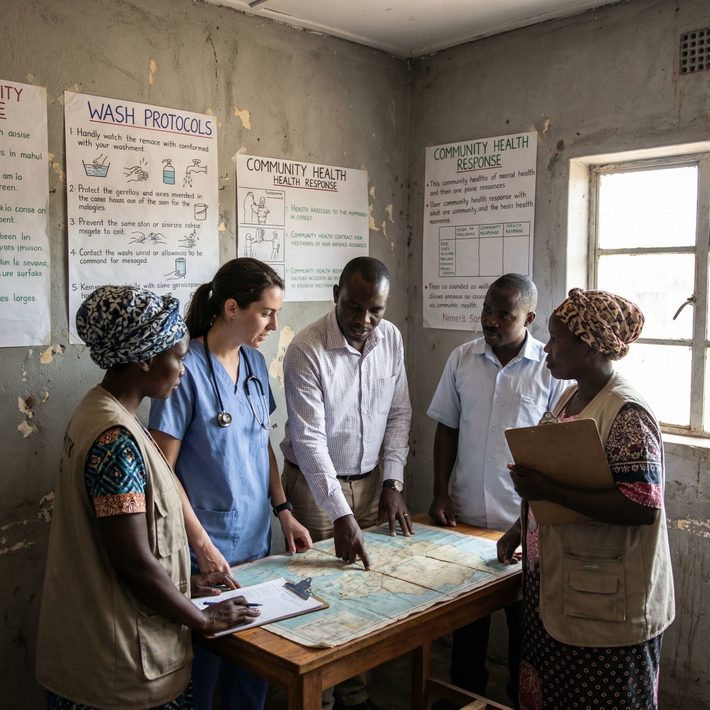
You need to prove global health hours. The site will not give you a letter. That is the whole problem, and it is solvable with structured evidence, not wishful storytelling.
I have reviewed enough applications, activity logs, and "please verify this" packets to say this plainly: institutional letters are convenient, not sacred. Reviewers care about auditable hours, credible scope, independent corroboration, and internal consistency. When a partner clinic, NGO, or remote platform cannot issue formal verification, you replace the letter with an evidence pipeline. The data shows that redundancy beats a single signature.
Typical applicant targets sit in the 40-80+ hour range for meaningful global health experience blocks. Occasional letters do not save a thin record. Consistent documentation does. Below is a five-step framework: define the evidence standard, build a time-stamped hours ledger, convert activities into verifiable outputs, harvest third-party corroboration, and package a letter-substitute portfolio that stands up to scrutiny.
This article is for educational purposes only. It is not financial advice, not legal advice, and not tax advice. Figures vary by individual circumstances, consult a qualified professional before acting.
Claiming Global Health Hours Without "No Letter" Sites: What the Data Says
"Proof" is not a vibe. Define it in measurable terms:
- Hours, counted, not estimated after the fact
- Dates, chronology that holds under a calendar check
- Tasks, scope you can defend line by line
- Outcomes, deliverables, not attendance
- Verification, independent signals that do not depend on one missing letterhead
The strategy is an evidence pipeline. Missing institutional letters get replaced by structured documentation plus third-party signals: platform receipts, calendar invites, email threads, registration records, activity logs, and quantified outputs. One artifact is weak. Three overlapping artifacts for the same block are strong.
I treat this like any other messy dataset. You do not throw out the analysis because one field is null. You build coverage. You run consistency checks. You show your work.
The five steps that follow are the operating system for that approach.
Step 1, Define the Evidence Standard: What "Prove" Means in Admissions/Review Terms
Start with a defensible definition of verification. Four pillars:
(A) Auditable hours, start/end times, totals that reconcile (B) Credible role description, what you did, at what level, with what boundaries (C) Third-party corroboration, records you did not invent in isolation (D) Consistency across records, ledger, emails, outputs, and contacts do not contradict each other
That is the standard. Everything else is packaging.
For each global health hour block, build a minimum viable dataset (MVD):
| Field | Why it matters |
|---|---|
| Date | Chronology and plausibility |
| Location / modality | On-site, hybrid, remote platform |
| Activity type | Service, training, data, coordination |
| Supervisor / lead contact | Role-stamped human anchor |
| Output or learning artifact | Proof of work product |
From a data analyst lens, missing one field is acceptable if redundancy covers it. Supervisor roster + calendar invites + activity logs can substitute for a polished letter. Reviewers do not require perfection. They require traceability.
Institutional verification letters are one channel. Operational verification artifacts are another: logs, registration confirmations, platform timestamps, shared-folder version histories, meeting agendas, sign-in sheets. Letters compress trust into one document. Artifacts distribute trust across the record. Distributed trust is often more robust under audit.
Reviewers implicitly look for three things:
- Specificity, "assisted with intake workflow redesign across 6 clinic mornings" beats "helped in clinic"
- Plausibility, hours fit travel, time zones, and role seniority
- Traceability, a skeptical reader can follow a claimed block to at least one independent signal
If your packet fails those three, no amount of adjective-heavy reflection will save it.
The curve is not magic. Confidence rises as completeness rises because redundancy compensates for missing letters. At roughly 75% field completeness with cross-checks, most reviewers stop treating the claim as noise. That is the practical threshold I aim for, not 100% perfection on day one.
Step 2, Build a Time-Stamped Hours Ledger (Numbers-First, Letter-Optional)
Letters are optional. Arithmetic is not.
Design the ledger as one row per shift or session:
- Date
- Start time
- End time
- Total minutes
- Decimal hours
- Activity category
- Location / modality
- Corroboration ID (link to artifact later)
- Notes (scope boundary in one line)
Calculation rigor matters. Convert minutes to decimal hours cleanly: 90 minutes = 1.5 hours; 45 minutes = 0.75 hours. Pick a rounding rule and stick to it, for example, round to the nearest 0.25 hour, or never round intermediate rows and only round the final total. Inconsistent rounding is a gift to skeptics. I have watched reviewers discount entire claims because totals drifted by 3-4 hours with no reconciliation note.
Run a consistency audit every time you update the file:
- Sum minutes → convert → compare to claimed total hours
- Flag any row missing start/end
- Flag any day with implausible duration (e.g., 14-hour "observation" with no break structure)
- Confirm category mix matches your narrative
Traceability anchors turn a spreadsheet into evidence. Attach what you actually have:
- Photo timestamps from non-clinical context (facility exterior, team workspace, never patients)
- Route or check-in logs where appropriate
- Platform login or session timestamps
- Calendar acceptances with organizer domain visible
Example schema you can reuse in any "no letter" environment:
block_id | date | start | end | minutes | hours | category | site_or_platform | supervisor_role | artifact_ids | deliverable_ids | privacy_flag
Export the ledger as both spreadsheet (working file) and PDF (submission freeze). Freeze versions. Do not keep "editing the truth" two days before a deadline.
If the ledger does not reconcile, stop packaging. Fix the numbers first. Narrative cannot repair a broken sum.
Step 3, Convert Activities Into Verifiable Outputs (Deliverables Replace Letters)
Hours alone answer "were you there?" Deliverables answer "did anything happen because you were there?"
Translate tasks into outputs:
- Training sessions delivered
- Patient education materials created (de-identified samples or outlines)
- Data collected or cleaned
- Workflow improvements implemented
- Referrals coordinated (counts, not names)
- Curriculum modules completed or adapted
- Forms audited
- Outreach events supported
Use a simple deliverable taxonomy:
- Direct service (1st order), encounters supported, education given, screening assistance under supervision
- Capacity building (2nd order), training others, materials, protocols
- Systems support (3rd order), data quality, logistics, process maps, dashboards
Quantify. "Supported clinic" is worthless. "Led 4 small-group education sessions (12-18 attendees each); drafted 2 one-page teach-back sheets; cleaned a 320-row intake completeness dataset" is reviewable.
Map outputs to role credibility. State scope boundaries without drama: what you did versus what you observed; what required licensed supervision; what was independent project work. Overclaiming is the fastest way to sink a strong hour total. Under-specifying is the second fastest.
Verification artifacts for outputs:
- Shared folder links or export manifests (with access notes)
- Meeting agendas with your item listed
- Anonymized pre/post quiz summaries
- Tool version histories
- Sign-in sheets (names redacted where needed; counts retained)
- Ticket or task IDs from project boards
In the example above, weeks are not identical, and they should not be. Real work varies. What matters is that each week produces countable artifacts tied back to ledger rows. When deliverables and hours move together, the story becomes hard to dismiss.
Step 4, Find Third-Party Corroboration Without a Formal Letter (The Data Sources Strategy)
Formal letters fail for boring reasons: no admin bandwidth, no policy, short-term partnerships, pure remote platforms, political sensitivity, or pure neglect. None of that erases your hours if other records exist.
Non-letter confirmation sources I actually use and recommend:
- Partner organization registration confirmations
- Volunteer platform receipts and dashboards
- Email threads with organizational domains
- Calendar invites and acceptances
- Badge or access logs (where legitimately available to you)
- Public or semi-public event pages
- Meeting minutes listing attendees and roles
- Shared drive activity or document ownership metadata
Triangulation is the method. Two independent records can validate one hour block even when the site will not write a letter. Example: calendar invite from [email protected] for 09:00-12:00 plus a platform session receipt for the same window plus a deliverable timestamped that afternoon. That is a closed loop. No letterhead required.
Privacy constraints are non-negotiable. Document without exposing PHI. Prefer aggregate reporting, de-identified notes, counts, and process descriptions. If a screenshot would show names, diagnoses, or identifiers, it does not enter the packet. Full stop. A clean packet that respects privacy is stronger than a "complete" packet that is reckless.
Calculate corroboration coverage:
[ \text{Coverage} = \frac{\text{Ledger rows with } \geq 1 \text{ independent artifact}}{\text{Total ledger rows}} \times 100 ]
Practical target: 60%+ of rows with at least one independent artifact, and 100% of large or unusual blocks covered. I do not pretend 100% row-level coverage is always possible on chaotic field sites. I do pretend that zero coverage is a choice, and a bad one.
Present contacts professionally. Log supervisor interactions with date stamps and role stamps: "12 Mar, Site education lead (email), confirmed session schedule and materials review." You are not manufacturing fake recommenders. You are preserving a contact trail a reviewer could, in principle, spot-check.

If your coverage sits under 40%, you do not have a packaging problem. You have a collection problem. Fix collection while the trail is still warm.
Step 5, Package It for Review: A Letter-Substitute Portfolio That Stands Up to Scrutiny
Raw folders look like chaos. Reviewers reward structure.
Build a submission packet with four layers:
- Hours ledger (reconciled, version-frozen)
- Deliverables summary (quantified, taxonomy-tagged)
- Corroboration index (artifact list mapped to block IDs)
- Optional brief supervisor statement if obtainable, nice, not required for the model to work
Use a one-page dashboard up front:
- Total hours claimed
- Date range
- Distribution by activity type (% direct / capacity / systems)
- Corroboration coverage %
- Top deliverable counts
- Rounding rule in one sentence
- Reconciliation note: "Ledger sum = claimed total; difference = 0.0 hours"
That dashboard is not decoration. It is a trust accelerator. It tells a busy reviewer you already did the audit they would otherwise have to improvise.
Include explicit QA language. State the rounding rule. State that totals match. If anything does not match, explain the delta like an adult: "Two remote sessions lacked end timestamps; duration estimated from agenda length and confirmed against email follow-ups; flagged in ledger rows 17-18." Hidden uncertainty is worse than labeled uncertainty.
Prepare for audits with a crosswalk:
claim_block_id → artifact_id(s) → deliverable_id(s) → contact_role
If someone asks "prove row 12," you answer in seconds, not with a scavenger hunt through your inbox.

This framework is not a one-off hack for a single application season. It is a repeatable documentation system for every future global health block, letter or no letter. Build it once, tighten the schema, and your next 40-80 hours will cost less panic and produce higher evidentiary density.
Key takeaways
- Treat proof as an evidence pipeline: time-stamped ledger + quantified deliverables + third-party corroboration can replace missing institutional letters.
- Use numerical targets, corroboration coverage percentages, consistency audits, reconciled totals, to signal rigor. The data shows reviewers trust structured redundancy far more than a single missing letterhead and a paragraph of enthusiasm.
You will keep doing global health work in imperfect systems. Sites will stay under-resourced. Letters will keep failing to appear. The applicants who win on documentation are not the ones who waited for permission to be verified. They counted, labeled, triangulated, and packaged. Start the ledger on day one of the next block. Future you, and any reviewer who opens your file, will see the difference in the numbers.