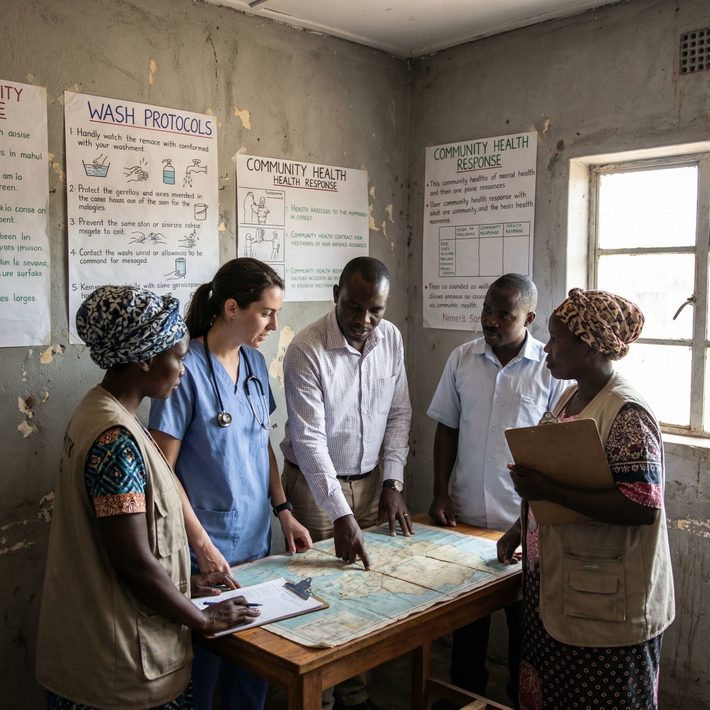
Most mission training programs cannot tell you whether their trainees are actually competent. They can tell you how many weeks the trainees spent on site, how many patients the clinic saw, and how satisfied everyone felt on the exit survey. None of those numbers answer the only question that matters: can this person safely do the job?
Let me break this down specifically. In this analysis, "skills-based" training means deliberate practice against competency frameworks, simulation, checklists, calibrated assessors, mentorship with feedback loops. "Rotation-based" training means learning through time embedded in service sites, the classic clinical rotation model exported to mission settings. The comparison matters because Global Health runs on three currencies: measurable competence, patient safety, and sustainability. Exposure alone spends none of them well. I will evaluate both models through five lenses: outcomes, timelines, costs, equity, and program fidelity.
This article is for educational purposes only. It is not financial advice, not legal advice, and not tax advice. Figures vary by individual circumstances, so consult a qualified professional before acting.
Definitions First: What Counts as "Skills-Based" and "Rotation-Based"
Precision matters here, because programs routinely mislabel themselves.
Skills-based training is defined by structure, not by location. It has explicit competency targets, deliberate practice with repetition, formative assessment, and measurable proficiency thresholds, an OSCE station, a scored checklist, a defined pass mark. Only after clearing those thresholds does the trainee escalate to supervised tasks on real patients. Concrete example: before a trainee gives an intramuscular injection to a patient, she has performed it fifteen times on a trainer arm, scored against a twenty-item checklist by an assessor who has been calibrated against other assessors. That is the architecture.
Rotation-based training is defined by time and place. The trainee is embedded in a service site for a fixed period, progressing from observation to participation as opportunities arise. Supervision intensity varies wildly. Competency gates, when they exist at all, are inconsistent, often a supervisor's global impression at the end of week four.
Most real programs claim to be hybrids. Be skeptical of the label. "Hybrid" frequently means a rotation with a single skills afternoon stapled to the front. If there is no standardized skill verification before live patient tasks, the program is rotation-based with better marketing. This is precisely why you still need data, the label tells you nothing about implementation.
For any comparison to mean anything, programs must operationalize outcomes identically: demonstrated competence, skill retention over months, patient safety signals, supervisor workload, and, critically, the gap between trainee self-efficacy and demonstrated performance. Self-efficacy is the most over-collected and least useful metric in this entire field. Confidence is cheap. Programs generate it for free. Competence is expensive, and only one of the two keeps patients safe.
The Data Lens: What We Should Measure (Not What We Assume)
Evaluation frameworks like Kirkpatrick's give a useful skeleton, but Global Health needs the skeleton fleshed out with measurable clinical endpoints: skills performance under observation, clinical decision accuracy, adherence to protocols, adverse event rates, and referral appropriateness. Miller's pyramid, knows, knows how, shows how, does, maps cleanly here. Rotation-heavy programs tend to assume the top of the pyramid from attendance at the bottom. Skills-based programs measure "shows how" directly. Assumption versus measurement. That is the whole argument in miniature.
Capture four outcome domains:
- Technical skills, procedures, sterile technique, physical examination maneuvers.
- Clinical reasoning and triage, sorting the sick from the stable, choosing the right disposition.
- Interpersonal communication, consent, counseling, shared decision-making across language and culture.
- Systems navigation, referral pathways, documentation, working around supply constraints.
Then measure time-to-competence: the proportion of trainees reaching a predefined threshold by week X. Not mean scores at program end. Mean scores are where weak programs hide their failures, the average can look acceptable while two trainees in the left tail never achieved competence and are now suturing patients anyway. I have watched exactly that happen on a short-term mission, and nobody's end-of-program report mentioned it.
Equity and safety belong in the measurement plan from day one. Baseline experience varies enormously within any cohort; a model that works for the trainee with prior ward experience may fail the one without it. Supervision burden is a safety variable, not an administrative footnote. And rotation-only exposure carries a specific, well-documented hazard: the competence illusion, where familiarity with a setting gets mistaken for proficiency in it.
Finally, measure the program itself: fidelity to curriculum, frequency of feedback, assessor calibration, and whether competency gates are actually enforced. A gate that everyone passes is wallpaper.
What the Evidence Tends to Show: Skills-Based Training Delivers Faster, More Consistent Proficiency
The pattern across competency-based education research is remarkably consistent, and it is this: repeated deliberate practice plus standardized feedback improves technical proficiency and compresses the spread between your strongest and weakest learners. That second effect, variance reduction, is the underappreciated one. A mission team's safety is set by its least competent member performing the riskiest task. Narrowing the tail matters more than raising the mean.
Simulation and checklist-based assessment earn their keep because they surface error patterns early, when they are still cheap to fix. Every error caught on a mannequin generates a remediation loop: demonstrate, correct, repeat, re-test. The rotation alternative is observe-and-hope, hope the relevant case walks in, hope the supervisor notices the error, hope there is time to correct it before the clinic queue swallows the afternoon.
Feedback frequency functions as a causal lever, not a nicety. Consider two trainees. One receives twelve short, structured feedback episodes in her first week, each tied to a checklist item she can act on immediately. The other receives one sit-down conversation at the end of a four-week rotation. These are not two versions of the same education. They are different interventions entirely.
Competency gating shows its value in the procedure data: when programs impose objective thresholds before live patient engagement, pass rates for key procedures on patients go up, because the first live attempt is no longer the first attempt. Retention tells a similar story. Skills decay on a predictable curve, and skills-based models handle decay better because they build in booster sessions and spaced re-practice. Rotation models typically end, and the decay begins, at the airport.
Look at the spread between the two rotation lines. That gap is the story: rotation outcomes are hostage to site quality, and site quality is the variable you control least.
Where Rotation-Based Training Performs, and Where It Often Fails Without Skill Gates
Rotations do things a skills lab genuinely cannot. Immersion in local clinical workflow. Exposure to real epidemiology, the disease mix you read about versus the one that walks through the door. Learning the referral network by actually using it. Cultural and communication adaptation under real conditions. You cannot simulate the queue. You cannot simulate a stockout of ceftriaxone on a Friday afternoon. Any honest analysis concedes this.
But the failure modes are predictable, and I have encountered every one of them. When rotations rely on incidental encounters, procedure volume varies enormously between trainees standing in the same clinic. One logbook shows forty observed deliveries and zero performed, four weeks of documented presence and no demonstrable skill. The common failure chain runs like this: no standardized learning objectives, therefore insufficient practice opportunities, therefore no objective verification, therefore shadowing inflation, hours logged masquerading as skills mastered.
Supervision constraints compound everything. The medical officer running a sixty-patient morning clinic in a district hospital does not have the bandwidth to be a full-time coach, and it is unfair to expect otherwise. Unstructured rotation models can therefore increase risk without adding proficiency, more hands near patients, no more verified competence.
The distinction that resolves this: rotation-as-context versus rotation-as-training. Rotations should contextualize skills that have already been acquired and verified. When they are asked to substitute for skills acquisition itself, they fail, quietly, and at the patient's expense.

Cost, Feasibility, and Mission Reality: What Data Says About Efficiency and Sustainability
Cost analysis in this space is usually done badly, because programs count budget lines instead of resources. The real cost ledger includes instructor time, travel and on-site resources, equipment wear, trainee downtime, and, most frequently ignored, the opportunity cost of local staff pulled into ad-hoc teaching.
Counted properly, skills-based training is typically more efficient per competent trainee, because it eliminates the two great money pits of rotation models: wasted learning time (trainees standing around waiting for relevant cases) and remediation spirals (discovering at week six that a trainee never acquired a week-one skill). Honesty requires acknowledging the setup costs: training-of-trainers, assessor calibration sessions, simulation logistics, consumables. These are real, and they are front-loaded.
Rotation-based training looks cheap on a spreadsheet and behaves expensively in the field. The hidden costs are variable supervision demands, lower competency pass rates, slower time-to-competence, and elevated safety risk during the long window when trainees are participating without verified skill. Cheap to start, expensive to finish.
The sustainability lens cuts deepest. Ask what remains after the team flies home. Skills-based models, done well, leave infrastructure: trained local assessors, locally owned curricula, calibration systems that outlast any single cohort. A rotation that depended entirely on visiting supervisors leaves nothing behind except the need for the next visiting team.
Blueprint for Decision-Making: A Hybrid Model That Lets Data Translate into Practice
The evidence does not point to either model. It points to a sequence. Here is the architecture I would build:
- Baseline assessment, establish each trainee's starting point; the cohort is never homogeneous.
- Skills acquisition off-site, deliberate practice in a lab setting, with checklists and repetition.
- Competency gate, objective verification before any live patient exposure. Define the gates explicitly: triage script performance, IV/IM insertion technique, sterile field maintenance, consent and counseling role-play.
- Supervised application on-site, the rotation, now doing its proper job: contextualizing verified skills within real workflows.
- Objective on-site assessment, mini-OSCEs and skills checks in the actual environment.
- Feedback, remediation, re-test, targeted coaching loops back to step two for whoever needs it.
- Systems integration, referral execution, handoffs, documentation, supply improvisation.
Design the rotation itself with intent. Map local workflows to learning objectives before arrival. Guarantee minimum procedure and decision opportunities per trainee, a quota, not a hope. Use checklists and encounter cards so supervision survives a busy clinic day.
Then close the data loop. Run periodic mini-OSCEs, chart review audits for protocol adherence, and safety signal monitoring, and adjust the curriculum mid-cycle, not in a post-mortem report nobody reads. The ethics requirement is non-negotiable: every trainee meets minimum competence before high-stakes tasks, and learning opportunities are distributed equitably. "The confident ones get the cases" is not a training strategy; it is how you manufacture dangerous practitioners with excellent self-assessments.
Exam-Style Takeaways: How This Shows Up in Test Questions and Clinical Reasoning
This topic has a recognizable exam fingerprint, and it is worth knowing cold.
The classic stem: "Which training approach best reduces error risk while maximizing measured competence?" The correct answer aligns with competency-based gates plus structured feedback. Every time.
The trap options: "Extend the clinical placement by two weeks" or "Increase patient exposure during the rotation." These describe more unstructured participation. Without assessment, more exposure produces more confidence, not more competence. Examiners love this distractor precisely because it feels intuitive.
The reasoning framework: read the stem and classify what it describes. Deliberate practice with feedback and objective measures (OSCEs, scored checklists, defined thresholds) signals the evidence-aligned answer. Incidental exposure, global supervisor impressions, and time-based progression signal the inferior one. The clinical translation mirrors the exam logic: standardization and verification outperform unstructured participation, and the advantage grows as mission timelines shrink. Time-limited missions have the least margin for observe-and-hope.
High-yield buzzwords that flag competency-based education in any question or proposal: measurable proficiency, formative assessment, remediation loop, assessor calibration, minimum competency gates.
What to Do With This on Monday Morning
The data points one direction: skills-based training produces faster, more consistent time-to-competence; rotations provide irreplaceable context but reliably fail as standalone training; and the defensible model is a gated hybrid. Now act on it:
- Audit your gates. List every high-stakes task your trainees perform on patients. Ask what objective verification precedes each one. Where the answer is "none," you have found your first fix.
- Define thresholds in writing. A competency without a pass mark is a wish.
- Instrument feedback. Count structured feedback episodes per trainee per week. If the number is near zero, no curriculum document will save you.
- Track time-to-competence, not completion. Report the proportion at threshold by week, with the spread visible.
- Build local assessment capacity. Train and calibrate local assessors so the capability survives your departure.
- Review data mid-cycle. Adjust while the cohort can still benefit.
Measure what you claim to teach. Gate what patients depend on. Everything else is exposure dressed up as education.