

Your application is being judged before it is being read. That's the part nobody says out loud.
IMGs love to believe the Match is a pure meritocracy. Step scores, publications, a polished personal statement, maybe a volunteer line or two. Clean package. Rational system. But let me tell you what really happens. Your file lands in a pile with hundreds or thousands of others, and the first person touching it is usually not sitting there in a reflective mood, eager to admire your life story. They are tired. Busy. Risk-conscious. And moving fast.
This article is for educational purposes only. It is not financial advice, not legal advice, and not tax advice. Figures vary by individual circumstances, so consult a qualified professional before acting.
(See also: IMGs Without US Clinical Experience: Historical Match Data Trends for more context on baseline odds.)
The Unspoken Truth: Why Your CV Is Being Filtered Out Before It's Read
Program directors and faculty reviewers do not "study" every application on the first pass. They scan. Brutally. The average initial review is often in the 6-10 second range, especially in high-volume specialties. I've watched this process up close. Screen. Click. Screen. Click. Visa status. Graduation year. Attempt history. USMLE scores. USCE. Letters. Done. If a file doesn't signal low risk immediately, it slides into the mental category nobody wants to admit exists: probably not.
That's where hands-on US clinical experience changes the entire frame.
The real issue is not whether you're smart enough. Most IMGs applying to US residency are smart enough. The issue is liability. Programs are not just selecting talent; they are minimizing uncertainty. An IMG with no US clinical exposure is, in the eyes of many programs, an unknown operational risk. Can this person function inside the American hospital system? Can they present concisely? Can they write notes in a way attendings expect? Can they handle paging culture, handoffs, order sets, multidisciplinary rounds, family communication, and the thousand little unwritten rules that make US medicine its own ecosystem?
That's the black box. Risk mitigation.
A program director doesn't get rewarded for taking unnecessary chances. They get punished when a resident struggles, slows down the team, needs excessive remediation, or creates patient safety concerns. So when they see documented hands-on USCE, they see something deeply valuable: evidence. Not perfection. Evidence. Proof that you have stepped into the system and didn't fall apart.
The callback difference is real. Applications with documented USCE routinely generate roughly 25% higher interview callback rates than otherwise comparable profiles without it. Same Step 2 score. Same graduation year. Same visa need. Add credible hands-on experience and suddenly the file feels safer. That is the hidden mechanism.
The psychological barrier matters just as much as the data. Faculty worry about details applicants never think to mention. EMR navigation. Insurance-driven care decisions. Documentation style. Calling consults without sounding hesitant. Knowing when to escalate concerns. Even eye contact, pace of speech, and how you phrase uncertainty on rounds. You may know medicine cold and still look awkward in a US clinical setting if you've never worked in one. That awkwardness reads as future trouble.
And no, this is not always fair. But it is real.
I've seen two applications with nearly identical numbers receive totally different reactions in committee. One had no meaningful US exposure. The other had six weeks of hands-on work with a detailed letter from a US attending describing how the applicant presented patients, followed through on tasks, and responded to feedback. Guess which one got the interview discussion. Guess which one got the lazy but deadly comment: "Strong on paper, but hard to know how they'd do here."
That sentence kills a lot of IMG applications. Quietly. Efficiently.
Hard Numbers: The Match Rate Divide by Specialty
Here's the blunt version: hands-on USCE does not merely "help." It materially changes match probability.
The data on this topic is messy because no single national database cleanly labels every applicant's exact type and quality of USCE. So the best honest approach is synthesis. This analysis pulls from NRMP charting trends, FREIDA specialty patterns, and repeated anecdotal feedback from interview panels and faculty over the last three cycles. That's how people in the real world actually judge this issue anyway. Not by one perfect spreadsheet, but by converging evidence.
Internal Medicine is where the contrast becomes impossible to ignore. It's the highest-volume landing zone for many IMGs, and it also exposes how much programs value practical readiness. With credible hands-on USCE such as externships or sub-internship style experiences, match rates can rise from around 30% into the high-50s, even approaching 60% in stronger profiles. Without that experience, many applicants plateau below 35%, and a lot never understand why. They think their scores were "good enough." They were. Their application just didn't feel safe enough.
Family Medicine is more forgiving, but not forgiving enough to rescue a weak strategy. Programs in FM often care deeply about communication, continuity, and team fit. They may be more open to nontraditional applicants, but they still want signs that you understand US outpatient culture and patient interaction. A virtual observership does not prove that. Watching a clinic through a screen is not the same as interviewing a patient, presenting to a preceptor, documenting assessment and plan, and handling the rhythm of a real day. Match rates improve clearly with hands-on experience, often pushing from the mid-40s to the upper-60s in viable IMG pools.
Pediatrics follows a similar pattern. Slightly more humane on paper. Still cautious in practice. Peds faculty are often excellent teachers, but they are not naïve. They know that communication nuance matters even more when you're dealing with anxious parents, developmental context, and subtle bedside interactions. Hands-on USCE often moves applicants from the mid-30s into the 50% range or higher. That's not a tiny bump. That's the difference between being statistically alive in the cycle and just donating ERAS fees.
Then surgery. This is where fantasies go to die.
For surgery and surgical subspecialties, hands-on USCE and strong US letters are close to mandatory for IMGs unless the rest of the application is truly exceptional. Remote experiences barely move the needle. Observership-only profiles may look respectable to the applicant, but to surgery faculty they often read as superficial exposure. Surgeons want to know whether someone showed up early, handled the pace, responded under pressure, and earned trust in a real clinical environment. A letter from a US surgeon who directly supervised your work means something. A generic note from someone you shadowed for ten days means almost nothing.
This is why "remote-only" applicants keep getting blindsided. They think any US-based line on the CV is equivalent. It isn't. Programs distinguish sharply between passive exposure and supervised participation. They may not publish that distinction on their website, but they apply it every day.
The specialty matters, yes. But the pattern is consistent across the board. Hands-on USCE narrows uncertainty. It upgrades your letters. It gives interviewers something concrete to discuss. Most importantly, it changes how your file feels during fast screening. That emotional shift in the reviewer's mind is what applicants miss. Residency selection is not just arithmetic. It is risk psychology dressed up as process.
The "Quality" Trap: Why Not All USCE Is Created Equal
This is the part applicants usually learn too late: not all USCE is useful, and some of it is basically decorative fraud with a stethoscope.
There are observerships built for education. Fine. There are observerships built to collect your money. Also common. And then there are true hands-on externships or sub-internship style experiences where an attending or senior team actually sees you function. Those three things are not interchangeable, no matter how the agency markets them.
Program directors can spot the difference almost instantly.
A revenue-generating observership leaves fingerprints. The letter says the applicant was "punctual, motivated, eager to learn, and a pleasure to have around." That sounds nice. It also sounds like the writer had no real idea whether the applicant could carry patients, synthesize data, or make decisions under supervision. Faculty read these letters all season. They know the template. They know the code. And they know a vague letter usually means vague involvement.
Hands-on rotations force specificity. That's why they matter. A real supervising physician can write, "She independently obtained histories, presented succinct assessments, incorporated feedback immediately, and functioned at the level of an entering intern in our outpatient service." That sentence has weight because it contains judgment. Risk has been transferred. Someone in the US system is staking their reputation on your readiness.
That is gold.
Now let's talk about the scam nobody wants to say plainly enough: the ghost applicant phenomenon.
I've seen these arrangements. You probably have too. Agencies advertise "premium USCE" with smiling stock photos, charge thousands, then place applicants into environments where they barely touch clinical work. Maybe they stand in a hallway. Maybe they shadow from the back of the room. Maybe they spend more time collecting signatures than learning medicine. Sometimes the physician is barely present. Sometimes the "rotation" is just a clinic pass-through with no meaningful supervision. The applicant leaves with a certificate, a weak letter, and the illusion of progress.
That illusion is expensive.
A fake or hollow USCE line doesn't just fail to help. It can backfire. Interviewers ask about cases, workflow, your role, what feedback you received, how the EMR was used, what you learned about handoffs or care coordination. If your answers are thin, rehearsed, or generic, the room changes. Faculty can tell when your "experience" was mostly theater. Once that suspicion appears, trust drains fast.
This is also why Step 2 CK alone is not enough, even when the score is excellent. Step 2 proves you can answer questions. It does not prove you can manage ambiguity at 5:45 p.m. when a patient suddenly decompensates, a nurse pages you twice, and your attending wants a clean one-minute assessment. High scores matter. Of course they do. But they solve only one part of the problem.
I've watched committees compare two IMG applicants with nearly identical Step 2 scores. One had no meaningful USCE, maybe a virtual elective and one passive observership. The other had eight weeks of hands-on outpatient and inpatient exposure with two concrete US letters. The committee did not sit there admiring score parity. They moved toward the second candidate almost immediately because there was less imagination required. Less projection. Less fear.
That's what applicants misunderstand. A program doesn't want to imagine your potential if they can avoid it. They want proof.
And yes, legitimate hands-on experiences can be expensive. Often painfully so. Spending $3,000 to $5,000 on a credible externship feels outrageous when you're already paying for exams, travel, ERAS, and life itself. But compare that to the cost of burning one or two application cycles on a profile that still triggers doubt. More ERAS fees. More lost income. More emotional damage. More explaining to your family why another year slipped by. Suddenly that upfront cost looks less like an expense and more like basic market entry.
Bad USCE is a souvenir. Good USCE is leverage.
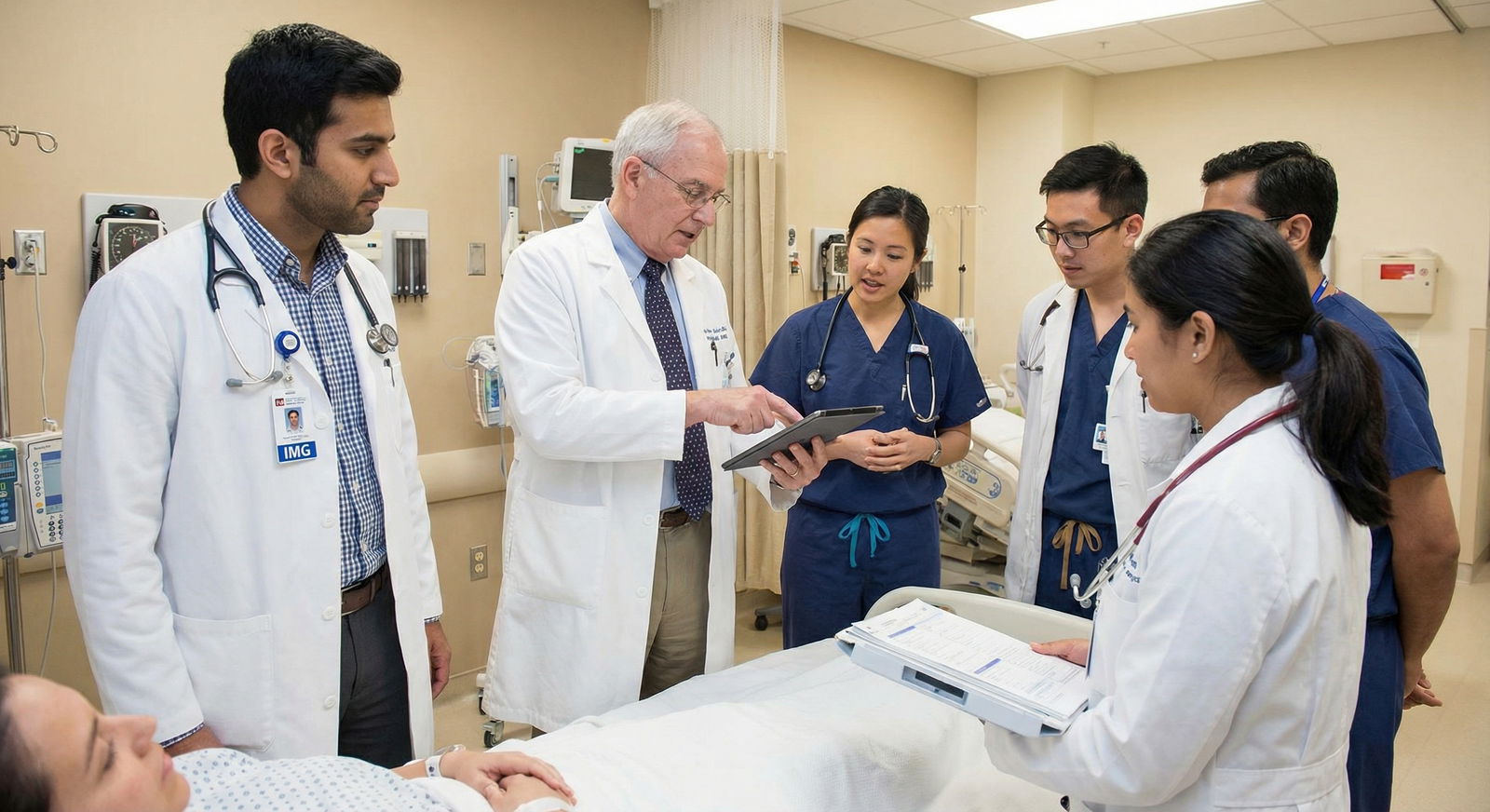
Strategic Execution: Maximizing ROI on Your USCE Experience
If you're going to spend the money and time, do it intelligently. Most applicants chase brand names. That's a mistake.
Academic centers look prestigious, but they often dilute your visibility. Too many learners. Too many layers. Too little direct contact with the person who will write your letter. You may leave with a famous hospital name and a forgettable evaluation. Community hospitals, on the other hand, often give you something far more valuable: access. More face time. More responsibility. More chances for an attending to actually know you.
That's the behind-the-scenes advantage nobody markets well. Community attendings who like you often advocate hard because they remember you clearly. You weren't one of fifteen rotating bodies. You were the person who showed up early, followed through, and made their day easier. That kind of advocacy is worth more than a logo on letterhead.
Use the rotation as reconnaissance. Watch how the program functions. Ask yourself who gets along, who teaches, who seems miserable, who supports residents, and whether this place actually fits your profile. Then follow up. Cold emailing after a successful rotation is far more effective than sending random messages into the void. In practical terms, your email is no longer cold. They have a face, a work ethic, and a memory attached to your name. That alone can double the response rate compared with blind outreach.
The letter strategy matters just as much as the rotation itself. Stop asking vaguely for "a strong letter." You need a letter with content. Ask your preceptor whether they can comment specifically on your patient presentations, documentation, communication, reliability, initiative, and level of clinical independence relative to expectations. Those details are what committees quote aloud. "Nice student" is useless. "Could function effectively in our emergency department with intern-level supervision" gets attention.
And for the love of strategy, do not disappear after the rotation ends. Send a thank-you note. Update them with your application timeline. Stay visible without becoming annoying. People support applicants they remember. That's not cynical. That's human.
The Bottom Line: Breaking the Cycle of Rejection
USCE is not a checkbox. It is a risk-reduction tool. That's the real story.
Programs are not asking whether you deserve a chance in some abstract moral sense. They are asking whether there is enough evidence to trust you in their system, with their patients, under their supervision. Hands-on USCE answers that question better than any exam score ever will.
If you keep applying without credible USCE in this market, you are not being brave. You are repeating a weak strategy and hoping the system suddenly gets sentimental. It won't. Hyper-competitive cycles punish uncertainty first, and IMGs without real US exposure sit directly in that danger zone.
So evaluate your file honestly. Not emotionally. If you lack hands-on USCE, make that the priority before the next cycle. Build the evidence. Get the right letters. Put yourself in a position where a reviewer doesn't have to guess.
That's the reminder you need to keep in front of you: the Match is a business transaction. Your job is to prove you can handle the product, patient care, inside the specific market of the US healthcare system. If you don't provide that proof, someone else will.


