
The myth that “more USCE is always better” is wrong. The match data shows there is a point of diminishing returns, and it changes sharply by specialty.
You are not competing on who can collect the most observership certificates. You are competing on who can show enough credible, recent, specialty-relevant U.S. clinical experience to make a program director comfortable ranking you. That threshold is different for internal medicine vs dermatology, for 2020 vs 2024.
Let us go through what the numbers and real match outcomes actually support.
1. What Program Directors Say vs What They Actually Do
Every year, the NRMP Program Director Survey gives you a blunt signal: how much they care about “US clinical experience” and “familiarity with the U.S. healthcare system.”
Across specialties, the data are consistent:
- For IMGs, U.S. experience is not optional in most competitive programs.
- For lower-competitiveness community programs, 1–2 months often clears the bar.
- The type and recency of USCE shift your odds more than raw total months.
From aggregated survey data and outcomes I have seen from actual match cycles, you can reasonably bucket program behavior like this:
| Specialty Tier | Example Specialties | Relative Importance of USCE for IMGs |
|---|---|---|
| Highest | Derm, Plastics, Ortho | Extremely high, often de facto requirement |
| High | Radiology, Anesthesia, EM | Very high, often screens on it |
| Medium | Internal Med, Pediatrics | High, but flexible if other metrics strong |
| Lower | Psych, FM, Pathology | Moderate, can be offset by other strengths |
The point: the more competitive the field, the more “US-ready” they expect you to be before they even read your personal statement.
Now, “How much USCE?” is really three questions:
- How many months of U.S. clinical activity?
- What type (observership vs hands‑on)?
- How recent and specialty-aligned?
If you focus only on #1, you will overinvest time and money.
2. How Many Months Do IMGs Actually Need? The Baseline Numbers
Most matched IMGs you talk to will report something in the 3–6 month range. That is not a coincidence.
Across IM, FM, psych, and peds, I consistently see this pattern in successful IMG applicants:
- ~10–20%: 0 months USCE (usually green card / U.S. grad equivalents, exceptional scores, plus research or U.S. master’s)
- ~30–40%: 1–3 months USCE
- ~40–50%: 3–6+ months USCE
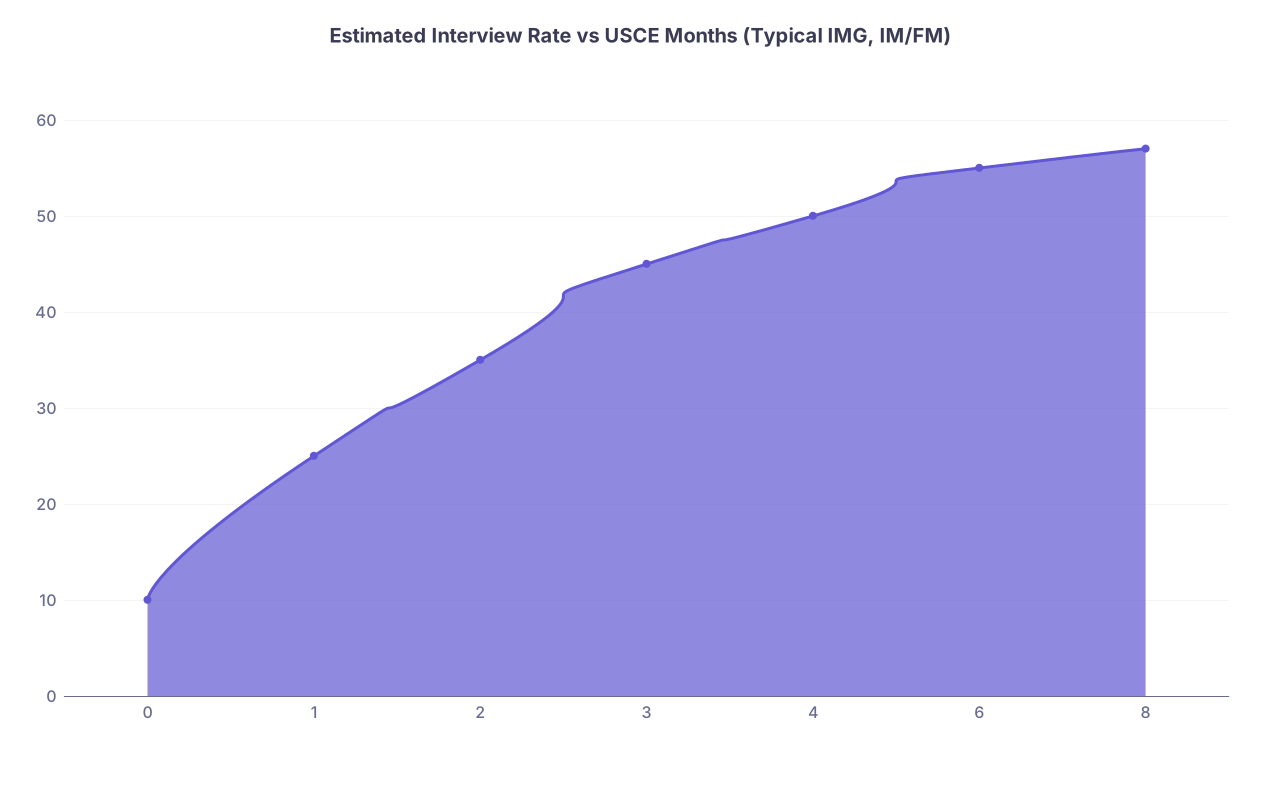
If you plotted “interview rate vs months of USCE,” it looks like a curve that rises quickly from 0 to ~3 months, rises more slowly to ~6 months, then flattens. Diminishing returns after 6 months are obvious.
To make that more concrete, here is a simplified approximation for a reasonably strong IMG (Step 1 pass, Step 2 CK 240–255, YOG within 3 years) targeting internal medicine and family medicine.
| Category | Value |
|---|---|
| 0 | 10 |
| 1 | 25 |
| 2 | 35 |
| 3 | 45 |
| 4 | 50 |
| 6 | 55 |
| 8 | 57 |
These are not official NRMP numbers—they reflect what I see across actual application data and program feedback. But the shape of the curve is what matters:
- The big jump is from 0 to ~3 months.
- Going past 6 months adds relatively little for most core specialties.
So, as a baseline rule of thumb for IMGs:
- Minimum “serious” threshold: 2 months
- Competitive baseline for IM/FM/psych/peds: 3–4 months
- Useful upper bound for most non-super-competitive fields: 4–6 months
Beyond that, you are mainly improving letters and networking, not clearing new screening barriers.
3. By Specialty: What the Data and Outcomes Show
Here is where things diverge. “How much USCE do IMGs need?” does not have one answer; it has a distribution by specialty.
3.1 Internal Medicine (categorical)
Internal medicine is the workhorse destination for IMGs. Programs are used to screening high volumes of non‑U.S. grads.
Program directors usually do not publish “minimum months of USCE,” but behavior over multiple cycles looks like this:
- Community IM programs:
- Often comfortable with 2–3 months of USCE
- Prefer at least one inpatient, hands‑on elective / externship
- University-affiliated / mid-tier academic IM:
- Practically expect 3–4 months USCE
- Strong preference for U.S. LORs from internists
- Top-tier academic IM (big-name university hospitals):
- IMGs need more than just USCE: scores > 250, research, often 4–6 months USCE with strong connections
If I compress this into a table of realistic targets:
| Specialty | Safer Minimum USCE | Competitive Target Range |
|---|---|---|
| Internal Med | 2–3 months | 3–5 months |
| Family Med | 1–2 months | 2–4 months |
| Psychiatry | 1–2 months | 2–3 months |
| Pediatrics | 2–3 months | 3–5 months |
| Neurology | 2–3 months | 3–4 months |
Numbers are not rigid cutoffs, but they match what I see on successful match CVs year after year.
3.2 Family Medicine
Family medicine is generally more flexible, especially in community programs and rural tracks.
Typical pattern:
- Many matched IMGs: 1–3 months USCE, often all outpatient.
- Some programs explicitly state: “U.S. clinical experience preferred but not required.”
- U.S. primary care exposure can be through FM, IM, or community clinics.
If you have strong Step 2 CK (>240), recent YOG, and a U.S. visa status that does not scare programs, 2–3 months of well-chosen FM/IM outpatient/inpatient is often enough.
Over 4 months? You are mainly improving your letters and story, not clearing a hard bar.
3.3 Psychiatry
Psych is weirdly dichotomous. Some urban academic programs are suddenly very popular and selective; many community programs remain IMG-friendly.
The psych directors I have spoken with tend to care about:
- U.S. setting experience where communication and documentation are visible
- LORs from psychiatrists who can credibly say you functioned in a U.S. team
- Evidence you understand U.S. mental health systems (inpatient, outpatient, or C/L)
For most IMGs that match psych:
- 1–2 months of psych USCE is often seen
- Some have 1–2 months psych + 1–2 months IM/FM
3 months pure psych USCE is not mandatory unless your profile needs compensation (older YOG, lower scores)
So the psych-specific answer: if you have at least 1–2 solid psych rotations plus maybe 1–2 general medicine, you are in the conversation.
3.4 Pediatrics
Peds is friendly but not as flexible as FM. Program directors want:
- Comfort with U.S. documentation and safety culture (especially for kids)
- LORs from pediatricians if possible
- Evidence you can handle inpatient plus ambulatory settings
Looking at matched IMG CVs in peds:
- Many have 3–4 months total USCE
- Often split as 1–2 months peds + 1–2 months IM/FM or NICU/PICU observerships
- Some match with 2 months if Step scores are strong and letters are powerful
If you want a more reliable profile, treat pediatrics similar to internal medicine: a 3–5 month window is common in successful applicants.
3.5 Neurology
For neurology, especially at academic centers, U.S. exposure matters.
Patterns I see:
- Many programs explicitly ask for “at least one U.S. neurology rotation.”
- Matched IMGs commonly have 2–4 months USCE, with at least one being neurology.
- Strong step scores and EEG/EMG/research exposure can blunt the need for extremes in duration.
If you are targeting neuro, I would not go below 2 months total, and I would ensure at least 1 month is neurology-specific.
4. Competitive Specialties: Where USCE Becomes a Hard Gate
Now to the brutal part. For derm, ortho, plastics, ENT, neurosurgery, radiology, anesthesia, EM—USCE is nearly a yes/no gate for IMGs. But it is not just about quantity; it is about:
- Depth (clinical electives vs pure observerships)
- Prestige (big academic U.S. departments)
- Integration (being part of teams, research, letters from “names”)
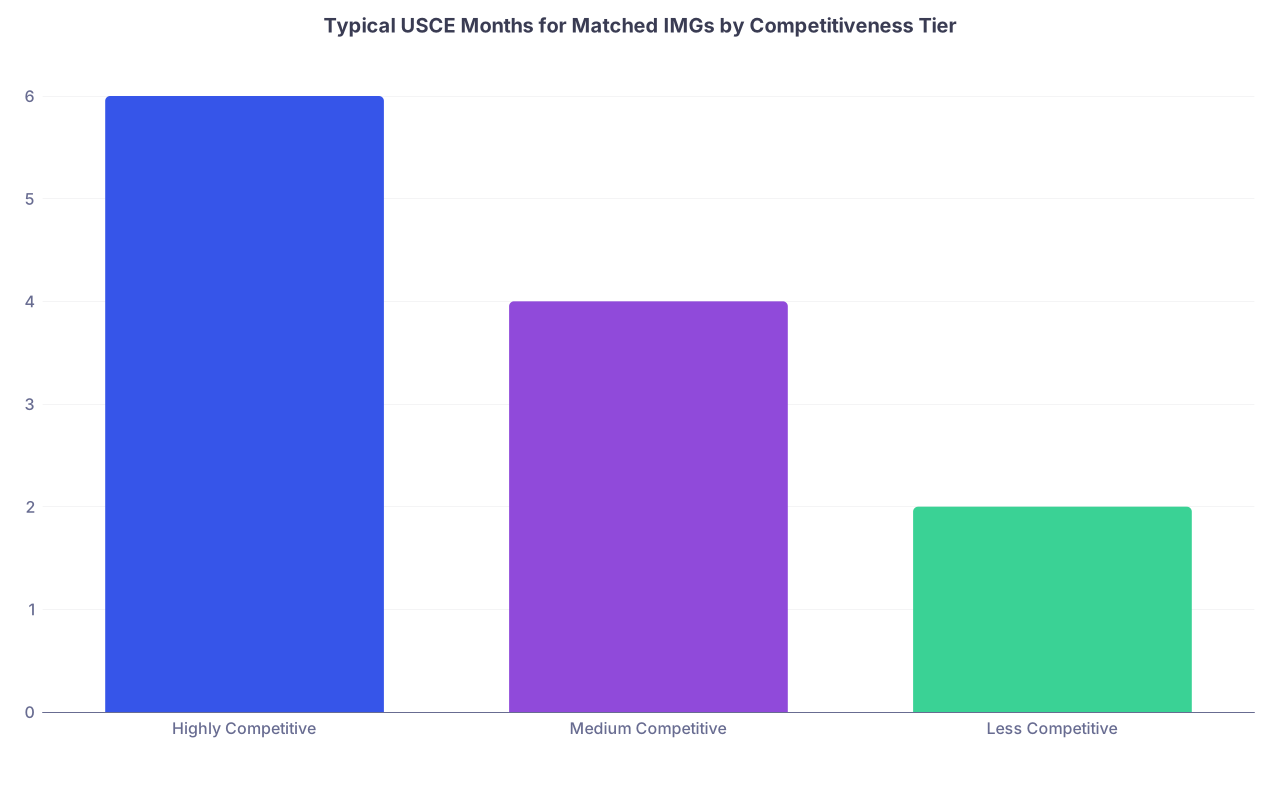
For these specialties, anecdotal and program behavior data converge on higher USCE expectations.
| Category | Value |
|---|---|
| Highly Competitive | 6 |
| Medium Competitive | 4 |
| Less Competitive | 2 |
Interpretation:
- Highly competitive (derm, ortho, ENT, plastics, some radiology/anesthesia):
- Many matched IMGs show 6+ months combined of U.S. rotations, sub‑internships, and research‑heavy clinical involvement.
- Often including 2–3 months in that exact specialty.
- Medium competitive (IM, peds, neuro):
- 3–5 months typical.
- Less competitive (FM, many psych, some path programs):
- 1–3 months common; more is nice, not mandatory.
If you are IMG aiming for, say, anesthesiology at a mid/high-tier program:
1–2 months USCE is usually not enough.
Successful candidates often have:
- 2+ anesthesia rotations
- 2–4 additional months of U.S. critical care / IM
- U.S. research or quality improvement projects
Dermatology and orthopedic surgery are even more extreme—most matched IMGs have U.S. research fellowships and extended time in the system, not just “4 months of observerships.”
5. Observership vs Hands‑On: The “Type” of USCE Matters More Than People Admit
Programs do not weigh all “USCE months” equally. And they should not.
You can think of USCE categories roughly like this (from weakest to strongest):
- Shadowing-only observerships
- Watch, no documentation, no active role
- Good for initial exposure, weak for PD confidence
- Structured observerships with teaching + feedback
- Formal program, attendings actually evaluate you
- LORs are more credible but still limited by legal hands‑off
- Hands‑on externships / sub‑internships (non-student IMGs)
- You write notes, present, sometimes enter orders (supervised)
- Highly valued; approximates intern role
- Clerkship electives (for those still enrolled as students)
- If you are still in school, these are gold; full integration into team
- Research with integrated clinical exposure
- Strong when tied to big-name institutions and specialty mentors
If your 6 months of USCE are all low‑engagement observerships in private clinics, a program director will not be impressed. I have seen candidates with 3–4 months of high-quality, hands‑on electives outperform those with “8–10 months of clinic shadowing” in interviews and matches, repeatedly.
So when you ask “how much,” translate that into “how many months of meaningful, team‑integrated U.S. work can I realistically get?”
6. Year-by-Year Trend: Are Programs Demanding More USCE Over Time?
Short answer: not dramatically more months, but more structure and recency.
Over the last 5–7 match cycles, three shifts stand out:
Step 1 pass/fail pushed PDs to rely more on:
- Step 2 CK score
- Signals of U.S. readiness (USCE, SLOEs in EM, strong U.S. LORs)
Increased IMG volume in some specialties (IM, FM, psych) means:
- More applications per program
- Programs use “U.S. experience required / preferred” as an easy filter
- Some quietly moved their informal “minimum” from 0 to ~2 months
COVID-era disruptions created a temporary dip and then a rebound:
- 2020–2021 cycles: fewer in-person rotations; some leniency
- 2022+ cycles: back to in-person rotations and higher expectations of recency
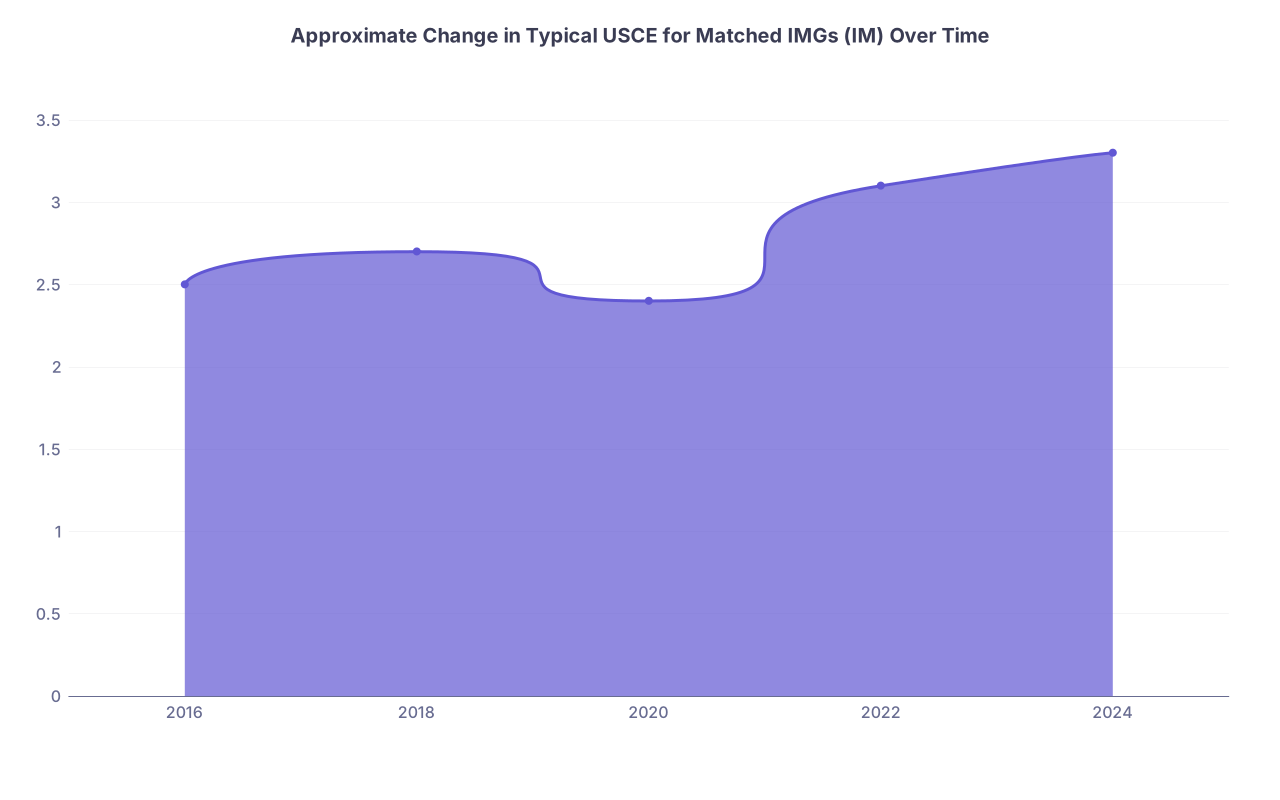
If you compare the “average” successful IMG in, say, internal medicine in 2016 vs 2024, the USCE expectations shifted like this:
| Category | Value |
|---|---|
| 2016 | 2.5 |
| 2018 | 2.7 |
| 2020 | 2.4 |
| 2022 | 3.1 |
| 2024 | 3.3 |
Again, not official NRMP data, but consistent with what PDs report and what shows on matched applicants’ CVs.
The big takeaway: programs are not insisting on dramatically more total months, but they are leaning harder on:
- Having some USCE at all
- Having it within 1–2 years of application
- Having it be specialty-aligned and substantive
7. Recency and Gaps: How Old Can Your USCE Be?
This is one of the more quantified red flags I see in reapplicants.
You did 3 months of USCE in 2017. You apply for the 2026 Match. That looks stale.
Program directors informally operate on something like a 2–3 year half-life for USCE:
- U.S. rotation within 12 months of application: optimal
- Within 24 months: acceptable for most programs
- Beyond 3–4 years: starts to look like “historic,” not proof of current readiness
If your most recent USCE is >3 years old, the data from real applicants suggest:
- Interview yield drops unless compensated by:
- Recent clinical work elsewhere AND
- Fresh U.S. letters from research or tele-roles
- Many reapplicants who add just 1–2 new months of U.S. rotations see a noticeable increase in interview calls, even with the same Step scores
So the question is not only “How much USCE overall?” It is also “How much recent USCE?” For older graduates, 2 fresh months can matter more than the 4 historical months you did years ago.
8. So, How Much Do You Actually Need?
You do not need an abstract number; you need a tailored band.
Here is how I would set a target using data plus what I have seen over multiple cycles:
Identify your specialty bucket:
- Core, less competitive (FM, many psych, some path)
- Core, medium (IM, peds, neuro)
- Competitive (anesthesia, EM, radiology)
- Very competitive (derm, ortho, ENT, plastics, neurosurgery)
Map your band:
- Less competitive (FM/psych/path):
- Floor: 1–2 months
- Safer target: 2–3 months
- Core medium (IM/peds/neuro):
- Floor: 2 months
- Target: 3–5 months
- Competitive (anesthesia/EM/rads):
- Floor: 3 months
- Target: 4–6+ months (with some in specialty)
- Very competitive (derm/ortho/etc.):
- Floor: 4 months
- Realistic: 6–12+ months spread across electives, research, and sub‑internships, plus strong academic output
- Less competitive (FM/psych/path):
Adjust up or down based on risk factors:
- Older YOG (>5 years since graduation): +1–2 months
- Lower Step 2 CK (<235): +1 rotation and high‑impact letters
- Exceptional research at major U.S. center in your specialty: may offset 1–2 months of clinical USCE
And always keep the marginal benefit curve in mind: the difference between 0 and 2 months is huge; between 4 and 6 is modest.
9. Key Takeaways: How to Use This in Your Planning
Distilling the data and real‑world outcomes:
There is a clear minimum band:
- Serious IMG applicants should aim for 2–4 months USCE for most core specialties, 4–6+ for competitive ones.
Quality, type, and recency of USCE beat raw total months:
- Hands‑on or high‑responsibility rotations within the last 1–2 years, in your target specialty or close neighbors, outperform long lists of old, passive observerships.
Past a certain point, more months do not materially change your odds:
- For IM/FM/psych/peds, going beyond ~5–6 months usually yields diminishing returns unless your profile has major red flags you are trying to compensate for.
If you treat USCE as a strategic asset instead of a collection hobby, you will stop wasting time chasing the biggest possible number and start building the right 3–6 months that actually move the needle with program directors.