
Paid USCE does not automatically hurt your credibility. The panic about it is louder than the evidence.
Let me be blunt: a lot of what you hear about “never do paid USCE, it looks desperate” is regurgitated forum folklore, not program data. Residents in U.S. hospitals right now matched with paid observerships, paid externships, paid “hands-on” experiences, and every weird branding term in between.
So the real question is not “Is paid USCE bad?”
The real question is: “What kind of USCE looks fake, low-quality, or lazy in the eyes of program directors—and what actually helps you?”
Let’s cut through the noise.
What Program Directors Actually Care About (Not Your Receipt)
You know what’s never on a rank list meeting slide deck?
A column labeled “Did they pay for their observership: YES/NO”.
Program directors don’t sit there asking, “Was this free?” They ask:
- Was this real patient-care exposure in the U.S. system?
- Was this supervised by someone I trust (or at least someone who writes a coherent letter)?
- Does the applicant’s experience match the story they’re selling in their personal statement and interview?
- Does the letter show clinical competence, reliability, and some sign they won’t implode on busy call nights?
If your experience answers those questions positively, the fact that you paid for coordination or access is peripheral at best.
What does raise eyebrows:
- Four “observerships” all in tiny private clinics, all 2 weeks long, all clearly cookie-cutter.
- Letters that read like a form: “I had the opportunity to know Dr. X for 2 weeks. She was punctual and respectful.” That’s not an endorsement; that’s a participation ribbon.
- Experiences that sound great on paper but fall apart when you talk about them in an interview. I’ve watched someone claim “substantial inpatient experience” and then blank on basic rounds workflow questions.
Program directors judge you on substance and coherence, not the payment model.
Myth: “Paid USCE Is Automatically Red-Flagged”
This one’s just wrong.
There is no NRMP rule, ACGME rule, or secret PD committee memo that says: “Paid rotations = automatic red flag.” It does not exist. What you have are individual opinions.
Let’s look at what does show up in data and annual PD surveys:
- Program directors consistently emphasize:
- Recent clinical experience in the U.S. (often within 1–3 years)
- U.S. letters of recommendation from their specialty
- Proof you understand the U.S. system: EMR, notes, handoff, team dynamics
- They rarely, if ever, distinguish between “paid” and “unpaid” when describing USCE.
They do distinguish between:
- University-affiliated vs. non-affiliated community experiences
- Inpatient vs. outpatient only
- Hands-on vs. purely shadowing
- Duration and recency
- Quality of letters
So where does the fear come from? Mostly from:
- Forums where one anonymous PD comment gets repeated 10,000 times as gospel.
- IMGs tearing each other down with “You paid? That’s unethical” as if the U.S. system itself isn’t already pay-to-play at every level.
Is there a PD out there who personally dislikes paid rotations? Absolutely. There are also PDs who think any IMG with more than a 1-year gap is untrainable. The existence of extreme opinions doesn’t turn them into universal rules.
The Real Risk: Low-Value, Cookie-Cutter Rotations
Paid USCE is not the problem. Garbage USCE is.
The worst offenders share certain traits:
- Zero academic or hospital affiliation. Address is a strip-mall clinic.
- “Guaranteed letter” advertised on the website. Huge red flag.
- Rotations stacked: one preceptor taking 5–10 observers at once. Nobody gets seen, let alone supervised.
- Activities are basically: sit in the corner, watch, maybe peek in the EMR if you’re lucky, and leave at noon.
That’s where your credibility starts to crumble. Not because you paid, but because:
- You cannot talk meaningfully about inpatient workflow, interdisciplinary communication, or EMR documentation.
- Your letters are vague and generic because the attending barely knows you.
- Your experiences look obviously transactional—4 × 4-week “rotations” all coordinated by the same third-party vendor, all with nearly identical duties.
Meanwhile, there are paid rotations that are structured, demanding, and legitimate:
- Direct hospital-based electives for IMGs with specific fees (e.g., admin/insurance/processing).
- Community hospitals that charge visiting IMGs because they’re not subsidized like medical schools.
- Proper “hands-on” externships where you present patients, write notes (which are co-signed), give SBAR handoffs, and attend didactics.
Those can absolutely boost your application if they generate strong letters and real stories.
Paid vs Unpaid: The Part Everyone Gets Backwards
Let’s line it up like adults instead of panicking like Reddit threads.
| Factor | Matters to PDs More Than Paid/Unpaid? |
|---|---|
| Inpatient exposure | Yes |
| Specialty-relevant | Yes |
| Strong LoRs | Absolutely |
| Recent (within 1–3y) | Yes |
| Academic affiliation | Often |
| Whether you paid | Rarely, and mostly indirectly |
The irony: a lot of “unpaid” experiences are still transactional—just the transaction is hidden. You:
- Have family or community connections that get you into a hospital
- Take up a slot because someone in admin “owes” someone else a favor
- Provide free labor or research grunt work in exchange for access
Is that morally better than paying a transparent rotation fee? Disguised privilege is still privilege.
From a PD’s perspective, what you did matters more than how you arranged it.
You’ll never be asked in an interview: “Did you pay a fee for that rotation?”
You will be asked: “Tell me about a complex patient you managed during your U.S. experience” or “How does U.S. inpatient care differ from your home system?”
That’s where applicants sink or swim.
Where Paid USCE Can Quietly Backfire
There are ways paid USCE can hurt you. None of them are about the payment. All of them are about pattern and optics.
1. Your whole CV screams “all I did was buy stuff”
I’ve seen this:
- Paid research program.
- Paid USCE × 4.
- A personal statement about “passion for underserved care” with zero long-term unpaid commitment anywhere.
It looks like a shopping list, not a career trajectory. Programs start wondering: if nobody ever chose to work with you unless money changed hands, what does that say?
2. You stacked too many short, thin rotations
Four different 2-week observer posts across random specialties: cardiology, dermatology, GI, neurosurgery. That doesn’t show exploration; it shows panic and poor planning.
Far better:
- 8–12 weeks in core specialty + 4–8 weeks in closely related areas.
- One or two settings where someone got to know you well enough to write a meaningful letter.
3. Your letters expose the truth
Attending letters betray bad rotations instantly. Phrases like:
- “Dr. X observed our practice and was respectful and punctual.”
- “I had limited opportunity to directly assess Dr. X’s clinical skills, but…”
Translation: we barely know this person; they were a shadow.
You can pay $3,000 for that letter. It’s still useless.
How Programs Actually Read USCE on Your Application
Here’s how it plays out in real life when a PD or faculty skims your ERAS.
They glance at your Experience section.
They look for: U.S. hospital names, recognizable institutions, or at least real hospitals (not just outpatient “medical centers”).They check dates.
Chronic old experience with nothing recent? Problem. A solid 4–12 weeks of recent U.S. exposure in or near their specialty? Good.They cross-match with specialty choice.
You’re applying to internal medicine but all your USCE is dermatology and radiology? They question your commitment or your understanding of the field.They read the letters from those rotations.
This is where the rotation lives or dies. Strong IM letters from U.S. attendings offset a lot of other weaknesses. Weak, generic letters do the opposite.
At no point are they sorting applicants by “those who paid” vs “those who didn’t.” They don’t even have that data unless you volunteer it.
How to Judge a Paid USCE Before You Burn Money
Here’s where you should be ruthless. If you are going to pay, then the rotation had better deliver.
Before you commit, you want clear answers to questions like:
- Is this rotation directly through a hospital or university, or purely via a third-party middleman?
- Is there inpatient exposure, or is this exclusively outpatient clinic? If outpatient only, will I at least see bread-and-butter pathology relevant to my specialty?
- What’s the max number of observers/externs per attending at a time? More than 2–3 is already suspicious.
- Will I be expected to present patients, give assessments/plan, participate in notes, or is it shadowing only?
- Do previous IMGs from this program actually match, and into what? You’re not buying a name. You’re buying outcomes.
If the coordinator can’t answer these clearly, or only talks about “certificates” and “guaranteed letters,” walk away.
You are not buying paper. You are buying environments that will produce stories, skills, and letters.
Hands-On vs Observership: Where Paid Makes a Difference
Some of the strongest defensible use of paid USCE is when payment is essentially your access ticket to real participation.
For example:
- A small community hospital that lets IMGs present on rounds, write draft notes, and be part of handoff, but charges a fee to cover malpractice, admin, EMR training, and supervision time.
- A structured externship where you’re assigned your own list of patients (under close supervision), attend didactics, and are evaluated with formal feedback.
If you can articulate in an interview:
- How you learned to structure a SOAP note in Epic or Cerner
- How you adjusted to short U.S.-style outpatient visits
- How your approach to documentation and communication changed
You’ve already done more than most who just lurk behind an attending and collect a letter.
USCE, Money, and the Ugly Double Standard
Let me address the hypocrisy head-on.
- U.S. med students pay tens of thousands per year in tuition that covers, among other things, their clinical rotations. Nobody calls that “unethical.”
- Visiting students from other U.S. schools pay fees for away electives. Nobody questions their credibility.
- IMGs pay for visa processing, exams, prep courses, document services, travel, and then are suddenly told that paying for structured USCE is “wrong.”
If you feel like the system is fine with your money everywhere except when it gives you a fair shot—that’s because, yes, there is a bias.
Your job is not to fix the system. Your job is to use it strategically without looking naive, fake, or bought.
Paid USCE is a tool. Tools can be used well or badly. The ethics debate is often a smokescreen for people who are uncomfortable that others are buying what they got through connections.
Quick Reality Check: What Actually Hurts Credibility More Than Paid USCE
If you’re going to worry, worry about the right things. These damage you more than paying for a rotation ever will:
- Obvious gaps in clinical activity with no explanation.
- Mismatch between your stated specialty interest and your actual experiences.
- Incoherent interview answers when asked about your “hands-on” experience.
- Weak LoRs that say nothing specific about your performance.
- Unprofessional behavior or poor communication during the rotation (yes, those stories travel).
Paid USCE, even if someone frowns about it privately, is not what gets you filtered out most of the time.
A Brief Data Snapshot: What Matters More
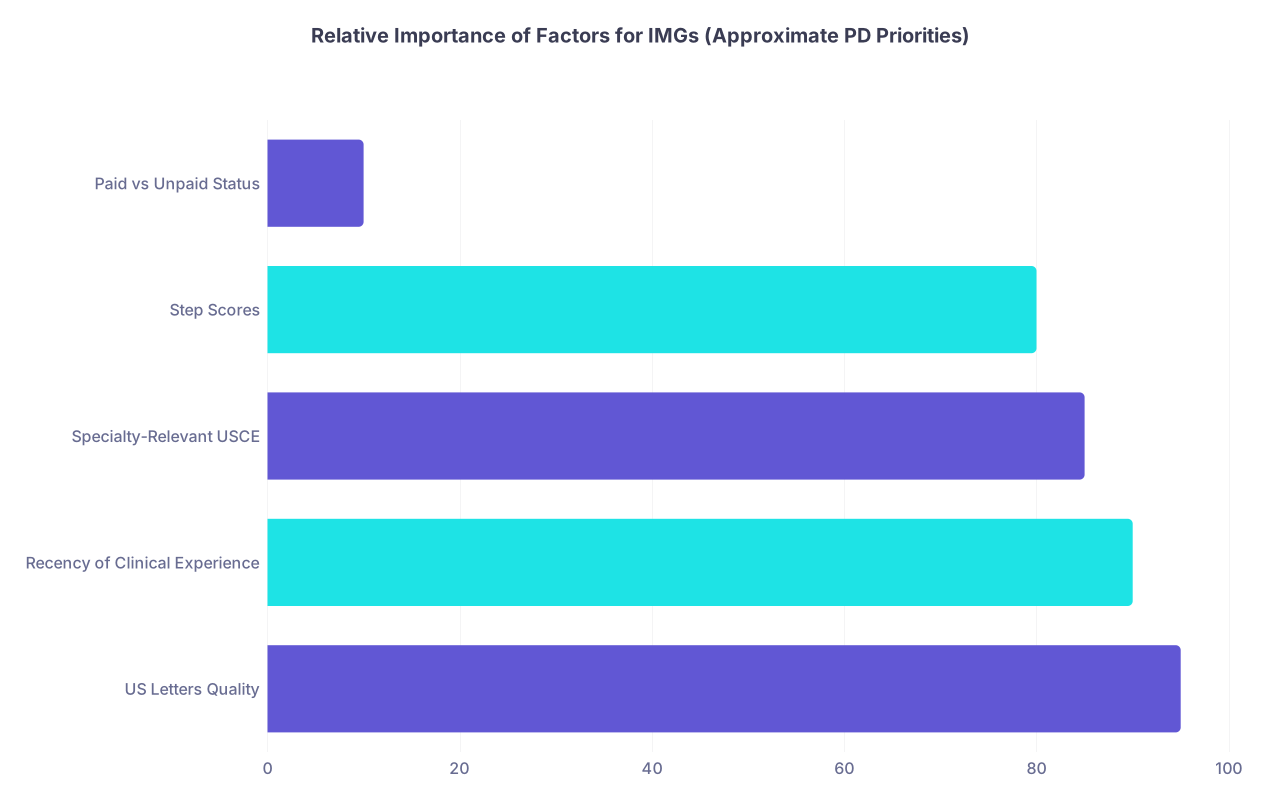
| Category | Value |
|---|---|
| US Letters Quality | 95 |
| Recency of Clinical Experience | 90 |
| Specialty-Relevant USCE | 85 |
| Step Scores | 80 |
| Paid vs Unpaid Status | 10 |
Is this exact? No. But talk to enough faculty and you’ll see the pattern. They care about whether you can function safely and sanely in their system. Not whether your rotation had a processing fee.
How to Talk About Paid USCE If It Ever Comes Up
On the tiny chance someone implies or asks indirectly about it, you answer from strength:
- Emphasize what you did and what you learned.
- Highlight any feedback, evaluations, or specific skills you gained.
- If someone digs about payment (rare), treat it like paying for a sub-internship fee: “Yes, like most visiting rotations there was a program fee to cover admin and liability, but what mattered to me was the chance to [X, Y, Z].”
Do not sound defensive. Do not overshare. You’re not on trial.
The Bottom Line
Let’s strip it to the essentials.
- Paid USCE doesn’t inherently hurt your credibility. Poor-quality, superficial, obviously transactional USCE does—whether you paid or not.
- Program directors care far more about recency, specialty relevance, inpatient exposure, and the strength of your U.S. letters than about whether your rotation had a fee attached.
- If you’re going to pay, be ruthless: buy depth, structure, responsibility, and real mentorship—not a certificate and a template letter.
Use paid USCE as a scalpel, not a shopping spree. If it gives you real skills, authentic stories, and strong letters, it’s an asset—not a liability.