
Program directors do not read your USCE letters the way you think they do.
They are not looking for compliments. They are looking for evidence — and for red flags that your letter writers did not intend to send but absolutely did.
I have sat in those rank meetings where a single phrase from a USCE letter quietly killed an IMG’s chances. I have also seen an average-looking application get bumped into the “interview no matter what” pile purely because of how one attending framed their letter.
You will not hear this from the shiny webinar crowd. But this is what actually happens.
How PDs Really Use Your USCE Letters
Let’s start with the ugly truth: most letters are skimmed, not studied.
On a first pass, many PDs or associate PDs will glance at:
- Who wrote it
- Where it’s from
- How long you worked with them
- A few key phrases in the first and last paragraphs
That’s it. Ten to twenty seconds.
Only if you clear that first “do I care?” filter does your letter get a deeper read.
So what are they really trying to infer?
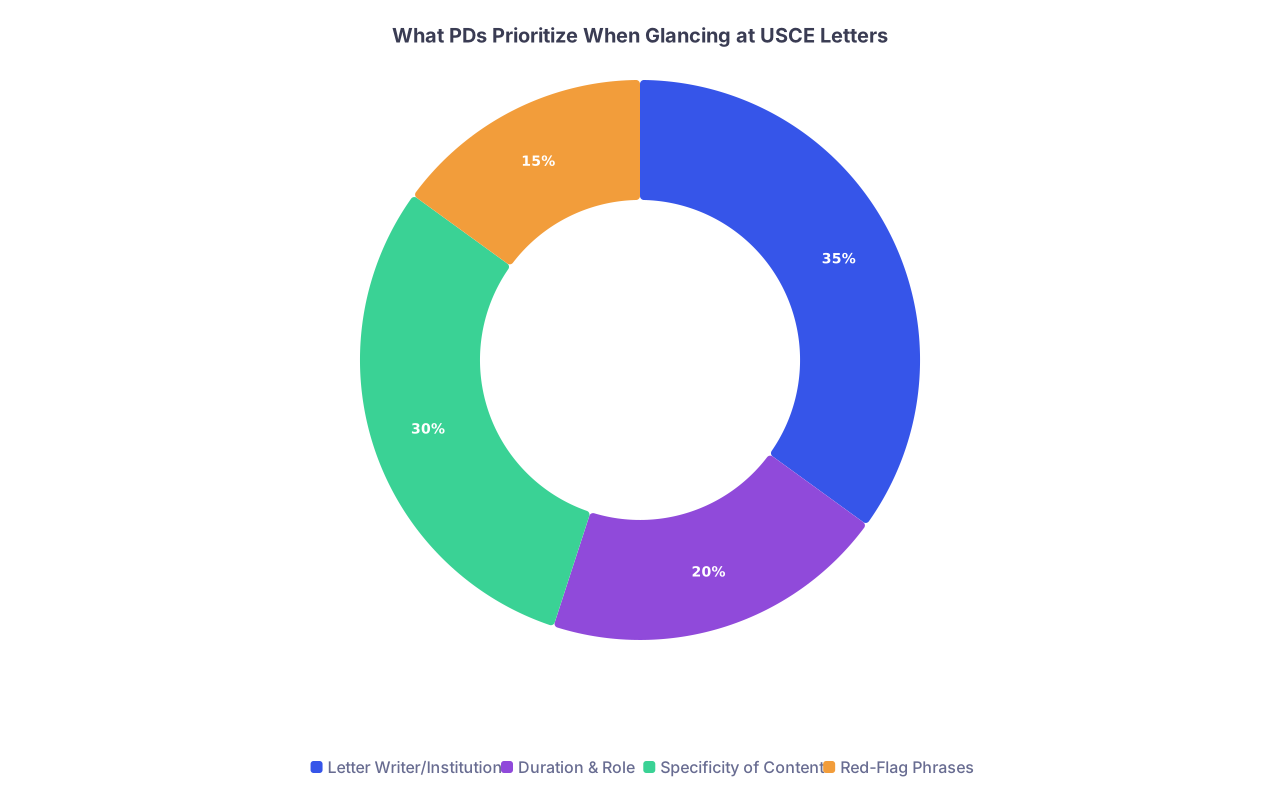
| Category | Value |
|---|---|
| Letter Writer/Institution | 35 |
| Duration & Role | 20 |
| Specificity of Content | 30 |
| Red-Flag Phrases | 15 |
They want to know:
- Are you safe to put in front of patients?
- Will you survive call nights without imploding?
- Are you teachable, or are you going to be a headache?
- Did a real US clinician actually see you do real work?
Your USCE letters are their main “on the ground” proof of those four things. The rest is decoration.
The Three Silent Tiers of USCE Letters
No one announces this to applicants, but inside faculty rooms, letters are mentally sorted into tiers almost instantly.
| Tier | PD Reaction | Interview Impact |
|---|---|---|
| Gold | "We want this one" | Strong positive |
| Silver | "Seems fine" | Neutral to mild positive |
| Red Flag | "Not worth the risk" | Strong negative |
1. Gold Tier: The “We Want This One” Letter
This is the letter that gets read out loud in rank meetings.
What it usually contains:
- A clear statement of enthusiastic support
- Concrete, specific clinical examples
- Direct comparison to US grads
- Evidence of reliability and ownership
You’ll see language like:
- “I would rank this candidate in the top 10% of all students I’ve supervised in the last 10 years, including our own medical students.”
- “He independently pre-rounded on 8–10 patients, synthesized plans, and his assessments were consistently accurate and actionable.”
- “We would be thrilled to have her as a resident in our program.”
Notice what’s happening there. They’re not just saying “hard worker” or “good team player.” They are taking a position and staking their reputation on you.
What PDs infer from a Gold-tier letter:
- You’ve actually functioned in a US system, not just shadowed.
- An attending took a real risk putting their name on you. That matters.
- You’re less likely to be a disaster when left on night float with a cross-cover pager.
If your application is borderline anywhere else — average Step 2, no research — a Gold letter from a solid US institution can still drag you into the interview pile. I’ve seen it done.
2. Silver Tier: The “Seems Fine” Letter
This is where most IMG USCE letters live.
They are “good” but not memorable. They sound like this:
- “She was punctual, enthusiastic, and eager to learn.”
- “He worked well with the team and was well-liked by patients.”
- “Overall, I believe she would be a solid addition to any residency program.”
Nothing wrong. Nothing great. It’s the letter equivalent of a B+ rotation.
What PDs infer:
- You’re probably safe. Not obviously problematic.
- You didn’t stand out enough to trigger over-the-top praise.
- You likely functioned more as an extra pair of hands than as a near-intern.
With enough Silver-tier letters and decent scores, you can absolutely match. But they will not carry you if other parts of your app are weak.
3. Red-Flag Tier: The “Not Worth the Risk” Letter
No one writes, “Do not rank this person.” They do something worse. They signal it.
Red-flag letters are not usually openly negative. They are subtly damning. They sound…polite. Chilly. Vague. Sometimes weirdly short.
You’ll see:
- “He completed his assigned tasks when reminded.”
- “Although there were some challenges early in the rotation, she showed improvement over time.”
- “With appropriate supervision, he can contribute meaningfully to patient care.”
Translation in PD brain: this person is a project, not a resident.
One phrase I heard discussed in a rank meeting:
“English is not his first language, but he makes an effort to communicate with patients.”
The room went silent for a second. Someone said, “So…they’re telling us he struggles to communicate.” Nobody argued. He got dropped.
What PDs Really Read Between the Lines
Let me walk you through how a PD actually “reads” common phrases in IMG USCE letters. Because the literal words are not the point; the subtext is.

Code Words for “Excellent”
These phrases raise eyebrows in a good way:
- “Top X% of students/residents I’ve worked with” — Strong signal. The smaller the percentage and the longer the attending’s time frame (e.g., “in 15 years of teaching”), the more weight it carries.
- “As strong as, and in some cases stronger than, our own US medical students” — For an IMG, that’s basically gold-plating. It tells the PD: this person can hang with our MS4s.
- “Required minimal supervision” — For a student or observer, this means you were safe, thoughtful, not reckless. They trust your judgment.
- “I would have no hesitation matching this candidate to our residency” — That last phrase is not thrown around lightly. When PDs see it, they take notice.
What PDs infer:
You elevated the team. You weren’t just “fine,” you were useful.
Code Words for “Average”
These are the “filler” phrases PDs mentally discount:
- “Hardworking and punctual” — Baseline expectation, not a compliment. That’s like saying a pilot “showed up to the airport.”
- “Eager to learn” — Usually what people say when they cannot comment on actual performance.
- “Got along with everyone” — Again, expected. Also sometimes used when there’s nothing else they can praise.
- “Will make a good resident” — Soft. Non-committal. No risk.
What PDs infer:
You didn’t screw up. But you didn’t move the needle.
Code Words for “Concerning”
This is where IMGs get blindsided, because on the surface these comments do not look terrible.
Read carefully:
- “Improved over time” — Means they were worried at the beginning. Period.
- “With continued practice, his clinical reasoning will further develop” — Translation: weak clinical reasoning now.
- “Used translation services appropriately” when the rest of the letter is vague — Often PDs will hear: “struggles with direct communication.”
- “Asked for help often” — If not followed by “appropriately,” it suggests insecurity or inability to work independently.
- “Better suited for a program that can provide close supervision and support” — This is as close as you’ll see to, “Do not send this person to a high-volume, high-acuity program.”
What PDs infer:
Risk. Potential need for remediation. Possibly professionalism or communication problems that did not make it onto paper directly.
Prestige, Proximity, and Power: Who Wrote Your Letter Matters
You already know that a letter from “Dr. Big Name, Harvard” carries weight. But you probably misunderstand how that weight plays out.
| Letter Writer | PD Reaction | Common Use |
|---|---|---|
| PD/APD of US Program | Very high trust | Tie-breaker, risk assessment |
| Core teaching faculty at academic hospital | High | Confirms readiness |
| Community attending who teaches often | Moderate | Character and work ethic |
| Private clinic preceptor with no teaching role | Low | Needs strong content to matter |
Here’s what PDs quietly infer based on who signed your USCE letter:
Letters from PDs/APDs
If a program director or associate PD wrote your letter:
- They understand exactly what residency requires.
- PDs at other institutions know that. So their words are weighted heavily.
- A strong letter from a PD can rescue an average Step 2 score. A lukewarm letter from a PD can quietly sink you.
Behind closed doors, someone will say, “Their PD called them ‘average’ — that makes me nervous.” And that is often that.
Letters from Core Teaching Faculty
This is your bread and butter. Attending physicians at academic or teaching hospitals who regularly supervise residents and students. Their letters matter a lot when they clearly describe:
- Your role on rounds
- Your ability to function as a sub-intern
- How you interact with residents and nurses
If they compare you to their own med students or interns, PDs listen.
Letters from Purely Outpatient / Private Practice Settings
These are not useless, but the default assumption is: “Less pressure, less acuity, less tested.”
So if all your USCE is clinic-only with generic “very nice, very polite” letters, and you are applying to a busy inpatient-heavy program, do not expect that to impress anyone. They want to know if you can swim, not just be pleasant in an exam room.
Length, Specificity, and Tone: The Stuff PDs Notice Without Admitting It
Nobody says this out loud, but it’s true: the shape of the letter tells as much of a story as the words.
Length
- Half-page, vague letter: PDs assume the writer barely knows you, or had concerns and kept it minimal.
- One to one-and-a-half pages with detailed examples: Normal, healthy, solid.
- Two pages packed with specifics: Either you’re stellar or the writer is naturally verbose. PDs still like seeing detail.
One-sentence “To whom it may concern, he did a rotation here and was good” letters? Death. I have literally seen a PD say, “If that’s all they had to say, we’re done.”
Specificity
Watch what PDs latch onto:
- Did the letter mention actual patient encounters?
- Did it describe your presentations?
- Did it explicitly mention US-style skills: writing notes, using EMR, following up labs, calling consults?
When they see specifics like “She pre-rounded on 8 patients and presented them succinctly on rounds with accurate plans,” they infer you’ve done near-intern level work.
Vagueness is poison. “He participated in patient care and showed good knowledge” tells them nothing.
Tone
Faculty do not think they’re transparent, but they are. PDs pick up tone instantly:
- Warm, confident, owns their praise → Trustworthy.
- Flat, formulaic, feels like a template → Possibly a favor letter, not earned.
- Stiff, oddly formal, with hedging (“may,” “could,” “potential”) → Hesitation = risk.
Whenever I saw, “I believe, given the right environment, he could develop into a competent resident,” everyone in the room understood the message: not competent yet.
The USCE Context: What Your Rotation Setup Tells Them
PDs do not just read the letter. They read your pattern of USCE.
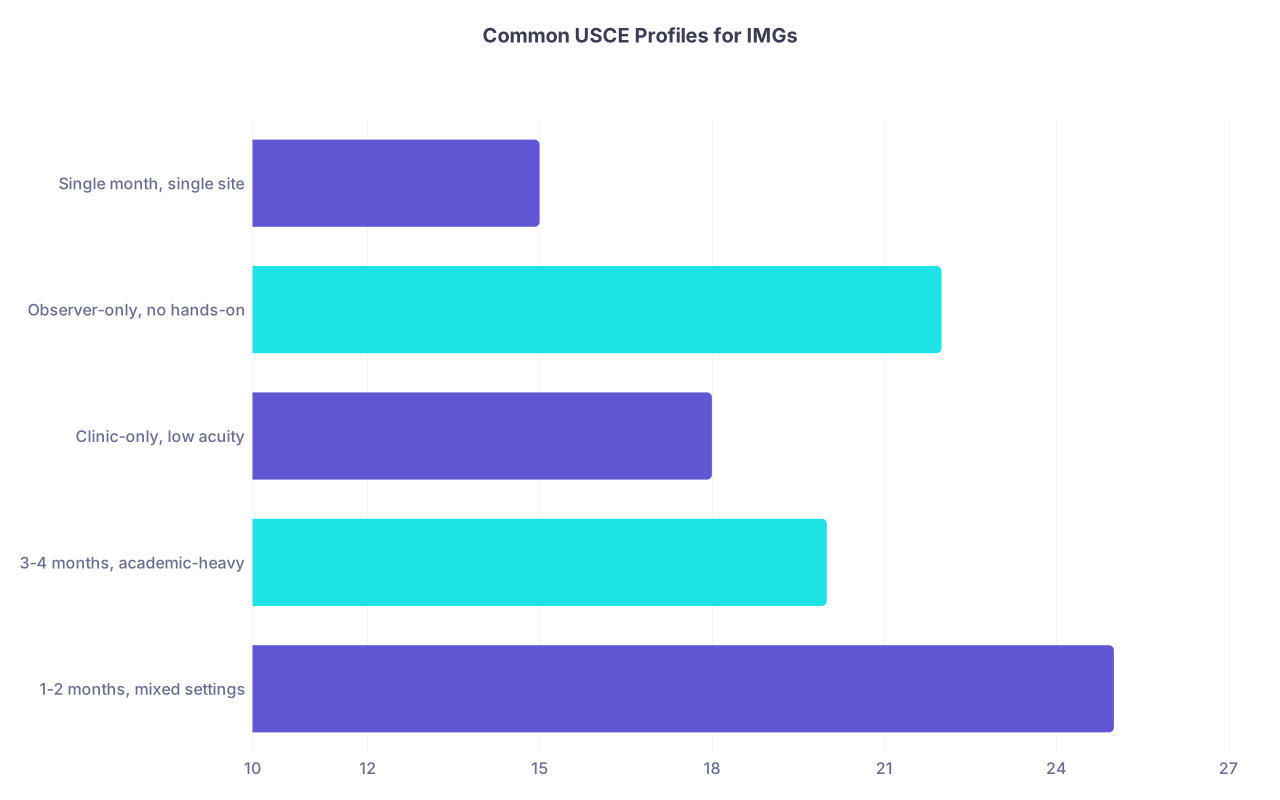
| Category | Value |
|---|---|
| 1-2 months, mixed settings | 25 |
| 3-4 months, academic-heavy | 20 |
| Clinic-only, low acuity | 18 |
| Observer-only, no hands-on | 22 |
| Single month, single site | 15 |
They ask implicitly:
- Did this person invest months in meaningful USCE, or did they check a box?
- Are all letters from the same obscure community clinic?
- Did they touch real patients, write notes, and interact with teams?
If your letters all come from:
- Unfamiliar private clinics
- Short “observerships” with no real responsibilities
- Rotations clearly organized through a for-profit middleman where everyone gets an automatic “excellent”
— PDs notice. They may not say anything. They just don’t trust the letters as much.
By contrast, if they see:
- 2–4 months of USCE at recognizable hospitals
- At least one letter from a core faculty member in your specialty
- Language in the letter that clearly conveys hands-on responsibilities
Then they are far more willing to accept that you can function on day one.
How to Engineer Better Inferences from Your Letters
You cannot write your own letter. You can influence what your letter writer actually sees and remembers.
Here’s what people who understand the game do differently on USCE:
They Perform Like a Sub-Intern, Not a Tourist
The best letters come from attendings who watched you behave like an almost-intern. That means:
- Owning a small list of patients, not “helping with whatever.”
- Writing notes (even if unofficial drafts).
- Pre-rounding, following up labs, updating problem lists.
- Taking feedback and showing visible improvement within days, not weeks.
If an attending sees you in that role, they can honestly write about your readiness for residency. If they only saw you ask a lot of questions and follow the team, your letter will sound exactly like that.
They Make It Easy for the Attending to Remember Them
You’d be surprised how many otherwise strong IMGs disappear into the crowd.
You want your attending, when they sit down to write, to remember stories.
So you:
- Present clearly, repeatedly, and ask for feedback: “How can I make my presentations more intern-level?”
- Follow through on tasks and then circle back: “I checked with radiology, the CT is scheduled for 3 PM; I’ll follow up on the report.”
- Send a short, focused CV and bullet list of cases you worked on with them when you request the letter. (Not a life story. Just: dates, your role, specific memorable patients.)
Good attendings will use those details. PDs see them and infer: this writer actually knows this person.
They Choose Their Letter Writers Strategically
One of the quiet mistakes IMGs make is chasing “big names” who barely know them rather than choosing “medium names” who watched them grind.
A strong letter from a mid-level academic hospitalist who worked with you daily is far more valuable than a two-sentence letter from a department chair who shook your hand once.
So your hierarchy, generally:
- Someone who supervised you closely and clearly liked your work
- Someone in your target specialty at an academic or teaching site
- Someone who can compare you to US students or interns
- Big title only if they truly know your performance
FAQ: USCE Letters and What PDs Infer
1. Is a short USCE letter automatically bad?
Not automatically, but usually yes, it’s a weak sign. Exception: some older faculty are chronically brief, but if the letter is both short and vague, PDs assume the writer either barely knew you or chose not to say more. Neither helps you.
2. Do PDs really care if my USCE was “hands-on” vs “observership”?
Absolutely. They will scan the letter for clues: did you examine patients, write draft notes, present on rounds, call consults? If the letter reads like you only watched, they infer your readiness is untested. For competitive or high-volume programs, that’s often a no.
3. Can a single bad or lukewarm letter kill my application?
Yes, if it’s from a credible source (PD/APD/core faculty) and the language signals concern. In rank meetings, when there’s doubt, people revert to: “What did the people who actually worked with them say?” A quietly negative USCE letter can outweigh three generic positives.
4. Do PDs care more about who wrote the letter or what it says?
Both, but content wins if it’s strong. A detailed, enthusiastic letter from a non-famous core faculty member is more persuasive than a bland, one-paragraph letter from a department chair. Ideally, you want both: credible writer and concrete, high-signal content.
5. How many USCE letters do I really need as an IMG?
For most IMGs, two strong USCE letters in your target specialty and one additional US clinical letter (or home-country letter from a major academic center) is a solid baseline. More letters are not better if they’re repetitive or weak. Three to four well-chosen, high-quality letters beat six generic ones every time.
With this lens, you can stop obsessing over “having USCE” and start focusing on what your USCE actually lets attendings say about you. That shift — from hours logged to impressions created — is what moves you from “maybe” to “we want this one.”
You’re now equipped to judge your own letters, your rotation choices, and your interactions with attendings with a program director’s eye. The next step is aligning those letters with the rest of your application — your personal statement, experiences, and interview performance — so that they all tell the same story about the kind of resident you will be. But that alignment is its own game, and that’s a story for another day.