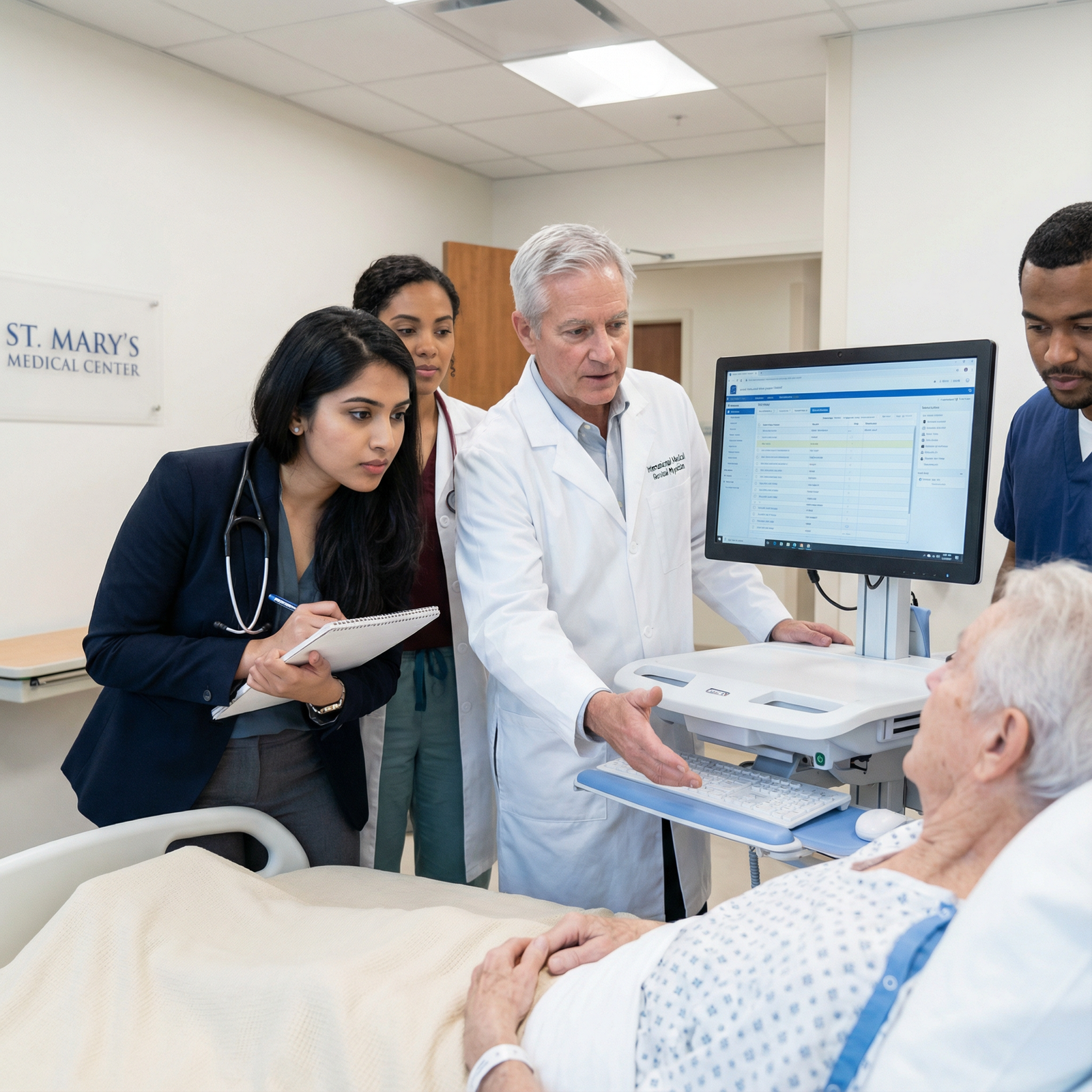
Most observerships are wasted. Not because they are useless, but because IMGs drift through them like tourists instead of treating them like a high‑stakes audition.
You are not there to “see American medicine.” You are there to extract letters, skills, and stories that get you interviews.
Let me show you exactly how.
1. Know the Real Game You Are Playing
A US observership is brutally simple to program directors:
- It is either clear, specific, and strong evidence that you can function in a US clinical environment.
- Or it is a vague line on your CV that sounds like medical tourism.
Your job is to convert “shadowing” into:
- Concrete, verifiable clinical behaviors
- Clear communication skills examples
- Evidence of reliability and work ethic
- A believable story for “Why this specialty? Why US? Why now?”
To do that, you need three outcomes from every observership:
- At least one strong US-style LOR (ideally from someone who actually saw you think and communicate).
- Specific, US‑relevant bullets for your CV and ERAS (not “I observed…” fluff).
- Real stories to use in interviews (conflict, communication, uncertainty, error‑prevention, teamwork).
You do not get those outcomes by passively following people around.
You get them by running a daily system.
2. The 5-Part Daily Framework
Use this every single day of your observership:
- Pre‑round prep (30–60 minutes)
- Rounds script: three ways to contribute without overstepping
- Midday micro‑tasks: add value, not burden
- End‑of‑day debrief and documentation
- Weekly calibration with your attending/fellow
Let us break that down into specific actions.
3. Pre-Round Prep: Show Up Already Useful
You cannot be clinically “in charge” as an observer. But you can be the person who walks in already oriented, already prepared, already paying attention.
3.1 Learn the micro‑environment first week
Day 1–2, your main job is to map the terrain:
- Where vitals, notes, imaging, labs are in the EMR
- Team structure: attending, fellow, senior, interns, nurse manager
- Routine timing: when do they preround, when do they staff, when do family meetings usually occur?
Ask a resident or fellow directly:
“I want to be as helpful and low‑maintenance as possible. Can you walk me through your usual morning flow so I do not get in the way?”
Write it down. Treat it like a protocol.
3.2 Build a daily “patient roster” sheet
You need a simple, paper (or tablet) tool you carry all day. Something like:
| Column | Example Entry |
|---|---|
| Patient ID/Room | 742B |
| Age/Sex | 64 F |
| Main Problem | CHF exacerbation |
| Hospital Day | HD 3 |
| Yesterday's Plan | Diuresis, echo, PT eval |
| Today's Key Labs | K, Cr, BNP |
Before rounds, from sign‑out or EMR:
- Fill in each patient’s chief problem, hospital day, and yesterday’s main plan items.
- Leave “today’s key issues” blank for now.
Even as an observer, walking into rounds already knowing who is on service makes you look like part of the team instead of dead weight.
3.3 Set one clinical focus per day
Pick a narrow lens for the day. One example:
- “I will focus on how the team manages electrolytes in heart failure”
- “I will focus on how attendings explain risk to patients”
- “I will focus on one guideline: sepsis bundles, ACS, COPD, etc.”
This protects you from trying to learn “everything” (which means you retain nothing) and lets you ask targeted, intelligent questions.
4. How to Be Active on Rounds Without Being Annoying
This is the part IMGs either underdo (silent shadow) or overdo (trying to act like a resident). Both are bad. You need a third option: structured, invited contribution.
4.1 The three safe ways to contribute
These are almost never inappropriate if done with the right timing and tone:
Clarifying data after others finish
- “So just to confirm for my notes, the BNP today was 1,200 and creatinine 1.8?”
- Low risk. Shows you are tracking the case intelligently.
Guideline‑based questions (not challenges)
- “In my training, we were taught X per [guideline]. In practice here, I have seen you do Y. Is that because of patient age or comorbidities?”
- This respects the hierarchy and invites teaching rather than arguing.
Communication‑focused observations
- After the encounter: “I noticed you paused to ask the patient to repeat back the plan. Do you usually do that to check understanding?”
- Shows interest in US communication norms, which attendings care about a lot.
4.2 Use the “ask permission” formula
Before you say anything that might sound like a suggestion:
“Can I ask a quick learning question about this case?”
Or:
“Is it alright if I share how we handled a similar patient in my home institution, just for comparison?”
You are signaling: I know my role. I am not trying to direct care. I am a learner.
4.3 Handle being cold-shouldered
It will happen. Some attendings just want you quiet.
If they ignore your first attempt, back off for that session. After rounds, ask a senior resident privately:
“I want to be respectful. In this team, what is a good way for me to ask questions or participate without slowing things down?”
Then adapt. Some teams tolerate questions only at the end. Some during. Some not at all on busy days. Read the room.
5. Midday: Turn Waiting Time into Value
Middle of the day is where observerships usually dissolve into nothing. People go to lunch, disappear into the work room, and you scroll your phone.
Big mistake. This is the window where you can actually contribute (within limits).
5.1 Three “micro‑roles” you can safely adopt
You cannot write in the chart. You cannot place orders. But you can do this:
The summary scribe (for yourself, not the EMR)
Build concise problem lists for each patient on your own paper.
Offer to show them to residents when they are updating:
“I wrote a quick summary for patient in 742B, would this be helpful for your sign‑out?”
Sometimes they will say yes, sometimes no. Either way they see you are thinking like a clinician.
The patient‑education observer/helper
Ask a nurse or resident:
“If appropriate, may I quietly observe when you explain the diagnosis or discharge plan? I am trying to learn US communication practices.”
Occasionally, if the patient speaks your language, you become a language bridge (with staff permission). Not official interpreting. But:
“He seems confused about the timing of the diuretics. Would it be helpful if I explain it in [language] and then confirm with you?”
This creates very strong LOR material about communication and empathy.
The protocol hunter
Each day, pick one protocol and learn it cold:
- DKA order set
- Chest pain / ACS pathway
- Sepsis bundle
- Stroke code workflow
Ask a resident: “Is there a standard order set you usually use for X? Can I look at it with you just to understand the sequence?”
Then later: summarize it in your notes. This becomes gold for interviews: “Tell me about differences in practice between your home country and the US.”
5.2 Lunchtime: 10‑minute networking that actually matters
Do not force social chatter. Do this instead:
- Sit with residents/fellows if they are open to it.
- Ask focused questions:
- “If you were in my shoes as an IMG applying to [specialty], what would you do differently?”
- “Which programs did you notice were IMG‑friendly in your interviews?”
- “What kind of LOR comments make a difference in your program?”
Write the useful pieces down after. People forget names, but they remember the IMG who took their advice seriously.
6. End-of-Day: The 30-Minute Conversion Ritual
If you just go home after the last patient, you are destroying 50% of the value.
You need a daily conversion ritual: converting raw experience into usable material.
Here is the 30‑minute protocol.
6.1 Step 1: Two-minute reflection per key patient
Pick 2–3 patients you followed closely and answer, in writing:
- What was the main clinical decision today?
- What did I learn clinically?
- What did I learn about US system/communication/protocols?
Keep it short. Bullet points. The goal is to accumulate specific examples.
6.2 Step 2: Capture one “story seed”
You need stories for ERAS personal statements and interviews:
- A conflict or disagreement that got resolved
- A moment of uncertainty or diagnostic challenge
- A communication barrier and how it was handled
- A safety issue that was caught or prevented
Each day, write one story seed:
“Young man with new DKA, language barrier, family anxious. Saw the attending use simple illustrations to explain insulin and carbs. Realized my previous approach was too technical. If I were the physician, I would…”
Do not write identifiable details (HIPAA). Just themes and your internal reaction.
Later, you will clean these into anonymous stories.
6.3 Step 3: Update your “ERAS bullets” file
Have a living document titled “USCE bullet points”.
Each day, add 1–2 bullet‑style lines like you would put on a CV:
- “Observed daily multidisciplinary rounds on a 24‑bed cardiology unit, tracking clinical progress and plans for 10–14 patients per day.”
- “Discussed guideline‑based management of sepsis, including fluid resuscitation and early antibiotic strategies, with attending physicians.”
By the end of a month, you will have 30–40 concrete bullets. Later you can select the best 4–6 for the final CV.
7. Weekly Calibration: Secure Your Letter of Recommendation
Most IMGs hope for a letter. They do not engineer one. That is why they get generic fluff.
You need a weekly 10‑minute feedback conversation with your supervising physician (or fellow if that is who really sees you work).
7.1 End of week 1: Set expectations on purpose
Script:
“Dr. Smith, thank you for allowing me to observe this week. My goal is to learn how care is delivered in a US teaching hospital and to demonstrate that I can adapt to this environment, since I plan to apply for residency here.
Is there anything I can do differently next week to be more helpful to the team or to show you how I think clinically while still respecting the limitations of my role?”
This accomplishes three things:
- Signals your ambition without begging for a letter.
- Invites specific behavioral feedback.
- Plants the idea: “I am evaluating this person for residency fitness.”
Write down what they say. Then obey it.
7.2 Week 2–3: Ask for more specific tasks
Once they know you are reliable and respectful, gently ask:
“Would it be acceptable if I prepare a short, unofficial SOAP‑style summary for 1–2 patients each day for you or the residents to review, just as a learning exercise for me?”
Some will say yes, some no. If yes:
- Keep it short and structured.
- Email or hand them on paper.
- Explicitly remind: “This is for learning only, not for the chart.”
You have now given them direct evidence of how you reason and document. Exactly what a letter writer needs.
7.3 Final week: Direct LOR request, the professional way
Do not ask: “Can you write me a letter?”
Ask:
“Dr. Smith, I have really valued this month on your service. I am applying for Internal Medicine residency this September.
Based on what you have seen of me here, do you feel you could write a strong letter of recommendation commenting on my clinical reasoning, professionalism, and communication in this environment?”
If they hesitate or say “I can write you a letter but it would be mainly observational,” accept it but know it may be weak. Better to have 2–3 strong letters than 4–5 generic ones.
To help them, send:
- Your CV
- Personal statement draft
- A short list of 3–5 concrete things you did during the observership:
- “Followed daily rounds on 10–12 patients
- Prepared unofficial summaries
- Discussed sepsis/heart failure guidelines
- Observed and reflected on difficult conversations.”
Make it easy for them to be specific.
8. Turning Observership Experience into ERAS and Interview Ammo
Your observership should show up clearly in three places:
- ERAS Experiences section
- Personal statement
- Interview answers
8.1 Writing strong ERAS bullets
Avoid:
- “Observed various clinical cases in a US hospital.”
- “Shadowed attendings and learned about US healthcare.”
Use structure: Setting – Scope – Action – Learning/Skill.
Examples:
- “Observed daily inpatient rounds in a 700‑bed academic center, tracking the evolution of 8–12 internal medicine patients and discussing differential diagnoses and management with residents and attendings.”
- “Participated in bedside education sessions by observing how physicians explained new diagnoses and discharge plans, then reflecting on communication differences between my home system and US practice.”
If you followed the daily ritual, you already pre‑wrote most of these.
8.2 Personal statement: one mini‑story from USCE
You do not need a dramatic resuscitation story. You need one specific, reflective vignette. Example skeleton:
- Patient situation (anonymous and brief)
- What the US team did differently than your home country
- What you realized about good medicine or communication
- How you changed your own approach because of it
Tie it to why you want that specialty and why the US system fits how you want to practice.
8.3 Interviews: answer “Tell me about your USCE”
Never say:
- “I saw many cases.”
- “It was a great experience and I learned a lot.”
Use a 3‑part approach:
Setting and role
- “I completed a four‑week observership in inpatient cardiology at X University Hospital, where I followed daily rounds and focused on understanding US communication and decision‑making.”
Two concrete examples
- One clinical (guideline or protocol you internalized)
- One communication / professionalism (family meeting, conflict, etc.)
Outcome
- “This experience showed me that I can adapt to a high‑volume, team‑based US environment and reinforced my choice of internal medicine because…”
If you used the system above, you will have 5–10 strong examples ready.
9. Guardrails: What NOT to Do as an Observer
Let us be blunt. These mistakes kill opportunities fast.
- Do not touch patients without explicit permission. No exams. No procedures. No vitals. You are not credentialed.
- Do not document in the EMR. If someone casually asks you to, remind them you are not allowed. Protect yourself.
- Do not give independent medical advice to patients.
- Do not correct staff in front of patients. If you see a concern, quietly raise it with a resident or nurse after.
- Do not overshare your complaints about the match. One short, honest answer is fine. Repeated frustration rants are not.
- Do not disappear. If you need to leave early or miss a day, communicate clearly in advance and apologize once. Not three times.
Your reputation travels much farther inside a hospital than you think. The nurse who liked you will mention you to the attending. The fellow you annoyed will mention you to the program coordinator.
Behave like a junior colleague, not a tourist.
10. Sample Daily Schedule: From Passive to Active
To make this concrete, here is what an “active” day can look like:
| Time | Action |
|---|---|
| 6:45–7:15 | Review patient list, update roster sheet |
| 7:15–9:30 | Rounds: observe, ask 2–3 targeted questions |
| 9:30–10:00 | Coffee: clarify cases with residents |
| 10:00–12:00 | Observe consults / follow key patients |
| 12:00–12:30 | Lunch with residents, ask focused questions |
| 12:30–15:00 | Protocol review, patient education sessions |
| 15:00–16:00 | Wrap‑up rounds / discharge discussions |
| 16:00–16:30 | Daily reflection + ERAS bullet write‑up |
You will not hit this perfectly every day. Services are chaotic. But this is the target.
11. If Your Observership Is Very Restrictive
Some hospitals practically lock observers in a corner. No EMR access. No bedside presence on sensitive units. Very little interaction.
You still have options.
11.1 Focus on systems, not just cases
Ask for permission to:
- Attend morbidity and mortality (M&M) conferences
- Attend grand rounds and noon conferences
- Watch multidisciplinary meetings (case management, tumor boards, etc.)
Then frame your learning around:
- How errors are discussed and prevented
- How interdisciplinary decisions are made
- How quality metrics drive practice
Program directors love this kind of systems thinking, especially from IMGs who can compare two healthcare systems intelligently.
11.2 Build 1:1 relationships off the ward
If bedside access is poor, the hallway and office become critical:
- Ask attendings: “If you have a 10‑minute gap this week, could I ask you a few questions about your career path and advice for an IMG in this specialty?”
- Ask residents: “Could I buy you a coffee one day and ask about how you approached the match as a resident here?”
These conversations can still lead to letters or at least honest guidance and possibly networking to better USCE elsewhere.
12. Two Extra Levers Most IMGs Ignore
12.1 Track your hours and volume
Do not rely on memory when you later fill ERAS.
Maintain a simple log:
- Dates of rotation
- Average patients observed per day
- Types of settings: inpatient, outpatient, subspecialty clinics
- Types of procedures/encounters you frequently observed
Later, you can support statements like:
- “Over four weeks, followed care of approximately 80–100 hospitalized internal medicine patients.”
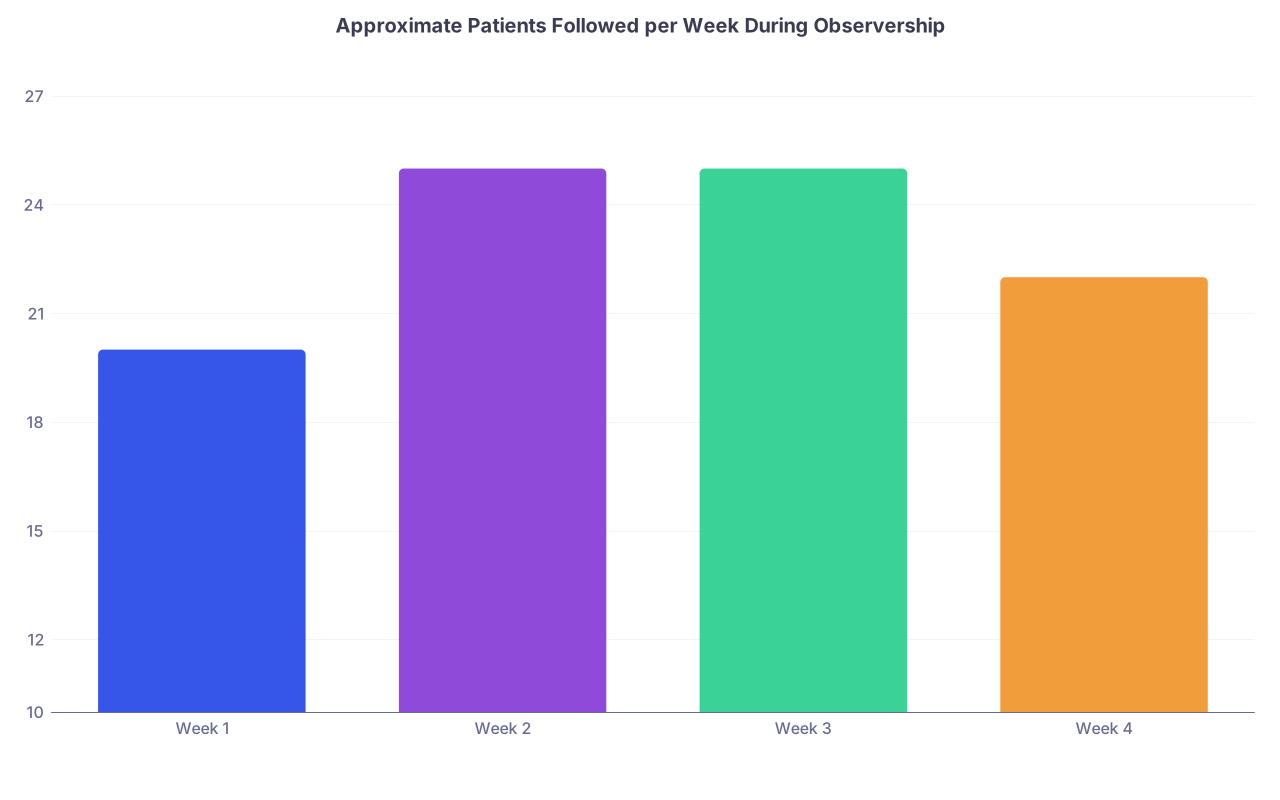
| Category | Value |
|---|---|
| Week 1 | 20 |
| Week 2 | 25 |
| Week 3 | 25 |
| Week 4 | 22 |
Numbers make your experience sound real, not invented.
12.2 Connect your USCEs into a narrative
If you have multiple USCEs (two observerships, an externship, a research position), do not present them as random jobs. Connect them.
Example narrative for IM:
- Observership 1 (cardiology): “Showed me the complexity of chronic disease in an aging population.”
- Observership 2 (primary care): “Taught me continuity and outpatient follow‑up.”
- Research: “Deepened my interest in outcomes in heart failure patients.”
Now your CV tells a story: “This person is building a coherent internal medicine path,” not “This person is collecting stamps.”
13. Simple Flow of an Active Observership
To wrap the process into a visual, here is the flow you should be following mentally every day:

| Step | Description |
|---|---|
| Step 1 | Pre-round prep |
| Step 2 | Active but respectful participation |
| Step 3 | Midday micro-roles |
| Step 4 | End-of-day reflection |
| Step 5 | Weekly feedback with attending |
| Step 6 | Stronger LOR & ERAS content |
| Step 7 | Better interview stories & match odds |
That is the pipeline. Start of day to Match benefit. No wasted steps.
FAQs
1. How many weeks of observerships do I actually need for residency applications?
For most IM specialties, 2–3 months total of USCE is adequate if it is high quality and yields 2–3 strong US letters. I have seen people match with 4 weeks if those 4 weeks were intense, well‑documented, and supported by excellent LORs. Beyond 3–4 months, more observerships add less value than improving Step scores, research, or your application strategy.
2. Should I prioritize hands‑on externships over observerships if I can?
If you can legally and safely do a true hands‑on externship with documentation and supervision, yes, it is stronger. Hands‑on shows you can function as a front‑line provider in the US. But a high‑quality observership with engaged attendings can still produce better letters and stories than a chaotic, poorly supervised externship. Do not chase “hands‑on” just for the label; evaluate who will actually see you in action.
3. How do I deal with an attending who clearly has no interest in teaching or giving feedback?
Shift your strategy to the people who actually spend time with you: fellows, senior residents, nurse practitioners. They often write excellent letters or strongly influence attendings who sign them. Still be professional with the disinterested attending, but invest your energy in those who notice and appreciate your effort. And if the entire environment is dead, maximize what you can learn about systems, communication, and US culture, then be aggressive about finding a second, better USCE site.
4. Can I ask for a second letter from the same observership (for example from a fellow and from the attending)?
Yes, but only if both truly know you and can comment on different aspects: the fellow on day‑to‑day performance, the attending on overall readiness and professionalism. Make sure they are not just co‑signing the same generic text. When you request letters, give each person slightly different bullet points and examples to emphasize so the letters complement each other instead of repeating the same vague phrases.
Key points: Treat every day of your observership as an audition, not a field trip. Use a structured daily system to convert observation into demonstrable skills and stories. Engineer feedback and letters instead of waiting and hoping.