
You are in your apartment, probably not in the United States. It is 11:47 p.m. Your ECFMG account is open in one tab, ERAS timeline in another, and your WhatsApp is full of messages from other IMGs showing off their “USCE done – 3 months!” screenshots.
You have zero U.S. contacts.
No uncle who is an attending.
No senior who can “put in a word.”
No PD you met on an observership.
And every program website seems to chant the same line: “U.S. clinical experience preferred / required.”
Here is the blunt truth: without a plan, this situation usually does not improve. You just get one year older and more anxious.
So I will give you a plan. Step‑by‑step. From “no contacts, no idea where to start” to “I have my first real externship confirmed.”
Step 1: Get Clear on What You Are Actually Aiming For
“USCE” is used loosely. Programs do not mean the same thing when they say it. If you do not understand the hierarchy, you will waste money on nonsense.
Here is the rough order of value for IMGs:
| Type of Experience | Direct Patient Care | Documentation in EMR | Can Write Strong LOR | Typical Cost |
|---|---|---|---|---|
| Paid externship | Yes | Yes | Yes | High |
| Unpaid externship | Yes | Sometimes | Yes | Medium |
| Visiting student elective (for students) | Yes | Yes | Yes | Medium |
| Inpatient observership | No | No | Sometimes | Low/Medium |
| Office-only shadowing | No | No | Weak | Low |
You said “externship” in the title. That usually means:
- Hands-on clinical work
- Taking histories, physical exams
- Writing notes, sometimes placing orders (supervised)
- Being part of the care team, not just standing in the corner
Programs care about three things from USCE:
- Can you function in a U.S. clinical system?
- Can you be trusted with patients under supervision?
- Did a U.S. physician actually see you perform clinically and write a letter about it?
So our target: a hands-on externship (paid or unpaid) in a real clinical setting that can generate at least one strong U.S. LOR.
No contacts? Then your advantage will be:
- Organization
- Volume of outreach
- Persistence
- Professionalism
That is how you compensate for “no uncle who is a cardiologist in New Jersey.”
Step 2: Fix Your Baseline Profile Before You Email Anyone
You do not approach U.S. physicians with a messy, incomplete profile. You will not get a second chance with most of them.
Minimum baseline before you begin:
ECFMG status (or close)
- If you are a graduate: you should be ECFMG certified or at least have passed Step 1 and Step 2 CK.
- If still a student: you should have passed Step 1 (or equivalent) with Step 2 CK scheduled.
Professional CV – 2–3 pages max
Must include:- Name, contact (U.S. phone if you can get a virtual number like Google Voice when in the U.S., otherwise email is fine)
- Medical school, graduation year (or expected)
- Exam scores (USMLE or alternatives)
- Clinical experience (home country, rotations, internships)
- Publications / presentations (even local, if serious)
- Certifications: BLS/ACLS (get these as soon as you can; they matter for hands‑on roles)
Short professional bio (3–5 sentences)
You will reuse this in emails and forms. Example:I am a final-year medical student at XYZ University, graduating in July 2026, with USMLE Step 1 (pass) and Step 2 CK (242). I am interested in Internal Medicine with a long-term goal of working in academic general internal medicine. I have completed core rotations in internal medicine, surgery, pediatrics, and OB/GYN, and I currently volunteer in a community health clinic. I am seeking hands-on clinical externship experience in the U.S. to strengthen my clinical skills and obtain U.S.-based letters of recommendation.
LinkedIn profile – clean, updated
- Photo in formal attire
- Same info as CV
- Headline: “ECFMG-certified IMG seeking Internal Medicine externship opportunities” or similar
Some attendings will google you. Make what they find look intentional.
You do not need to be perfect. But you must look serious and ready.
Step 3: Decide Your Strategy – Paid vs DIY Externship
If you have no contacts, there are basically two paths:
- Use paid externship companies (fewer emails, more money)
- Build a DIY externship by directly approaching clinics/hospitals (many emails, less money, more control)
You can combine both. But do not just throw money blindly.
3.1 Understand What Paid Companies Actually Offer
Many IMG externship companies exist. Some are decent. Some are pure garbage.
What they usually offer:
- Pre-arranged clinical sites (private practices, small hospitals)
- A supervising physician who “knows the drill” with IMGs
- Documented experience and a letter at the end if you show up and do your job
- Some add-ons: CV help, personal statement reviews, mock interviews
What they usually do not offer:
- Guaranteed strong LOR
- Academic hospital rotations
- Direct pipeline to residency
If you go this route, you need to compare content, not logos.
| Checkpoint | Good Sign | Red Flag |
|---|---|---|
| Site details given | Named hospitals/clinics, locations | Vague “top hospitals” claims |
| Hands-on vs observership | Clear wording: “direct patient care” | Only “observation” mentioned |
| LOR policy | Criteria-based, not automatic | “Guaranteed letter no matter what” |
| Physician credentials | Board-certified, ABIM/ABFM etc. | Hard to verify, no names |
| Reviews | Detailed reviews from real IMGs | Only generic 5-star comments |
Do not assume more expensive = better.
I have seen $900/month externships better than $2500/month ones.
3.2 DIY Externship Route – What You Are Aiming For
For DIY, your realistic target is usually:
- Community hospitals that allow IMG volunteers / externs
- Federally Qualified Health Centers (FQHCs)
- Private outpatient practices (IM/FM/Peds)
- Free clinics, residency-affiliated clinics
The externship may be unpaid. That is fine. What matters:
- You interact with patients.
- You write or participate in documentation.
- The attending can write a detailed letter.
Step 4: Build a Target List Even Without Contacts
Stop thinking “I have no contacts.” You can create weak ties and entry points.
You will build three lists:
- Hospitals with IMG-friendly residencies
- Community and teaching clinics
- Individual physicians
4.1 Hospitals With IMG-Friendly Residencies
Search like this:
- Specialty: e.g., “Internal Medicine”
- Terms: “NRMP Charting Outcomes IMGs pdf” (read who is taking IMGs)
- Then look up those programs:
Example:
- “Wyckoff Heights Medical Center internal medicine residents”
- “Interfaith Medical Center family medicine residency”
- “Lincoln Medical Center internal medicine residency”
On each site:
- Look for: “Medical student rotations,” “International medical graduates,” “Observership/Externship”
- Many have formal programs (often with application forms).
Build a spreadsheet with columns:
- Hospital / Program name
- City, State
- Specialty focus (IM/FM/Peds/Surg, etc.)
- USCE program? (Yes/No/Unclear)
- Contact email
- Notes (fees, months, requirements)
You want 40–60 entries minimum. Volume matters.
4.2 Community Clinics and FQHCs
Google:
- “FQHC near [city]”
- “Community health center [state] residency affiliation”
- “Teaching health center graduate medical education [state]”
Many FQHCs partner with residency programs and often appreciate extra help.
Scrape:
- Clinic name
- Medical director name
- Specialty mix (IM, FM, Peds)
- Contact email
Again, 30–50 entries.
4.3 Individual Physicians
This part separates people who “wish” from people who execute.
Methods:
- Use Doximity (even the public version) to find attendings at community hospitals.
- Use Google Maps: search “internal medicine clinic” in targeted cities.
- Click each clinic.
- Go to its website.
- Note physician names and emails.
Focus on:
- Internal Medicine
- Family Medicine
- Pediatrics
- Psych (if that is your interest)
These are more open to IMGs usually than Ortho, Derm, etc.
Target: 60–100 physicians on your list.
Yes, that is a lot. That is the point.
Step 5: Create Outreach Templates That Do Not Sound Desperate or Spammy
Most email outreach from IMGs is terrible. Too long, vague, or begging.
You need three templates:
- To hospital/clinic academic offices
- To clinic administrators / practice managers
- To individual physicians
5.1 Core Principles
- Subject line must be clear and short.
- First 2 sentences must establish who you are and what you want.
- Do not ask for “observership/externship/anything really.” Ask for something specific.
- Attach CV but do not dump your life story in the email.
5.2 Example – Email to a Clinic / Hospital Education Office
Subject: Visiting IMG seeking hands-on externship – Internal Medicine
Body:
Dear [Name or “Clinical Education Coordinator”],
My name is [Your Name], an international medical graduate from [School, Country], ECFMG-certified with USMLE Step 1 (pass) and Step 2 CK (245). I am planning to pursue Internal Medicine residency in the United States in the [202X] Match.
I am writing to ask whether your institution offers any opportunities for short-term, hands-on clinical externships or structured observerships for international medical graduates in Internal Medicine or primary care.
I would be grateful for any information on: – Eligibility requirements for IMGs
– Application process and timelines
– Any associated feesMy CV is attached for your reference. I am prepared to complete necessary requirements (immunizations, HIPAA training, background checks) and can be available for 4–8 weeks between [Month–Month, Year].
Thank you very much for your time and consideration.
Sincerely,
[Name]
[Email]
[Phone, if applicable]
You will reuse 80% of this each time with small changes.
5.3 Example – Email to Individual Physician (for DIY Externship)
Subject: Request for short-term hands-on externship – [Specialty]
Dear Dr. [Last Name],
My name is [Your Name], an international medical graduate from [School, Country], currently ECFMG-certified and preparing to apply for [Internal Medicine] residency in the [202X] Match.
I am reaching out to ask whether you would consider hosting me for a short-term, hands-on externship in your practice for 4–8 weeks. My goal is to strengthen my clinical skills in the U.S. outpatient setting and to learn how care is delivered in practices like yours.
Briefly, I have completed my core clinical training, passed USMLE Step 1 (pass) and Step 2 CK ([score]), and I hold current BLS and ACLS certifications. I am comfortable taking focused histories, performing physical exams, presenting patients, and assisting with documentation under supervision.
I would be happy to provide any documentation you may require (CV, vaccination records, malpractice coverage if needed) and to adapt to your clinic’s schedule and workflow. I am available during [Month–Month, Year], and I can relocate to [City/State] for the duration of the externship.
I understand you are very busy. Even if you are unable to host an extern, I would be grateful for any guidance or referrals to colleagues who might be open to this.
Thank you for considering my request.
Sincerely,
[Name]
[Email]
[Phone]
LinkedIn: [URL]
This is calm, professional, and shows you are not asking them to reorganize their life for you.
Step 6: Run Outreach as a System, Not Random Messages
You are not sending three emails and then complaining nothing works. You are running a small campaign.
6.1 Set Weekly Targets
Concrete target:
- 10–15 hospitals/clinics per week
- 15–20 individual physicians per week
That is 25–35 high-quality emails weekly.
Use a spreadsheet to track:
- Date emailed
- To whom
- Role (program, clinic, individual)
- Response? (Yes/No/Pending)
- Follow-up date
- Outcome (No / Maybe later / Yes – details)
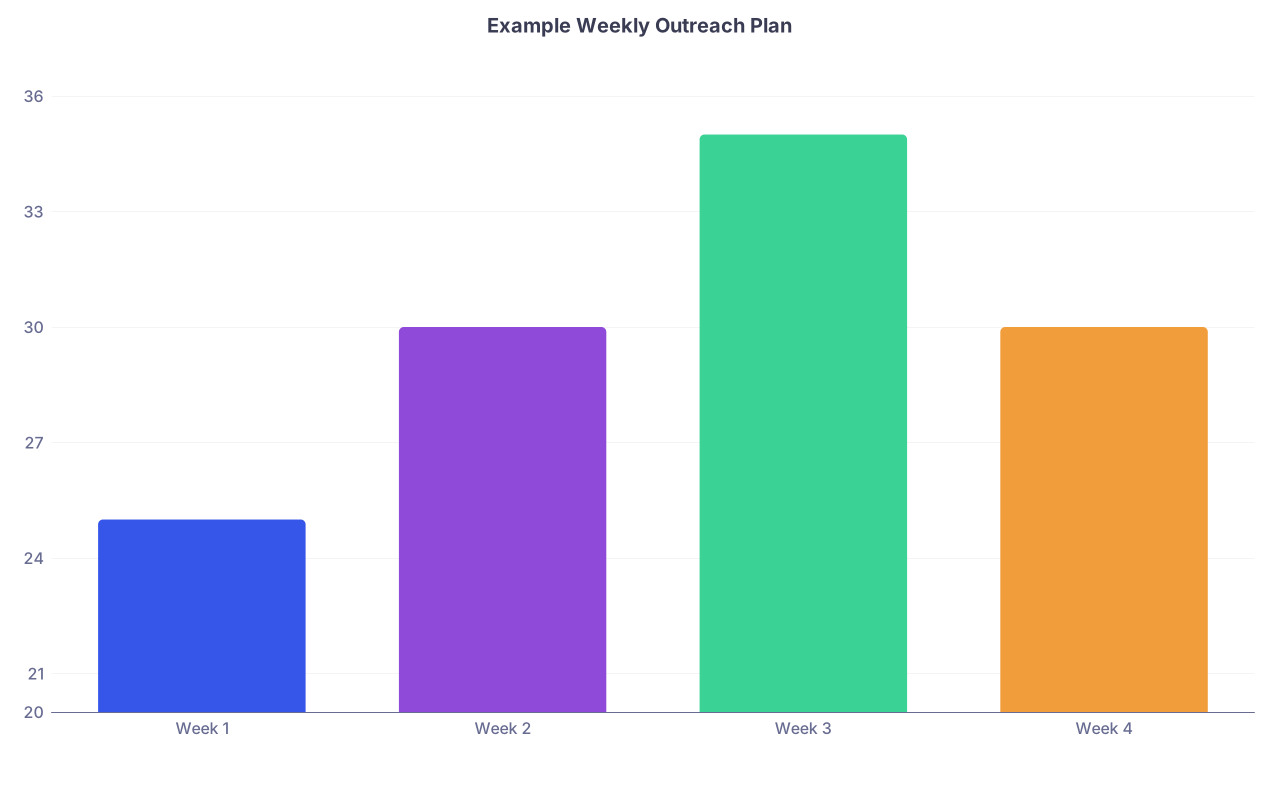
| Category | Value |
|---|---|
| Week 1 | 25 |
| Week 2 | 30 |
| Week 3 | 35 |
| Week 4 | 30 |
6.2 Follow-up Protocol
Most externships you get will come after follow‑up. People are busy. You are low on their list.
Protocol:
- Wait 7–10 days after initial email.
- Send 1st follow-up.
- Wait another 7–10 days.
- Send a final brief follow-up.
- If no response after 2 follow-ups, move on.
Example follow-up:
Dear Dr. [Last Name],
I wanted to follow up on my email from [date] regarding the possibility of a short-term externship in your practice.
I understand how busy your schedule must be. If you are unable to host an extern at this time, I would still be very grateful for any brief advice or referrals you might have for an IMG like me seeking U.S. hands-on experience in [specialty/area].
Thank you again for your time.
Sincerely,
[Name]
Do not be emotional. Do not guilt them. Just be persistent and respectful.
Step 7: Handle the Logistics So You Are Not the Problem
Let us assume someone replies: “We might be able to host you. Can you send details of your requirements?”
This is where many IMGs lose the opportunity because they are slow, disorganized, or vague.
You need to be ready with:
Document packet (scanned, ready to email):
- Passport
- Medical school diploma or transcript
- ECFMG certificate or exam score reports
- Immunization records (MMR, Varicella, Hep B, Tdap, COVID if required, TB testing)
- BLS/ACLS cards
- Background check (if easily obtainable in your country)
Statement on malpractice coverage Some externships require you to have your own malpractice insurance.
- Look up “student/graduate malpractice insurance for externship” (e.g., through groups like CM&F Group, Proliability, or country-specific options).
- Get a quote and know how fast you can activate it.
Clear availability
- Have a defined 4–8 week block you can travel.
- If you are still waiting on visa, be honest but show a timeline.
Visa planning
- Externships are usually unpaid.
- Many IMGs come on a B-1/B-2 visa for “observational and educational” purposes.
- Hands-on activity can be a gray zone legally, so expect that some sites will restrict you to “observing with limited involvement.”
- Do not lie to consular officers. Ever.
Step 8: Make Sure the Experience Is Actually High-Value Once You Get It
You do not travel, pay rent, and then just sit quietly in the corner of the clinic for four weeks.
On day 1–2, you need to establish:
- What exactly are your allowed responsibilities?
- Can you:
- Take histories?
- Perform focused exams?
- Present to the attending?
- Assist with documentation?
If not, can you move closer to that line over the first week?
8.1 Conversation With the Attending in Week 1
Something like:
Dr. [Last Name], thank you again for this opportunity.
To make sure I am as useful as possible, I wanted to ask:
– How would you like me to help with patient care?
– Are you comfortable with me taking initial histories and presenting to you before you see the patient?
– Would you like me to help with documentation in the EMR under your supervision?My goal over the next [X] weeks is to learn your workflow and become as helpful as possible while staying within what you are comfortable with.
You are showing initiative and respect for boundaries.
8.2 Behaviors That Turn an Externship Into a Strong LOR
Every attending has seen passive observers. They barely remember them.
You must be:
- Prepared: Read about common conditions seen in that clinic (DM, HTN, COPD, depression, etc.).
- Reliable: On time. Every day. Early. You do not leave early unless told.
- Curious, but not clingy: Ask 1–2 good questions per session, not 20 small ones.
- Proactive: When there is downtime, offer to:
- Review charts for next day
- Call patients for follow-ups (if allowed)
- Organize educational materials
Ask early on:
Do you have any reading you recommend about the conditions we see most often? I would like to review it in the evenings.
By week 2, the physician should know:
- You show up.
- You are safe with patients.
- You think.
- You are coachable.
That is what makes them comfortable writing a good letter.
Step 9: Convert This Into a Letter of Recommendation Without Being Awkward
You do not wait until the last day to ask for a letter. That is too late.
9.1 Timing
- Start externship: Week 1
- Work hard, show value: Weeks 1–2
- Ask about feedback and potential LOR: End of Week 2 or early Week 3
9.2 How to Ask
Dr. [Last Name], I value the time I have spent learning from you. I plan to apply for [Internal Medicine] residency in the [202X] Match.
If you feel that you know my clinical abilities well enough by the end of this rotation, would you be comfortable writing a letter of recommendation on my behalf?
I want to be clear that I am only asking if you feel you can write a positive and detailed letter. If you prefer not to, I completely understand and I appreciate this experience regardless.
You are giving them a polite exit. That actually increases the chance they say yes.
9.3 Make It Easy for Them
If they agree:
Send them (by email):
- Your CV
- Your personal statement draft (or 1-page summary of your goals)
- A bullet list of things you did in the externship:
- Took H&Ps on X patients/day
- Helped manage chronic conditions (examples)
- Prepared concise patient presentations
- Participated in care planning discussions
Attending doctors are busy. The easier you make it, the better the letter.
Step 10: Use One Externship to Bootstrap the Next
Once you have one U.S. physician who knows you and likes you, you are no longer “I have no U.S. contacts.”
Now you:
Ask for introductions:
“Do you know any colleagues who might also be open to hosting an IMG extern?”
Ask for permission to mention their name in future emails:
“Would you be comfortable if I mention in future emails that I completed an externship with you?”
Update your CV and LinkedIn immediately with:
- “[Dates], Clinical Extern, [Clinic/Hospital], [City, State] – supervised by Dr. [Name], Board-certified in [Specialty]”
Then your next outreach email becomes much stronger:
I recently completed a 4-week hands-on externship in Internal Medicine with Dr. [Name] at [Clinic/Hospital] in [City, State], where I was involved in direct patient care, documentation, and patient education.
That one experience changes how your email reads.
Step 11: Rough Timeline – From Zero Contacts to First Externship
If you start from nothing and work consistently:
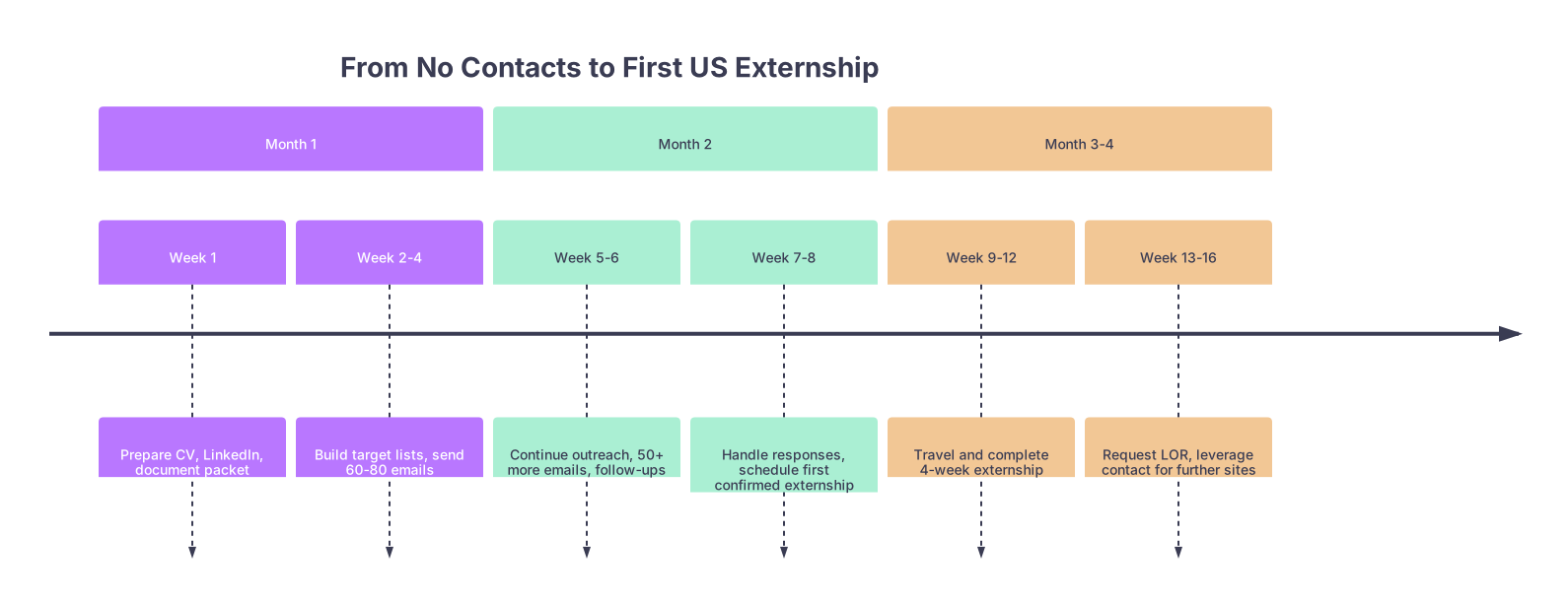
| Period | Event |
|---|---|
| Month 1 - Week 1 | Prepare CV, LinkedIn, document packet |
| Month 1 - Week 2-4 | Build target lists, send 60-80 emails |
| Month 2 - Week 5-6 | Continue outreach, 50+ more emails, follow-ups |
| Month 2 - Week 7-8 | Handle responses, schedule first confirmed externship |
| Month 3-4 - Week 9-12 | Travel and complete 4-week externship |
| Month 3-4 - Week 13-16 | Request LOR, leverage contact for further sites |
Reasonable expectation:
- 2 months of serious outreach and follow-up
- Hit rate: maybe 5–15% positive/possible responses if your profile is solid
- Realistically 1–3 solid options you can convert into a first externship
If you are not seeing any responses after 4–6 weeks, you either:
- Have too weak a profile (no exams done, poor CV)
- Are writing bad emails
- Are targeting the wrong institutions
Adjust accordingly.
Step 12: Track ROI and Cut Losses
You have limited money and time. Do not cling to bad options just because “it is in the U.S.”
Red flags that an externship is not worth it:
- You are mostly sitting in a corner observing with no patient contact, day after day.
- The attending barely speaks to you.
- You are one of 6–10 observers fighting for attention.
- They hint that the letter is generic or automated.
Better to:
- Finish the agreed minimum time professionally.
- Thank them.
- Do not rely on that LOR as a major pillar.
- Invest in a different site next.
You are trying to build:
- 2–3 high-quality U.S. LORs
- 2–4 months of real U.S. clinical exposure
- Confidence in U.S. systems before residency
Not just collecting paper.
Final Visual: Where Your Effort Should Actually Go
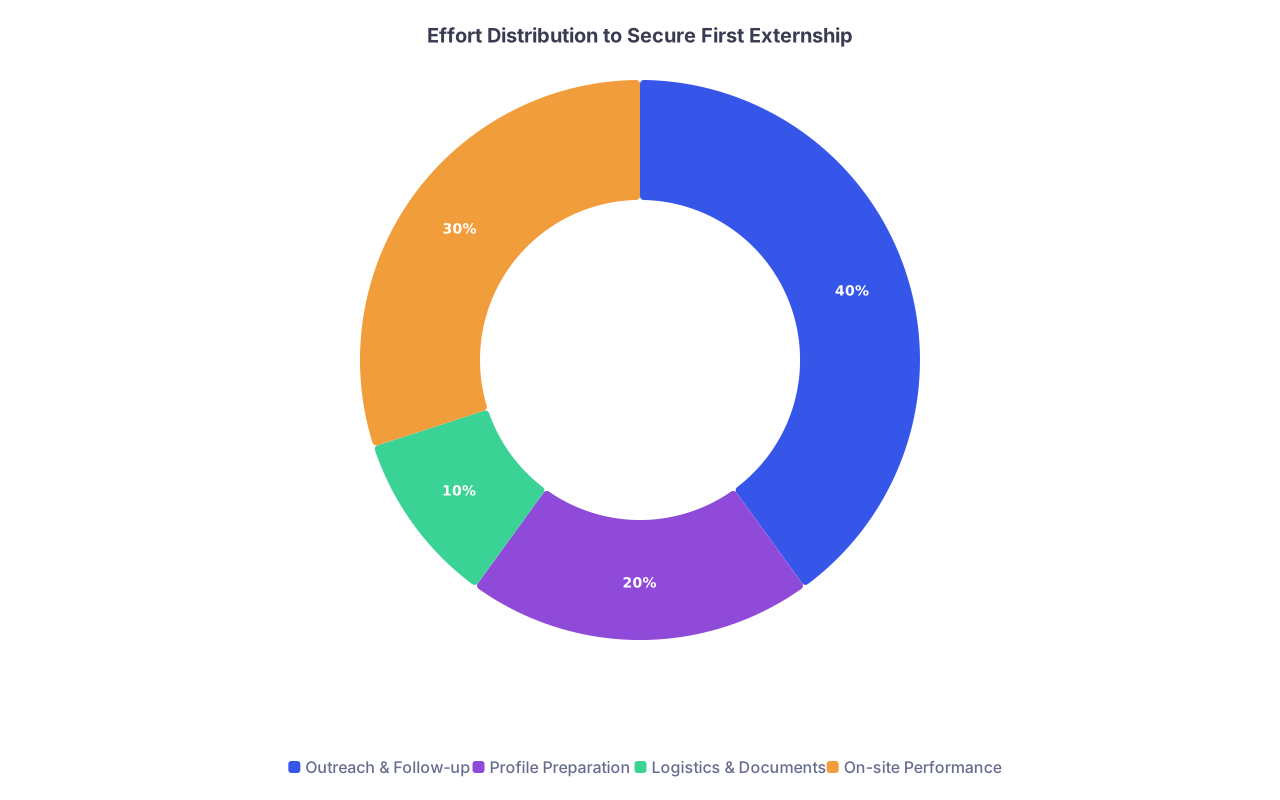
| Category | Value |
|---|---|
| Outreach & Follow-up | 40 |
| Profile Preparation | 20 |
| Logistics & Documents | 10 |
| On-site Performance | 30 |
Notice what dominates: outreach and follow-up, and then how you perform once you are there.
Key Takeaways
- You do not need existing U.S. contacts to get your first externship. You need a clean profile, a big target list, and disciplined outreach with follow-up.
- Prioritize hands-on, supervised experiences that allow direct patient interaction and strong LORs. Avoid paying big money for pure shadowing.
- Once you land a single solid externship, squeeze everything out of it: responsibilities, feedback, and especially a strong, specific U.S. letter that becomes the foundation for your next opportunity and your residency application.