
Most IMG observers never realize this: attendings decide in the first 2–3 days whether you’re “letter material” or just another shadow in the hallway.
You’re not told that. Officially, you’re “here to learn,” “not evaluated,” “not involved in direct patient care.” The subtext in faculty rooms is different: “Is this someone I’d be comfortable putting my name on in a letter?” That judgment happens fast, and it almost never gets said to your face.
Let me walk you through what actually makes U.S. faculty pay attention to an IMG observer—and what quietly gets you written off.
How Attendings Actually See IMG Observers
The brutal truth: to many attendings, an IMG observer is extra cognitive load. One more badge to keep track of, one more introduction, one more person to not accidentally assign orders to.
But there are three “buckets” faculty mentally sort observers into:
| Type of Observer | How Faculty Describe Them | Outcome |
|---|---|---|
| High-value | Engaged, sharp, useful | Strong letter, advocacy |
| Neutral | Quiet, harmless | Generic letter, if any |
| Negative | Needy, clueless, risky | Avoid, may warn colleagues |
I’ve sat in workrooms where attendings literally say, after rounds, “This observer? Sharp. I’d write for them.” Or, “Please don’t assign me more observers like that.”
They’re not evaluating your H&P skills. You’re officially not supposed to be doing those. What they’re judging is much more subtle:
- How you think
- How you behave under hierarchy
- Whether you understand unwritten American clinical culture
You cannot fake this. But you can learn it.
Rule #1: Your First 48 Hours Decide Your Ceiling
Faculty and senior residents start forming a narrative about you on Day 1. By Day 3, it’s hard to change.
They’re asking themselves three questions:
- Do you understand boundaries?
- Are you adding friction or reducing it?
- Are you the kind of person I’d trust with my patients in July?
So your first 48 hours are not “orientation.” They’re your audition.
What winning the first 48 hours looks like
You show up early. Not “on time.” I mean 15–20 minutes before sign-out. You introduce yourself to the senior resident first, then the attending when appropriate, with a clean, rehearsed line:
“Good morning, Dr. Smith. I’m Dr. Ahmed, an IMG observer from Pakistan, interested in internal medicine. I know observers can’t write notes or place orders, but I’d really like to learn your team’s workflow and help however is appropriate.”
Notice what that does. You’ve shown:
- You understand limits (no notes/orders).
- You respect workflow.
- You want to help within the rules.
On rounds, you don’t talk much at first. But when you do, you’re precise:
- You ask one or two high-yield clinical questions.
- You don’t argue.
- You don’t tell long stories about how it’s done “back home.”
By the end of Day 2, the team should know three things about you:
- You’re reliable (you show up, on time, every time).
- You’re teachable (you adjust when corrected once).
- You’re low-maintenance (you don’t constantly need direction).
That buys you something precious: psychological safety in the attending’s mind. Once they feel safe with you, they’ll let you get closer to the core of the team.
Rule #2: Learn the Hierarchy and Use It Ruthlessly
Here’s the part most IMGs miss: U.S. faculty expect you to operate through the chain of command. If you skip it, you get silently blacklisted.
Your real “boss” on the team is almost never the attending. It’s the senior resident or chief resident. That’s who decides whether you’re a help or a hassle.
You do not repeatedly corner the attending with:
- “Can you sign my evaluation form?” on Day 2
- “Can I present on rounds?” before the team trusts you
- “Can I scrub into every case?” without checking with residents
You go through the resident:
“Dr. Lee, I’d love to make this rotation useful for the team and for my learning. What’s the best way for me to contribute without getting in the way?”
Residents love that sentence. You’ve acknowledged their authority. You’ve also given them a chance to shape your role. If they invest in you, attendings notice.
Inside the workroom, what actually happens is this:
Attending: “So how’s the observer working out?”
Senior: “Honestly, they’re great. They read, they don’t wander off, they even help pull up images during rounds.”
Or:
“They’re… fine. Quiet. Don’t really know what to do with them.”
You want to be the first answer. The second answer leads to a generic, useless letter at best.
Rule #3: Ask Smart Questions, at the Right Time, to the Right Person
Faculty don’t remember the observer who never speaks. They also don’t remember the one who asks 17 basic questions before lunch. Both get mentally filed as “noise.”
They remember the one or two observers per year who ask attending-level questions at appropriate times.
There’s a simple framework:
- Basic/how-to/EMR questions → interns or students
- Interpretation/management questions → residents
- High-level reasoning/ethics/system questions → attendings
You do not ask, on rounds, in front of the patient:
“Why didn’t we start anticoagulation yesterday?”
You ask, after rounds, in a quiet corner:
“Dr. Patel, can I ask a quick question about the DVT patient? I was reading CHEST guidelines last night and wondered how you balanced the bleeding risk with the clot burden in his case.”
Different energy entirely. Now you’re someone who:
- Reads at night
- Thinks in terms of guidelines
- Understands clinical nuance, not just memorization
Attendings talk about you later: “That observer? Actually reads. Good questions.”
Rule #4: Master the American “Professional Personality”
This one’s invisible but it’s what kills the most IMGs quietly.
U.S. clinical culture has a very specific personality profile it rewards:
- Calm
- Brief
- Non-defensive
- Curious but not intrusive
- Confident but not arrogant
The problem? In plenty of countries, the respected trainee is the one who talks the most, argues the most, or shows off the most detail. Bring that to a U.S. attending, and you get eye-rolls the second you leave the room.
Here’s what impresses instead:
When an attending corrects you and you respond with:
“Got it, thank you. I’ll read more about that tonight.”
Not:
“But in my country we… / Actually, I read that…”When you answer questions in 1–2 clear sentences, not a 3-minute wall of text.
When your face and body language don’t register panic every time something goes wrong.
I’ve seen faculty reject writing letters for brilliant IMGs purely because their interpersonal style made nurses and residents tense. Nobody told them directly. They just never got the letter.
Rule #5: Contribute Without Violating the Rules
You’re technically “observing only.” But the best observers find ways to reduce friction for the team while staying compliant.
That does not mean secretly placing orders or seeing patients alone “like we do back home.” That gets you reported. I’ve seen it. The rotation ended that week, and no letter was ever discussed.
What it does mean:
- You pull up labs, imaging, and prior notes in the EMR when a resident is literally sitting next to you and you’re just driving the mouse.
- You keep a running list (on your own paper) of tasks the team mentions, so if someone forgets, you can gently remind them after rounds.
- You volunteer for low-risk, non-clinical help: finding equipment, wheeling the computer-on-wheels, tracking down printed reports.
There’s a reason nurses sometimes tell attendings, “Your observer is really helpful.” When that happens, your stock rises.
You want faculty thinking: “They’re technically an observer, but they behave like a junior intern who understands limits.”
Rule #6: Build a Clinical Narrative, Not Just “I Was There”
Faculty don’t write letters about your presence. They write letters about your trajectory.
They need a story in their mind something like:
“Over four weeks, ___ consistently arrived early, read about our patients, and gradually started offering thoughtful, concise differentials and management questions that reflected real growth.”
You help them build that narrative by making your progress visible in small, controlled steps.
Week 1:
Mostly listening. Asking 1–2 smart questions per day. Reading at night.
Week 2:
You ask the senior:
“Would it be alright if I try to present one of the patients informally to you before rounds, just for feedback?”
You’re not demanding a formal role. You’re asking for practice. That signals humility and ambition at the same time.
Week 3–4:
Residents may start tossing you low-stakes questions on rounds. “What’s your differential?” “What else would you add?” Attendings watch how you handle this. Calm, structured, brief answers impress them.
Over time, they see: you’re not static. You’re coachable. That’s what residency programs want.
Rule #7: The Reading That Actually Impresses
Everyone says, “I’ll read UpToDate at night.” Almost nobody does it in a way that faculty notice.
Here’s how you make your reading visible without being obnoxious:
You pick 1–2 patients per day. You read something targeted that night: guidelines, good UpToDate sections, maybe a NEJM review if you’re ambitious.
Next day, you drop one line with your new knowledge, tied directly to a patient:
“Dr. Johnson, I was reading ACC/AHA heart failure guidelines last night. For Mrs. X with reduced EF and CKD, I noticed they mention SGLT2 inhibitors even down to eGFR in the 20s. Is that something you’d consider for her later?”
That’s it. One surgical strike. Not a lecture.
The attending thinks, “They read. And they apply it.” That’s the difference between “hardworking observer” and “future colleague.”
Rule #8: The Right Way to Handle Mistakes and Awkward Moments
You will screw something up socially. Ask a question at the wrong time. Stand in the way in a code. Speak when the attending is clearly rushed.
What faculty watch is how fast you adapt.
The wrong move:
Getting flustered. Explaining yourself. Bringing it up 10 more times: “Sorry about earlier…”
The right move:
If someone corrects you, say:
“Understood, thank you for telling me.”
And then don’t repeat it.
Inside the workroom, somebody will say, “I told the observer not to stand near the head of the bed in codes; they were blocking RT.” If the senior can follow with, “Yeah, and they never did it again,” you’re fine.
If it’s, “I’ve told them three times,” you are done. Even if they’re polite to your face.
Rule #9: How Attendings Decide to Write You a Letter
Here’s the part nobody tells you: most attendings walk into a rotation assuming they will not be writing letters for observers. Too many requests, too little data, too much risk to their reputation.
So how do you flip that?
They need three conditions satisfied:
- They’ve actually seen you think
- You’ve been consistent for more than a few days
- Someone they trust (often a senior resident) vouches for you
You can help all three.
Mid-rotation, you quietly ask a senior resident for feedback:
“Dr. Lopez, I’m hoping this rotation leads to a strong letter one day. What would I need to be doing, from your perspective, to be at that level?”
Yes, that direct. Residents appreciate honesty more than vague hints. If they’re positive, they’ll often mention you to the attending unprompted:
“By the way, our observer is really good. Might be worth keeping in mind for a letter.”
Then, during the final week, you approach the attending in person, not by cold email alone:
“Dr. Smith, I’ve really valued learning from your team the past four weeks. I’m applying for internal medicine residency this September. Based on what you’ve seen of my work, would you feel comfortable writing a strong letter of recommendation for me?”
That word—strong—is deliberate. If they hesitate, you thank them and move on. If they say yes, you follow up with:
- Your CV
- Your personal statement draft
- A 1-page summary of patients/cases you saw with them and concepts you discussed
You’re making it easy for them to remember concrete details. Letters with specifics get taken seriously by program directors.
Rule #10: How This Looks From the Program Director Side
Let me spell out the hidden pipeline.
Program directors and selection committees see a flood of IMG applications with:
- Generic “observership at ___ Hospital” lines
- Bland letters: “They were punctual and eager to learn.”
Those letters are almost worthless. They know the writer barely remembers the applicant.
The letters that matter say things like:
“Although Dr. Rao was officially an observer in our service and could not write orders or notes, they functioned at the level of a sub-intern in terms of knowledge, thought process, and professionalism. I would rank them in the top 10% of IMGs I have worked with in the past five years.”
Those sentences don’t appear by accident. They come when:
- Faculty actually trusted you
- You behaved like a low-drama, high-ceiling future resident
- You understood every unwritten rule I’ve just walked through
Program directors recognize “code phrases.” So do attendings writing letters. You’re not just trying to be liked. You’re positioning yourself so that faculty can safely write those sentences about you.
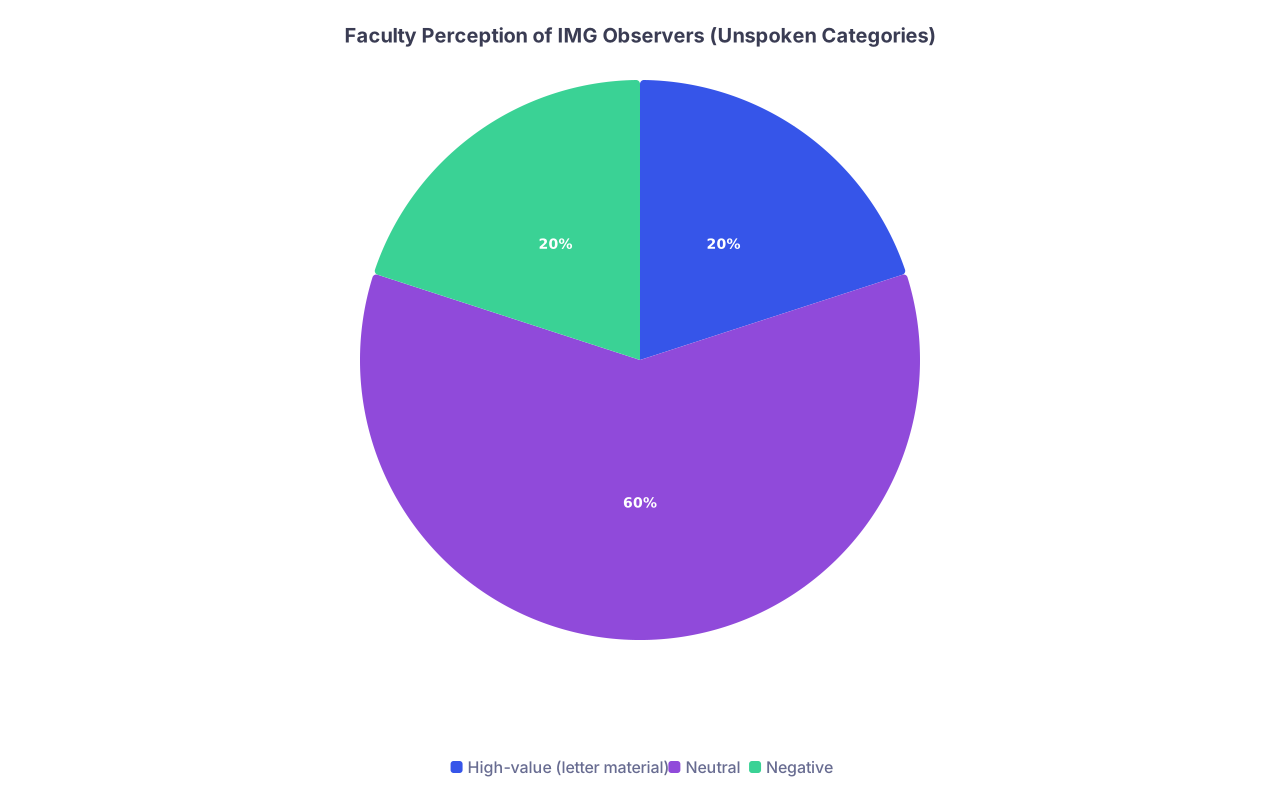
| Category | Value |
|---|---|
| High-value (letter material) | 20 |
| Neutral | 60 |
| Negative | 20 |
Practical Day-by-Day Behavior That Signals “Letter Material”
To make this concrete, let me sketch how a normal day should look from the outside when you’re doing it right.
You arrive early. You check the list on the board, look up 1–2 key patients you recognize, skim overnight events in the EMR. When residents arrive, you’re already oriented.
On rounds, you stand where the team stands. You’re not attached to the attending’s shoulder like a shadow. You’re part of the semicircle, not the center of it.
When an attending asks, “Thoughts?” and eyes drift briefly toward you, you give a 1–2 sentence answer. Structured. Something like:
“My main concern would be aspiration given her dementia and cough with meals. I’d also keep PE in mind given the recent surgery, though the vitals are reassuring at the moment.”
No monologue. No micro-lectures. Just competent reasoning.
Between patients, you do small, useful things: grab the mobile computer, help scroll through images, ask if anyone wants coffee when you go for water. That sounds trivial, but it nudges you from “extra body” to “team member.”
In the afternoon, you pick one interesting case, ask a resident:
“Do you have 5 minutes later so I can run my understanding of this case by you and see if I’m thinking about it the right way?”
That’s how you quietly turn yourself into a trainee instead of a tourist.

| Step | Description |
|---|---|
| Step 1 | Day 1-2: First Impression |
| Step 2 | Day 3-7: Reliable & Teachable |
| Step 3 | Week 2: Limited Clinical Contributions |
| Step 4 | Week 3: Recognized by Residents |
| Step 5 | Week 4: Attending Trust & Letter Discussion |
Common Behaviors That Quietly Destroy Your Chances
Let me be blunt about a few things I’ve seen over and over that will tank you, even if no one confronts you.
- Talking over medical students to impress attendings
- Comparing your home country constantly: “In India we do…” every 10 minutes
- Arguing with nurses, even politely, about “how it should be done”
- Standing frozen in a procedure room, in the way, clearly terrified but refusing to step back
- Asking for a letter on Day 3
- Disappearing for long stretches with no explanation (“I was in the cafeteria…”)
- Hovering at the front desk asking the ward clerk for patient lists or printing random charts without supervision
No one will sit you down and say, “Because you did X, I’m not writing you a letter.” They’ll smile, say “Sure, I’ll think about it,” then ignore your email. That’s the real world.
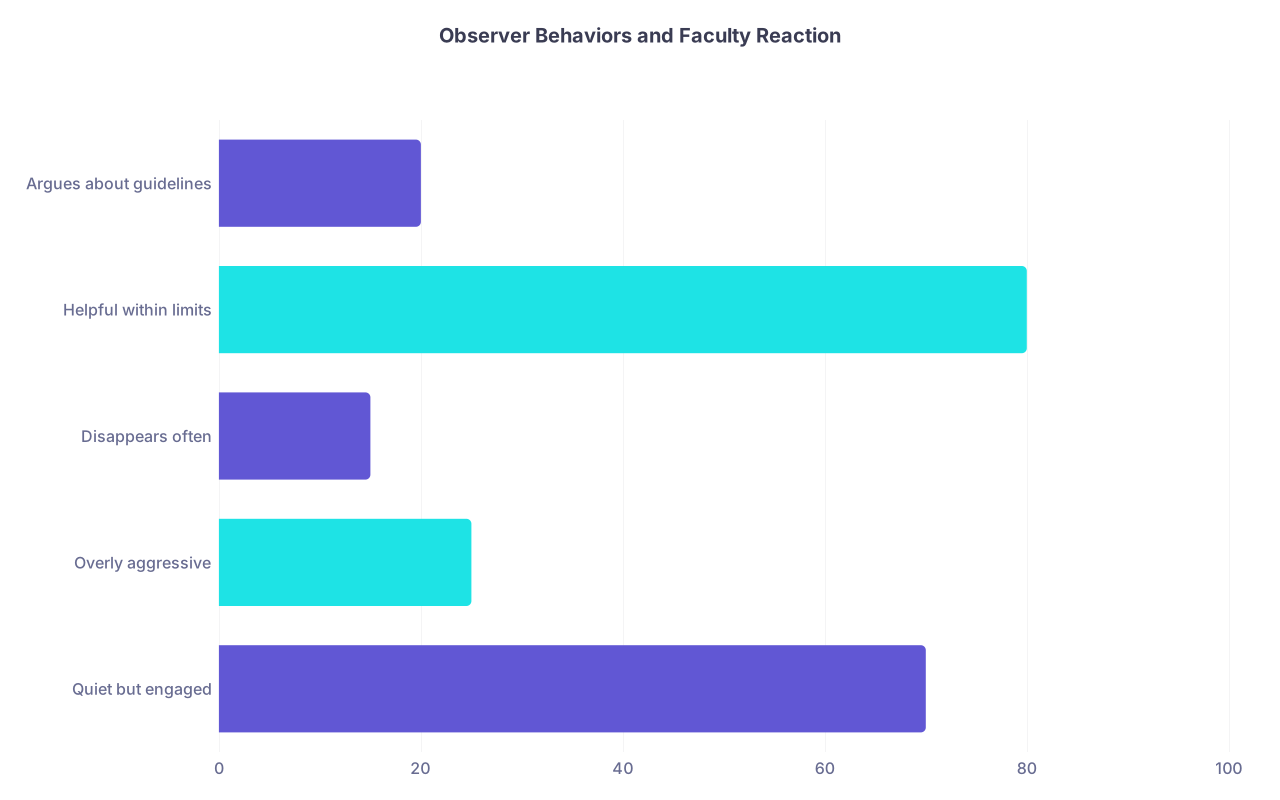
| Category | Value |
|---|---|
| Quiet but engaged | 70 |
| Overly aggressive | 25 |
| Disappears often | 15 |
| Helpful within limits | 80 |
| Argues about guidelines | 20 |
FAQ: The Unspoken Details You’re Afraid to Ask
1. How many weeks of observership with one attending do I need before asking for a letter?
Four weeks is the realistic minimum for a meaningful letter. Two weeks is usually not enough for an attending to see your consistency, unless you were extraordinary and the service was intense. If you’re there for less than four weeks, you should still act like “letter material,” but temper expectations.
2. Is it okay to bring up my Step scores or research during the observership?
Yes, but not in a bragging way and not on Day 1. Let it come up naturally when someone asks about your background, or when you’re discussing career goals. You want the attending to discover your scores and research, not feel like you’re selling yourself. One or two short mentions is enough.
3. What if the team seems too busy and no one has time for me?
That’s common. You stay present, quiet, and observant. You help with micro-tasks that don’t require orders or documentation. Then you look for tiny pockets of downtime—walking between rooms, elevator rides—to ask one focused question. You don’t demand teaching; you squeeze learning out of the chaos.
4. Should I dress more formally than residents to “look professional”?
Clean, well-fitted, conservative is enough. If residents are in scrubs and white coats, you’ll usually be fine in the same. Overdressing in a suit daily when everyone else is comfortable in scrubs can actually make you feel more distant and awkward. The real “professionalism” that matters is behavior, not your tie.
5. What do I do if an attending says they cannot write me a strong letter?
You thank them sincerely. Do not push. Do not argue. Simply say:
“Thank you for being honest with me. I appreciate your time and the opportunity to learn from you.”
Then you mentally categorize that rotation as experience, not as a letter source. You move on and double down on excellence in the next one.
If you remember nothing else, take this with you:
- Your observership is a month-long audition disguised as “just observing.”
- Faculty and residents are judging how safe, teachable, and culturally fluent you are—not your ability to place orders.
- The IMG observers who match are the ones who quietly behave like junior residents within the rules, read at night, and make it easy for attendings to say, “Yes, I’ll write you a strong letter.”