
Most IMGs waste half of their US clinical experience because they never capture it in a usable way. A sloppy, half-remembered “I saw some patients” will not get you a strong LOR or a convincing interview story. A well-designed USCE logbook will.
Let me break this down specifically: you are not making a cute diary. You are building evidence. Evidence that you showed up, thought clinically, understood systems, and grew over time. Programs care about that. Attendings who write letters care about that. And when you sit in front of a PD and they ask, “Tell me about a challenging case,” you will care about that.
We will build a logbook that does three things extremely well:
- Tracks cases and responsibilities in a way attendings and PDs recognize as serious.
- Generates ready‑to‑use material for your personal statement, ERAS experiences, and interviews.
- Drives genuine clinical reflection, not just box‑ticking.
Step 1: Decide the Core Purpose of Your USCE Logbook
A good logbook serves three overlapping purposes: documentation, development, and storytelling. If it does not do all three, rework it.
1. Documentation: “Show me what you actually did.”
Program directors are tired of inflated USCE descriptions. “Extensive hands-on experience” that turns out to be “I shadowed and occasionally checked vitals.” Your logbook needs to demonstrate:
- What settings you worked in (inpatient vs outpatient, academic vs community).
- What types of patients and pathologies you saw.
- What level of involvement you had (observer, active participant, primary documenter, etc.).
- Which attendings/residents you worked with and for how long.
You are building a structured memory that can be:
- Summarized in ERAS.
- Cited during letters of recommendation (“I observed her take ownership of X cases over four weeks”).
- Broken down by specialty if you apply to more than one field.
2. Development: “Are you actually improving or just existing on rounds?”
You are not just counting patients. You are tracking growth in:
- Clinical reasoning
- Communication (with patients and the team)
- Efficiency and workflow
- Professionalism and systems awareness
Your logbook should make trends visible: early entries vs late entries should not look identical. If they do, something went wrong—either in the rotation, in you, or in the logbook design.
3. Storytelling: “Can you talk about your experience like a US trainee?”
Residency interviews are basically: “Tell me a story that proves you are ready.”
Your logbook should feed you:
- 4–6 strong clinical cases to use as anchor stories.
- 2–3 conflict/ethical/communication situations.
- 1–2 system‑based practice examples (handoffs, discharge planning, safety incident, EMR use).
- Clear examples of feedback received and how you acted on it.
If you design the logbook right from day one, you will not struggle later to remember “one time I managed a difficult patient.”
Step 2: Core Structure – Three Layers of a USCE Logbook
Do not overcomplicate this with 15 sections you never fill. You need three layers:
- Rotation overview (macro)
- Daily summary (meso)
- Case mini‑logs (micro)
Think of it like zoom levels in Google Maps.
A. Rotation Overview Pages
Make one overview page per rotation (or per attending block if they change mid‑rotation). This is what you will pull from when writing ERAS and describing the rotation to PDs.
Key fields you should have:
- Rotation title: “Internal Medicine Inpatient – Community Hospital – 4 weeks”
- Institution: Name, city, state, type (academic, community, county, VA, etc.).
- Dates: Start and end.
- Attending(s): Names and emails (carefully and correctly).
- Level of involvement: Shadowing only / Active observer / Hands‑on (documenting in EMR, writing notes for review, presenting cases, etc.).
- Weekly schedule: Typical hours, call/long days, weekend shifts.
- Patient exposure: Main systems and conditions seen (just a list).
- Systems exposure: EMR used, handoff tools, order systems, multidisciplinary rounds, etc.
- Evaluation:
- How feedback was given (formal mid/end, informal).
- Main strengths mentioned.
- Main areas to improve.
Make this structured. You want to be able to glance at all your rotations and compare them.
| Field | Example Entry |
|---|---|
| Rotation | Internal Medicine Inpatient – 4 weeks |
| Institution | Mercy Community Hospital, Chicago, IL (Community) |
| Dates | 07/03/2025 – 07/30/2025 |
| Attending | John Smith, MD ([email protected]) |
| Level of Involvement | Active observer: H&P, presentations, progress notes |
| Typical Daily Hours | 7:00–17:30 (q4 call, 1 weekend day per week) |
| EMR | Epic |
This one page will carry half the weight of what you say about that USCE on ERAS.
Step 3: Daily Log – What You Actually Did Each Day
Most people either write nothing or write useless prose like “Busy day, learned a lot.” That is dead weight.
You want a daily format that takes 5–10 minutes to fill and gives you:
- A snapshot of your role.
- Key tasks.
- One or two learning points.
- One reflective note.
Here is a clean, efficient daily template.
Daily Log Template (Meso Level)
Each day gets one entry. Use a table, spreadsheet, or structured note. Suggested fields:
- Date
- Setting: Inpatient / Outpatient / ED / ICU / Clinic type (IM, FM, Cards, etc.).
- Team: Attending, main resident/fellow.
- Hours: Start–end time.
- Patients followed: Number you rounded on / saw directly.
- Roles / tasks performed (checklist style):
- Took history
- Performed focused exam
- Presented on rounds
- Wrote notes (draft vs entered in EMR)
- Discussed plan with attending
- Counseled patient/family
- Followed up labs/imaging
- One clinical learning point (specific, not “CHF management” but “escalation of diuretics in acute decompensated HF with CKD”).
- One systems/professionalism point (handoff, communication, time management, cultural issue).
- One “to improve” action for next time (e.g., “practice more concise one‑liners on rounds”).
This format does three things: it proves effort, demonstrates progression, and gives you something to say when an attending asks, “What did you learn today?”
Step 4: Case Mini‑Logs – The Real Gold
This is where the logbook becomes powerful. Not every patient needs a case mini‑log. If you try that, you will stop writing by week two. You want to log:
- High‑yield cases (classic pathologies in your chosen specialty).
- Unusual or complex cases (zebras, multi‑system disease).
- Cases that tested your communication or professionalism.
- Cases that might generate a strong interview story.
Aim for 2–4 mini‑logs per week on a typical inpatient rotation; maybe 1–2 per clinic session.
Case Mini‑Log Template (Micro Level)
Each mini‑log fits on one page or one structured digital note. It needs to be lean but rich. Here is a format that works:
- Case ID: A simple code (e.g., IM1‑D3‑01 = Internal Med, week 1, day 3, patient 1). Never use patient names or MRNs.
- Demographics: Age, sex, key comorbidity tags: “68F, DM2, CKD3, HTN.”
- Presenting problem: One sentence. “Progressive dyspnea and orthopnea for 5 days.”
- Working diagnosis / final diagnosis: Start with your initial impression, then the final if it changed.
- Your role: Be precise. For example: “Obtained initial H&P, presented to senior, followed daily, drafted notes, called family with interpreter, coordinated echo scheduling.”
- Key clinical reasoning step:
- What was the main diagnostic or management challenge?
- How did the team reason through it?
- Where did you specifically contribute?
- Outcome: Disposition and key outcome element. “Improved on IV diuresis, discharged home with weight‑based diuretic plan and cardiology follow‑up.”
- Reflection: 3–5 sentences on one of:
- What you misunderstood initially.
- What surprised you.
- What you would do differently next time.
- How this case changed your understanding / empathy / approach.
- Competencies tagged: Choose 1–3 tags such as: Clinical reasoning, Communication, Teamwork, Systems‑based practice, Professionalism, Patient safety.
You want these mini‑logs to sound like the way US residents talk about cases: structured, focused, reflective.
Step 5: Digital vs Paper – Choose the Right Platform
This matters more than people admit. If the tool is clumsy, you will stop using it by week two.
Digital Options (recommended)
Use something searchable and easily backed up. A few workable setups:
- Spreadsheet (Google Sheets / Excel):
- Good for daily logs and rotation overviews.
- You can filter by rotation, date, setting, etc.
- Note apps (Notion, OneNote, Evernote, Apple Notes):
- Excellent for case mini‑logs with templates.
- Easy to tag and cross‑reference.
- Hybrid:
- Overview + daily logs in a sheet.
- Each case mini‑log is a linked note (e.g., Notion page) keyed by Case ID.
You do not store identifiable patient data. No names, no MRNs, no addresses. Age, sex, broad categories of disease, major labs/imaging findings (without specific dates or identifiers) are fine.
Paper Options (if digital is impossible)
If you must go paper:
- Use a bound notebook, not loose pages.
- Pre‑rule sections at home before rotation starts:
- First 3–4 pages: rotation overview(s).
- Each day: half a page.
- Each case mini‑log: one page.
- At the end of each week, photograph the pages and upload to a secure personal cloud (again, no PHI).
Paper looks “cute” but slows you down for searching later. If you are serious about residency applications in the US system, digital really is better.
Step 6: Example Templates (You Can Copy-Paste This)
Let me give you concrete skeletons you could recreate in a spreadsheet or notes app.
Rotation Overview Template
Fields:
- Rotation name
- Institution
- Location (city, state; academic/community/VA/county)
- Dates (start–end)
- Speciality
- Attending(s): name, email
- Your role level (shadow / observer / active / hands‑on)
- Average daily hours
- Call/weekend structure
- EMR and main tools (Epic, Cerner, paper, sign‑out method)
- Typical patient population:
- Age range
- Insurance mix (private, Medicare/Medicaid, uninsured)
- Common conditions (e.g., CHF, COPD, DM, etc.)
- Key responsibilities you had by end of rotation (in your own words, concrete tasks)
- Summary feedback from attending(s) – 3 bullets:
- Strengths
- Areas for growth
- Overall impression
Daily Log Template (Spreadsheet Row Example)
Columns:
- Date
- Rotation (short code)
- Setting (Inpt/Outpt/ED/ICU/Clinic)
- Main attending/resident that day
- Hours (07:00–17:30)
- Tasks (short coded: Hx, PE, Pres, Notes, F/U labs, Family talk, Discharge planning, etc.)
- Top clinical learning point (1 sentence)
- Top systems/professionalism point (1 sentence)
- “Tomorrow I will…” (1 short goal)
One row per day. It does not need to be literary. You are writing for your future self, not for publication.
Case Mini‑Log Template (Note/Page)
Title: Case ID – Brief label
Example: “IM1‑D5‑02 – NSTEMI in CKD”
Sections:
- Snapshot
- Age/sex: 74M
- Key comorbidities: DM2, CKD4, CAD, COPD
- Setting: Inpatient / cardiology consult
- Presenting problem
- “Crushing chest pain for 2 hours with SOB.”
- Working vs final diagnosis
- Working: Unstable angina vs NSTEMI
- Final: NSTEMI with acute on chronic CHF exacerbation
- My role
- “Obtained initial focused history and exam, presented to senior, followed daily, drafted progress notes, updated daughter via phone, prepared discharge medication list under supervision.”
- Clinical reasoning point
- “Debate about immediate cath vs medical management given advanced CKD and DNR status. I learned to weigh procedural benefit vs risk of contrast nephropathy and align treatment with patient’s stated goals.”
- Outcome
- “Managed medically, no immediate cath. Symptom improvement, discharged with cardiology f/u and revised goals‑of‑care note.”
- Reflection
- “I initially thought ‘NSTEMI => cath,’ but this case showed me how comorbidities and patient preferences shape decisions. I saw how the attending used simple language to explain risks to the daughter and respected the patient’s choice. In future similar scenarios, I want to better prepare myself with data on outcomes in CKD to contribute more meaningfully to the discussion.”
- Competency tags
- Clinical reasoning, Communication, Professionalism, Systems‑based practice.
Keep each mini‑log this tight. You do not need the whole chart.
Step 7: Using Your Logbook to Strengthen ERAS and LORs
Design the logbook backwards: from what ERAS and PDs actually want to see.
Turning Rotation Overviews into ERAS Entries
When you fill in an ERAS “Experience” section for USCE, you will be asked about:
- Organization name and role
- Dates and hours/week
- Description of duties and achievements
Your rotation overview + daily logs give you:
- Exact dates and approximate hours/week (average your daily hours).
- A list of specific tasks you can translate into ERAS language:
- “Performed focused histories and physical exams on 3–6 patients daily.”
- “Presented cases during attending rounds and formulated initial assessment and plan under supervision.”
- “Drafted daily progress notes and discharge summaries for review in EMR (Epic).”
- “Participated in multidisciplinary rounds with case management, social work, and nursing.”
This looks much sharper than “Observed patient care.”
Feeding Your Attendings for Strong Letters
Most IMGs never do this properly. They ask for a letter with nothing to help the attending remember details. So the letter becomes generic.
Instead:
- Two weeks before rotation ends, tell your attending you keep a brief structured log and would be happy to email a one‑page summary of your activities and key cases.
- Build that one‑page from your logbook:
- Brief rotation description and dates.
- Bullet list of responsibilities you consistently performed.
- Three mini‑case summaries (just the role + what you learned).
- A short paragraph showing how you responded to feedback during the rotation.
You are not writing the letter. You are refreshing their memory and giving concrete points. Many attendings will literally say, “Send me something like that,” and then build their letter heavily from it.
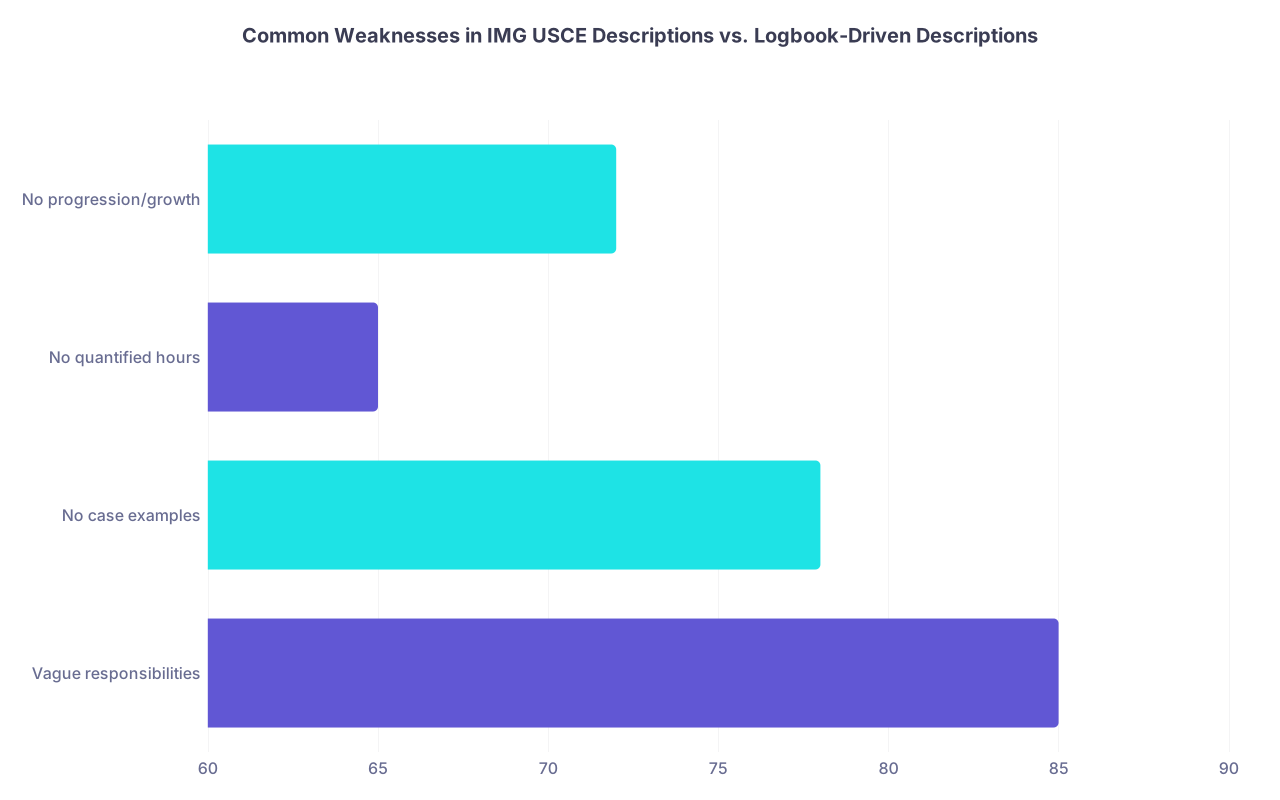
| Category | Value |
|---|---|
| Vague responsibilities | 85 |
| No case examples | 78 |
| No quantified hours | 65 |
| No progression/growth | 72 |
The logbook fixes all four of those problems if you actually use it.
Step 8: Reflection That Actually Changes Behavior
Most “reflection” in medical education is embarrassingly superficial. You are not trying to impress a faculty development committee. You are trying to sharpen your own judgment.
Here is a simple, hardcore reflection framework you can apply intermittently (weekly or after a major case), built directly off your logbook.
Weekly Reflection Using Your Daily + Case Logs
Once a week, spend 15–20 minutes on three prompts:
Pattern recognition
- Scan your daily logs: What patterns do you see?
- Are you consistently weaker at one task (presentations, time management, documentation)?
- Are you avoiding certain things (difficult family conversations, phone calls, procedures)?
One clinical growth point
- Pick one mini‑log case where you misjudged something (differential, priority, communication choice).
- Write out: “Next time I see a patient with [X], I will ensure I always [Y].”
One systems/professionalism growth point
- Identify a moment where the system (handoff, discharge, EMR, language barrier) almost failed the patient—or did fail.
- Ask yourself: “What could I have done differently within my role?”
- Write a one‑sentence behavioral commitment.
Those commitments can be incredibly simple:
- “Write down all labs/imaging I must follow up before leaving for the day.”
- “Practice 30‑second case summaries with the senior when there is a free moment.”
These reflections are what PDs want to hear in interviews when they ask, “Tell me about a time you made a mistake or would do something differently.”
Step 9: Specialty‑Specific Tweaks
You are not going to track a psychiatry outpatient rotation the same way as general surgery. Let me be concrete.
Internal Medicine / Family Medicine
- Track chronic disease follow‑up and continuity:
- Which patients you saw more than once.
- How management plans adjusted over time.
- Competency tags: Clinical reasoning, continuity, patient education, systems‑based practice.
Surgery
- Add fields in daily logs for:
- Role: observer vs first assist vs closing skin, etc.
- Case mini‑logs: focus on peri‑op decision‑making, complications, and brief procedural steps you learned.
Pediatrics
- Emphasize communication with parents/guardians, age‑specific exam adaptations, vaccination discussions.
- Tag cases that involve social services, child protection, or development concerns.
Psychiatry
- Focus more heavily on:
- Interview structure
- Risk assessment (SI/HI)
- Capacity and consent issues
- Interdisciplinary coordination (social work, case managers).
- Case mini‑logs should put more weight on longitudinal management and therapeutic alliance.
Emergency Medicine
- Add timing and acuity:
- Triage category or perceived severity.
- Time from presentation to key decisions (imaging, consults, disposition).
- Good place to track logistics, throughput, and teamwork under pressure.
You do not need a totally different logbook per specialty. Just adapt certain fields and reflections.
Step 10: Make It Sustainable – Avoid the Common Failure Patterns
I have seen IMGs design beautiful, unusable systems. Three main failure points:
Overcomplicated templates
- If it takes more than 10 minutes at the end of the day, you will eventually stop.
- Solution: ruthlessly cut nonessential fields after week one.
Irregular entry
- “I will fill this every few days” is a lie. You will forget details by day two.
- Solution: block 10 minutes after sign‑out or before leaving. Non‑negotiable.
Treating it like homework
- If you write only what you think sounds “good,” you will not capture the real growth and mistakes.
- Solution: remember this is private. You are not turning it in. Be honest and blunt.
Example Weekly Snapshot Using the Logbook
To show you how this pans out in practice, imagine your Week 2 of an IM inpatient elective, summarized from your logbook:
- Mon–Fri: 7:00–17:30, 5–8 patients on your team, you are fully following 3–4.
- Tasks: daily H&P updates, progress note drafts on 3 patients, presenting two new admissions on rounds, following up test results, calling PCPs for med reconciliation.
- Case mini‑logs this week:
- New diagnosis of DKA in a young adult with poor access to insulin.
- CHF exacerbation with social barriers to low‑sodium diet.
- Readmission for COPD due to poor inhaler technique and no follow‑up.
- Weekly reflection points:
- Clinical: improved structure in presentations, now using “one‑liner + problem list” format.
- Systems: realized two discharges were delayed due to missing home health orders; next week you plan to proactively ask about discharge needs during rounds.
That single weekly snapshot is already more compelling and specific than most IMGs ever communicate about their USCE.
Final Key Points
- A serious USCE logbook is not optional if you want competitive residency applications as an IMG. It is your evidence, memory, and story generator.
- Structure it at three levels—rotation overview, daily logs, and selective case mini‑logs—and keep it brutally simple and sustainable.
- Use the logbook deliberately to fuel ERAS entries, LOR support, and interview stories, and to track actual growth in how you think, communicate, and function on a US team.