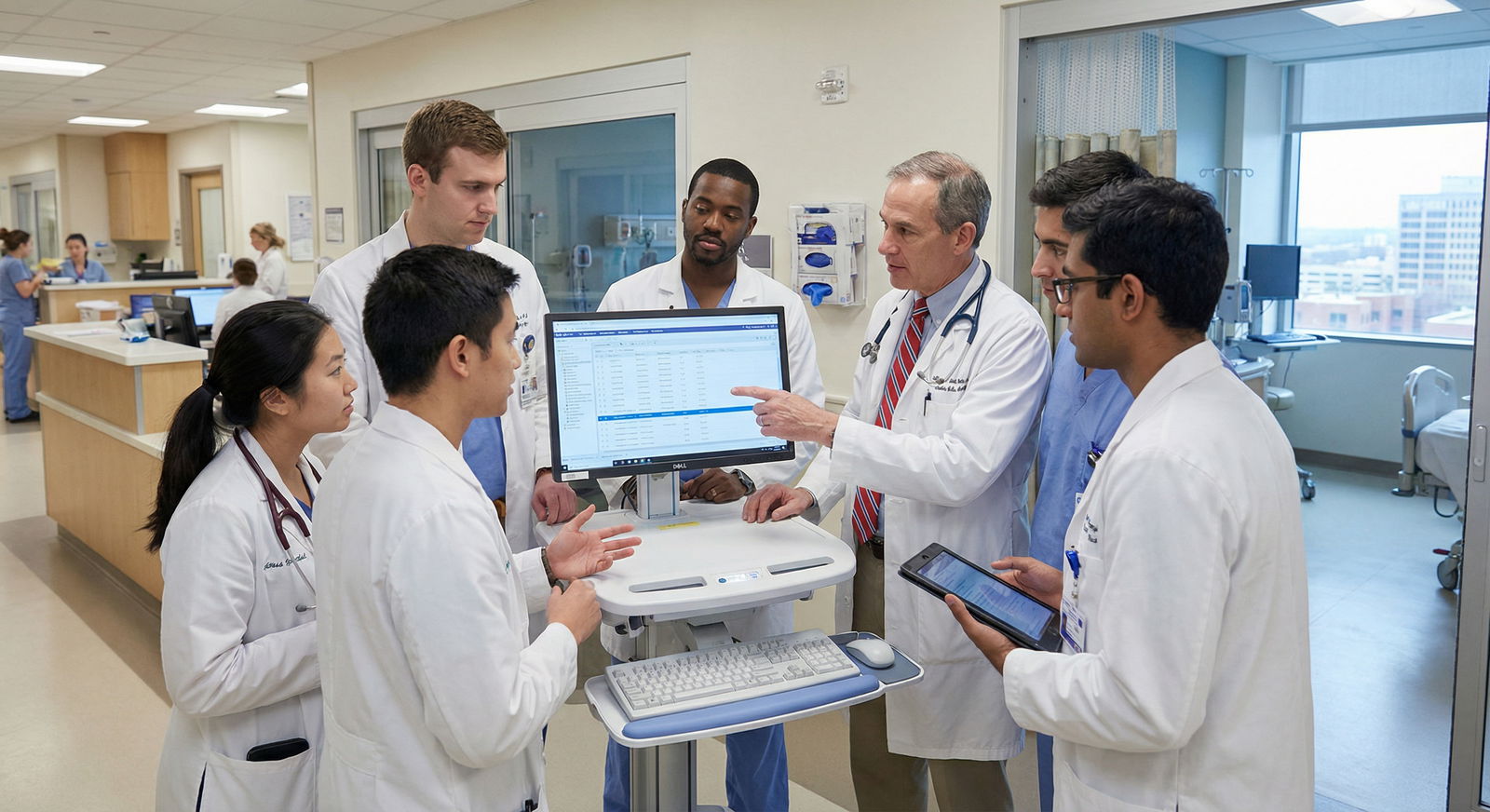
Most IMGs break HIPAA in their first week of USCE and nobody tells them.
Not because they are careless. Because nobody bothers to explain the real rules beyond “don’t post on social media” and “log out of Epic.”
Let me fix that.
You are coming to the United States for observerships, electives, or externships. You want strong letters, no drama, and zero risk of being blacklisted. The fastest way to sabotage that is a HIPAA incident with your name on it.
Let me break down, very specifically, what you can and cannot do on the wards as an IMG in US clinical experience (USCE) when HIPAA is involved.
HIPAA Basics for IMGs: What Actually Applies to You
You are not a licensed US physician. You might not even be an official “workforce member” of the hospital. But HIPAA still matters to you for two reasons:
- The hospital is legally bound by HIPAA.
- Your behavior can put the hospital (and the supervising physician) in violation.
If they think you are a risk, you are gone. And that follows you.
The bare minimum you must understand
HIPAA has three basic privacy ideas you must internalize:
Protected Health Information (PHI)
Any information that can identify a patient + something about their health, care, or payment.
Not just names. Identifiers include:- Name
- Address more specific than state
- Dates (birth, admission, discharge, death, procedure dates)
- Phone, email, fax, MRN
- Photos, especially of face or any recognizable feature
- Any unique number, code, or characteristic that can identify the patient
Minimum Necessary Rule
You access, view, or use only the minimum PHI needed to perform your assigned role.
As an IMG in USCE, your role is:- Education
- Observation
- Limited participation in care (if explicitly allowed)
Need-to-Know
You see PHI only for patients you are involved with on that service, on that day, for that purpose. Curiosity is not a justification.
You are not a resident. You are not hospital staff. Your access is a privilege, not a right.
Types of USCE and How Much You Can Touch the Chart
This is where most IMGs get confused. Your HIPAA “freedom” depends heavily on what type of USCE you are doing.
| USCE Type | EMR Access | Direct Order Entry | Write Notes | Discuss Identifiable Details Outside Team |
|---|---|---|---|---|
| Pure Observership | Usually No | No | No | No |
| Hands-on Externship (non-credit) | Maybe (limited) | No | Draft only / pre-chart | No |
| Official Elective (US med school, VSLO) | Yes (full student) | No | Yes (as student) | Only for education, de-identified when outside |
| Research-only Hospital Access | Very limited or none | No | No | No |
If you take nothing else from this section: Your HIPAA boundaries are defined by your official role, as documented by the institution. Not by what the resident casually tells you is “fine.”
If your appointment letter or onboarding calls you an observer and they still hand you an EMR login and tell you “just use it,” be very careful. You have legal exposure without the protection that employees have.
What You CAN Do on the Wards (When Done Right)
Let’s be practical. You are there to learn, impress, and build connections. Here is what is generally acceptable, and how to do it without stepping into HIPAA trouble.
1. Participate in bedside rounds
This is allowed. You are with the care team; PHI is being shared for treatment and operations.
You can:
- Listen to case presentations that include names, locations, diagnoses, labs.
- Ask clinically relevant questions about the patient’s condition and plan.
- Present the patient at bedside or in the workroom if the attending asks you to, using the patient’s name.
You must:
- Keep your voice discreet. Loud hallway storytelling about “the guy with metastatic colon cancer in 713” is a problem.
- Avoid discussing patients in public spaces: cafeteria, elevator, lobby, Uber, bus, hotel lobby.
2. Take personal learning notes – de-identified only
You are allowed to write notes in a personal notebook or on your device if:
- They are de-identified.
- They are for your education, not for publication or sharing.
Good example:
“65F with new-onset afib RVR after pneumonia; CHADS-VASc 4; started on metoprolol, heparin drip; echo pending.”
Bad example:
“65F from [small town name], Mr. X’s wife, in Room 8423, admitted 1/3/2026 with AFib RVR.”
Strip out:
- Names
- Exact dates
- Precise location (room number, small town)
- Unique occupational or family details (“the principal of [named] school”)
If your notes would make it easy for someone who knows the patient to identify them, they are not de-identified.
3. View charts of your assigned patients (when you have EMR access)
If you are officially granted EMR access as a student or extern on a team, you can:
- Open charts of patients currently under that team’s care.
- Review labs, imaging, notes for educational purposes and patient care discussion.
You cannot:
- Open charts of:
- Your neighbor
- Your friend’s parent
- A celebrity or “interesting” case you heard about but are not on
- Patients from other services that have nothing to do with your team
Every significant EMR in the US logs every chart you open. Random chart surfing gets flagged. I have seen students pulled into meetings months later because “audit shows you accessed X patient’s chart without involvement.”
Curiosity is not a defense.
4. Practice writing notes in a controlled, approved way
On electives or externships that allow hands-on work, attendings often say: “Write the note. I will review and co-sign.”
You can:
- Write H&P, progress notes, or consult notes on assigned patients if your role as “student” allows it.
- Use the hospital EMR to enter those notes under your student profile, to be co-signed.
- Save personal, fully de-identified versions of the structure (not the PHI) for your learning. Example: “SOAP format for decompensated CHF – template.”
You cannot:
- Print out your notes with full names and MRNs to “study later.”
- Email them to yourself.
- Take screenshots of your notes on your phone or laptop.
If you want templates, abstract the structure, not the patient.
What You CANNOT Do (Where IMGs Most Often Get Burned)
This is the part no one spells out for you in detail. These are the behaviors that absolutely will damage you if discovered.
1. Storing PHI on your personal device
This includes:
- Taking photos of:
- Monitor screens
- EMR screens
- Whiteboards with patient names
- Written sign-out lists
- Wound images or rashes
- Keeping patient identifiers in:
- Your phone’s Notes app
- WhatsApp chats
- Email drafts
- Cloud storage (Google Drive, Dropbox, iCloud)
“I will delete it later” is not a defense. Once it leaves the hospital system, you lost control of it.
Correct behavior:
- No PHI on your phone. Zero.
- No emailing yourself patient info.
- If you accidentally receive PHI (e.g., a nurse messages you the full name in a non-secure way), delete it immediately and do not forward it.
2. Posting or messaging about patients, even “anonymously”
This includes:
- Instagram stories: “Wild case today, 24-year-old with [super rare condition] after [specific incident].”
- WhatsApp to friends back home: “We have a 32-year-old woman from [country] with stage IV [rare cancer] pregnant at 20 weeks…”
- Medical forums: case discussions that include rare combinations of details that can identify someone.
The truth: This is extremely common among IMGs and US grads. It is still wrong and potentially reportable.
De-identification on social media is stricter. If the combination of:
- Age
- Rare diagnosis
- Unusual circumstance
- Timeframe (“today,” “this week”) could identify the patient to someone who knows them, you are skating on thin ice.
If you must discuss an interesting case for learning:
- Remove dates and time clues.
- Vaguify age (say “middle-aged” instead of “52”).
- Remove location ties (“from Mexico” becomes “from another country”).
- Do it on appropriate secure educational platforms, if the institution allows.
And frankly, during USCE, safest move: do not post clinical stories. At all.
3. Accessing “cool” charts you are not assigned to
Classic violations:
- ED patient stabbed in a public incident you read about in local news → you search their name.
- Famous athlete admitted to your hospital → you open their labs “just to see.”
- Your co-ethnic colleague says “There is a patient from [your country], go look at them” → you explore their chart without being on that team.
This is audited. Especially for VIPs and high-profile cases. Hospitals will run specific audits on who accessed those charts.
If the attending calls you in and asks, “Why did you open this chart?” and your answer is anything except “I was on the treating team” — you have a problem.
4. Taking identifiable patient photos “for your portfolio” or “for my LOR writer”
You cannot:
- Photograph wounds, rashes, or procedures on your personal phone, even if the face is not visible.
- Keep any image of a patient’s body part that is unique or time-linked.
- Show those photos later to friends, interviewers, or mentors using your personal device.
“Face not shown” is not enough. Body tattoos, birthmarks, room numbers, dates, or even context can identify a person.
Can you ever be part of clinical photography? Yes, but only:
- On an IRB-approved research protocol with documented consent, or
- Under a formal consent process for clinical photography where images are stored on hospital systems, not your phone.
As an IMG in short-term USCE, 99% of the time, the correct default is: you do not take patient photos. At all.
5. Keeping sign-out sheets, stickers, or printed lists
Residents sometimes hand you printed patient lists or stickers from label printers to help you follow along. You might be tempted to keep them “for your learning” or to remember names for thank-you emails.
Do not.
You must:
- Return or shred printed patient lists before leaving the hospital.
- Never leave lists on cafeteria tables, in your bag long-term, or in your apartment.
- Never photograph them as a “backup.”
If you want to remember who you worked with:
- Keep a separate list of staff: attendings, residents, fellows. That is fine.
- Do not keep a list of patients.
Hallway Realities: Conversations, Families, and “Off-the-Record” Moments
HIPAA violations are not usually about grand hacking. They are about careless speech.
1. Talking about patients with your co-IMGS / friends
Acceptable:
- Discussing cases with your team in appropriate clinical spaces.
- Talking through a case with another student on the same team, in a private workroom.
Risky to unacceptable:
- Case gossip in the cafeteria within earshot of visitors.
- Detailed case talk on public transit on your way home.
- Sharing juicy details with a friend in another department “because it is so unusual.”
A good habit:
- Use bed numbers or generic descriptors in public-ish spaces: “Our afternoon admission with GI bleed” instead of “Mr. Alvarez in 624 with alcoholic cirrhosis and varices.”
2. Family encounters and “Are you the doctor?”
HIPAA is not just about charts; it is also about disclosure.
As an IMG in USCE:
- You are not the attending.
- You are often not authorized to disclose new diagnoses, prognoses, or test results independently.
When a family member corners you:
- “What did the scan show?”
- “Is it cancer?”
- “Will he go to the ICU?”
Correct move:
- Acknowledge you are part of the team but not the primary decision-maker.
- Example: “I am part of the care team and here to help, but your [doctor/resident/attending] is the best person to explain the results and plan. I will let them know you have these questions.”
Wrong move:
- Giving a full explanation of a result that has not yet been discussed by the attending.
- Speculating about prognosis or disclosing sensitive information that has not been communicated by the primary team.
This is partly professional hierarchy, partly privacy and consent.
Protected vs De-Identified vs “Still Risky”: Concrete Examples
Let us be very concrete. You need to develop an instinct for what is safe to say or write.
Example 1: Your study notebook
Unsafe:
“John Smith, 47, from [small town], admitted 1/4/26 with new AML, WBC 110k, DIC, on hydroxyurea + apheresis.”
Safer:
“Middle-aged man with newly diagnosed AML, hyperleukocytosis (WBC ~110k), DIC, managed with cytoreduction + apheresis.”
What changed:
- Name removed.
- Exact age vague.
- No location or date.
- Clinical details preserved.
Example 2: WhatsApp to a friend
Unsafe:
“We have a 32-year-old Syrian refugee, 28 weeks pregnant, with metastatic breast cancer to brain. Never seen anything this sad.”
Why this is a problem:
- Rare constellation: age, refugee status, pregnancy, metastasis.
- If anyone in that community knows her, they can identify her from this description alone.
If you must share a learning point (and again, I strongly suggest you do not during USCE):
“I saw a case of advanced malignancy in pregnancy. Learned a lot about balancing maternal vs fetal risks in chemotherapy timing.”
Research, Case Reports, and Presentations: HIPAA in Academic IMGs
Many IMGs try to squeeze a case report or poster out of USCE. Reasonable goal. Very easy to handle badly.
Case reports / case series
You cannot just:
- Write up a case.
- Remove the name.
- Submit to a journal.
You must:
- Work with a supervising faculty member officially affiliated with the institution.
- Confirm whether IRB or formal privacy review is required for that type of case report (policies vary by institution).
- Use the hospital’s process to de-identify data and images.
- Sometimes obtain a signed patient authorization if identifiable risk is still present.
On your own, as a visitor, scraping cases for later write-up is a terrible idea. If you want academic output:
- Say to your attending: “I am very interested in academic work. Is there an ongoing project I could contribute to, or a case we might be able to write up through the proper channels?”
Teaching sessions, conferences, and grand rounds
Inside the hospital, in closed educational settings, sharing cases with PHI is generally allowed as part of healthcare operations and education.
But:
- Slides for internal presentations should still limit identifiers.
- If slides may be emailed outside or posted, they must be fully de-identified.
As an IMG student/observer, if you are asked to present:
- Ask clearly: “Will these slides stay internal or be shared outside the institution?”
- Build only de-identified slides. No names, no MRNs, no faces.
EMR Logins, Passwords, and “Can You Just Use Mine?”
This part is simple.
Never use someone else’s login.
- Not your attending’s.
- Not a resident’s.
- Not another student’s.
Never let anyone else use your login.
If someone says, “Just log in for me so I can quickly check something,” the answer is no.Lock your workstation when you step away.
- Ctrl+Alt+Del → Lock (Windows) or equivalent.
- Log out fully when leaving for the day.
If the system logs a weird access, it is tied to your username. “The resident told me to” will not protect you.
If the hospital only gives you a “view-only” student login:
- Accept it. Do not try to hack around it.
- Your job is to learn, not to be a junior resident.
High-Risk Scenarios That Catch IMGs Off Guard
Three situations I have seen repeatedly:
1. The “rare and fascinating” case
You will see something you have never seen before:
- Pregnant patient with a hematologic malignancy.
- Neonate with a very unusual cardiac defect.
- Multi-trauma with a bizarre mechanism.
Your brain says: career-defining case report.
Slow down.
- Talk to faculty first.
- Do not save anything on your own device.
- Do not mention the patient on social media or to friends.
- Let the faculty decide if and how to pursue academic work.
2. Group selfies and photos on the ward
Common:
Residents and students want a group photo on the last day of your rotation.
Safe:
- Take group photos in conference rooms or empty hallways with no patients and no screens visible.
- Verify no whiteboards / tracking boards / doors with patient names are in the background.
- Keep photos for personal memories; think twice before public posting with program/hospital tagged.
Not safe:
- Group photos at the nurses’ station with visible monitors showing charts.
- Photos where identifiable patients or family members are in the background.
If there is any visible medical data on a screen behind you, delete the photo.
3. Emailing your attending with a case recap
You want to thank the attending and reference a patient you discussed. Done badly, this can leak PHI into insecure email.
Bad:
“Thank you for teaching me about Ms. Johnson in 742B with the necrotizing fasciitis of her left leg, admitted 01/03/26.”
Better:
“Thank you for the teaching around the necrotizing soft tissue infection case we saw together. I learned a great deal about early recognition and surgical management.”
No names, no bed numbers, no dates.
How HIPAA Violations Affect Your Residency Prospects
Hospitals and programs do not treat this lightly.
Consequences can include:
- Immediate removal from the rotation.
- Report to your home institution (if you are doing a visiting elective).
- Notation in your file that can reach program leadership.
- Loss of EMR access for the remainder of your time there.
- In severe cases, institutional reporting beyond the hospital.
Residency program directors talk. If you are labeled as “the IMG who mishandled patient privacy,” it will not be officially recorded in ERAS, but word of mouth can close doors you never see.
When I see applications, a quiet, drama-free USCE history beats “super enthusiastic but questionable judgment around boundaries.”
You want attendings to say:
- “Professional.”
- “Trustworthy.”
- “Understands boundaries and privacy.”
A Simple Personal Rulebook You Can Actually Use
Here is the condensed rule set I would tell any IMG before day 1 of USCE:
- No PHI on personal devices. No photos, no emails, no screenshots, no saved lists.
- Only open charts of patients you are clearly assigned to. If you would have trouble explaining the access, do not do it.
- Talk cases in clinical areas, not public ones. Elevators, cafeterias, and rideshares are not secure.
- De-identify aggressively in any personal notes. Clinical details only, stripped of names, dates, locations, and unique combos.
- Never post case details online during USCE. If you are unsure, treat it as forbidden.
- Deflect sensitive family questions to the main team. You are not the spokesperson for diagnoses and prognoses.
- Use your own login, protect it, and log out. Shared passwords are an automatic red flag.
Follow those seven and you will be safer than half the actual staff.
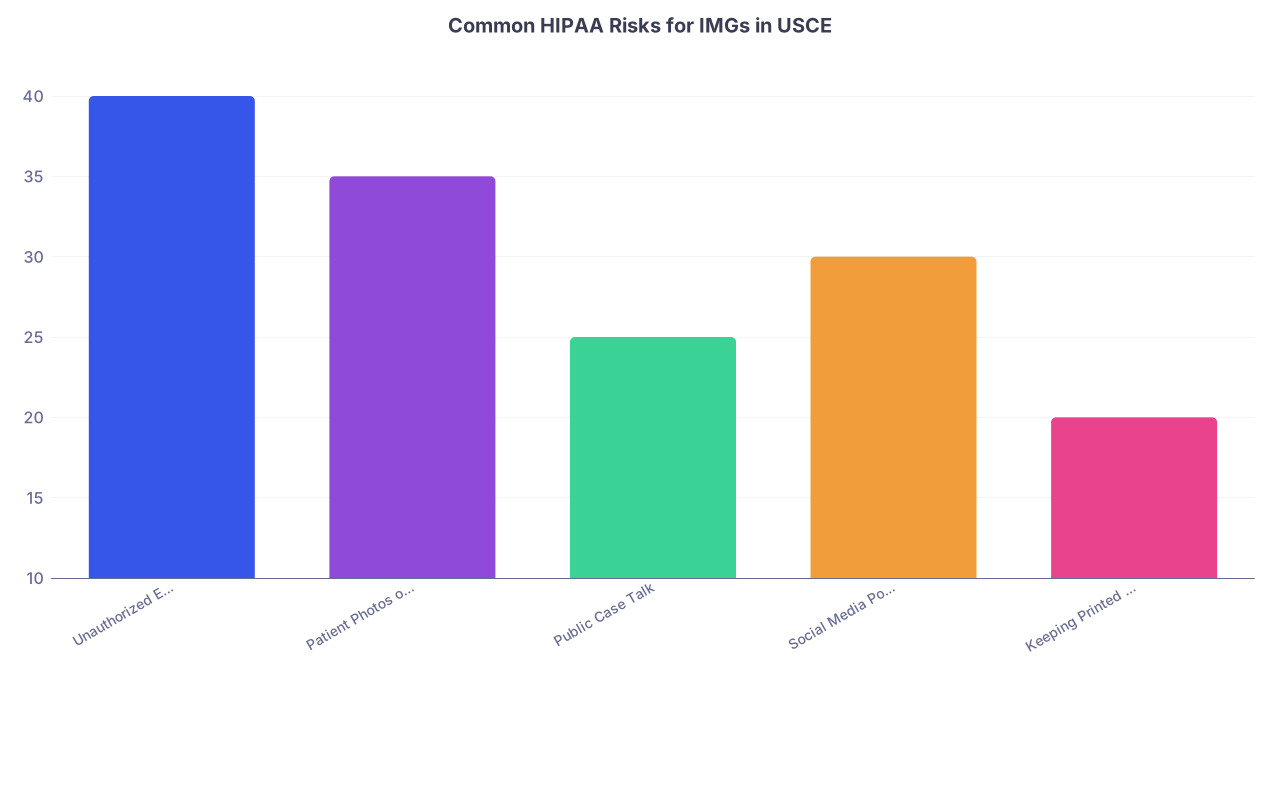
| Category | Value |
|---|---|
| Unauthorized EMR Access | 40 |
| Patient Photos on Phone | 35 |
| Public Case Talk | 25 |
| Social Media Posts | 30 |
| Keeping Printed Lists | 20 |

| Step | Description |
|---|---|
| Step 1 | Think about opening chart |
| Step 2 | Do NOT open |
| Step 3 | Open chart |
| Step 4 | On my team today? |
| Step 5 | Educational/care reason? |

Key Takeaways
- Your HIPAA boundaries are defined by your official role (observer, extern, elective student), not by what residents casually say is “fine.”
- The biggest risks for IMGs in USCE are personal devices, unauthorized chart access, and public or online case talk—avoid those and you avoid most disasters.
- If you cannot confidently defend an action as necessary for your explicit educational or care role, do not do it. In USCE, professional judgment and privacy discipline are as important as your clinical knowledge.