
Community hospital externships are not “second-class.”
They’re just second to your fantasy of what you think program directors care about.
Let me be blunt: a lot of IMGs are sabotaging their residency applications because they are chasing a big-name university logo instead of chasing actual, documented value—supervised clinical work, strong letters, and evidence they can function in a U.S. system.
Community sites frequently deliver more of that than shiny academic hospitals do. But that is not what the message boards tell you, so people keep making the same mistakes.
Let’s dismantle this properly.
The Core Myth: “If It’s Not a Big-Name Academic Hospital, It Doesn’t Count”
The dominant myth in IMG circles sounds like this:
- “Program directors only respect university hospitals.”
- “Community hospital externships look weak on ERAS.”
- “If it’s not [insert famous name—Cleveland Clinic, Mayo, Hopkins], it’s a waste of money.”
- “Community hospitals mean weak letters.”
I’ve heard all of these… often from people who have never once looked at actual NRMP, NRMP PD survey, or AAMC data.
Here’s what program directors actually say matters. Not on forums. In official surveys.
| Factor | % of PDs rating as Important/Very Important |
|---|---|
| US Clinical Experience (USCE) | ~75–80% |
| Letters of Recommendation (US) | ~80–85% |
| MSPE/Dean’s Letter / Evaluations | ~75% |
| Perceived Commitment to Specialty | ~70% |
| Performance in Clinical Clerkships | ~65–70% |
Notice what is missing:
“Must be from a famous academic center.”
Program directors care about:
- Did you work in the U.S. system under supervision?
- Did a U.S. attending actually see you work and write a decent letter?
- Can you function on day one of residency without imploding?
They do not care that much whether your badge said “University Hospital” or “Regional Medical Center” if the rest of the application is weak.
What Community Hospitals Actually Offer (That You’re Underestimating)
The reason community hospital externships keep getting dismissed is simple: prestige bias. People confuse brand recognition with training quality and with how PDs make decisions.
Here’s the reality of what a good community hospital externship can give you.
1. Real Responsibility (Within Limits) → Better Letters
In a big tertiary academic center:
- The service is stuffed with med students, residents, fellows.
- You are the 7th wheel on the rounding team.
- The attending might barely learn your name in 4 weeks.
In a solid community hospital:
- Teams are lean. Often just attending + maybe a resident or PA, sometimes just you and the attending.
- You actually get to present patients, propose plans, follow them day to day.
- You become noticeable very fast—especially if you show up prepared.
Guess which setting is more likely to generate this kind of line in a letter?
“She consistently pre-rounded on 6–8 patients, presented succinctly, and independently drafted daily notes that I co-signed. Her level of ownership was comparable to an early intern.”
That kind of sentence is catnip for program directors. It screams: “This IMG is not ornamental. They can function.”
Academic “observerships” too often produce letters like:
“He was an eager observer, attended rounds, and showed interest in cardiology.”
Translation: I barely know this person, and they never touched a patient.
2. Actual USCE (Not Just Shadowing With a Fancy Name)
Be careful with definitions. Programs increasingly distinguish:
- “Hands-on USCE” (externship / sub-internship–style)
- “Observership” (no orders, no notes, no real responsibility)
Many academic centers only offer observerships to IMGs: no EMR access, no order entry, no independent notes, no direct responsibility.
Many community hospitals, especially those affiliated with residency programs, will:
- Give you EMR access
- Let you write notes for co-sign
- Let you propose orders (under close supervision)
- Let you call consultants or present in multidisciplinary rounds
That’s the stuff PDs want to see. They do not care that the letterhead has a “Top 10 Hospital” logo if all you did was stand in the back of the room.
What the Data and Match Patterns Really Show
Let’s anchor this in something more than opinion.
The NRMP Program Director Survey and years of match statistics for IMGs tell a simple story:
- U.S. clinical experience matters a lot.
- Letters from U.S. attendings matter a lot.
- Specialty-specific experience (e.g., IM rotations for IM applicants) matters a lot.
- Prestige of the site barely shows up as a formal factor.
What PDs do notice like a red flag:
- “USCE” that is obviously just observerships at famous places
- Letters that are generic and non-committal
- Gaps with no clinical activity, especially if you graduated years ago
Here’s a simplified pattern I’ve seen repeatedly in IMGs applying to Internal Medicine and FM:
| Profile | Externship Type | Interview Outcomes (typical) |
|---|---|---|
| High Step 2 (250+), 2 strong community letters | Community IM/FP, hands-on | Many community + some university |
| Similar scores, only big-name observerships | Famous academic observerships only | Fewer interviews, weaker letters |
| Mid scores, strong hands-on community IM | Community, with EMR + notes | Solid community program interest |
| Mid scores, no USCE | None | Very limited interviews |
Is this controlled randomized trial data? No. But the consistent pattern from PD anecdotes, match outcomes, and letters I’ve read isn’t subtle:
Strong, hands-on community experience beats ornamental name-brand observerships. Almost every time.
When a Community Hospital Externship Is a Problem
Now for the unpleasant truth: not all community externships are good. Some are absolutely low value or even harmful.
You should be skeptical of:
- “Programs” that:
- Charge thousands of dollars
- Promise “strong LOR guaranteed”
- Won’t tell you exactly what your day-to-day responsibilities are
- Have no residency programs on-site at all
- Setups where:
- You never touch the EMR
- You never present to the attending
- You mostly follow a private physician in clinic and watch them click boxes
If your externship looks like this, PDs can smell it from your letters and your interview stories. You’ll talk about “observing great care” instead of “managing X patients with Y diagnoses under supervision.”
Let me put it simply:
Bad community hospital externship vs bad academic observership? Both are trash.
The axis that matters is not “community vs university.” It’s:
- Hands-on vs observer-only
- Structured vs random
- Supported (teaching, feedback) vs transactional (“thanks for your money, see you”)
How PDs Actually Read Your USCE
Here’s what goes through a program director’s mind looking at your ERAS experiences section and letters:
- “Did this applicant function in a role even vaguely similar to what an intern does?”
- “Did someone who does real clinical work in the U.S. put their name behind this person?”
- “Is there consistency between the personal statement, CV, and what the letter writer says?”
They do not have a “downgrade all community hospitals” reflex. What they have is a “downgrade vague, fluff experiences” reflex.
Let’s contrast two real-style entries.
Academic Hospital Observership (CV entry)
“Observer in Cardiology, [Prestige University Hospital]. Attended rounds, observed complex cases, and participated in discussions.”
Community Hospital Externship (CV entry)
“Clinical extern in Internal Medicine, [Regional Community Hospital with IM Residency]. Pre-rounded on 6–8 inpatients, presented on rounds, wrote daily notes for co-sign, and participated in admission workups under direct attending supervision.”
Which one tells a PD you might survive night float?
Not the one with the big-name logo.
The One Thing Community Hospitals Often Do Better: Access
Big-name academic centers have gatekeepers.
IMGs trying to get in often face:
- “We do not offer hands-on experiences to non-affiliated graduates.”
- “Observership only, no EMR access, no order entry.”
- “Only for alumni of our own medical school.”
Community hospitals are often:
- More open to international graduates
- Less bureaucratic
- More flexible with dates
- Keen to recruit good externs into their own residency programs
That last point is critical and under-discussed.
Many community hospitals with residency programs use externships as an extended audition. I’ve watched IMGs match directly into the same program where they did a strong, months-long externship, because:
- The PD already knows they’re reliable
- The residents already like working with them
- The letters reflect real performance, not a 2-week snapshot
Is that guaranteed? Obviously not. But your odds of being “truly known” by a program after a community externship are often higher than after briefly floating through a giant academic service.
How to Evaluate a Community Hospital Externship (Without Getting Scammed)
You want to know whether an externship—community or academic—is actually worth your time and money? Ask annoying, specific questions.
Questions you should be asking before you pay anything:
- “Will I have EMR access?”
- “Will I be allowed to write notes for co-sign?”
- “How many patients will I be expected to follow?”
- “Who exactly will I work with—residents, attendings, both?”
- “Are there ACGME-accredited residency programs in this hospital? Which specialties?”
- “What percentage of your past externs matched into U.S. residency in the last 2–3 years, and into what?”
If they dodge, give vague answers, or only talk about “exposure” and “networking”, that’s your red flag.
Here’s a quick framework comparing what you want vs what you should avoid:
| Feature | High-Yield Externship | Low-Yield Externship |
|---|---|---|
| Site Type | Community or academic w/ resid. | Any site w/out real structure |
| EMR Access | Yes | No |
| Notes / Orders | Draft notes, propose orders | Only watching / shadowing |
| Supervision | Direct attending, maybe residents | Mostly alone, or just shadowing |
| LOR Quality Potential | Specific, performance-based | Generic “observed, interested” |
Notice again: “Community vs academic” is not the differentiating column. Structure and responsibility are.
But Do Top Academic Programs Discriminate Against Community Experience?
If your dream is a top-10 academic IM program with heavy research, yes, they care more about:
- Publications
- U.S. MD grads
- Brand-name references
But even those programs are not rejecting you because you have community hospital experience. They’re rejecting you because:
- You do not fit their typical profile (US MD/DO, strong research)
- Your Step scores / research / visa status do not align with their priorities
Here’s the uncomfortable truth:
For the vast majority of IMGs, the realistic target is community or hybrid programs, not the top 10 academic giants. And for those programs, solid community USCE is absolutely fine—often preferred.
And I’ll add one more dirty secret: some academic PDs are more impressed by a brutally busy community hospital rotation where you learned to manage 15 bread-and-butter IM patients… than watching you “observe complex transplant cases” without touching anything.
How to Use Community Hospital Externships Strategically
If you want community externships to work for you instead of against you, stop treating them as consolation prizes. Use them as leverage.
Tactically:
- Choose community hospitals with residency programs in your target specialty.
Even better if they’re in the geographic region where you want to match. - Do at least one rotation that mimics intern work as closely as possible (inpatient IM, FM, possibly EM where allowed).
- Get at least 2 strong, detailed letters from U.S. attendings at these sites.
- In interviews, reference specific patient cases, workflows, and responsibilities from these rotations to prove you understand U.S. systems.
Then your story becomes:
“I trained in X country, but I’ve already adapted to U.S. inpatient medicine through my externship at [Community Hospital], where I handled daily notes, admissions, and care coordination similar to an intern—under supervision. Here’s an example…”
That is infinitely stronger than:
“I observed at [Famous Hospital] and saw very advanced cases.”
Visualizing What PDs Actually Care About
Let me put this in a simple chart: how much PDs care about each factor when evaluating your clinical experience.
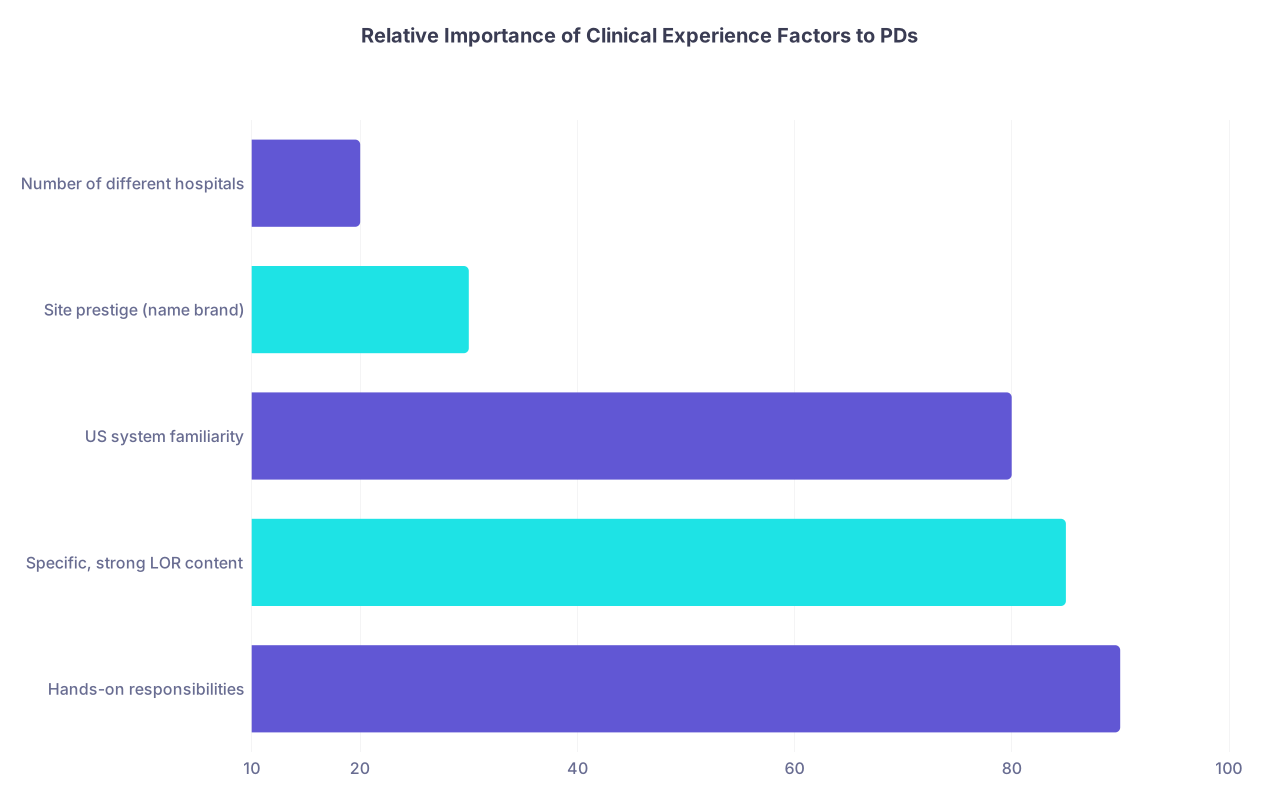
| Category | Value |
|---|---|
| Hands-on responsibilities | 90 |
| Specific, strong LOR content | 85 |
| US system familiarity | 80 |
| Site prestige (name brand) | 30 |
| Number of different hospitals | 20 |
This reflects reality: they care most about what you did and what others say you can do, not the logo on your badge.
Do Not Confuse Your Ego With Strategy
A lot of resistance to community hospital externships is ego. People want to tell family and friends:
- “I did a rotation at Harvard.”
- “I was at Mayo Clinic.”
If that’s your priority, fine. Just be honest with yourself: you’re buying status, not necessarily match odds.
If your actual goal is a residency spot in the U.S., especially in IM, FM, psych, peds, or even some categorical surgery in the right settings, you should be biased toward:
- The places where you can function like an intern.
- The attendings who will actually fight for you in a letter.
- The environments where you’re not the invisible extra student at the back of a 20-person team.
That’s very often a community hospital.

The Bottom Line
Strip away the myths, and you’re left with three things that actually matter:
Community hospital externships are not second-class; low-value, non-hands-on experiences are. The prestige of the hospital matters far less than whether you had real responsibility and can prove it.
Strong, specific letters from U.S. attendings at community hospitals often beat vague letters from famous academic centers. PDs read content, not logos.
If you choose structured, hands-on community rotations—especially at hospitals with residency programs—you’re not “settling.” You’re doing exactly what most successful IMGs quietly do to match.