
Big-name hospitals on your USCE do not guarantee you residency interviews. Not in 2025. Not with the way programs screen now.
They help. They’re not magic.
The problem is simple: IMGs have turned “get a famous hospital on my CV” into a religion. People will pay $4,000 for four weeks of “observership” at a marquee institution and then act shocked when they get 2 interviews out of 120 applications.
Let’s dismantle the myth and walk through what the data – and program behavior – actually show.
The Prestige Illusion: What Programs Really See
Here’s the harsh truth: your “Harvard observership” doesn’t look the way you think it does from the program side.
You imagine:
“Wow, this applicant rotated at [Insert Famous Name]. They must be top tier.”
What many PDs and screeners actually think:
“Okay, an unpaid observership. No responsibilities. No real evaluation of clinical performance.”
Remember: they’ve seen hundreds of CVs with the same big-name places. It’s not rare anymore.
Let me be concrete. I’ve seen:
- Dozens of IMGs with observerships at Cleveland Clinic, Mayo, or Johns Hopkins who got zero interviews from those institutions
- IMGs with community hospital hands-on electives and strong letters who matched at big-name academic programs
- Applicants with 3–4 brand-name observerships and USMLE 212 who got almost no invites, while someone with 1 unknown community rotation, USMLE 240+, and strong letters got 15+
Prestige alone doesn’t move the needle like you think. It’s a weak signal drowned out by stronger ones.
What Actually Drives Interview Offers (And Where USCE Fits)
Programs don’t sit in a room and vibe-check your hospital names. They filter. Hard.
Here’s the real stack rank for most programs, especially competitive or university ones:
- USMLE scores (or your country’s equivalent if they use it)
- Attempts / failures
- YOG (year of graduation)
- Visa status
- Meaningful USCE with strong letters
- Research / publications (for academic-heavy programs)
- Personal statement and overall story
- Prestige of your school / rotations
Notice where “prestigious hospital name” lives: buried inside #5 and #8.
What matters more than the name:
- Was it hands-on or purely observational?
- Were you evaluated?
- Did you get strong, specific letters from US faculty who know you well?
- Does your USCE match the specialty you’re applying to?
- Does it explain gaps or tie into your story?
If you did a “brand-name” rotation where you never touched a patient, barely spoke to attendings, and walked away with a templated letter, you essentially paid thousands for a line that programs glance over in 1.5 seconds.
Data Reality: Why Prestige Can’t Save a Weak Application
Let’s talk about how filtering works.
Most programs receive 3,000–5,000 applications. They’re not manually reading every CV. They use filters:
- USMLE Step 1/2 CK cutoffs
- Attempts = automatic reject at many places
- YOG cutoffs (often 5–7 years)
- Visa sponsorship = yes/no filter
- Sometimes: US grad vs IMG vs FMG tags
Your shiny “Mayo Clinic observership” never even gets seen if you’re filtered out.
Here’s a rough illustration of how this ends up playing out.
| Applicant | USMLE Scores | YOG | Visa Needed | USCE Type | Hospital Name | Likely Screening Outcome |
|---|---|---|---|---|---|---|
| A | 211 / 214 | 2016 | Yes | Observerships only | Big-name academic center | Auto-screened out at many |
| B | 244 / 250 | 2021 | Yes | 2 hands-on electives | Mid-tier community | Passes filters, read closely |
| C | 233 / 238 | 2019 | No | Mix of community + academic | Mostly unknown | Widely competitive |
| D | 218 / 223 | 2013 | Yes | 3 big-name observerships | Multiple famous names | Blocked by YOG at many |
Programs don’t say: “Scores are low, YOG is old, but wow, Cleveland Clinic. Let’s interview.” That’s fantasy.
They say: “We have 400 candidates who meet our cutoffs with decent USCE. We’ll start with them.”
Your hospital name is background noise if the fundamentals aren’t there.
The Letter Myth: “But If My LOR Comes From a Famous Place…”
This is the next layer of delusion: believing that a mediocre letter from a famous name beats a strong letter from a no-name hospital.
I’ve actually heard applicants say, “I’d rather have a generic letter from Harvard than a strong letter from a small community program.” That’s wrong. Flat-out.
Here’s how PDs actually react when reading letters:
A generic, vague LOR from a famous institution screams:
“This attending barely knows you. You shadowed. You didn’t stand out.”A specific, detailed LOR from a community hospital says:
“We saw this person take care of patients. We’re willing to put our name on them as a safe intern.”
If a letter sounds like it could have been written about any of 50 observers that year, the name on the letterhead doesn’t rescue it.
I’ve seen LORs from big names that literally read like this, word-for-word pattern:
“Dr. X participated in clinical observership in our department. They are punctual, professional, and eager to learn. I believe Dr. X will make a good resident.”
You think that sounds OK. To PDs, it sounds like: “I have nothing real to say.”
Now compare to this from a community internist:
“Dr. Y pre-rounded independently on 8–10 patients daily, presented on rounds with concise assessments, and consistently followed through on assigned tasks like calling families and organizing follow-up. When our team was unexpectedly short-staffed during a heavy admission night, Dr. Y stayed late, helped admit 3 new patients, and maintained an excellent attitude.”
Guess which one actually carries weight.
Observership vs Hands-On: The Distinction That Matters More Than Prestige
Here’s a big one that IMGs love to ignore: not all USCE is equal.
Observership ≠ elective ≠ sub-internship.
Let me break it bluntly:
Observership
No orders. No notes that count in the chart. No formal graded evaluation. Limited patient contact. Often more shadowing than doing.Hands-on elective / clerkship / sub-I
You see patients, present to attendings, sometimes write notes, sometimes put in orders under supervision, and get real evaluations. This is “closest to intern” experience.
Many university hospitals only offer observerships to IMGs, not true electives. Community hospitals, on the other hand, are more likely to offer real, hands-on roles.
If you’re choosing between:
- Famous-name observership only
- Modest community hospital hands-on elective with evaluation and likely strong LOR
The second is usually the smarter strategic move.
And programs know exactly which institutions only allow observers and which allow real involvement. You’re not fooling anyone.
When Prestige Does Help – But Only in Context
Let me be fair: prestige isn’t worthless. It’s just overhyped.
A well-executed, meaningful experience at a big-name place can help in very specific ways:
If it leads to a truly strong LOR
You worked closely with an attending. They supervised you meaningfully. The letter is detailed, comparative, and clearly not a template.If it’s aligned with your specialty
Rotating at a known academic neurology center and applying in neurology can help if the letter writer is known in that community.If the rest of your file is already strong
Good scores, recent grad, visa situation reasonable. Prestige here becomes a mild positive differentiator, not a savior.If you did research + clinical together
At certain academic programs, a combination of USCE + ongoing research with the same group can move you from “random IMG” to “someone we actually know and trust.”
But again, this is context-dependent. Without the fundamentals, prestige is lipstick on a pig.
Why Everyone Keeps Overrating Names: The Psychology Angle
The overvaluation of prestige is basically insecurity plus marketing.
- IMGs feel disadvantaged → latch onto visible signals (logos, brands) that feel like “validation.”
- Agencies and middlemen need to sell something → “Mayo observership!” sounds better than “hands-on community rotation with actual responsibility.”
So you get this pipeline:
- Applicant with mediocre scores panics.
- Some “placement service” sells them a dream: Rush, Yale, Hopkins, whatever.
- Applicant spends huge money, mostly shadows, gets generic letter.
- Applies to 150 programs, gets 3 interviews, blames “bias against IMGs.”
The brutal truth? They misallocated limited resources chasing the appearance of competitiveness instead of the substance.
Strategic Use of USCE: What Actually Works Now
If you want your USCE to convert into interviews, stop worshipping logos and start thinking like a PD.
You want:
- Hands-on experience wherever possible
- At least 2–3 strong, specific US LORs
- Continuity – not ten scattered 2-week observerships, but 1–3 longer, meaningful rotations
- Specialty alignment – doing all your USCE in FM and then applying psych is… not ideal
- Evidence you can function in US systems – EMR use, communicating with nurses, following up labs, etc.
Here’s what a smarter plan often looks like for an IMG with limited money:
- One 3–4 week unpaid observership at a big-name place in your chosen specialty IF it’s affordable and gives you exposure.
- One or two 4–8 week hands-on rotations at smaller/community programs with realistic chances of strong LORs and maybe interview consideration.
- Focus on USMLE performance, Step 3 (if useful for visa-need IMGs), and fixing the big red flags first.
If you only have money for one experience, I’d pick hands-on community with likely strong LOR over “famous-name pure observership” in most cases.
The Numbers Game: Where Prestige Actually Sits Among Priorities
To make this painfully obvious, here’s how I’d rank priorities for a typical IMG applying to IM/FM/Psych/Neuro.
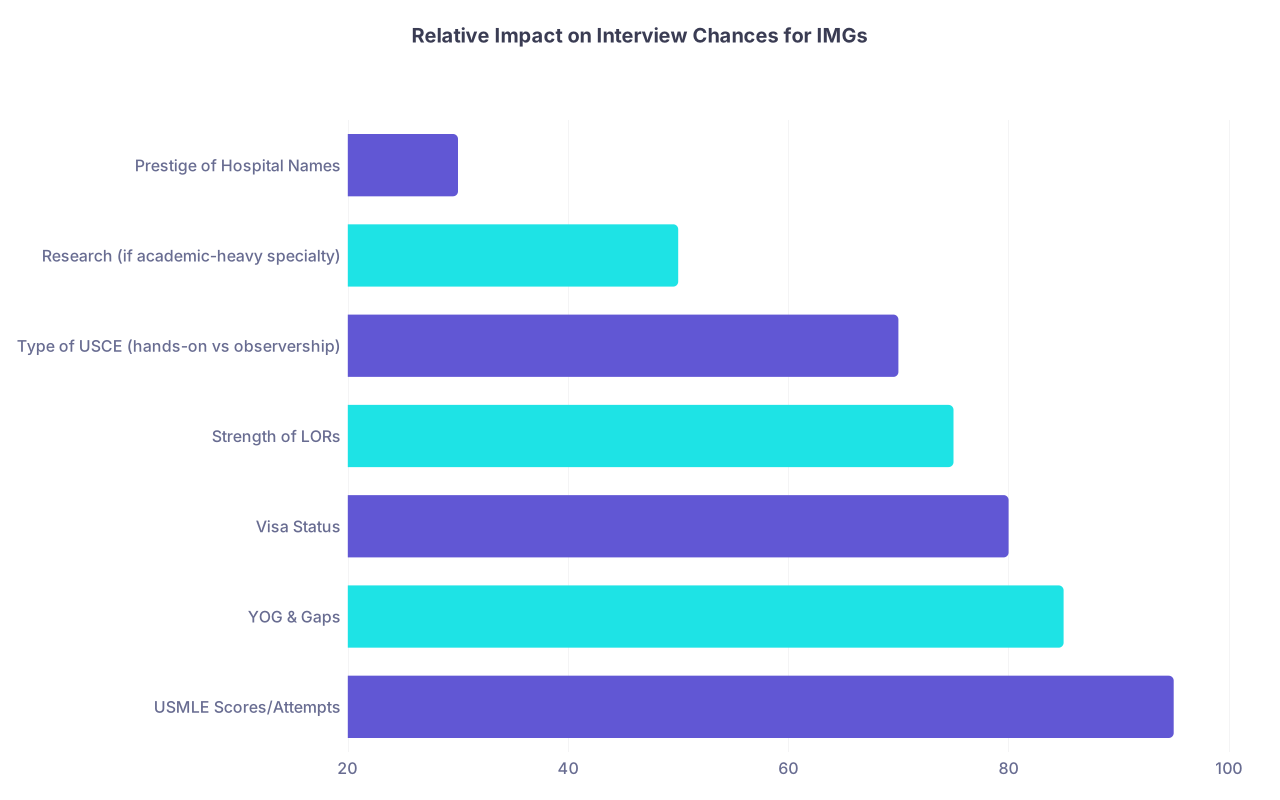
| Category | Value |
|---|---|
| USMLE Scores/Attempts | 95 |
| YOG & Gaps | 85 |
| Visa Status | 80 |
| Strength of LORs | 75 |
| Type of USCE (hands-on vs observership) | 70 |
| Research (if academic-heavy specialty) | 50 |
| Prestige of Hospital Names | 30 |
Are these exact numbers? No. But they’re directionally right based on how PDs describe their process and what we see in outcomes.
Notice where “Prestige of Hospital Names” lands: the lowest of the stack. Still present. Just not the star of the show.
A More Honest Question: “Would They Trust You on Night Float?”
Strip away the branding. Ask yourself the only question that really matters for residency selection:
“Does my application convince a PD that I’m safe and functional as an intern on night float?”
Everything else is secondary.
Big-name observerships rarely answer that question. Hands-on work, robust letters, solid scores, and coherent training history do.
So when you’re debating between dropping thousands on another prestige observership or using that money to:
- Extend a hands-on elective
- Take Step 3
- Apply more broadly
- Fix a language or communication gap
Ask which choice will more directly convince someone you’re a safe, reliable intern.
Usually, it’s not the logo.
Years from now, you won’t remember the exact hospitals you shadowed in. You’ll remember who actually trusted you enough to let you take care of patients—and who didn’t. Focus on becoming the kind of applicant programs feel safe trusting at 2 a.m., and the interviews will follow, prestige or not.