
What actually happens when a program director sees “observership” instead of “hands-on clerkship” on your CV? Do they mentally downgrade you—or do they barely care as long as you can function on day one?
Let’s cut through the nonsense you see on Telegram groups and “consultants”’ Instagram slides.
You’ve probably heard variations of these claims:
- “Observerships are useless; PDs want only hands-on.”
- “If you don’t have US LORs from hands-on rotations, you won’t match.”
- “Any hands-on experience is automatically better than any observership.”
All three are wrong in the way that half-truths are always wrong: they sound logical, they’re repeated a lot, and they ignore how PDs actually think under real constraints—like liability, time, and ACGME rules.
Myth #1: “Program directors hate observerships”
No, they don’t. They hate useless experience, vague letters, and red flags. Observerships just get blamed because they’re the most common low-yield item IMGs collect.
Here’s what program directors really see when they look at “US clinical experience” (USCE):
| Factor | Priority Level |
|---|---|
| How you’ll function as an intern | Very High |
| Quality/specificity of LORs | Very High |
| Recency of US experience | High |
| Type of institution (academic vs community) | Medium |
| Observership vs hands-on label | Medium–Low |
Look at that last row. The binary “observership vs hands-on” obsession is mostly an IMG community invention. PDs are asking a different question:
“Does this experience give me evidence that this person can work safely and realistically in my system on July 1?”
If your “hands-on” rotation gave them:
- A generic, two-paragraph letter: “hardworking, punctual, a pleasure to work with”
- No mention of your actual responsibilities
- No link to ACGME-style expectations
…that’s weak.
Meanwhile, a strong observership with:
- A US academic attending who has actually worked with residents
- A detailed letter: “She pre-rounded independently, presented on rounds, formulated plans we discussed; I would trust her at an intern level with appropriate supervision.”
- Clear evidence you understand US documentation, workflow, and culture
…is more useful than 90% of “hands-on” rotations that are really glorified shadowing plus a template letter.
What the data says (instead of rumors)
The NRMP Program Director Survey (2022) doesn’t have a checkbox for “Observership vs Externship.” PDs are not filtering you like that. They rate:
- “US clinical experience in specialty”
- “Evidence of professionalism”
- “Perceived ability to function in a training program”
That’s behavior and performance, not your rotation marketing label.
Are there PDs who openly say “we prefer hands-on”? Of course. But even those PDs will rank a strong observership candidate over a weak “hands-on” candidate. I’ve seen it. Multiple times. Especially in IM and FM programs that just want someone who won’t collapse on a busy July ward month.
Myth #2: “Any hands-on experience is automatically better”
This one is popular with for-profit “externship” companies. Because it sells.
Here’s the dirty secret: a lot of so-called “hands-on USCE” for IMGs is hands-on in advertising only. You “write notes” in a separate note template that never touches the real EMR. You “present” to a preceptor who does not attend on residents. You do no cross-cover. You never touch a pager.
It’s cosplay residency.
Compare two real-world scenarios I’ve seen:
Candidate A: “Hands-on externship,” 4 weeks, $3,500. Private clinic. No residents. Physician has never been core faculty. Letter is two paragraphs, completely generic, no comparison to US grads, no specific descriptions of clinical judgment.
Candidate B: University hospital “observership,” 4 weeks. Not allowed to write in EMR, but: pre-rounding, oral presentations on team rounds, case presentations in noon conference, involved in teaching medical students. Letter from an Associate Program Director who knows exactly how to calibrate: “Her performance was comparable to a senior US medical student. I would be comfortable training her in our program.”
Who do you think an Internal Medicine PD at a mid-tier university hospital is more impressed by?
If you answered A because it’s “hands-on”, you’ve bought the myth.
What “hands-on” actually means to PDs
When faculty say “hands-on,” they’re not talking about you physically touching patients. They’re asking:
- Have you written real notes that were used for patient care?
- Have you managed cross-cover or triage under supervision?
- Have you been responsible for follow-up calls, results, or disposition?
- Have you functioned in a team structure like an intern?
Very, very few IMG “externships” give you that. For liability reasons alone.
So when you see “hands-on” in an IMG-oriented ad, read it as: “You can talk to patients and maybe practice notes on a parallel system. You might place a peripheral IV if someone feels adventurous.”
That’s fine. It can still be valuable. But do not treat the word “hands-on” as a magic rank booster. PDs are not stupid; many of them have seen the same externship logos on dozens of weak applications.
Myth #3: “Without hands-on USCE, you won’t match”
Flat-out wrong. Plenty of IMGs match every year with observership-heavy CVs, especially in IM, Psych, FM, Path, and sometimes Neuro.
The pattern for IMGs who match without “rich” hands-on USCE usually looks like this:
- Strong scores or solid pass performance (for Step 1) and good Step 2 CK
- At least 2–3 recent US experiences (even observerships), clearly described
- Detailed, comparative LORs from US physicians who actually supervise residents
- No big red flags (unexplained gaps, unaddressed failures, chaotic PS)
Meanwhile, I routinely see this combination:
- 3–4 “hands-on externships”
- Mediocre or vague LORs
- Older graduation year
- Spots only in low-yield specialties (Derm, Ortho, Rad)
- Minimal or no match
But that doesn’t make a good Telegram story. So the myth lives on.
What recent, specialty-aligned experience actually does
Where USCE really helps isn’t the checkbox. It’s three things:
It supplies letters that speak the right language. PDs read thousands of letters. They know when someone is just being “nice to the IMG” vs genuinely impressed.
It reassures them you won’t melt down when faced with US workflow: EMR, consults, case management, prior authorizations, impatient families. If your letter says you’ve seen that movie, they relax.
It gives you reality-based talking points for interviews. If all your answers sound like theoretical textbook knowledge, you come off as someone who has never actually seen a US EMR screen.
None of that inherently requires “hands-on.” It requires involvement, observation with purpose, and a letter writer who paid attention.
Myth #4: “All observerships are the same (and all bad)”
This one is lazy thinking. There’s a massive difference between:
- “Tourist observership”: you stand at the back, no one knows your name, you come three days a week, you disappear after a month.
versus
- “Embedded observership”: you’re assigned to a team, pre-round with residents, present orally, attend all conferences, ask targeted questions, stay late on call days, follow patients through the course.
From a PD’s standpoint, the second can look surprisingly close to true clinical immersion—minus the legal privilege to write orders.
How to make an observership actually count
Here’s what I’ve seen work repeatedly:
- Treat it like a sub-I, not a sightseeing tour. Show up early. Leave when the team leaves.
- Offer to pre-round and prepare oral presentations. Even if your notes don’t go in the EMR, your thinking is what they’re evaluating.
- Ask to attend sign-out, morning report, noon conference. Not just “rounds + lunch + Instagram.”
- Request specific feedback midway: “Doctor X, I’m aiming for IM residency in the US. What can I do this week to demonstrate intern-level readiness?”
- When requesting a letter, give them a short “reminder” of 2–3 cases you followed and what you did or suggested. Make it easy for them to write something concrete.
That’s how an observership turns into a letter that says something meaningful like: “She consistently arrived prepared with up-to-date literature, presented clearly and succinctly, and improved substantially over the rotation.”
PDs read that and think: “Okay, she’ll survive on wards.”
Myth #5: “Academic hands-on is always better than community observership”
Not automatically. Both can be high-yield or low-yield, depending on how structured they are and how your letter writer is plugged into the training world.
Let’s compare what typically matters for PDs:
| Aspect | Academic Center | Community Hospital/Clinic |
|---|---|---|
| Letter writer is PD/APD/faculty | Often yes | Sometimes yes, often no |
| Exposure to resident workflow | High | Variable |
| Level of oversight/documentation | High | Variable |
| Name recognition on ERAS | Higher | Lower–Medium |
I’ve seen community hospital observerships lead to excellent, specific letters from long-time teaching attendings who are well-known in the state. I’ve also seen big-name academic “hands-on experiences” where the attending barely remembers the IMG.
Again: not about the label. About what you actually did and who is willing to vouch for your performance in language PDs respect.
Short, harsh truth: most IMGs are chasing the wrong variable
Your peer group obsesses over:
- Hands-on vs observership
- Academic vs community
- Famous city vs unknown town
PDs obsess over:
- Will this person be safe and functional on July 1?
- Does this letter show me actual clinical reasoning, work ethic, and professionalism?
- Is this candidate’s story consistent and believable?
You’re optimizing for the brand name of your experience. They’re optimizing for risk reduction.
I’ll give you a concrete PD thought process I’ve heard word-for-word:
“I don’t care that much if it was called observership or externship. I care whether the letter has any teeth.”
“Teeth” = specific behaviors, comparison to US grads, explicit recommendation.
How to choose between observership and hands-on in the real world
You don’t live in a fantasy land where you can pick any USCE you want. You live in a world of visas, money, limited months off, and limited availability. So the right question isn’t “Which is better?” It’s:
“Given my constraints, which option is more likely to produce a strong, specific US letter and concrete evidence that I can function here?”
Use a simple filter:
| Question | If YES | If NO |
|---|---|---|
| Will I work directly with teaching faculty (PD/APD, core)? | Strong plus | Be cautious |
| Will I be clearly part of a resident/student team? | Strong plus | Lower yield |
| Will my supervisor see my reasoning, not just my presence? | Critical to say yes | Very low yield |
| Can this realistically lead to a detailed LOR? | Main deciding factor | Consider skipping |
If a so-called hands-on option fails these but an observership passes them, the observership wins. Every time.
Where truly hands-on USCE does matter
There are cases where hands-on—or something close to it—genuinely helps:
- You have older YOG and need undeniable, recent proof you can still function.
- You had academic issues back home and need to show you’ve matured clinically.
- You’re aiming for more procedure-heavy or competitive specialties where PDs want to see some real responsibility: EM, Anesthesia, occasionally Surgery.
Even then, the hands-on must be real enough to generate a letter that says: “They carried a patient load under supervision, wrote notes used for care, and handled cross-cover appropriately.” If it cannot give you that, it’s mostly brand, not substance.
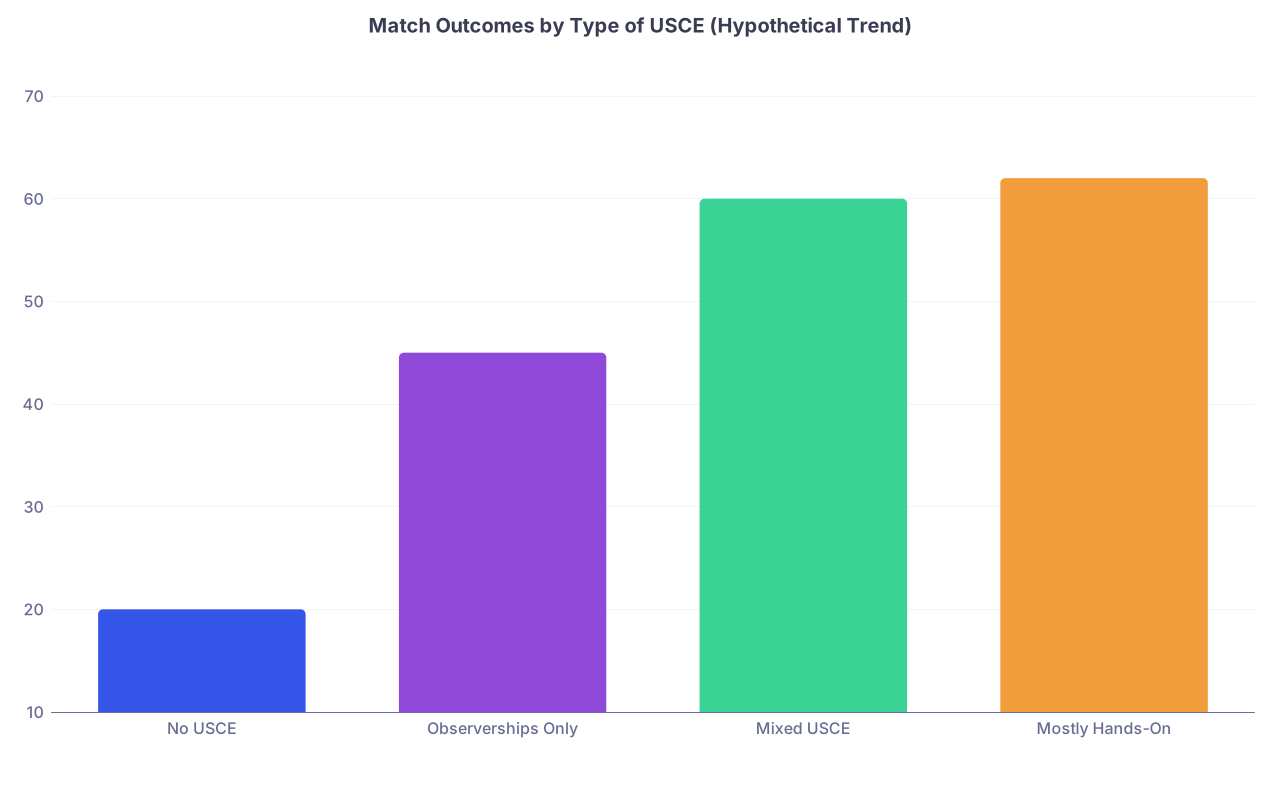
| Category | Value |
|---|---|
| No USCE | 20 |
| Observerships Only | 45 |
| Mixed USCE | 60 |
| Mostly Hands-On | 62 |
Notice how “Mixed USCE” and “Mostly Hands-On” are similar. That’s what I actually see: beyond a certain point, the marginal benefit of “more hands-on” is small compared to the benefit of one or two excellent, specific letters and coherent experience.
How to talk about observerships in your application
You also hurt yourself with how you present observerships.
Bad way on ERAS or in interviews:
“I did a 4-week observership in Internal Medicine at XYZ Hospital.”
Better:
“I joined the inpatient medicine team for four weeks at XYZ Hospital, pre-rounded on 4–6 patients daily, presented on attending rounds, and participated in resident teaching conferences. I followed several patients through admission to discharge and discussed management plans daily with the team.”
Then, if they ask, you can be transparent:
“I was not able to write in the EMR due to institutional policy, but I practiced full notes independently which my attending reviewed informally with me.”
That’s honest. And concrete. PDs respect that more than inflated “hands-on” stories they can smell from a mile away.

| Step | Description |
|---|---|
| Step 1 | USCE Entry on ERAS |
| Step 2 | Low Impact |
| Step 3 | Moderate Impact |
| Step 4 | Good but Not Distinctive |
| Step 5 | High Impact on Rank List |
| Step 6 | Clear Role Described? |
| Step 7 | Letter Specific? |
| Step 8 | Shows Intern-Level Potential? |
The label—observership or hands-on—barely appears in that decision tree.
Key points to remember
- PDs don’t rank “observership vs hands-on”; they rank evidence of how you’ll function as an intern. A strong observership with a sharp letter beats a weak “hands-on” rotation every time.
- Your real goal isn’t to collect USCE logos. It’s to create 2–3 detailed, credible US LORs that describe your reasoning, reliability, and readiness in concrete terms. How you get there matters less than you think.