
The last 90 days of your US clinical experience can either quietly disappear… or turn into interview invitations. Most IMGs waste this window. You are not going to.
You’re in the conversion phase now. Not “learning medicine” in some vague sense. Converting actual faces, cases, and rotations into:
- Strong, specific letters
- Advocates who email PDs
- Concrete bullets for your ERAS
- Interview invitations
Here’s how to run those final 3 months like a campaign.
90–61 Days Before Application Submission: Position Yourself as “Letter-Worthy”
At this point you should stop thinking like “a student on rotation” and start thinking like “an applicant building a case file.”
Main objectives for Days 90–61
- Lock in 2–3 US-based letter writers.
- Become obviously memorable on your current rotation.
- Capture detailed stories for your future personal statement and interviews.
Week-by-week breakdown
Weeks 13–12 from Application (Days 90–77): Pick Your Targets
You’ve probably got multiple attendings and maybe a senior resident who likes teaching.
At this point you should:
- Identify 3–4 potential letter writers:
- At least 2 attendings in your chosen specialty (or close to it).
- 1 “character witness” who really saw you work (hospitalist, clinic preceptor, strong sub-specialist).
- Decide your top 2 based on:
- Who actually saw you with patients frequently.
- Who gives detailed feedback, not just “good job.”
- Who already knows your name without looking at your badge.
What you do daily this week:
- Show up 10–15 minutes earlier than everyone else.
- Pre-round on at least 1–2 patients with real preparation:
- Yesterday’s labs
- Overnight events
- Your plan with backup rationale
- During downtime, ask targeted questions:
- “Dr. Smith, for my residency applications, how would you describe the ideal intern on this service?”
Then become that person.
- “Dr. Smith, for my residency applications, how would you describe the ideal intern on this service?”
Weeks 11–10 from Application (Days 76–63): Become Impossible to Ignore
You’re not trying to “be nice.” You’re trying to give your attendings a reason to write: “This IMG worked at the level of an intern.”
At this point you should:
- Ask for direct, slightly uncomfortable feedback:
- “Dr. Patel, if I were already an intern on this service, what’s one thing I’d need to fix this week?”
- Then fix it. Fast.
- Volunteer for unglamorous, visible work:
- Update med lists
- Call families with supervision
- Write first drafts of discharge summaries
- Start keeping a “wins and cases” log in your phone:
- 1–2 lines per day:
- “Helped calm agitated COPD patient; used teach-back to explain BiPAP”
- “Presented sepsis case concisely; attending complimented clarity”
- 1–2 lines per day:
That log becomes your:
- ERAS bullet points
- Personal statement material
- Interview stories
60–31 Days Before Application Submission: Lock Letters and Build Advocates
This is the most sensitive window. This is where IMGs either secure strong LORs or walk away with generic garbage.
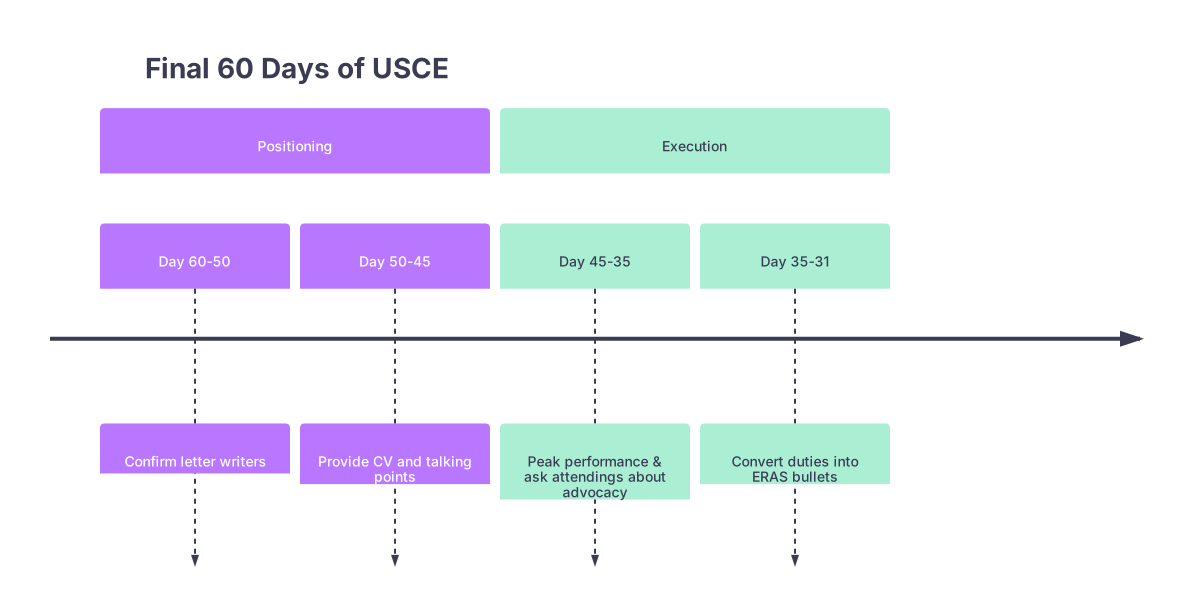
| Period | Event |
|---|---|
| Positioning - Day 60-50 | Confirm letter writers |
| Positioning - Day 50-45 | Provide CV and talking points |
| Execution - Day 45-35 | Peak performance & ask attendings about advocacy |
| Execution - Day 35-31 | Convert duties into ERAS bullets |
Main objectives for Days 60–31
- Secure commitments for at least 2–3 LORs.
- Turn strong attendings into actual advocates, not silent admirers.
- Translate your daily work into application-ready content.
Weeks 9–8 from Application (Days 60–47): Ask for Letters the Right Way
You should not walk out of a rotation without a clear yes/no on letters. “Maybe later” almost always means “no.”
How to ask (in person, not over email if possible)
Timing:
- Toward the end of the rotation week, after a good day.
- After you’ve had at least 2–3 weeks with them.
Script (adapt this, don’t recite):
- “Dr. Lee, I’m applying to Internal Medicine this cycle, and I’ve really valued working with you. Would you feel comfortable writing me a strong letter of recommendation based on my performance on this rotation?”
Key points:
- Use the word strong. Forces honesty.
- If they hesitate: thank them and don’t push. You just avoided a weak letter.
- If they say yes:
- Ask: “Would you prefer I send my CV, personal statement draft, and a list of cases we worked on together?”
Same day or next day, you email:
- CV (clean, one or two pages)
- Personal statement draft (even if not perfect yet)
- Short bullet list:
- “Cases you saw me manage: DKA, GI bleed, new CHF, etc.”
- “Examples of my work you might recall: X presentation, Y family talk.”
What a “conversion-focused” LOR request packet looks like
At this point you should send something that makes their job easy and shapes the narrative.
| Item | Description |
|---|---|
| Updated CV | Focus on clinical experience & USCE |
| PS Draft | 1-page, specialty-committed |
| Case List | 5–10 memorable patients/cases |
| Skills Highlights | 5–7 bullets tailored to that rotation |
| Deadline & Instructions | Exact ERAS upload date and link/instructions |
You are not “telling them what to write.” You’re reminding them what they actually saw.
Weeks 7–6 from Application (Days 46–31): Convert Attendings into Advocates
Strong IMGs do not stop at “please write my letter.” They ask for targeted advocacy.
At this point you should:
- Identify which attendings have residency connections:
- PD or APD
- Core faculty
- Alumni of target programs
- Have a short, respectful conversation:
- “Dr. Gomez, I’m planning to apply to [X, Y, Z] programs. If you feel it’s appropriate based on my work here, would you be willing to mention my name to colleagues in those programs or highlight me to your PD?”
You’ll be surprised how many say yes if:
- You’ve done consistently good work.
- You’re specific about your target specialty and geographic focus.
Day-by-day habits this period:
- Keep showing up like you’re being evaluated for a job. Because you are.
- Ask for one mid-rotation mini-evaluation:
- “Could you share 1–2 things I’m doing well that I should highlight in my application?”
- Write the exact phrases down. Those words go straight into your ERAS descriptions.
30–15 Days Before Submission: Turn Work into ERAS Content
Now you’re in the documentation phase. You already did the hard part. Don’t sabotage it with vague, forgettable ERAS entries.
At this point you should:
- Translate your rotations into concrete, measurable bullets.
- Sync your USCE story: LORs, PS, ERAS all telling the same narrative.
Build high-yield ERAS entries from your USCE
Typical IMG mistake: “Observed management of patients with various conditions.” That’s filler. PDs ignore it.
You want bullets like:
- “Independently pre-rounded on 3–5 inpatients daily, prepared and presented assessment/plan for each under attending supervision.”
- “Completed first-draft H&Ps and progress notes on 2–3 new admissions per week; incorporated attending feedback on clarity and diagnostic reasoning.”
- “Discussed plan of care with 5–7 patients/families weekly using teach-back method; documented understanding and concerns.”
Take your daily log and convert it:
- Case: “Helped manage DKA patient overnight”
- ERAS bullet: “Participated in the acute management of diabetic ketoacidosis, including insulin titration, electrolyte monitoring, and communication with ICU team under attending supervision.”
Calibrate your time balance in these 2 weeks
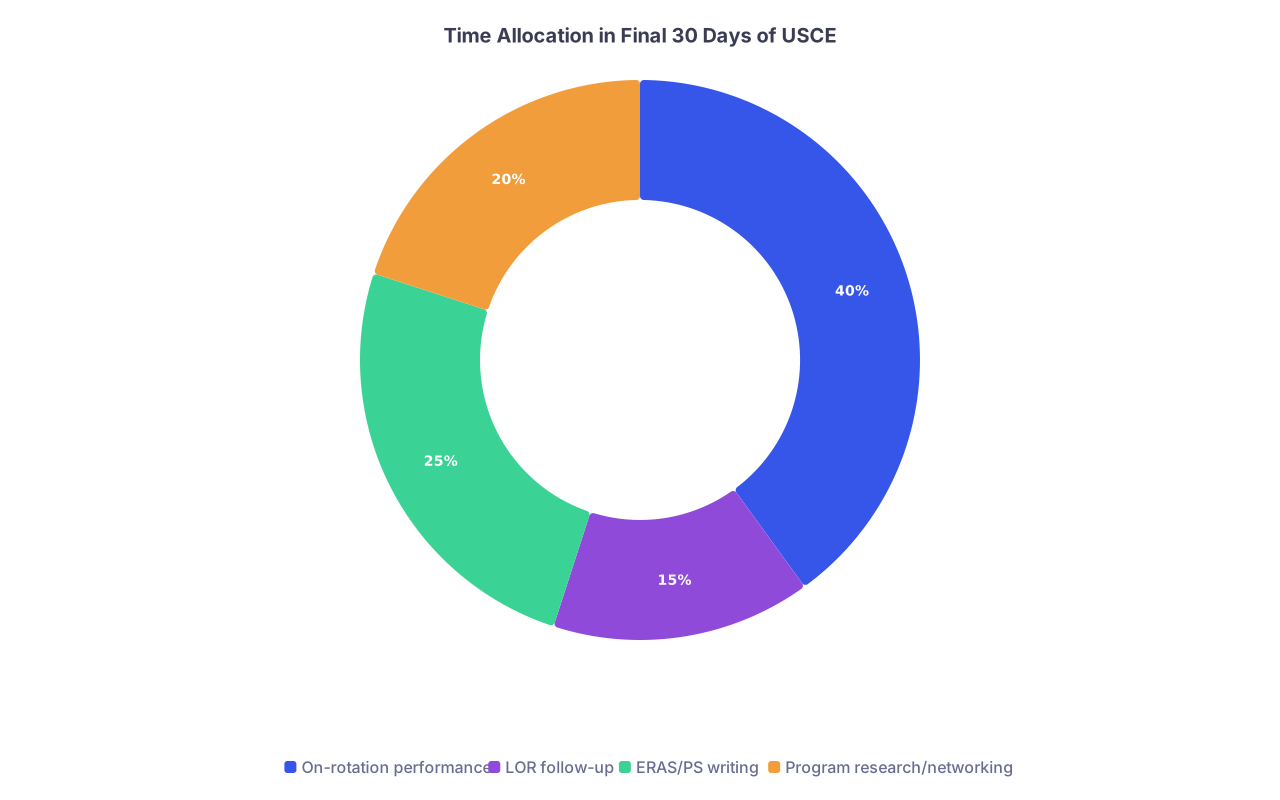
| Category | Value |
|---|---|
| On-rotation performance | 40 |
| LOR follow-up | 15 |
| ERAS/PS writing | 25 |
| Program research/networking | 20 |
If you’re spending 80–90% of your time on “perfecting” your personal statement and almost none on:
- Confirming letters are uploaded
- Cleaning up ERAS entries
- Staying visible and reliable on service
…you’re misallocating your last 30 days.
At this point you should:
- Check ERAS weekly:
- Which letters are marked “received”?
- Which are still missing?
- Send one polite reminder if needed:
- “Dr. Khan, I hope you’re well. Just a quick reminder that ERAS opens for programs to download applications on [date]. I remain very grateful for your support with my letter. Please let me know if there’s anything else you need from me.”
Final 14 Days on Rotation: Make Yourself Easy to Remember
Most attendings write letters after you leave. So the last impression is what they remember when they sit down to type.
At this point you should:
- Finish strong.
- Be visible.
- Close the relationship like a professional, not like a student disappearing after an exam.
Day-by-day focus (Last 2 weeks)
Daily:
- Have at least 1 patient or task that is “yours”:
- You follow the labs
- You call radiology
- You update the family
- Verbally summarize your work to your attending:
- “For Mr. R, I called his daughter, updated her on the CT results, and clarified the NPO instructions.”
That reminds them what you’re actually doing.
3–5 days before leaving: At this point you should:
- Thank each attending in person:
- “Dr. Silva, thank you for teaching me during this rotation. I learned a lot about managing [X]. I’ll be applying to [specialty] this year and really appreciated your guidance.”
- If they’re writing a letter, confirm:
- “Just to confirm, ERAS opens for programs to download applications on [date]. I really appreciate your support.”
Last day:
- Send very short, specific thank-you emails to:
- Attendings
- Senior residents who really taught you
- Program coordinator if they helped set up the rotation
Template:
- Subject: Thank you – [Your Name], Visiting Student
- Body (4–6 lines max):
- “Thank you again for the opportunity to work with you on [service/hospital]. I especially appreciated learning more about [X] and your teaching on [Y]. I’ll be applying to [specialty] this coming cycle and will carry what I learned here into my training.”
Save these emails. These are your future contacts when you’re scheduling interviews or sending updates.
After USCE Ends but Before ERAS Submission: Keep the Momentum Alive
You’ve left the hospital. Now what? This is where IMGs either go silent or smartly maintain a professional presence.
At this point you should:
- Make sure all letters are uploaded.
- Connect strategically, not desperately.
4–3 Weeks Before Programs Download Applications
Checklist:
- ERAS:
- All USCE entries finalized.
- US LORs assigned correctly (specialty-specific letters tagged).
- LOR status:
- If any expected letters are still missing → one final polite reminder.
- LinkedIn / professional email:
- Update headline to: “IMG applying to [Specialty] Residency – USCE at [Hospital/Program].”
- Add your USCE positions with month/year.
This matters when someone Googles you after an attending mentions your name.
Once Applications Are In: How to Leverage Your USCE for Interview Invites
This is the part everyone ignores. You don’t just send ERAS and “hope.”
At this point you should use your USCE network strategically.
0–4 Weeks After ERAS Submission: Activate Quiet Advocacy
You do not email PDs saying “Please interview me.” You use your established relationships.
Who to contact:
- Attendings who:
- Wrote you letters.
- Verbally praised your performance.
- Have clear connections to specific programs.
Short email script:
- Subject: Update and gratitude – [Your Name], Residency Applications
- Body (trim as needed):
- “Dear Dr. [Name],
I wanted to thank you again for your support and mentorship during my rotation on [service] at [hospital]. I’ve now submitted my ERAS application for [specialty] residency, with particular interest in programs in [region/programs if appropriate].
I remain very grateful for your letter of recommendation and any guidance or support you feel is appropriate as programs begin reviewing applications.”
- “Dear Dr. [Name],
You’re not begging. You’re reminding. They either act or they don’t. That’s their decision, not your problem.
Use USCE stories deliberately in interview prep
As invites start (or trickle) in, you’ll notice most strong interview answers come from your USCE, not medical school back home.
At this point you should:
- Build a “story bank” of 6–8 USCE experiences:
- A difficult patient conversation
- A diagnostic challenge
- A time you adapted quickly to US hospital culture
- A conflict or disagreement you handled professionally
- For each, write:
- Situation
- What you did
- What you learned
- How it will make you a better intern
This is how you turn “I had USCE” into “I functioned like an intern on a busy US service and here’s proof.”
Quick Reality Check: What Not to Waste Time On
In these final 90 days, I’ve watched IMGs lose weeks to the wrong tasks.
Don’t:
- Obsess over one more generic online course on “US healthcare system”
- Rewrite your personal statement 18 times while your letters sit undone
- Stick to passive “observing” when you could be:
- Writing notes
- Practicing presentations
- Making follow-up calls under supervision
- Treat USCE like tourism:
- Taking selfies in front of the hospital sign but not asking a single attending for feedback
You’re building a residency case file, not a scrapbook.
Three Things to Remember
- These 90 days are about conversion, not collection. You’re converting faces, rotations, and daily work into letters, advocates, and concrete ERAS content.
- You must ask clearly and early for strong letters and (where appropriate) for advocacy. Vague hints produce vague outcomes.
- Your daily behavior on the wards in this window writes your application for you. Show up like an intern, leave like a colleague, and your USCE will keep working for you long after you hand in your badge.