
The usual IMG advice about listing observerships and externships is half-right and often backwards.
If you’re asking, “Observership vs. Externship: which should I list as my primary USCE?” the honest answer is: externship wins almost every single time. But there are exceptions, and people mess this up in very predictable ways.
Let’s walk through how programs actually see these, and how you should structure your ERAS to make the strongest case with what you’ve got.
First: What Program Directors Really Mean by “USCE”
Let me cut through the confusion.
When most residency programs say “US Clinical Experience (USCE),” they primarily mean:
- Hands-on work with patients
- In a US clinical setting
- With responsibility appropriate to your level (taking histories, presenting cases, writing notes that matter, being part of a team)
That usually includes:
- Externships (true hands-on, often billed as “sub-internships” or “clinical rotations” for grads)
- Hands-on electives during medical school (if they were in the US)
- Some structured postgraduate hands-on programs (rare but they exist)
And usually does not include, or counts much lower:
- Pure observerships (shadowing only)
- Online rotations or tele-shadowing
- Random volunteer “health fairs” unrelated to clinical training
Now, observerships aren’t useless. For some specialties and some IMGs, they’re the only realistic door in. But if you have both observerships and an externship, and you’re asking what to put as your primary USCE, externship almost always goes on top.
Observership vs. Externship: The Real Difference
Forget the marketing terms programs use. Here’s the functional difference that matters to PDs.
| Feature | Observership | Externship / Hands-on Rotation |
|---|---|---|
| Patient contact | Watch only | Direct, supervised involvement |
| Notes/orders | Not allowed | Often draft/write notes |
| EHR access | Usually no | Often yes (or structured access) |
| Role on team | Shadow | Active learner/team member |
| LOR strength ceiling | Limited | Often much stronger |
If:
- You never touched the chart
- You never presented on rounds
- Nobody cared if you showed up 30 minutes late once in a while
You were essentially an observer, no matter what your “certificate” says.
If:
- You took histories
- You presented patients
- You got formal feedback and were evaluated like a student
You were essentially in a hands-on role, even if they called it an “externship,” “sub-internship,” or “clinical rotation.”
Programs care much more about the function than the label.
So Which Should You List as “Primary USCE”?
Here’s the direct answer you’re looking for:
If you have any genuine hands-on US experience (externship, sub-I, US med school elective), that should be your primary USCE on ERAS. Period.
Only pick an observership as your primary USCE if:
- You truly have no hands-on US experience at all, and
- That observership is:
- Recent
- Specialty-relevant
- In a recognizable or solid program where you got a real letter
Otherwise, you’re artificially weakening your application.
Priority order (most valuable → least valuable) for “primary USCE”
Think in this rough ranking:
- US externship / sub-internship with hands-on involvement
- US final-year elective as a med student (with solid responsibility)
- Structured postgraduate hands-on clinical program (with documentation)
- High-quality, intensive observership in your chosen specialty
- Random or short observerships across multiple places
If your CV includes #1 or #2, that’s your primary USCE. Always.
How Program Directors Actually Read This on ERAS
They’re not sitting there parsing the labels as much as you think. They’re asking:
- Is this person comfortable in a US system?
- Has anyone here trusted them with real clinical work?
- Would I feel safe handing them a pager on July 1?
So they look for clues like:
- Did you take histories and present on rounds?
- Did you attend didactics, M&M, journal club?
- Did your notes end up in the chart (even as drafts)?
- Did your LOR mention your clinical reasoning and reliability?
If your externship looks like this:
“Worked as a sub-intern on the internal medicine inpatient service. Took histories, performed physical exams, presented patients during daily rounds, wrote draft notes in the EHR, and followed 4–6 patients daily under attending supervision.”
…and your observership looks like this:
“Observed outpatient clinic encounters and attended educational conferences. No direct patient care responsibilities.”
Then listing the observership as “primary USCE” is just self-sabotage.
Edge Cases: When an Observership Might Deserve Top Billing
There are situations where leading with an observership makes sense. They’re not common, but they’re real.
1. Brand-Name vs. Unknown Clinic
Example:
- Externship: 4-week family medicine externship at an unknown private clinic with minimal structure
- Observership: 8-week cardiology observership at Cleveland Clinic or Mayo, with a strong LOR from a big-name faculty
If you’re applying to internal medicine or cardiology-related programs, that brand-name observership plus a powerful LOR might carry more weight than a weak externship at a no-name place.
In that case, I’d:
- Put the externship in your USCE section as hands-on
- But feature the Mayo/Cleveland Clinic observership prominently in your experiences and personal statement
- Still describe both clearly – don’t pretend the observership was hands-on
2. Specialty-Specific Strategy
Let’s say:
- Externship: 4 weeks in internal medicine (hands-on)
- Observership: 3 months in neurology at a major academic center, you’re applying neurology
For neurology programs, that neurology observership might feel more relevant than a short IM externship. I’d still list the externship as a key USCE, but:
- Use the neurology observership as your anchor experience in your personal statement
- Get a neurology LOR front and center
- Emphasize continuity: “3 months on the neurology service at X, working with Dr. Y”
3. Quality Difference
If your externship was badly run, looked fake, or you barely did anything (it happens a lot in some paid programs), but you had a truly engaged, structured observership with real teaching and a detailed LOR, I’d lean into what shows you at your best.
But be very honest in descriptions. If you didn’t touch patients, don’t imply that you did.
How to Present Both on ERAS Without Shooting Yourself in the Foot
You’re not just picking which one goes “on top.” You’re shaping a narrative.
Here’s how to do it intelligently.
1. Use the right experience type
- Externship / hands-on rotation → List as “Clinical Experience”
- Observership → Also “Clinical Experience,” but be crystal clear in the description that it was observational
Don’t try to cheat this. PDs can smell vague descriptions from a mile away.
2. Be explicit in your descriptions
For externships / hands-on rotations, use phrases like:
- “Directly involved in patient care…”
- “Took histories, performed focused physical exams…”
- “Presented new admissions on rounds…”
- “Drafted daily progress notes in EHR under supervision…”
For observerships, use phrases like:
- “Observed outpatient and inpatient encounters…”
- “Shadowed attending physicians in clinic and on rounds…”
- “Participated in case discussions and educational conferences…”
The goal: when they skim, they instantly see what was hands-on and what wasn’t.
What If All You Have Are Observerships?
Then your primary USCE will be an observership by default. That’s reality for a lot of IMGs.
You’re not doomed, but you need to be strategic:
- Highlight continuity and depth, not just a long list of 2-week shadows
- Prefer 1–3 solid, longer observerships over 8 micro-experiences
- Make sure at least one is recent (within 1–2 years of application)
- Pull at least one strong, detailed US LOR out of them
And if you’re still early enough in your planning: strongly consider investing in at least one legitimate hands-on externship before application season. It makes a difference, especially in IM/FM/psych/IM subspecialties.
Common Mistakes IMGs Make (And How to Avoid Them)
Let me be blunt about the errors I see every cycle.
Mistake 1: Over-selling an observership
Writing things like:
“Managed a panel of patients and wrote notes”
…when you were actually just shadowing is a disaster if programs call or cross-check. A suspicious PD will tank your file. Don’t lie. Don’t blur the line.
Mistake 2: Hiding that an externship was paid
Programs know most externships for IMGs are paid. That’s not the issue. The issue is whether you:
- Showed up
- Worked hard
- Took feedback
- Got a meaningful, specific LOR
Focus on the function, not the enrollment fee.
Mistake 3: Listing eight mini-observerships like badges
Four 1–2 week observerships in four different states looks more like tourism than training. Pick the strongest 2–3, especially those that:
- Match your specialty
- Gave you LORs
- Allowed you to attend conferences/teaching
Mistake 4: Burying your best USCE
I’ve seen applicants with a solid 4-week IM externship at a community hospital put it after some random research position or a 2-week brand-name observership. That’s backwards.
If you’re applying IM/FM/psych, your best hands-on USCE should be one of the first clinical experiences the reader sees.
Visual: How Programs Perceive Value of Experience Types
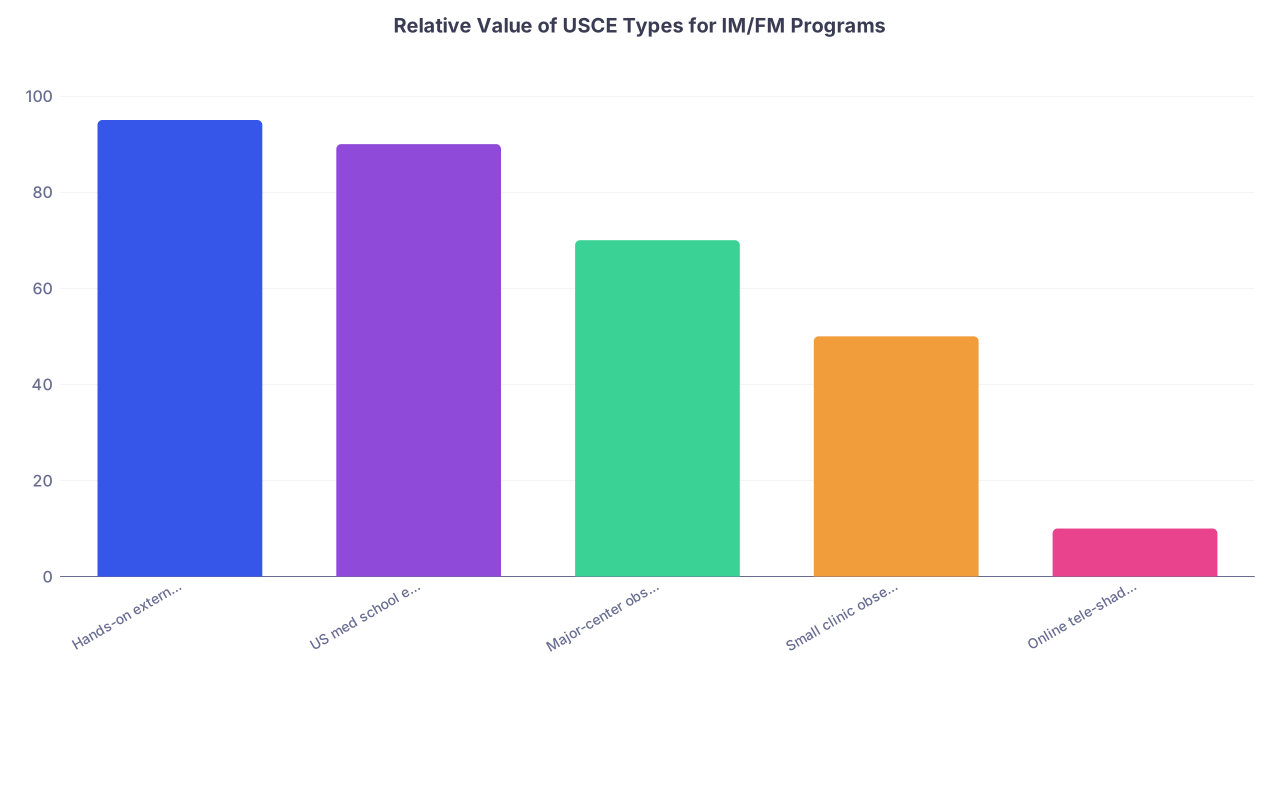
| Category | Value |
|---|---|
| Hands-on externship | 95 |
| US med school elective | 90 |
| Major-center observership | 70 |
| Small clinic observership | 50 |
| Online tele-shadowing | 10 |
This isn’t exact science, but it’s very close to how most PDs think.
How This Plays Into Your Overall Application Strategy
Choosing primary USCE is one piece. How it fits with the rest of your file matters more.
Here’s the quick alignment check:
Applying Internal Medicine / Family Medicine
→ Prioritize hands-on externships, especially inpatient or continuity primary care.
→ Observerships are “supporting evidence,” not the main act.Applying Neurology / Psych / PM&R
→ Ideal: 1 hands-on IM/FM rotation + 1–2 specialty-focused US experiences (externship or high-quality observership).
→ Primary USCE can be IM if that’s the only hands-on experience, but your statement and LORs should scream your specialty.Applying Highly competitive specialties (Derm, Ortho, etc.) as an IMG
→ You’re fighting uphill already. A strong brand-name observership plus research and networking might matter more than a random externship. But for most people in this group, matching is brutally hard regardless.
A Simple Decision Flow
Here’s the logic in plain English.

| Step | Description |
|---|---|
| Step 1 | Do you have any hands-on USCE? |
| Step 2 | Is it in or near your target specialty? |
| Step 3 | Primary USCE = Best observership |
| Step 4 | Primary USCE = Hands-on rotation |
| Step 5 | Is your best observership very strong, long, or brand-name? |
| Step 6 | Primary USCE = Hands-on, but spotlight observership heavily |
You’ll notice: in nearly every path where you have hands-on experience, that’s still your anchor USCE.
Don’t Forget the Letters of Recommendation Angle
Sometimes the real question isn’t “Which is primary USCE?” but “Which experience gives me the best letters?”
Your order on ERAS matters less than:
- Who is writing for you
- How detailed and enthusiastic they are
- Whether they can credibly say you functioned at a PGY-1-ish level
If your externship gave you:
- A detailed LOR describing your H&P skills, reliability, communication, and ability to take feedback
…and your observership gave you:
- A generic, “Dr. X observed in our clinic and was polite and punctual” letter
Then your externship is not just primary USCE; it’s the backbone of your application.
One More Thing: Timing and Recency
Recency matters more than people admit.
If:
- Externship: 2018, hands-on
- Observership: 2024, recent, specialty-aligned
You’re in a gray zone. Most PDs don’t love ancient clinical experience. In that case, I’d:
- Still clearly highlight that you have done hands-on USCE, even if older
- Use the recent observership to show you’re clinically up-to-date and engaged in the US system
- Make sure your recent letters (2–3) are from the last 1–2 years
Think of it as: externship proves you can function clinically; recent observership proves you’re still active and connected.
Quick Reality Check Before You Decide
Ask yourself these three questions:
- In which setting did I actually behave most like a junior resident or sub-I?
- From which experience did I get the strongest, most detailed US letter?
- Which experience is closest in content and structure to the residency I’m applying for?
If the answer to all three is “externship,” that’s your primary USCE.
If the externship was weak, ancient, or barely clinical, and a long, high-quality observership checks more of those boxes, then you can justify spotlighting the observership in your narrative—but still be transparent about roles.
Final Takeaways
Three things to remember:
- Hands-on beats shadowing. If you’ve got a real externship or US elective, that’s your primary USCE almost every time.
- Honesty and clarity win. Don’t oversell observerships or blur lines. Clearly label what was hands-on and what was observational.
- Think like a PD, not like a brochure. They care less about the label and more about what you actually did, what your letters say, and whether they can trust you with patients on day one.
If you structure your experiences around those ideas, you’ll stop overthinking the observership vs. externship label and start presenting the version of yourself that programs actually want to see.