
You’re staring at a website that wants $4,000 for a 4-week “premium USCE rotation” at a big-name hospital you’ve actually heard of. There’s a countdown timer, some photos of smiling IMGs in white coats, and the words “LOR guaranteed” in bold.
Your bank account is already limping. Your home country currency is weak against the dollar. And you’re asking the only question that matters:
Is paying for USCE actually worth it—or are you just getting scammed with a white coat and a badge?
Let me answer it directly:
Sometimes it’s worth it. Often it’s not.
You need a clear framework or you’ll burn money for very little match benefit.
This guide gives you that framework.
1. Start With This: Do You Even Need USCE?
US programs do not value all “clinical experience” equally. There’s a rough hierarchy, whether they say it out loud or not.
| Type | Value for Match | Usually Paid? | Generates Strong LOR? |
|---|---|---|---|
| ACGME-affiliated clerkship/acting intern | Very High | Rarely | Yes |
| Hands-on elective via med school | Very High | No | Yes |
| Structured paid externship (hands-on) | Moderate–High | Yes | Often |
| Pure observership at teaching hospital | Moderate | Sometimes | Sometimes |
| Community clinic shadowing | Low–Moderate | Sometimes | Weak/variable |
If you’re an IMG, programs usually want recent, US-based, supervised clinical exposure that shows:
- You can function in a US hospital/clinic
- You understand US documentation, culture, and team dynamics
- A US physician is willing to put their name behind you in a letter
If you already have:
- 2–3 strong US letters from actual inpatient / outpatient hands-on experiences, and
- Recent (within 1–2 years) USCE with decent names attached, and
- A Step 2 CK score that won’t get you filtered out,
then paying thousands more for yet another observership has diminishing returns.
But if you have:
- Zero USCE
- Only home-country letters
- A few years gap after graduation
- Or older USCE (3–5+ years back),
then some targeted paid USCE can actually rescue your application.
2. What “Worth It” Really Means (Stop Thinking Just About Name Brand)
Most IMGs overvalue prestige and undervalue function.
Programs look at paid USCE through three main lenses:
Does it generate a credible, detailed LOR?
“IMG rotated with me for 4 weeks, observed rounds, was punctual,” is useless.
“IMG took responsibility for 6–8 patients, wrote notes I co-signed, communicated with nurses and families,” is gold.Is the environment actually similar to residency?
Busy ACGME-affiliated hospital with residents and EMR vs a private clinic where you stand in a corner and smile.Does it fix a specific weakness in your profile?
For example:- No US internal medicine exposure → do an IM inpatient rotation.
- All psychiatry experience but applying to FM → do primary care / FM.
- Large time gap → get “recent clinical experience” in the US.
If the paid USCE you’re considering does not move at least one of those levers in a clear way, it’s usually not worth it.
3. A Simple Decision Framework: 5 Questions Before You Pay
Here’s the structured filter I use when advising IMGs. Answer these honestly before paying.
Question 1: What is your current USCE + LOR situation?
Be specific, not vague.
- 0–1 US letters → You probably need more USCE.
- 2 solid specialty-aligned US letters (e.g., applying IM with 2 inpatient IM letters) → Extra USCE is optional.
- All letters from your home country and you’re >2 years post-graduation → You almost certainly need USCE.
If you have one weak observership letter that basically says “nice person,” it barely counts.
Question 2: Are you paying for actual responsibility, or just physical presence?
If the program cannot offer any of the following, be suspicious of value:
- You’re assigned patients to follow daily
- You present on rounds
- You write notes (even if they’re “trial” notes)
- You attend teaching conferences with residents
- The preceptor supervises you directly and promises an honest letter
If the sales pitch focuses on:
- Badges
- Scrubs
- “Opportunity to stand behind residents and observe”
—and nothing about what you will actually do—you’re paying for a tourist package.
Question 3: Who is the attending and what is their role?
You’re not buying the clinic; you’re basically buying access to a letter-writer.
Look for:
- Attending is faculty at an ACGME program or a core teaching site
- They actively supervise residents or students
- They are comfortable writing LORs for residency and have done it before
Red flags:
- “Clinic doctor with no hospital privileges, no academic title”
- “NP/PA as your primary contact” (they cannot write meaningful LORs for residency)
- No mention of letters at all, or “generic certificate of completion only”
Question 4: Are you paying for branding or actual match impact?
Some companies blast “Mayo / Cleveland / Harvard-affiliated” everywhere. Then you look closely:
- The clinic is 30–60 minutes away from the main hospital, in a random office building
- The attending has minor volunteer or previous affiliation, not actual faculty appointment
- You never set foot in the main teaching hospital
That “brand” on your CV is not the same as doing an actual rotation there as a student.
I’m not saying the rotation is useless—but do not overpay purely for a name you can’t honestly represent.
Question 5: Will this experience change how a PD reads your file?
Be ruthless here.
If you’re an older grad (5–10 years) with weak or no USCE, and this rotation gives you:
- 1 strong, recent US IM letter
- Evidence of current clinical activity
- A US-based referee who can answer phone calls/emails,
then yes, it can materially change how PDs view you.
If you’re a fresh grad, with 250+ on Step 2, solid home-country clinical, and one good US-based elective, another $3,000 observership probably won’t.
4. Types of Paid USCE: What’s Usually Worth It vs Mostly Fluff
Let’s break it down.
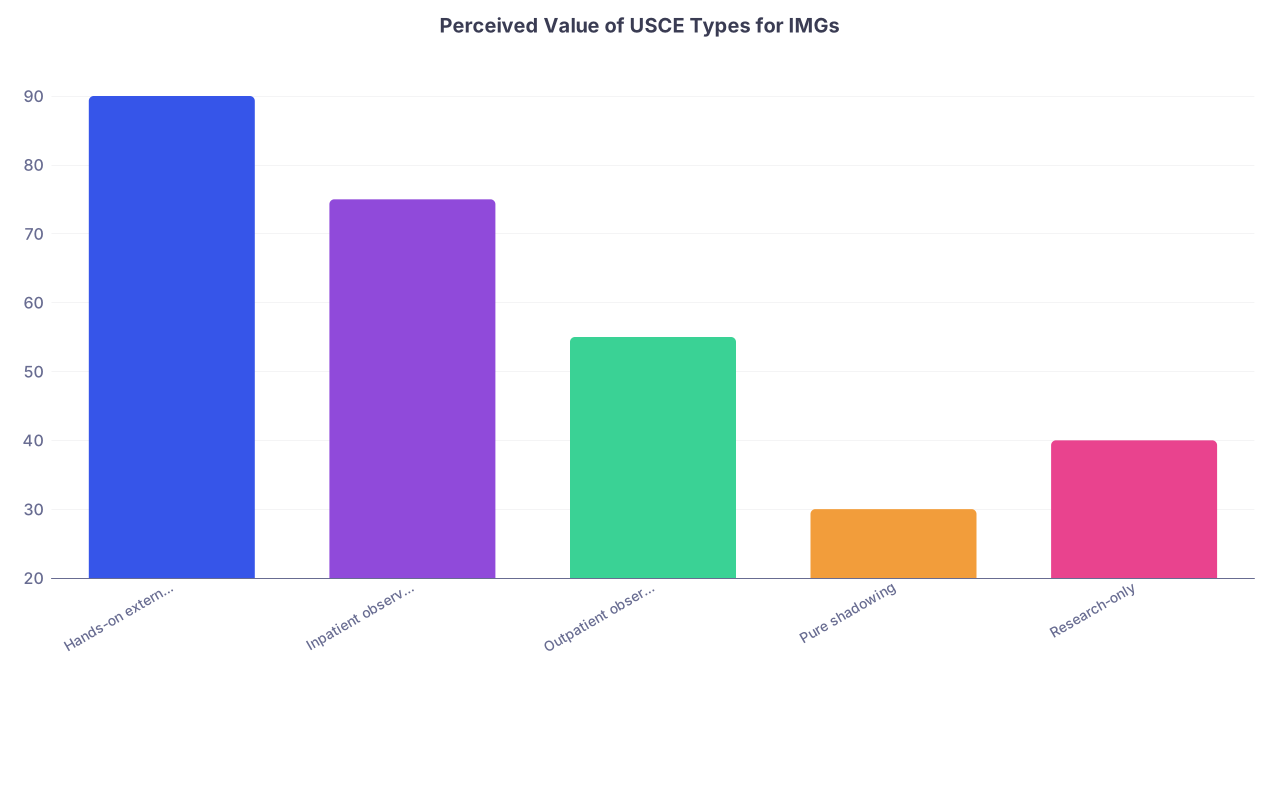
| Category | Value |
|---|---|
| Hands-on externship | 90 |
| Inpatient observership | 75 |
| Outpatient observership | 55 |
| Pure shadowing | 30 |
| Research-only | 40 |
1. Structured Hands-On Externships (Real Responsibility)
These are rare but valuable when legit.
Signs it’s good:
- You write notes, participate actively, present patients
- Attending is clearly involved in teaching and evaluation
- You’re integrated into resident workflow, not just sitting in the back
These can be worth paying for, especially if:
- You have no USCE
- You need a strong letter in the specialty you’re applying to
- You’re willing to work hard and actually learn
2. Inpatient Observerships at Teaching Hospitals
These can be moderately valuable if:
- You’re attached to a team with residents
- You round daily, present patients orally (even without writing notes)
- You attend morning report, noon conference, etc.
- Attending is willing to write a meaningful letter based on observed performance and initiative
They’re weaker than hands-on externships but still decent, especially for IM or FM.
3. Outpatient-only Observerships
These are all over the internet.
Some are decent: busy primary care offices where you see a lot of bread-and-butter US medicine and can interact with patients.
Many are useless: you sit in a corner of a one-room office watching quick visits with no teaching, no involvement, and the attending barely remembers your name.
These are only worth it if:
- You have zero US experience at all, and
- It’s your only feasible door into the system financially or logistically.
4. Pure Shadowing / “Clinical Experience” That’s Basically Volunteering
If your main tasks are:
- Rooming patients
- Checking vitals
- Filing forms or doing phone calls
- No direct physician supervision
Then this is closer to “clinic staff help” than USCE. Fine for exposure, weak for residency applications.
5. How Much Should You Pay? A Reality Check
Let’s be blunt: some companies are exploiting desperate IMGs.
Typical ranges I’ve seen:
| Type | 4-Week Cost (USD) | Comment |
|---|---|---|
| University elective | 0–2,000 | Hard to get, high value |
| Hands-on externship | 2,000–3,500 | Sometimes worth it |
| Inpatient observership | 1,500–3,000 | Case-dependent |
| Outpatient observership | 800–2,500 | Very variable quality |
Paying $4,000+ for an outpatient-only observership with no guarantee of a personalized LOR is almost never a good deal.
If your total budget for your entire match attempt (exams, travel, ERAS fees) is, say, $10,000, blowing $6,000 on USCE leaves you underfunded for interviews. That’s dumb.
6. How to Vet a Paid USCE Program in 10 Minutes
Before you send a single dollar, ask them explicitly (and get answers in writing if possible):
- Who will directly supervise me? Name, title, and hospital affiliation.
- Do you routinely write residency LORs for IMGs? In which specialties?
- Will I be:
- Assigned patients?
- Allowed to present on rounds?
- Able to attend teaching conferences?
- How many prior IMGs from your program have actually matched in the last 3 years, and to which specialties?
- Will my badge/ID be from the hospital, or just your company?
- Can I speak to a recent former participant (not just the one you hand-pick)?
If they dance around these questions, or just keep sending you glossy brochures—walk away.

| Step | Description |
|---|---|
| Step 1 | Need USCE? |
| Step 2 | Consider Paid USCE |
| Step 3 | Paid USCE Usually Low Yield |
| Step 4 | Assess Attending & LOR Potential |
| Step 5 | Outpatient Only - Lower Value |
| Step 6 | Likely Worth It |
| Step 7 | Skip or Find Cheaper Option |
| Step 8 | May Be Worth Limited Investment |
| Step 9 | Not Worth Paying |
| Step 10 | 0-1 US LORs or old experience? |
| Step 11 | Hands-on or inpatient? |
| Step 12 | Affordable & Specific Gap Fixed? |
| Step 13 | Only Option & No USCE? |
7. When Paying for USCE Is Usually Worth It
Let me be specific.
It’s often worth paying if:
- You’re 3–10 years post-graduation with no recent clinical work and no USCE.
- You’re switching specialties (e.g., prior psych experience, now applying IM) and need aligned US letters.
- Your Step scores are decent but not stellar, and you need some angle to show “I can function in US hospitals.”
- You’re applying to a moderately competitive specialty as an IMG (like neuro, EM via prelims, etc.) and want 1–2 truly strong letters.
And the program you picked:
- Gives you daily interaction with a teaching-attending
- Lets you show work ethic and clinical reasoning
- Results in 1–2 personalized, detailed US letters that mention specific cases and behaviors
In those situations, that $2,000–3,000 can easily be the difference between 2 interviews and 8 interviews.
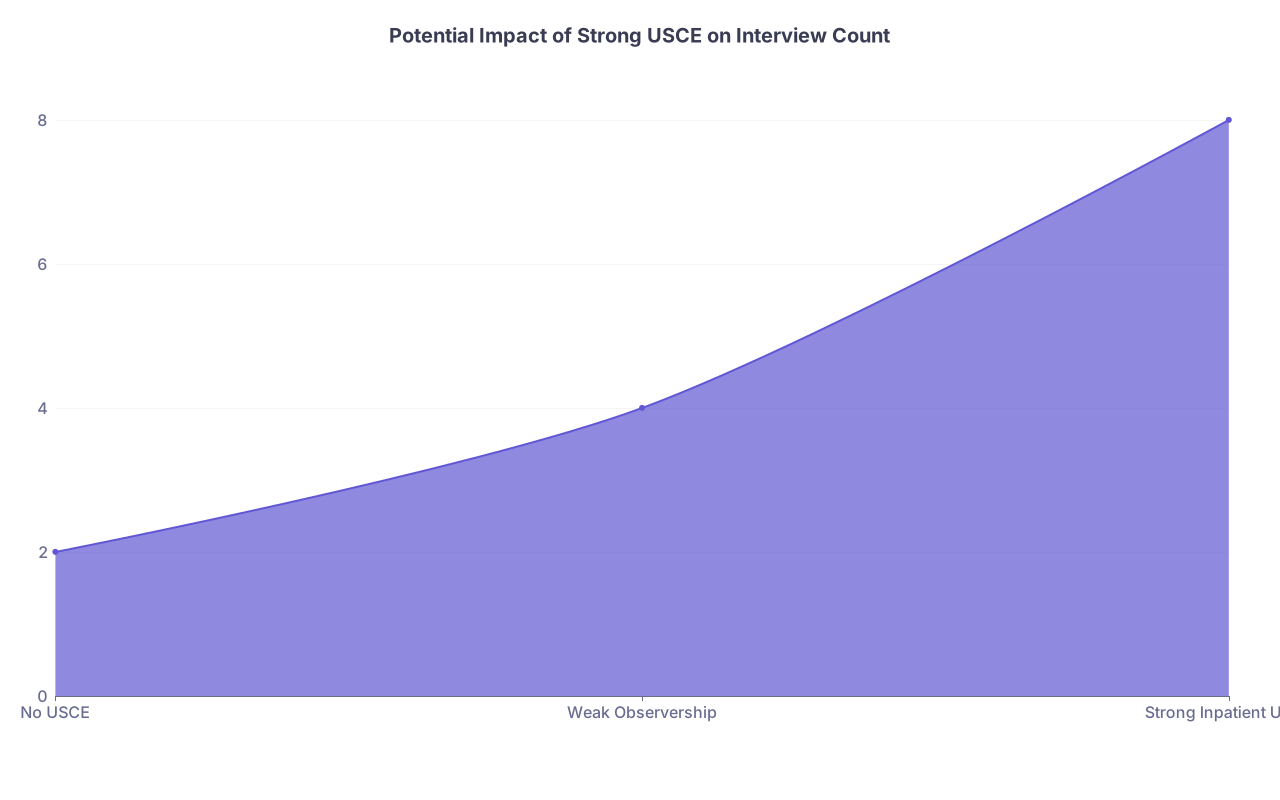
| Category | Value |
|---|---|
| No USCE | 2 |
| Weak Observership | 4 |
| Strong Inpatient USCE | 8 |
(Obviously, numbers vary; this is illustrative. But I’ve seen that pattern often.)
8. When Paying for USCE is Usually a Waste
You’re probably wasting your money if:
- You already have:
- 2–3 strong US LORs in your target specialty
- Recent USCE within the last 1–2 years
- The program:
- Is outpatient-only, low teaching, minimal interaction
- Won’t clearly confirm that letters are customary
- Emphasizes “certificates” more than actual clinical work
Or if you’re doing it purely for:
- “CV padding” without LOR
- “Harvard name” when it’s actually a far-off affiliated outpatient clinic
- “Photo in a white coat in the US” for your social media
Residency programs are not stupid. They can tell which experiences are fluff.
9. Alternatives If You Can’t Afford Paid USCE
If paying thousands isn’t realistic, don’t assume you’re doomed.
Realistic alternatives:
- Hustle for individual observerships by emailing departments and attendings directly at community hospitals. Less glossy, but sometimes more genuine.
- Get strong home-country LORs from people with any US/UK/Canada connection or prior academic roles.
- Do high-quality research with US collaborators (if you can get that relationship), and get a research-based LOR.
- Focus heavily on Step 2 CK and a clean, clear personal statement to offset lack of USCE somewhat.
It’s harder, yes. But I’ve seen IMGs match with zero paid USCE because they compensated with scores, research, and smart program lists.
10. Quick Decision Checklist
Before you pay for any USCE, you should be able to answer “yes” to most of these:
- Does this rotation clearly fix a gap in my application?
- Will I work directly with an attending who writes residency LORs?
- Are there former IMGs from this program who actually matched?
- Is the cost proportionate to my total budget and not crippling the rest of my match process?
- Can I honestly describe this on my CV without exaggeration?
If you’re saying “no” or “I don’t know” to most of those, pause. Ask more questions. Or just walk away.

FAQs
1. Is paid USCE viewed negatively by program directors?
Generally no, as long as:
- The environment is legitimate (real clinic/hospital, real attending), and
- You do solid work and get a meaningful LOR.
PDs care more about the quality of the experience and the strength of the LOR than whether you paid a broker to set it up. What looks bad is a string of fluffy, meaningless observerships with generic letters.
2. How many months of USCE do I need as an IMG?
For most IMGs aiming at IM/FM:
- Target: 2–3 months of solid USCE with at least 2 strong US LORs.
- More than 4–5 months rarely adds much extra value unless you’re addressing a huge gap (older grad, career change, etc.). At some point, more months just look like you’re wandering.
3. Does the name of the hospital matter more than the type of experience?
No. A hands-on, well-supervised community hospital IM rotation with a strong LOR beats a big-name “Harvard-affiliated” office where you never touch a chart or present a patient. If you can get both prestige and real responsibility, great. But if you must choose, pick substance over brand.
4. Can an outpatient-only USCE help me match into Internal Medicine?
Yes, but with limits. Outpatient IM or FM can help, especially if:
- You have no other USCE, and
- The attending writes a detailed letter focusing on your reasoning, communication, and reliability.
However, programs still prefer inpatient experience for IM. If you can, combine at least one inpatient month with outpatient work.
5. I already did one paid observership. Should I pay for another?
Ask yourself:
- Did the first one give you a strong LOR?
- Is the new one clearly better (inpatient, stronger attending, better teaching site)?
- Does your application still have a real USCE/LOR gap?
If your first observership produced a good LOR and you have at least 2 strong letters total, another paid experience is usually low-yield. At that point, your money is often better spent on applications, travel for interviews, or Step 3.
Key takeaways:
- Paid USCE can be worth it when it clearly fixes a specific gap—especially lack of US LORs or recent clinical activity.
- You’re paying for responsibility and a credible letter, not for a white coat or a brand name. If you’re not getting those, think twice.
- Always vet programs hard, balance cost against your total match budget, and prioritize experiences that will genuinely change how a PD reads your file.