
Letters are not earned on the last day of your rotation. They’re decided in the first 72 hours.
That’s the part most IMGs never hear. They obsess over the last note, the last call, the last thank‑you email. Attendings make their internal “will I put my name on this person?” decision much earlier, then spend the rest of the month looking for reasons not to change that judgment.
You’re asking about US clinical experience for IMGs and how this translates into letters and advocacy. Let me tell you how it actually works behind closed doors—match meetings, hallway conversations, the quick email to the PD.
What Attendings Really Think About IMGs on Day 1
On day 1, you walk in and you’re already in one of three buckets in your attending’s head. Nobody will say this to your face, but I’ve heard these exact phrases in work rooms:
- “Probably fine, will be solid help.”
- “Wild card, might be great, might be work.”
- “Do not let this person near my name.”
You think this is about your school name or country. It isn’t. That’s background noise. The real sorting is fast, brutal, and based on behavior in the first interactions.
The first 15 minutes: the unsaid checklist
When an IMG student or observer walks onto the team, most attendings are quietly checking:
- Are you on time and already logged into the EMR?
- Do you introduce yourself clearly and confidently to everyone (including nursing)?
- Do you know the basic structure of US rounds and notes?
- Do you ask smart clarifying questions—or constant basic ones?
If you show up late, can’t log in, and have to ask how to write a SOAP note in the US format, you’ve just moved into the “probably not recommend” bucket. Harsh, but true.
Here’s the part nobody tells you: attendings are not starting from neutral with IMGs. They are starting from, “Is this going to slow my day down?” If the answer becomes “yes,” your recommendation chances drop immediately, and it takes a lot to dig out of that hole.
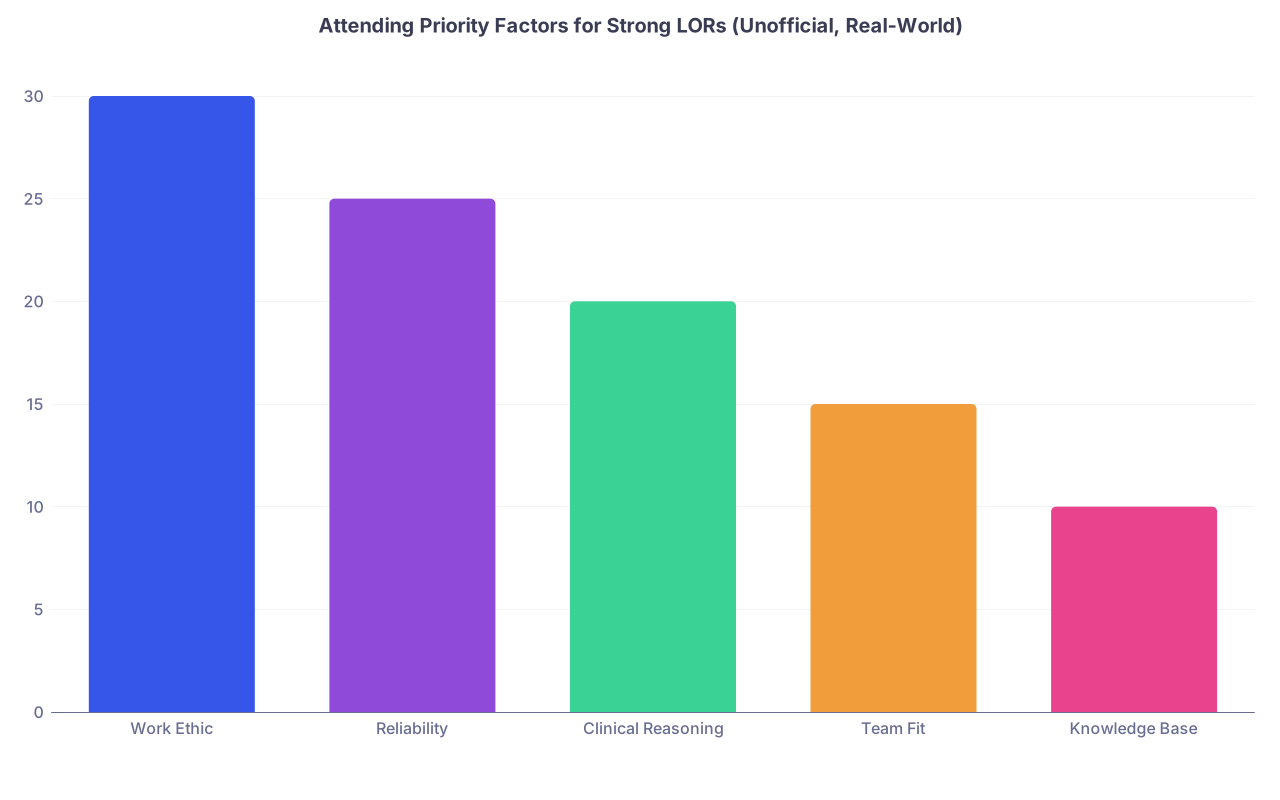
| Category | Value |
|---|---|
| Work Ethic | 30 |
| Reliability | 25 |
| Clinical Reasoning | 20 |
| Team Fit | 15 |
| Knowledge Base | 10 |
Those numbers are roughly how faculty rank things when they talk candidly. Knowledge matters, but it’s not number one. They assume you’ll all be smart. They’re sorting for the ones who make the ward run smoother, not slower.
The Three Quiet Gates: How You Get Into “I’ll Recommend You”
There are three “gates” most attendings use internally—even if they’d never phrase it this way.
They don’t tell you the gates. I will.
Gate 1: “Can I trust you with basic tasks?”
This is the minimum bar. If you don’t clear this, you’re never getting a strong letter.
Trust here isn’t about managing septic shock on your own. It’s about:
- If I ask you to call radiology, do you actually do it and report back?
- If I say “follow up this lab,” do I need to remind you 3 times?
- If you present something, is it 80–90% accurate?
I once heard an attending say, “I like him, but I can’t trust his data. I’m not putting my name on that.” The student was pleasant, enthusiastic, nice with patients. No letter. Because his problem list never matched reality and his notes had errors.
For IMGs, this gate is where many fail early because of system differences. They’re good clinically, but they:
- Don’t understand US note expectations
- Are slow with EMR
- Forget follow-ups because they’re not used to this workflow
The fix is not “work harder.” The fix is: before the rotation starts, get training in EMR basics, US note structures, order sets, and workflow. If the attending feels they can “set and forget” you on simple tasks, you’ve cleared Gate 1.
Gate 2: “Would I want this person as my intern?”
This is the real question most attendings ask themselves before writing a meaningful letter.
Not: “Are you nice?” Not: “Are you smart?” But: “If this person were on my team at 2 a.m. with a crashing patient, would I feel okay seeing their name on the cross-cover pager?”
That translates into:
- Do you respond well when things get busy, or do you disappear?
- When you don’t know something, do you own it or fake it?
- Do you improve over the month, or stay at the same level?
I’ve been in attending rooms where someone said, “She’s not there yet, but if you give her a year, she’ll be a solid intern. I’ll write for her.” That “trajectory” matters more than your starting point.
The IMGs who impress attendings at this gate do a few things consistently:
They ask for feedback early and implement it visibly.
They say things like, “Yesterday you mentioned my assessment was disorganized. I tried to tighten it up today—can you tell me if that’s closer to what you’re looking for?”
Now you’ve signaled two things: you listen, and you adapt. That triggers a different mental category: “Teachable. Worth investing in. Potential resident.”
Gate 3: “Would I stake my reputation on you with my PD?”
This is the top gate. This is not just a letter. This is, “I will email or call my PD and say, ‘Take this person seriously.’”
Most IMGs never get to this gate because they assume letters are transactional: you do the rotation, you get a letter. That’s how weak, generic LORs are made.
At this gate, the attending is thinking:
- If this person fails as a resident, does it come back on me?
- Will the PD roll their eyes when they see my name, or will they pay attention?
- Have I seen enough of this person to vouch for them beyond “hardworking and pleasant”?
Here’s what actually triggers this highest level of advocacy:
- A pattern of mature clinical thinking: you’re not just regurgitating UpToDate; you’re synthesizing.
- Ownership of patients: you follow your panel, know them, anticipate needs.
- You’ve made the attending’s life meaningfully easier at least a few times.
I watched an attending at a mid-tier IM program write an email to the PD about an IMG from a totally unknown school. This was the subject line: “We should take this one if we can.” That student didn’t have elite scores. What they had was: absolute reliability, clear communication, and three months of sustained, high-level performance.
That’s the game you’re actually playing.
What Attendings Say vs. What They Mean (When Writing LORs)
You’ve seen those LORs. All sound the same:
“Hard-working, team player, great asset to our team, strongly recommend.”
You’re probably underestimating how programmed attendings are in LOR-speak. Behind closed doors, they translate these phrases into specific tiers of strength.

Here’s the insider translation most program directors use when reading letters from US rotations:
| Letter Phrase | What It Really Signals |
|---|---|
| "Recommend without reservation" | Strong, safe approve |
| "One of the top students I have worked with" | Very strong, standout |
| "Would be a solid resident in any program" | Good, but not elite |
| "I expect they will do well in residency" | Neutral, generic |
| "With appropriate support, will succeed" | Mild concern |
When attendings really like you, they go beyond stock phrases. They add specifics, context, and comparison:
- “In the top 5% of students I’ve supervised in five years.”
- “Functioned at or above the level of a sub-intern.”
- “Required less supervision than typical students at this level.”
They also describe concrete behaviors:
- “Regularly came in early to pre-round and have thoughtful plans ready.”
- “Called families proactively with updates and documented clearly.”
- “Stayed late during a code to ensure tasks were completed, without being asked.”
If your letters are missing percentile language, missing comparison to peers, missing specific anecdotes—then they’re not hurting you, but they’re not moving you either. In a competitive IMG pool, that matters.
The IMG-Specific Biases You’re Up Against (and How to Disarm Them)
Let me be blunt: there are specific, recurring anxieties attendings have about IMGs. Most won’t admit them out loud. I’ve heard them in workrooms, after sign-out, in faculty meetings.
The usual quiet worries:
- “Will their English slow things down with patients?”
- “Are their clinical skills aligned with the US system, or will I have to un-teach things?”
- “Do they understand documentation, billing, medico-legal issues here?”
- “Are they going to be passive or too deferential to speak up?”
You cannot fix all of this in one month. But you can deliberately attack the ones that matter most for letters.
Your language and communication
If the attending has to mentally “translate” you, that’s a problem. It’s not about accent; it’s clarity, efficiency, and professional phrasing with:
- Patients
- Nurses
- Consults on the phone
- During presentations
This is why some IMGs with very strong knowledge still never get the “top 5%” language. The attending is uncomfortable imagining them running a US ward.
You want them thinking: “I could put this person on night float tomorrow and they’d at least communicate clearly.”
Your decision-making and independence
Another bias: “IMGs won’t speak up or disagree; they’ll just say yes.”
The dangerous version of that is the student who nods, says “okay,” then does not actually understand the plan. Attendings hate discovering this late.
The IMGs who flip this bias do something simple but powerful: they verbalize their thought process, including uncertainty.
“I was considering X vs Y because of [reasons]. I’m leaning toward X, but I wasn’t sure about [specific point]. How would you approach it?”
Now you’re no longer the silent unknown. You’re someone whose brain they can see working. Much easier to recommend.
Your understanding of “the US way” of care
You may be excellent in your home system. Attendings are grading you on your ability to function in this one. That means you’re judged on:
- Problem lists formatted properly
- Focused notes that don’t copy-paste entire labs
- Safe handoffs with the right structure (e.g., I-PASS style)
- Understanding of what must be documented for procedures, consent, etc.
If you’re unfamiliar with this, you must overprepare before stepping onto the floor. You should not be learning from zero during your paid/precious USCE month.
When and How Attendings Decide to Say “No”
People romanticize letters. Let’s talk about refusals.
Most attendings will not tell you, “I can’t write you a strong letter.” They’ll say:
- “I can write you a letter describing your performance.”
- “I’m happy to write you a letter if you need more, but I only worked with you briefly.”
- “I think Dr. X, who worked with you more closely, might be a better choice.”
Those are polite “no’s.” Translate that in your head as: “This letter will be generic and not helpful.”
Here’s what usually triggers an internal “no” during the month:
- You’re unreliable with follow-through.
- You don’t improve after repeated feedback.
- You disappear right at 4:59 p.m. every day when work is clearly unfinished.
- You have even one serious professionalism issue (argument with staff, inappropriate joke, poor boundaries with patients, etc.).
The attending may still write you something. But will they put real weight behind it? No.
I’ve seen faculty say in selection meetings: “Yes, I wrote for them, but it was not a strong letter.” PDs know how to read between those lines.
How to Convert a Neutral Attending into a Strong Advocate
Now the part you actually need: how to move someone from “fine student” to “I’ll put my name on you.”
Here is the uncomfortable truth: the students who get the best letters almost always engineer those letters. Not by begging. By making it incredibly easy for the attending to remember them and argue for them.
Step 1: Signal your intentions early
In the first week—after you’ve shown basic competence—say something like:
“I’m applying to internal medicine this cycle and I know strong US letters are important, especially for IMGs. My goal is to work hard enough this month that you’d feel comfortable recommending me strongly. If at any point you don’t think I’m on track for that, I’d really appreciate your feedback so I can adjust.”
You’ve just:
- Told them you’re serious
- Given them explicit permission to critique you
- Put “strong recommendation” in their head as an option
Most students never do this. They hope the attending will magically notice and offer. They rarely do.
Step 2: Ask for specific, not vague, feedback
Instead of “Do you have any feedback?”, ask:
- “What’s one thing I could do tomorrow that would make me more useful to the team?”
- “How can I make my presentations closer to what you’d expect from a sub-I?”
- “Is there any way I can add more value on rounds without slowing things down?”
This signals coachability and future-resident mentality. That’s what makes attendings comfortable saying, “Yes, this person will thrive with us.”
Step 3: Do one or two memorable, unforced things
You do not need to be a hero. You do need one or two anchor memories the attending can reference in the letter.
Examples I’ve seen attendings actually mention:
- Calling a family every evening with updates—and documenting it.
- Catching a subtle lab trend or imaging finding that changed management.
- Staying late to help with a complicated discharge without being asked.
- Taking initiative to create a simple sign-out summary that the whole team started using.
These are not grand gestures; they’re resident-level behaviors from a student. They give concrete stories, not adjectives.
Step 4: Time your letter request properly
Ask too early, and it feels transactional. Ask too late, and they’ve forgotten details.
Best timing: last week of the rotation, after a good day where you’ve clearly contributed.
Phrase it like this:
“I’ve really valued working with you this month and the feedback you’ve given me. I’m applying to [specialty] this cycle. If you feel you know me well enough to write a strong letter of recommendation, I would be very grateful. If not, I completely understand and would prefer you tell me honestly.”
That “if not, I understand” is important. It gives them a graceful out, which paradoxically makes them more willing to say yes if they truly can.

| Step | Description |
|---|---|
| Step 1 | Start USCE Rotation |
| Step 2 | Clear Gate 1: Reliable with Tasks |
| Step 3 | Clear Gate 2: Intern-Level Potential |
| Step 4 | Signal Interest and Ask for Feedback |
| Step 5 | Create Memorable Positive Behaviors |
| Step 6 | Request Strong LOR with Opt-Out Language |
| Step 7 | Attending Advocates to PD/Program |
One More Hidden Channel: Off-Record Emails and Phone Calls
Everyone focuses on the formal letter. But there’s a quiet, more powerful channel: the quick email or call.
This is what PDs really pay attention to:
- “By the way, that IMG from [hospital] you’re interviewing—she’s excellent. I’d take her.”
- “We had this applicant last year on our wards. Very strong. Worth ranking high.”
These comments happen:
- At faculty meetings
- Over email when PDs cross-check applicants
- At conferences, when PDs ask each other, “Do you know this person?”
You cannot ask for this directly. You earn it. And you only earn it if the attending feels you are low risk and high return for their name.
Some of you will never know this advocacy happened. But it will show up quietly in your rank position.