
The clerkship might be a mess, but your performance does not have to be.
I have seen students turn completely chaotic, useless rotations into the strongest talking points in their letters and interviews. I have also watched others let the same rotations bury them. The difference was not luck. It was a system.
You are an IMG in a US clinical experience, aiming for residency. The clerkship is disorganized, no clear schedule, teaching is random, no one seems responsible for you, and you are starting to panic that this is going to tank your application.
Here is how you salvage it and still impress faculty.
Step 1: Diagnose the Type of “Disorganized” You Are Dealing With
You cannot fix what you have not clearly named. “This rotation is terrible” is useless. You need specifics, because each type of chaos has a different fix.
Common patterns I see:
No structure
- No clear start/end times
- No defined team or preceptor
- You wander between floors trying to find someone to follow
No defined role
- No one knows what you are allowed to do
- Nurses ask, “Who are you with?” and you do not have a good answer
- You are either ignored or treated like a shadow
No teaching
- Rounds are just “check boxes” and dispo discussions
- Attendings never ask you a question, never give feedback
- You learn more from UpToDate than from people
No feedback or evaluation plan
- No mid-rotation feedback
- No clarity on who is writing your evaluation or letter
- Portal evaluations stay “not started” until the last day
No patient continuity
- You are moved between services every 1–2 days
- Impossible to follow cases or “own” patients
Take 10 minutes and write down what is actually broken in your rotation. Not a rant. A list.
- “No daily schedule”
- “No clear supervising attending”
- “Never assigned own patients”
- “No feedback after 2 weeks”
You are going to build your response around that.
Step 2: Lock Down a Supervisor and Expectations (Even If the System Is Fuzzy)
You cannot impress “the hospital.” You can only impress specific people.
Your first salvage move: identify a primary supervising attending or senior resident and define expectations with them. If the site never did this, you will.
How to do this without sounding needy
Pick the most stable person on your team:
- The attending who is there most days
- Or the senior resident who actually runs rounds
Then say something like this early in the rotation (or now, if you are already in the middle):
“Dr. Smith, as an IMG doing this US clinical experience, I want to be sure I am meeting your expectations. Would it be possible to clarify:
- What you would like me to do daily (notes, presentations, pre-rounding)?
- How you usually evaluate students here?
- Who will likely complete my final evaluation?”
Short. Direct. Professional.
If the attending defers to the resident:
“Dr. Lee, Dr. Smith mentioned you are the main person supervising students here. Could I ask what your expectations are for me day-to-day and what I can do to be most useful to the team?”
You are solving their problem: they have a student they do not know how to use. You are showing them you want structure, not hand-holding.

| Step | Description |
|---|---|
| Step 1 | Notice disorganization |
| Step 2 | Identify stable supervisor |
| Step 3 | Clarify expectations and role |
| Step 4 | Create your own structure |
| Step 5 | Document work and ask for feedback |
| Step 6 | Secure strong evaluation or letter |
Step 3: Create Your Own Daily Structure So You Look Organized While Everything Around You Is Not
Disorganized clerkship or not, your day needs a reproducible pattern. This is where most IMGs either look like professionals or like lost observers.
Build a simple daily template
Aim for something like this:
Pre-round (even if no one told you to)
- Pick 2–4 patients to follow consistently
- Arrive 30–60 minutes before rounds
- Check overnight events, new labs, imaging, notes
- Talk to the patient briefly
- Write a focused SOAP note or at least a note skeleton (if notes are not allowed, write it in your notebook)
Rounds
- Offer to present the patients you follow
- Use a clear, concise structure (no rambling)
- Always have 1–2 prepared questions if there is dead time
Midday
- Follow up on pending labs/studies for “your” patients
- Ask residents for tasks you can help with: med recs, discharge summaries (draft), patient education, calling outside pharmacies
- Select 1 case from the morning and quickly read 10–15 minutes on the main issue
Afternoon wrap-up
- Check back with each patient you are following
- Update your notes
- Confirm with your supervising resident/attending:
“Anything else I can do before I go? Any patient you would like me to follow tomorrow?”
You are signaling reliability and initiative without being annoying.
The “invisible notebook” that saves disorganized rotations
Have a small notebook or digital note (respect HIPAA: no identifiers) with consistent sections:
- Date, team, attending
- Patients you followed – diagnoses and key events
- Tasks you did – calls, notes, follow-ups
- One “learning point” per day with source (e.g., ACC/AHA guideline, UpToDate topic, NEJM article)
- Any feedback given (even informal)
This notebook becomes:
- Evidence of your involvement
- Raw material for your MSPE / Dean’s letter comments
- Concrete details for your LOR writers
- Stories for residency interviews when they ask, “Tell me about a challenging rotation”
Step 4: Manufacture Teaching and Learning When None Is Provided
Disorganized clerkships often equal zero formal teaching. That does not mean you cannot learn or show faculty you are serious.
Use 5–10 minute micro-teaching blocks
Attending has 5 minutes between patients? You do not scroll your phone. You say:
- “Dr. Jones, could I quickly present a 2-minute summary of a case I am following and get your feedback?”
- “I read a quick summary about [condition] this morning. Could I run 1 question by you to be sure I understood the management correctly?”
Keep it surgical:
- 2–3 sentences of relevant history
- 1–2 focused questions
- Accept feedback, write it down, apply it that same day
Over a 4-week rotation, 2 of these micro-interactions per week with the same attending turn you from “the random IMG” into “the student who keeps improving.”
Use targeted self-study tied to real patients
You do not need to study everything. You need to study what proves you are clinically sharp:
Each day:
- Pick one patient’s key problem
- Spend 15–20 minutes reading:
- First: UpToDate / local guidelines
- Second: 1 relevant recent review article if you have time
- The next day, apply it:
- “I read that for decompensated cirrhosis with ascites, we should [X]. For our patient, would [Y] be appropriate?”
You are not showing off. You are showing that your reading changes what you do on the wards. That is what residents and attendings remember.
Step 5: Turn Chaos Into an Opportunity to Look Mature and Professional
Faculty notice how you behave under bad conditions.
In a clean, well-run rotation, everyone can look decent. In a messy one, your behavior under stress is diagnostic.
Here is how you differentiate yourself.
Behaviors that scream “resident-ready” in a disorganized clerkship
You are calm and low-maintenance
- You do not complain about the rotation daily
- You ask for what you need once, clearly
- Then you adapt
You protect patients from the chaos
- You quietly double-check orders or discharge instructions
- You clarify things for confused families (within your scope)
- You notice when follow-up or labs were forgotten and gently remind the resident
You communicate like a junior resident
- You use SBAR or similarly structured communication:
“Quick update on Mr. K: He developed new chest discomfort, vitals are stable, EKG unchanged from prior, but troponin is pending. I wanted to let you know and ask if you would like me to…” - You give short, clear updates, not rambling narratives
- You use SBAR or similarly structured communication:
You manage your own time
- When no one gives you tasks, you:
- See patients
- Read
- Observe procedures
- Follow admissions in the ED
- You ask, “Is it ok if I go to the ED to follow up on the new admission and then come back for afternoon rounds?”
- When no one gives you tasks, you:
Residents love students like this. So do letter writers.
Step 6: Document Your Contributions Ruthlessly (So They Can Be Seen and Written About)
In disorganized clerkships, your risk is invisibility. People will like you but forget what you did. That leads to bland, generic letters.
You are going to fix that.
Build a one-page “evidence sheet” before you ask anyone for a letter
Toward the end of the clerkship, create a concise, 1-page document. Not a CV. A focused “rotation snapshot” you can give to an attending you ask for a letter.
Sections:
Header
- Name, medical school, IMG status
- Rotation name, hospital, dates
- Your role (observership / hands-on clerkship / sub-I)
Clinical responsibilities
- “Followed 3–4 inpatients daily, pre-rounded, and presented on rounds”
- “Drafted daily SOAP notes (reviewed by residents)”
- “Participated in admissions from ED when permitted”
Specific cases
- “Actively followed: decompensated CHF, new diagnosis of DKA, COPD exacerbation”
- “Led family discussion (with resident supervision) to explain new diabetes diagnosis”
Self-directed learning
- “Daily reading tied to patients; reviewed ACC/AHA heart failure guidelines, ADA diabetes guidelines”
- List 3–5 topics you studied in depth
Feedback applied
- “Initial feedback: presentations too detailed. Adjusted to more focused, problem-oriented format after week 1.”
You can hand this to the attending when you ask:
“Dr. Smith, I have really valued working with you on this rotation. I am applying to Internal Medicine this cycle and would be honored if you felt you could write a strong letter of recommendation. I prepared a short summary of my work this rotation to make it easier if you agree.”
Most will say yes. You just made their life easier and reminded them of what exactly you did.
Step 7: Engineer Useful Evaluations Even When the System Is Sloppy
Sometimes the “official” evaluation system is a mess:
- Wrong attending assigned
- Portal never updated
- No one remembers to submit
You cannot control their system. You can control your inputs.
Tactics that actually work
Ask early who will evaluate you
- “Dr. Lee, for this rotation, who usually completes the student evaluations in the system?”
- If they say, “I do” – good. If they say, “Not sure” – you follow up with the clerkship coordinator.
Mid-rotation check-in (even if they did not schedule it)
- Week 2 or midpoint, ask:
“I want to be sure I am on track. Could I get 5 minutes for feedback on how I am doing clinically and professionally, and what I can improve in the second half?”
- Write down what they say. Apply it. Explicitly show change.
- Two weeks later:
“Last time you mentioned I should be more concise in presentations. I have been trying to implement that. Am I closer to what you expect?”
- Week 2 or midpoint, ask:
This “you gave feedback, I changed” loop is gold. Faculty talk about it in letters.
- End-of-rotation prompt
- 3–4 days before the end:
“Dr. Smith, I believe the evaluation link was sent to you for my rotation. Is there anything else I could do in these last days that would help you fairly assess my performance?”
- 3–4 days before the end:
This politely reminds them the evaluation exists. You are not nagging. You are asking what you can do better.
Step 8: Decide When and How to Ask for Letters in a Disorganized Setting
You do not need every attending to write your letter. You need 2–3 people who actually saw you work and can write with detail.
Who to pick for LORs from a messy rotation
Prioritize:
The attending who:
- Watched you present multiple times
- Saw you pre-round and follow patients
- Gave you some feedback
- You interacted with across at least 2 weeks
Or the senior resident who:
- May not write the letter but can advocate to the attending:
“Dr. Smith, that IMG student actually did a great job. I think they would be a strong candidate.”
- May not write the letter but can advocate to the attending:
Avoid:
- Attendings who barely remember your name
- Sites with purely observational roles unless they still saw your engagement and thinking
Exact script that usually works
“Dr. Patel, I really appreciated the chance to work with you on this rotation, especially on the days we managed patients with [X and Y, concrete example]. I am applying to [specialty] residency and your letter as a US attending would be very valuable as an IMG. If you feel you can write a strong, positive letter reflecting my work here, I would be very grateful.”
Two options they have:
- “Yes, I can write a strong letter.” Good.
- “I am not sure I observed you enough.” Also good. You politely move on.
You want “strong” or “very strong.” Not lukewarm.
Step 9: Use the Experience Strategically in Your Personal Statement and Interviews
Disorganized clerkships, when salvaged, become some of the best stories you can tell.
Programs know that many IMGs get thrown into low-structure rotations. If you show that you:
- Noticed the chaos
- Took ownership of your learning
- Improved clinical skills anyway
- Stayed professional under frustration
They see someone who will survive internship.
How to frame it in your application
In the personal statement, you do not complain. You say things like:
- “During a US inpatient clerkship where team roles were initially unclear, I realized I could either wait for structure or create it for myself. I began pre-rounding independently on a small panel of patients, presenting concise assessments on rounds, and seeking targeted feedback from my senior resident. Over the month, I transitioned from feeling like an observer to functioning much closer to a junior resident, which confirmed my desire to train in a system where responsibility and initiative are valued.”
Clean. Mature. No whining.
In interviews, when they ask:
- “Tell me about a challenging clinical experience.”
- “Describe a time you had to adapt quickly.”
You can outline:
- The problem (disorganized rotation, lack of structure)
- The actions (you built your own structure, found a supervisor, created routines)
- The result (strong feedback, better presentations, more confidence managing patients)
That is what programs want: not perfect conditions, but adaptive behavior.
Step 10: Protect Yourself From Being Exploited or Undermined
One last reality: some “disorganized” clerkships are actually poorly supervised or borderline exploitative, especially for IMGs. You still need to protect your safety, your time, and your reputation.
Red flags where you should push back or escalate
You are asked to:
- See patients entirely alone and write notes that are signed without review
- Function like an intern without supervision
- Perform procedures you are not trained for, “because we are short-staffed”
You experience:
- Repeated disrespect or harassment
- Pressured work far beyond what you were told the rotation would involve
In those cases:
- Document what is happening (dates, what was asked, who was present)
- Reach out to:
- Your school’s clinical coordinator
- The program’s educator/contact person
Be factual, not emotional:
“I wanted to share a concern. As a student, I am being asked to [X], which seems beyond appropriate responsibility without supervision. I want to provide value to the team but also stay within the proper student role.”
Programs that respect trainees will take that seriously.
Quick Comparison: Passive Student vs Salvage Student
| Aspect | Passive Student | Salvage Student |
|---|---|---|
| Daily structure | Waits for instructions | Creates consistent pre-round + follow-up routine |
| Supervisor relationship | Never clarified | Proactively identifies and aligns with one |
| Teaching | Complains there is none | Creates micro-teaching moments |
| Feedback | Hopes for it at the end | Asks mid-rotation and shows visible change |
| Documentation | Remembers “I worked hard” | Keeps evidence of patients, tasks, learning |
Example: How This Plays Out Over a 4-Week Rotation
To make this concrete, here is a simple progression you can aim for.
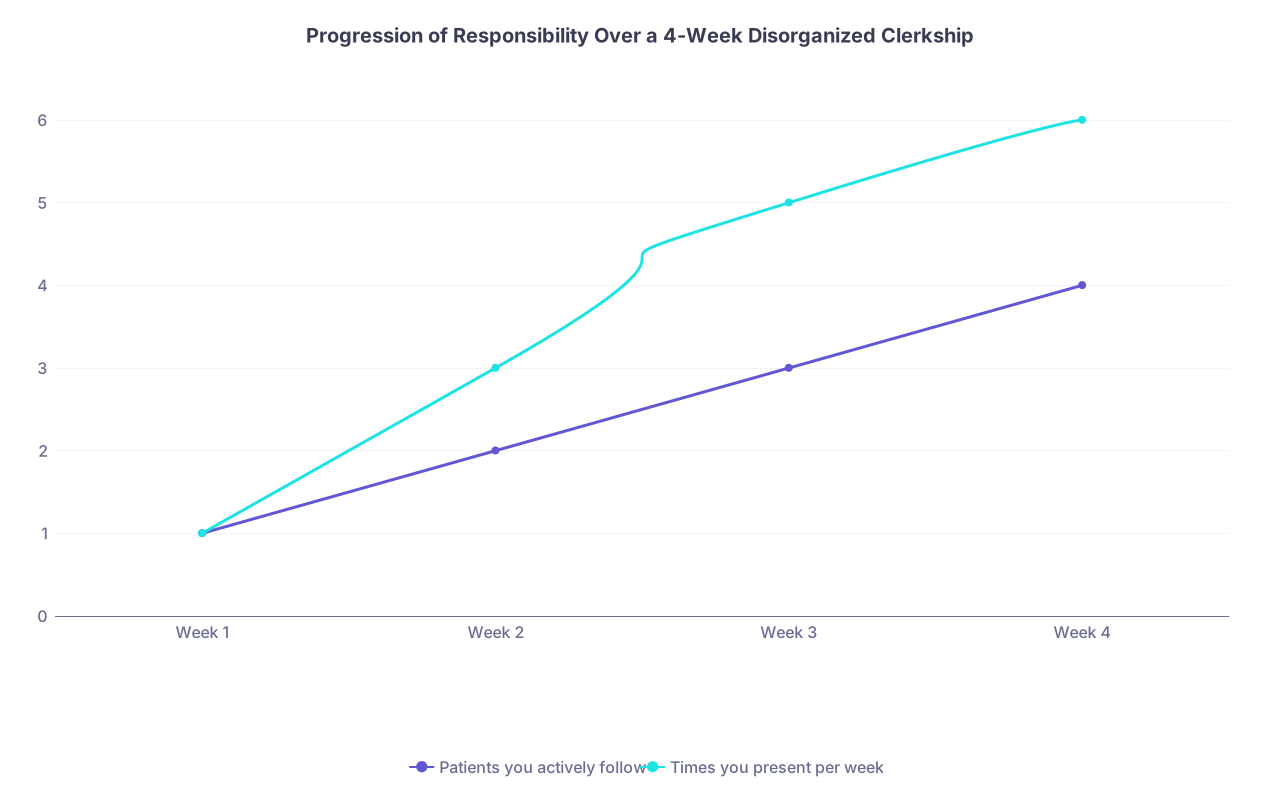
| Category | Patients you actively follow | Times you present per week |
|---|---|---|
| Week 1 | 1 | 1 |
| Week 2 | 2 | 3 |
| Week 3 | 3 | 5 |
| Week 4 | 4 | 6 |
Week 1
- You learn the team structure
- You identify main attending/senior resident
- You start pre-rounding on 1–2 patients
Week 2
- You ask for explicit expectations and feedback
- You increase to 2–3 patients you own daily
- You start 1–2 micro-teaching questions every few days
Week 3
- You refine presentations based on feedback
- You show initiative on follow-ups and patient education
- You start building your 1-page “evidence sheet”
Week 4
- You ask for end-of-rotation feedback
- You ask for letters from those who saw your growth
- You extract at least one strong story for your personal statement or interviews
This is how you walk out of a dysfunctional rotation with something you can use.
Do Not Miss This: External Validation Still Matters
You can do everything right and still need proof. Programs do not see your intentions; they see your outcomes.
Try to secure at least:
- One strong US letter from this rotation
- Clear documentation in your CV:
- “US Clinical Experience – Inpatient Internal Medicine, [Hospital], [City, State], [Month/Year], 4 weeks, hands-on: followed 3–4 inpatients daily, presented on rounds, drafted notes for review”
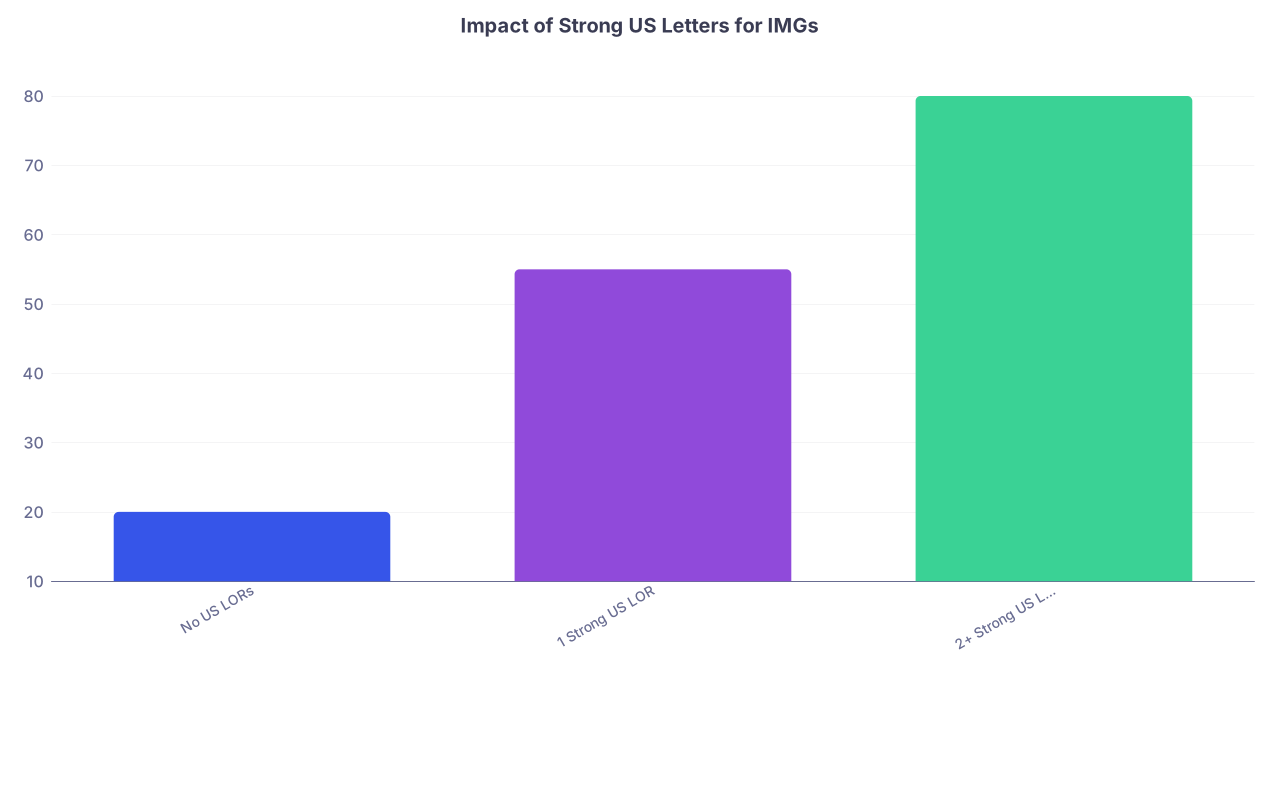
| Category | Value |
|---|---|
| No US LORs | 20 |
| 1 Strong US LOR | 55 |
| 2+ Strong US LORs | 80 |
(Values are illustrative, but the pattern is real: strong US letters dramatically improve how programs perceive IMGs.)
Final Points
You do not need a perfect clerkship to impress faculty. You need:
Deliberate structure in the middle of chaos
Define your supervisor, build a daily routine, and document what you do.Visible growth that others can describe
Ask for feedback, change based on it, and give attendings concrete evidence so their letters are specific.
Do this, and the disorganized rotation that scared you today becomes the exact experience that convinces a program director you are ready for residency.