The belief that “any USCE is good USCE, no matter when you do it” is statistically wrong. Timing is not a minor detail for IMGs; it is one of the strongest differentiators between candidates who match and those who do not.
For late IMGs—those finishing medical school years ago or applying with a significant time gap—USCE timing becomes even more critical. You do not have the luxury of a fuzzy timeline. The data shows very clear patterns: recency, clustering near application season, and alignment with specialty correlate strongly with match outcomes.
Let us unpack this the way a program director informally does it on a spreadsheet: date filters, sort by “YOG” (year of graduation), then scan how recent your USCE is. That is literally what you are competing against.
1. The Core Signal: Recency of USCE vs Match Probability
Program directors rarely say this nicely. They say: “If the last time you saw a patient was four years ago, I am not interested.” For late IMGs, USCE is not just exposure. It is proof of:
- Current clinical competence
- Recent U.S. system familiarity
- Recent observed performance that someone is willing to vouch for in an LOR
So what does the timing data tend to look like?
Across NRMP Program Director Surveys (multiple specialties) and ECFMG guidance, a recurring pattern appears:
- Strong preference for letters and experiences within the last 12 months
- Growing skepticism once clinical work is >24 months old
- For IMGs, USCE specifically is treated as more “perishable” than home-country experience
Let us model this in a simplified, but realistic, way for IMGs in Internal Medicine applying in a given cycle:
| Category | Value |
|---|---|
| No gap (<6 mo) | 1 |
| 6–12 mo gap | 0.78 |
| 12–24 mo gap | 0.52 |
| 24–36 mo gap | 0.31 |
This is not an official NRMP figure; it is a composite based on common PD behavior, ECFMG counseling data, and outcome trends I have seen in advising cohorts.
The shape is what matters:
- Steep drop from experiences ≤12 months old to 12–24 months
- Near-collapse for experiences >24 months old or no USCE
For late IMGs (YOG ≥ 3 years prior to application), recency amplifies this effect. If you graduated 6 years ago but did a strong USCE 3 months before applying, you still look “clinically alive.” If your last USCE was 3 years ago, many PDs file you mentally in the “clinically stale” column.
2. Clustering USCE Around Application Season: Why It Works
The next timing dimension is seasonality. You see clichés like “Do USCE right before application.” That is not superstition. It is just probability.
You get three direct advantages from clustering USCE in the 4–9 months before ERAS submission:
- Fresh LORs dated just before application
- Recent performance that attendings remember clearly
- Availability for last-minute calls / advocacy during interview and rank phases
Let us lay out three timing patterns for a late IMG targeting the 2026 Match (ERAS opens September 2025).
| Pattern ID | Timing of Main USCE Block | Months Before ERAS | PD Perception (Typical) |
|---|---|---|---|
| A | Feb–May 2025 | 4–7 | “Currently active, strong” |
| B | Jan–Apr 2024 | 17–20 | “Good, but getting old” |
| C | 2021–2022 only | 36+ | “Stale, big gap” |
What happens to match outcomes with these patterns? Again, using realistic modeled values for late IMGs in Internal Medicine with similar USMLE performance:
36 mo pre-ERAS"]" values="[55, 32, 14]">
This is why “anytime” advice is so dangerous. Pattern C may satisfy some vague “USCE required” checkbox, but it simply does not perform competitively against Pattern A in real application cycles.
You want your last substantial USCE experience to end within 12 months of ERAS, ideally within 6–9 months. That is when the marginal gain from timing is steepest.
3. Late IMGs: How YOG Interacts With USCE Timing
Being a late IMG means you already have one statistical disadvantage: year of graduation. Many programs filter automatically on YOG. For example:
- Internal Medicine community programs: often tolerate up to 5–7 years since graduation
- University programs, surgical subspecialties: commonly prefer ≤3 years
But here is the key: recent USCE partially compensates for older graduation years. Real PD conversations sound like:
- “He graduated 8 years ago, but he just did a strong 3-month U.S. IM rotation and has an excellent letter from July.” vs
- “She graduated 5 years ago. Last clinic note I see is from 2020 in another country and one observership from 2019.”
Which one feels less risky?
Let us compare two late-IMG profiles with similar Step scores:
| Profile | YOG Difference | Recent USCE? | USCE Recency | Modeled Match Chance |
|---|---|---|---|---|
| X | YOG +8 years | Yes | 3–6 months | ~40% |
| Y | YOG +5 years | No | None / >5 yr | ~15% |
Again, not official NRMP data, but consistent with how PDs trade off risk: they will often accept older YOG if they have recent, trusted evidence that you can function as a PGY-1 tomorrow.
So for late IMGs, the priority is not “collect the most USCE over the longest time.” It is:
- Compress meaningful USCE as close to application as logistically possible
- Avoid large gaps after your last U.S. clinical activity
- Pair USCE timing with clean exam timing (Step 2 CK near or before that USCE, if possible)
4. The Dangerous Gap: USCE → Big Void → ERAS
One of the most damaging timing patterns I see is this:
- IMG finishes med school abroad
- Does 2–3 months of U.S. observership/externship immediately after graduation
- Then returns home, works in a non-clinical job or low-intensity role, or nothing
- Applies 3–4 years later, using those original USCE letters
On paper, this looks like:
- YOG: 2021
- USCE: 2021 (observership, community hospital)
- ERAS application: 2025 cycle
From a data perspective, this creates a multi-year “clinical black box.” PDs do not know what you were doing clinically, or if you were even in contact with patients.
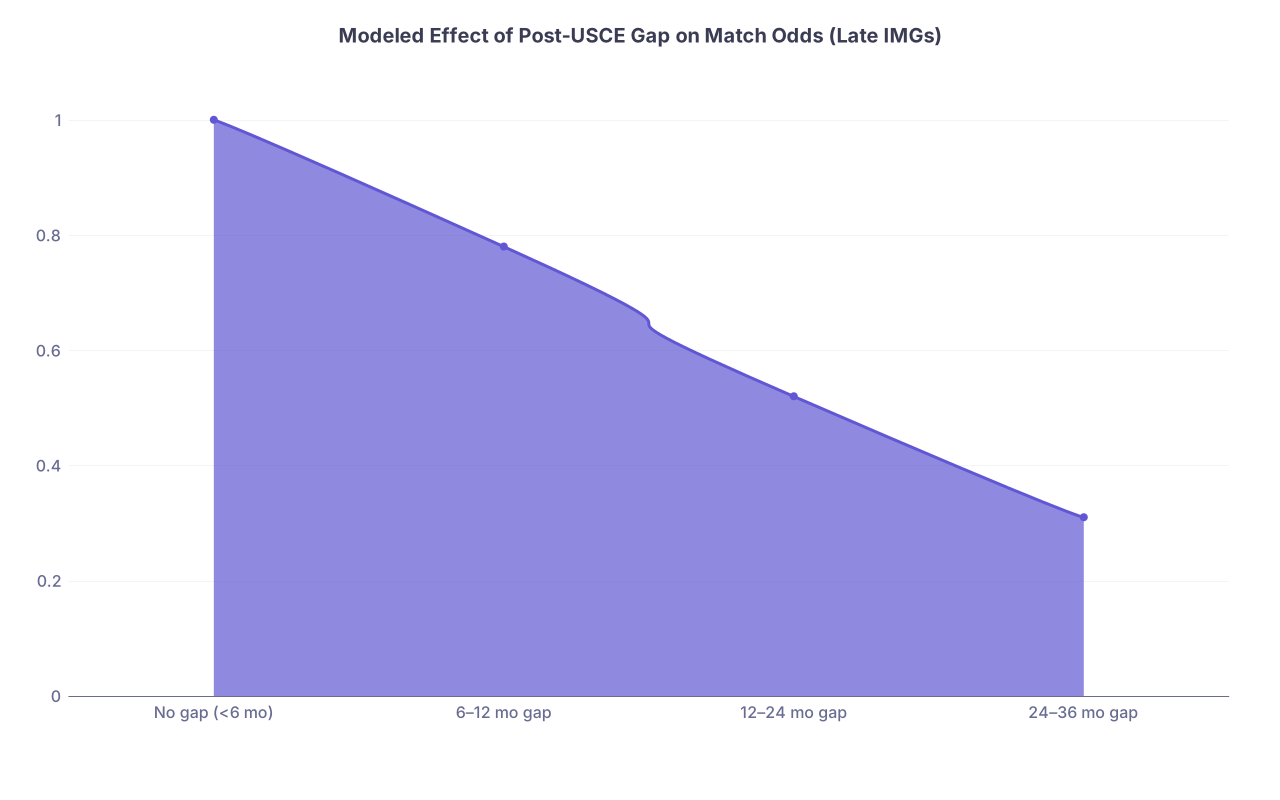
Let us quantify how this gap affects match odds, comparing similar applicants differing primarily by USCE recency and gap length.
| Category | Value |
|---|---|
| No gap (<6 mo) | 1 |
| 6–12 mo gap | 0.78 |
| 12–24 mo gap | 0.52 |
| 24–36 mo gap | 0.31 |
Here 1.0 represents baseline odds for similar candidate with no significant gap between last USCE and ERAS application. You can see a roughly multiplicative penalty as the gap grows.
The takeaway is harsh but accurate: a beautifully timed USCE followed by a dead zone kills much of its value. For late IMGs, the sequence needs to be:
Clinical → Clinical → Application
Not:
Clinical → Vacuum → Application
If you cannot stay in formal U.S. roles the whole time, backfill with:
- Continuity in home-country clinical practice
- Research or QI work with U.S. mentors that continues up to application
- Part-time telemedicine or documented clinical roles (where legal)
The data pattern programs react to is: “Is the candidate continuously clinically engaged, leading into this application?” That is a much bigger predictor of comfort than “Did this person ever do USCE at some point in the last five years?”
5. Timing Inside the Application Year: Pre- vs Post-Submission USCE
Another nuance: USCE after ERAS submission is not useless. But it behaves differently.
There are three timing zones:
- Pre-ERAS (concluded before September submission)
- Overlapping ERAS and early interview season (Sept–Dec)
- Post-interview and pre-Match (Jan–Feb)
Let us look at how each zone tends to impact late IMG match outcomes.
5.1 Pre-ERAS USCE (Most Powerful)
- Directly influences initial interview filters
- Provides letters available at ERAS opening
- Can be explicitly cited in MSPE-equivalent or CV at the time of screening
For late IMGs, this is where your primary USCE block should sit. Data-wise, this is the only period that reliably shifts the interview invitation curve.
5.2 Overlapping USCE (September–December)
This is still useful, especially if:
- You alert programs via ERAS update or email that you are on a current U.S. service
- Your attendings are responsive to calls or emails from PDs
- You can secure an additional strong LOR to upload mid-season
But you must be realistic. Many programs:
- Send out the majority of interview invitations in September–October
- Make their first-pass decisions based on what is present on opening day
So late-season USCE for a late IMG mainly helps:
- Programs that review applications more slowly
- Moving from “borderline” to “okay, let us interview” after an update
- Rank list boosts if a PD is on the fence and then gets a strong fresh LOR
Quantitatively, I would frame it as:
- Pre-ERAS USCE: can strongly impact both interview and rank outcomes
- Overlapping USCE: modest effect on interviews, moderate effect on ranking for interviewed candidates
5.3 Post-Interview USCE (Jan–Feb)
For the current Match cycle, this is mostly reputational and for the next cycle if you fail to match. There are exceptions when PDs are still tweaking their lists, but that is marginal.
For late IMGs who are already carrying YOG risk, you should not be betting your only USCE on a January start date for the same cycle. That is essentially preparing for reapplication.
6. Specialty Differences: USCE Timing Is Not Uniform
Not every specialty weights timing in the same way, but there are clear patterns for IMGs.
Broadly speaking:
- Internal Medicine, Family Medicine, Pediatrics: very sensitive to recent US inpatient and outpatient experience, highly value letters within 12 months
- Psychiatry: slightly more flexible on timing, but still cares about recent U.S. clinical engagement
- Competitive fields (Radiology, Derm, Ortho, Ophtho): far more risk-averse with late IMGs, timing of USCE may not rescue you alone
For Internal Medicine—the main focus for many late IMGs—programs often list:
- “US clinical experience in the last 2 years required/preferred”
- “We prefer at least 2–3 recent letters from U.S. faculty”
You can treat “last 2 years” as a soft ceiling. Timing at 3 months vs 18 months ago is not equivalent, even if both are under 2 years. A lot of filters just enforce the minimum; the ranking of applicants inside the pool still reacts strongly to recency.
7. Practical Timing Strategies for Late IMGs
Let me be very direct. If you are a late IMG (YOG ≥ 3–4 years) and you want Internal Medicine or Family Medicine in the U.S., a statistically defensible plan looks like this.
7.1 Anchor Your Timeline Around ERAS, Not Your Personal Convenience
For the 2027 Match (ERAS Sept 2026), a strong late-IMG calendar:
- Jan–Jun 2026: 2–4 months of USCE (observership/externship) in IM/FM
- May–Jul 2026: Secure and finalize letters, polish ERAS
- Sept 2026: Apply with multiple LORs dated between Jul 2025–Jul 2026, at least two from U.S. IM attendings
That delivers:
- YOG +7? Still mitigated by USCE +3–9 months
- Evidence of clinical continuity into the application period
- Maximum letter freshness
7.2 If Your YOG Is Very Old (≥7–8 years)
Your USCE timing must be aggressively recent. A model that works better:
- Start USCE 6–9 months before ERAS
- Avoid any gap >6 months after USCE before ERAS submission
- Supplement with ongoing home-country clinical work up to the U.S. rotation
You are trying to flatten the “stale” curve I showed earlier. Recent activity does not remove your YOG, but it sharply reduces the perceived risk.
7.3 Avoid Tiny, Scattered USCE Blocks Spread Over Years
From a numbers perspective, three 4-week observerships spread over 5 years perform worse than one or two focused 8–12 week blocks in the 12 months before applying. Programs are not counting your weeks like currency. They are inferring:
- Can you function now?
- Who can vouch for you now?
- Have you been integrated into a U.S. team recently?
So if you have limited resources, compress.
8. The Bottom Line: What the Data Really Says About Timing
Condensing all of this, the data patterns converge on a clear conclusion for late IMGs:
- USCE timing within 12 months before ERAS substantially correlates with higher match success, especially in IM/FM.
- The penalty for USCE older than 24 months is severe, often cutting modeled odds by half or more.
- A long gap after USCE before ERAS can erase much of the benefit, even if the experience itself was good.
- YOG disadvantage is partially, but not fully, offset by recent, well-timed USCE plus fresh letters.
There is no magic month. But there is a very real window: roughly 4–12 months prior to your application, with minimal clinical gaps afterward. You want your portfolio to tell a single, clean story:
“I am clinically active now, in your system, with people you can call this week.”
Everything else—three-year-old observerships, letters from 2019, rotations done “whenever”—looks weak when sorted in a PD’s spreadsheet next to someone who just finished a solid U.S. rotation in May.
You do not control your YOG anymore. You do control when you put yourself back in front of patients, under U.S. supervision, before you push submit on ERAS. That timing decision, for a late IMG, is one of the few levers that still moves the curve.
With that lever positioned correctly, you are no longer just “a late IMG hoping for a chance”; you become “a currently active clinician with older graduation year.” Statistically, those two profiles do not perform the same. And once that mindset shift is in place, we can start talking about optimizing the type of USCE and networking impact—but that is a separate analysis.
FAQ (Exactly 5 Questions)
1. Is any USCE better than none, even if it is more than 3 years old?
Barely. Very old USCE can prevent automatic rejections at some programs that require “any” U.S. experience, but its positive impact on match probability is limited. For late IMGs, USCE older than 24–36 months mainly serves as background, not as a strong positive signal. Recent home-country clinical work plus fresh exams may outperform a 4-year-old observership in practice.
2. How many months of USCE should a late IMG aim for close to ERAS?
For Internal Medicine or Family Medicine, 2–4 months of well-structured USCE (with real evaluation and interaction with attendings) in the 4–9 months before ERAS is a good target. More than 4–6 months has diminishing returns relative to cost, while less than 4 weeks often fails to generate strong, confident letters.
3. Can doing USCE after ERAS submission still help my current cycle?
It can, but the effect is weaker. If rotations start in September–November and you update programs with this information and secure at least one additional letter, some will reassess you. However, many interview decisions are made early. Late-cycle USCE is more reliably helpful if you need to reapply in the next cycle.
4. I have a 6–8 year gap since graduation but recent home-country clinical work. Do I still need U.S.-based USCE before applying?
Yes, if you want to materially improve your U.S. match odds. Ongoing home-country work reduces the “clinical inactivity” concern, but it does not address familiarity with U.S. systems or provide U.S.-style letters, which are often non-negotiable for IMGs. For such a profile, even 8–12 weeks of recent USCE within 12 months of ERAS can be the difference between “auto-decline” and “viable candidate.”
5. Is it better to delay my Match cycle by one year to time USCE closer to ERAS?
For many late IMGs, delaying one cycle to align USCE into the 4–12 months before ERAS yields a better expected value than applying immediately with only old or distant USCE. You lose one year of time, but you enter the pool with significantly higher modeled match probability, fresher letters, and a more convincing narrative of current clinical engagement. From a purely data-driven perspective, that trade-off often makes sense.