One strong U.S. clinical experience can change your entire application; three weak ones often just waste your money.
I’m going to tell you something most IMGs only realize after they fail to match: program directors do not “count” experiences the way you think. They’re not sitting there with an Excel sheet: “3 USCEs = good, 4 USCEs = great.” That’s fantasy. What actually happens in the rank meetings is much simpler and much harsher:
Someone in the room says,
“Who really knows this applicant?”
If the answer is “no one,” your three observerships might as well not exist.
If the answer is, “Dr. X from our own department said she’d take this person as an intern tomorrow,” your single 4‑week rotation just outran every padded CV in the pile.
Let’s walk through how this really works from the inside, because the obsession with number of USCEs is quietly killing IMGs’ chances every year.
What Program Directors Actually Look For In USCE
Forget the brochure talk. Clinically, U.S. experience is supposed to show you understand:
- How U.S. hospitals function
- How to work in a team
- How to care for patients safely under supervision
- That at least one U.S. physician is willing to put their name and reputation behind you
But here’s the unspoken truth: the whole value of USCE to a residency program boils down to two things:
- Quality and strength of the letter writer
- Credibility of the context where they saw you work
Everything else is decoration.
I’ve sat in meetings where an IMG had:
- Three “USCE” entries: 2-week observer here, 3-week unpaid “extern” there, some private clinic shadowing
- All letters from people nobody on the committee recognized, in non-teaching or unstructured settings
Then another IMG had:
- One 4-week inpatient rotation at a mid-tier but real teaching hospital
- One detailed letter from a core faculty member who’d clearly worked with them closely
Guess who got ranked higher. Every time.
The committee does not say this out loud, but the thinking is:
“I’d rather have one person vouch for you deeply than five people who barely know your name.”
The Anatomy of a Strong vs Weak USCE
Let me be blunt: most “US clinical experience” sold to IMGs is watered-down shadowing in a white coat.
You want to know how we tell strong from weak in 30 seconds? We look at four things: type of hospital, role, letter quality, and alignment with your specialty.
Here’s the behind-the-scenes comparison.
| Factor | Strong USCE | Weak USCE |
|---|---|---|
| Hospital type | Teaching hospital with residency program | Private clinic or non-teaching hospital |
| Role | Active involvement, notes, presentations | Mostly observing, minimal interaction |
| Letter writer | Core faculty / PD / APD | Community doc unknown to PDs |
| Duration/structure | 4+ weeks, clear responsibilities | 1–2 weeks, vague duties |
Here’s what a strong 4-week rotation looks like in reality:
You’re in a U.S. teaching hospital. There are residents, attendings, morning reports. You’re showing up before rounds, pre-charting, seeing patients with a resident, presenting on rounds (even if short), getting pimped. You’re writing notes that may be “educational only,” but they’re reviewed, edited, and discussed. You give at least one short talk to the team. You’re introduced as “our visiting student/extern from X” and not just “an observer.” You’re in the work.
Now the weak one:
You’re in a private clinic. Maybe a solo doc. You wear a white coat, follow the physician from room to room, stand in the corner. You’re never responsible for anything. No sign-outs, no calls, no team. No one sees your reasoning process. At the end, you get a short letter: “X is punctual, polite, and interested in internal medicine.”
Translation for a PD reading that letter: “I have nothing meaningful to say about this person’s readiness to be an intern.”
And here’s the key: I’ve seen residency selection committees literally ignore two or three such weak experiences and anchor entirely on the one serious in-hospital rotation.
What Happens In the Rank Meeting (The Part No One Tells You)
You need to understand how quickly your application gets filtered.
On paper, PDs and faculty are supposed to read everything. In reality, by the time your application is up for discussion, half the room has your ERAS open on a second screen, skimming like they’re scrolling through social media. Speed-reading section headers. Looking for reasons to say yes—or easy reasons to move on.
The conversation goes something like this:
Faculty 1: “IMG from Pakistan, Step 2 243, two years out, three U.S. observerships.”
Faculty 2: “Where?”
Faculty 1: “Private clinic in New Jersey… some ‘externship’ in Florida… cardiology observership in Texas, all letters from community docs.”
PD: “Any letters from teaching hospitals?”
Faculty 1: “No.”
PD: “Ok, keep them mid-low. Next.”
Now contrast that:
Faculty 1: “IMG from India, Step 2 236, one U.S. rotation in internal medicine at University Hospital X, 4 weeks.”
PD: “Letters?”
Faculty 1: “One from Dr. Smith, core faculty, says she’d be an asset to any IM program, comments specifically on her presentations, work ethic, and how quickly she adapted to Epic.”
Faculty 3: “I know Smith, she doesn’t write that lightly.”
PD: “Good. Bump her up.”
One strong voice in the room—someone who trusts your letter writer or recognizes the hospital—does more for your rank position than three random lines of “USCE” in ERAS ever will.
Why Committees Value One Deep Relationship Over Multiple Superficial Ones
Residency is a trust game. PDs are asking themselves one brutal question:
“If I put this person on nights in July, are they going to be safe or are they going to drown?”
They cannot know for sure. So they look for proxies.
A deep, detailed, specific letter from someone who actually watched you function on a real team is one of the strongest proxies they have. Especially when that letter writer is embedded in U.S. academic medicine.
What they want to know is:
- Did you show up consistently?
- Did you improve over the 4 weeks?
- Could you synthesize data and present a coherent plan?
- Were you teachable, not just smart?
- Did nurses like you or complain about you?
No two-week fly-by observership gives enough time for a faculty member to be confident in answering those questions. They may like you. They may find you pleasant. That’s not the same as, “Yes, I’d put this person on my own call schedule.”
I’ve seen letters where an attending literally wrote:
“After working with her closely on our inpatient service for four weeks, I would trust her on my team as an intern.”
That single sentence outweighs three pages of “hardworking, punctual, polite” written by someone who watched you in clinic twice a week.
The Hidden Math: Depth vs Breadth
IMGS often think like this:
“Programs ask for U.S. clinical experience. More must be better. I’ll collect as many rotations as possible.”
Meanwhile, PDs are thinking:
“I want at least one setting where this person was truly tested.”
So you end up with two very different strategies:
- Breadth strategy: 3–4 short, cheap-ish, loosely structured observerships scattered across states and specialties.
- Depth strategy: 1–2 longer, higher-quality, maybe more expensive or more competitive rotations in genuine teaching hospitals, ideally in your target specialty.
Here’s how that plays out in credibility.
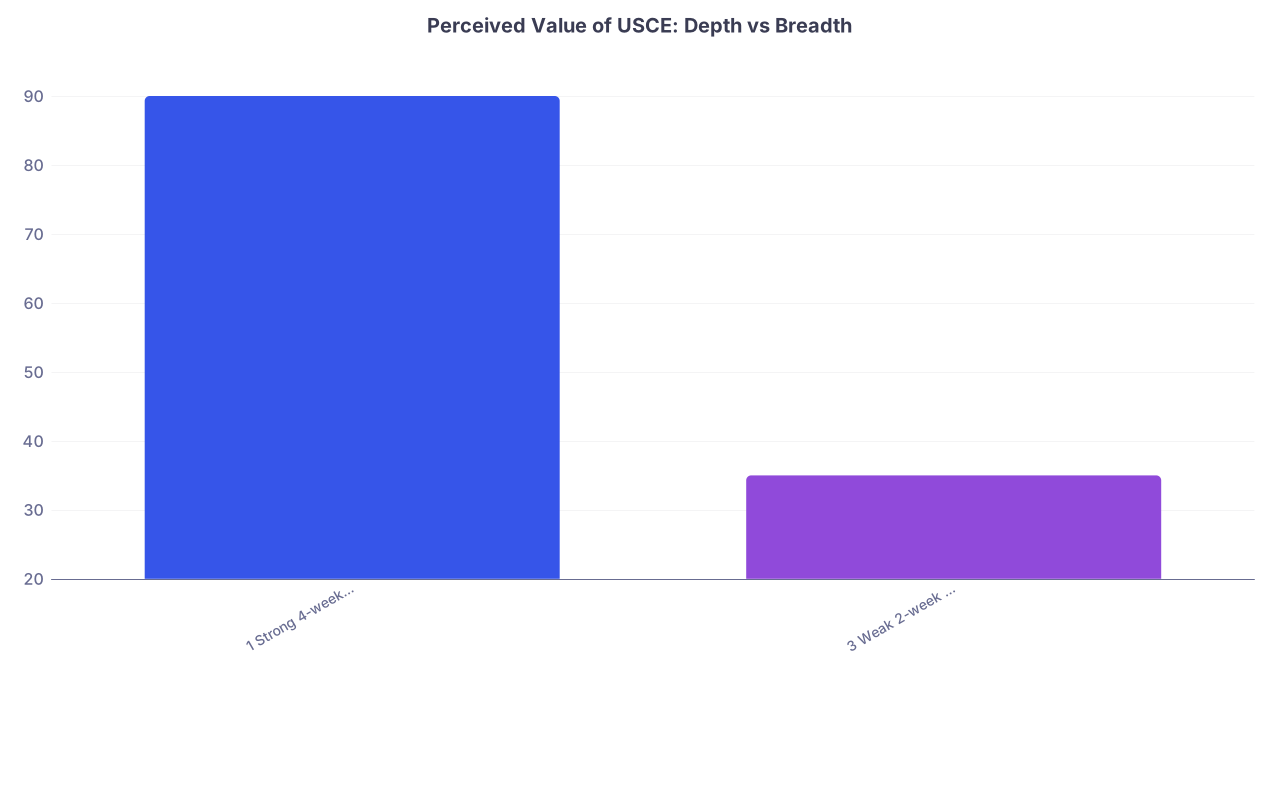
| Category | Value |
|---|---|
| 1 Strong 4-week Teaching Hosp | 90 |
| 3 Weak 2-week Observerships | 35 |
Does anyone write numbers like this on a whiteboard? No. But mentally, that’s the gap many faculty feel.
You don’t need endless exposure. You need one strong narrative: “I came to the U.S., integrated into a real team, showed I can work at this level, and here’s a respected physician backing that up.”
Three weak rotations often tell a darker story:
“I tried multiple places and no one was willing to write me a strong, detailed letter.”
We notice that. People talk about it.
What Makes A USCE “Strong” For IMGs: The Non‑Advertised Criteria
Let me break down how attendings and PDs silently grade the quality of your U.S. experience. Not what they say on the website. What they actually believe.
1. Teaching Environment
If there are residents, conferences, morning report, M&M, noon lectures, weekly didactics—this screams real U.S. clinical environment. PDs love that.
If your experience is just: “I followed Dr. X in clinic for two weeks,” the assumed teaching value is low.
2. Documented Responsibilities
Letters that say:
“He pre-rounded on three patients daily, wrote educational notes in the EMR, and presented them on rounds. He gave a 10-minute talk on COPD exacerbations to the team.”
…land completely differently from:
“She observed patient care in my clinic and demonstrated great interest in medicine.”
We know which one actually tested you.
3. Who The Letter Writer Is
Here’s the part you rarely hear: the name at the bottom of the letter often matters more than the logo at the top of the page.
- Core faculty vs. peripheral affiliation
- Someone who regularly evaluates residents vs. someone with no role in teaching
- A PD/APD vs. an unknown solo doc in a strip-mall clinic
PDs trust people who live in their world. If you spent one month with an academic internist who has evaluated hundreds of residents, their comparative judgment of you means a lot.
I’ve watched PDs literally say:
“Oh, that’s a good letter. She’s tough. If she’s impressed, that’s real.”
Nobody says that about the cardiologist who supervises one observer a month and never steps into a teaching conference.
4. Specialty Alignment
Matching in internal medicine with a strong inpatient IM rotation? Great.
Trying to match neurology with three random outpatient family medicine clinics? Weak. It looks like you were collecting experiences wherever someone would take your money, not strategically building your case for a specialty.
Why Weak Experiences Can Actively Hurt You
Weak USCEs aren’t neutral. Stack enough of them and they start sending bad signals.
I’ve seen this exact comment more than once in selection meetings:
“They have four different short experiences with four different docs and I don’t see a single really strong, specific letter here. I’m worried no one got excited about them in person.”
Translation: the more places you rotate without generating a convincing advocate, the more we suspect the problem is you—not the system.
Red flags we quietly notice:
- All USCE is 1–2 weeks long
- All letters are generic, interchangeable, vague
- All in loosely structured outpatient settings
- No clear primary specialty focus
It starts to look like you were shopping for letters, not training. That doesn’t play well.
How To Turn One Rotation Into A Powerhouse Asset
You want the truth on how to get maximum value from a single strong USCE? You have to work like you’re already an intern.
Not in terms of legal responsibility. In terms of mindset and commitment. Here’s how candidates who impress us operate during a 4-week block:
They show up early. Every day.
They know all their patients inside out.
They volunteer to present new admissions.
They ask for feedback mid-rotation, not just at the end.
They ask for chances to give a case presentation or mini-talk.
They introduce themselves to the program director or APD if possible—once, professionally, not annoyingly.
And then they follow through after the rotation:
- A short thank-you email to the attending with a specific thing they learned
- A polite, clear request for a letter once the attending has actually seen them in action
- Occasional, very light updates (e.g., “I’ve applied to internal medicine this year and listed you as a reference, thank you again for your support.”)
You know who PDs remember in February? The IMG whose faculty letter came from someone emailing:
“By the way, that student I wrote about—the one from Egypt—if you’re on the fence, I’d interview them.”
That’s the leverage you’re chasing. You don’t get that from three weeks of silent shadowing where the doc barely remembers your last name.
Choosing Between One Good And Three Mediocre: A Hard Truth On Money
This part no one says out loud because it makes people uncomfortable.
Many IMGs are under huge financial pressure and understandably look for cheaper USCE options. Agencies and clinics know this. They slap “externship” on what is essentially shadowing and charge you a fee.
You end up spending:
- $1,500 each on three low-yield observerships
- That’s $4,500 on experiences that may produce three soft, non-specific letters
Versus:
- $4,000–$5,000 (yes, painful) for one legitimate 4- or 8-week experience in a real teaching environment, with an actual path to a strong letter
Is it fair that the best experiences often cost more, are harder to get, or require connections? No. But PDs are not calibrating your application to fairness. They’re asking: “Can this person handle our floors in July?” And they listen to people they trust.
If you must choose, I’ll say this very plainly:
One month in a credible teaching hospital with one serious faculty letter is usually far more valuable than three months in random clinics with three forgettable letters.
I have personally seen candidates match with that single anchor experience, even with average scores—especially in IM, FM, psych. I’ve also watched applicants with five “USCE” lines and zero real advocates sit unmatched.
A Realistic Strategy For IMGs Right Now
Stop asking: “How many U.S. clinical experiences do I need?”
Start asking: “Where can I build one or two deep, meaningful, high-quality relationships that translate into strong letters and credible stories on interview day?”
For most IMGs aiming for IM/FM/psych, a realistic strong profile is:
- 1 high-quality inpatient or combined inpatient/outpatient rotation in your target specialty at a teaching hospital
- Possibly 1 additional experience if you can afford it and it’s genuinely structured, not just “shadow and smile”
- 2–3 serious, detailed U.S. letters, even if they all come from the same 4–8 weeks of work
Then you go to interviews and say:
“During my month at X Hospital, I was integrated into the internal medicine team. I pre-rounded, presented patients, and adapted to the EMR quickly. That experience confirmed I can work in a U.S. academic setting and made me want to train in a program like yours.”
That sounds like someone ready for residency.
“During my three observerships, I saw many patients in clinics in different states” does not.

| Step | Description |
|---|---|
| Step 1 | Need USCE |
| Step 2 | Apply for 4-week+ structured rotation |
| Step 3 | Avoid multiple weak observerships |
| Step 4 | Work like an intern, earn strong letter |
| Step 5 | Save resources, target one high-yield later |
| Step 6 | Stronger application with 1 key advocate |
| Step 7 | Access to teaching hospital? |
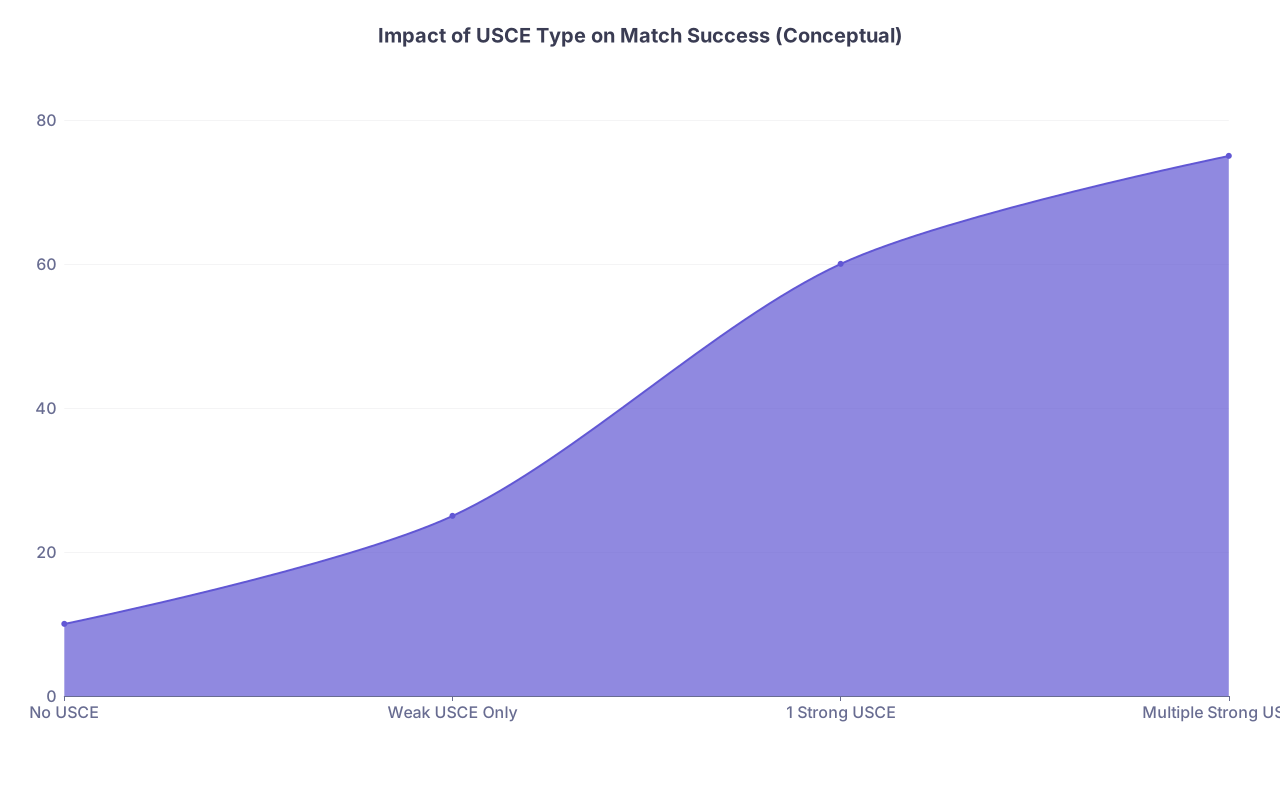
| Category | Value |
|---|---|
| No USCE | 10 |
| Weak USCE Only | 25 |
| 1 Strong USCE | 60 |
| Multiple Strong USCEs | 75 |



FAQs
1. How many U.S. clinical experiences do I really need as an IMG?
You don’t need a magic number; you need at least one credible, structured experience that proves you can function in a U.S. system. For most IMGs, 1–2 strong rotations in your target specialty at teaching hospitals are enough to anchor your application, if they produce high-quality letters. Beyond that, more experiences help only if they’re equally strong—not just more of the same weak observerships.
2. Is an unpaid “externship” in a clinic worth it if it’s all I can get?
If it’s just glorified shadowing with no real responsibilities, no residents, and no clear path to a strong, detailed letter, it has limited value. One such experience is fine as basic exposure. But stacking three or four like this, instead of saving for a single strong teaching-hospital rotation, is a bad trade. Programs see through it and may interpret it as “no one in a serious setting was willing to back this applicant strongly.”
3. Can I match with only one strong USCE and the rest of my experience from my home country?
Yes, I’ve seen it many times—especially in internal medicine, family medicine, and psychiatry. If your Step scores are reasonable, your graduation year isn’t ancient, and that one U.S. rotation generates a powerful letter from a respected academic physician, you absolutely can match. Programs care far more about one convincing piece of evidence you can function in their environment than a long list of weak, superficial U.S. attachments. Focus on making that one experience as strong—and as well-leveraged—as possible.