
Your observership is saying more about you than your personal statement. And program directors are reading those signals whether you realize it or not.
Everyone talks about “getting USCE” like it’s a checkbox. Shadow someone. Get a letter. Done. That’s not how programs actually use this information. On the other side of ERAS, your observership history is a code. It tells them what kind of applicant you are, who is willing to vouch for you, and how much risk you represent.
Let me walk you through how they really interpret it.
1. What Your Observership Type Really Tells Them
There’s a harsh hierarchy in how programs value US clinical experience, especially for IMGs. They won’t say it on their websites, but behind closed doors the pattern is extremely consistent.
| USCE Type | Typical Value to Committees |
|---|---|
| ACGME residency rotation | Highest |
| Formal university observership | High |
| Community hospital observership | Moderate |
| Private clinic shadowing | Low |
| Paid ‘agency’ observership | Very low / suspicious |
Here’s how this plays out in the room.
ACGME-affiliated, structured observerships
If your observership is in a teaching hospital with an ACGME-accredited residency in the same specialty, that’s gold. Even if it's “observer, no hands-on.”
Selection committees read that as:
- You’ve seen real resident workflows and expectations
- Someone inside an academic system was willing to put you on their service
- You’re less likely to fall apart when you hit July 1 as an intern
When I was sitting in meetings for an IM-heavy internal medicine program, a candidate who had a 4-week IM observership at, say, University of Illinois or Case Western automatically went in a different mental bucket than someone whose “USCE” was a private cardiology clinic. Same Step scores, but different perceived “risk.”
Observerships vs “just shadowing”
Your title on the letter or CV matters. “Observer” on an inpatient service with conferences, notes reading, sign-out exposure – that’s taken seriously. “Shadowed Dr. X in clinic” signals minimal responsibility and zero systems exposure.
Programs won’t reject you purely for having lighter experiences, but they won’t credit it heavily either. I’ve heard attendings say on selection days:
“This is not real USCE. This is just shadowing. They’ve never seen resident-level work.”
And the room nods, and that candidate quietly slides down the rank list.
Paid agency observerships
Let me tell you a secret everyone dances around: most programs can smell agency-arranged, pay-to-play observerships from a mile away.
The language in the letter. The generic nature of the evaluation. The fact that the clinic name matches certain “famous” IMG prep groups. Inside committees, this is the unspoken reaction:
- “They could not get a real academic spot.”
- “They’re paying for access, not being invited.”
- “This letter is templated, I’ve seen this exact paragraph 20 times.”
Do these experiences help? Slightly. They show you at least came to the U.S. But they are not even close to equal to a real, hospital-based, department-supported rotation.
2. The Number, Timing, and Pattern of Your Observerships
Committees don’t just read where you did observerships. They read how many, when, and in what pattern.
The quantity game: when “more” starts to hurt
Here’s the part nobody tells you: past a certain point, piling up observerships starts to look desperate or directionless.
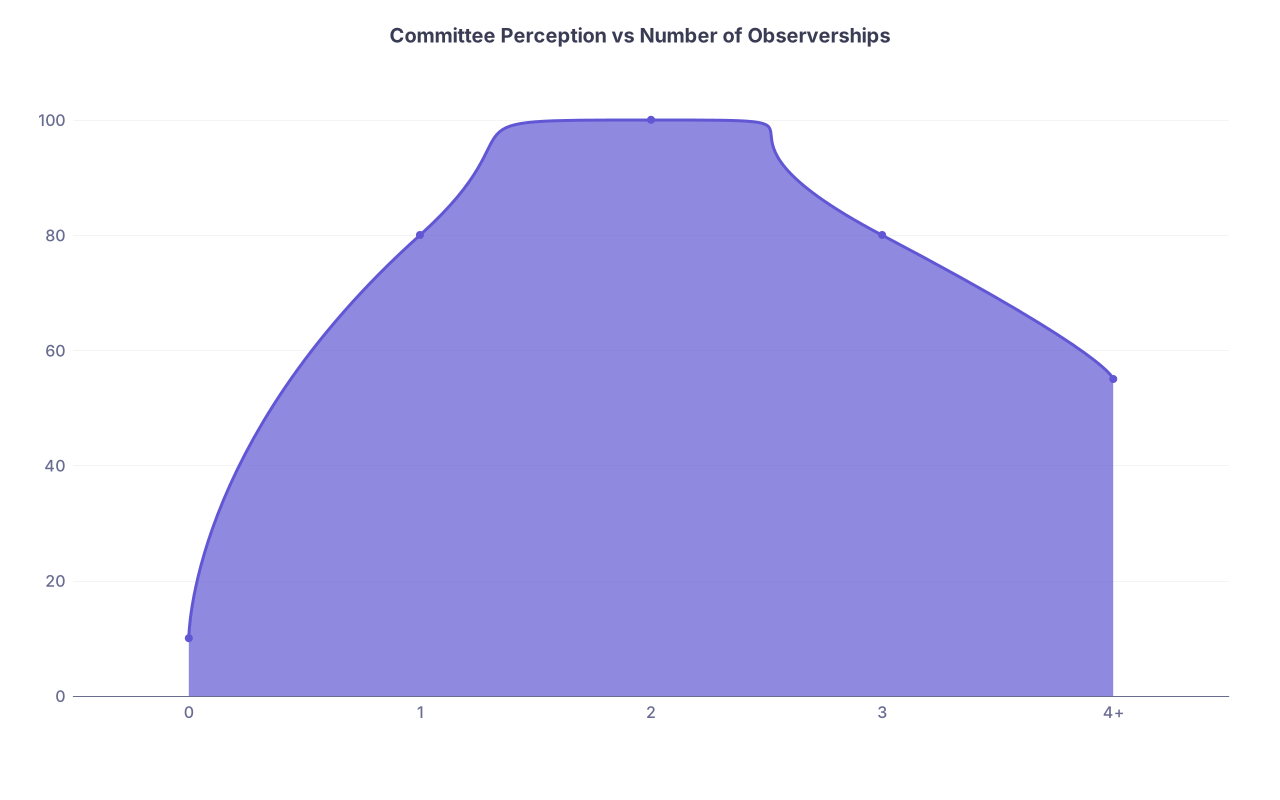
| Category | Value |
|---|---|
| 0 | 10 |
| 1 | 80 |
| 2 | 100 |
| 3 | 80 |
| 4+ | 55 |
The quiet commentary in committee goes like this:
- 0 USCE: “Risky. They have no idea what our system looks like.”
- 1–2 rotations: “Good. Focused. They’ve tested the waters.”
- 3 rotations: “Fine, if the quality is good and recent.”
- 4+ rotations, all observerships:
- “Why no hands-on?”
- “Why no research? No job? What have they been doing for 2 years?”
- “Are they just bouncing around trying to collect letters?”
If you’re 4 years out of graduation and all you have to show for it is five disconnected observerships across random states and specialties, that sends a clear signal: nobody has committed to you in a substantial way (research position, prelim year, paid role), and you haven’t committed to a path either.
Recency: how old is too old?
This is straightforward: most programs mentally discount observerships that are more than 2–3 years old. They might still help, but they don’t fully reassure anyone.
I’ve heard PDs say:
“They were here in 2017. That’s ancient. I don’t know who they are now.”
If your “best” observership is distant in time and you’ve been doing unrelated work since, the impression is that you’ve drifted away from clinical medicine, or you’re trying to recycle old experiences to cover a recent gap.
The pattern across specialties
If you want to know what programs think of the “sampling buffet” strategy – 1 month in IM, 1 in FM, 1 in psych, 1 in surgery – here’s the truth:
- For broad fields (IM/FM): 1–2 related observerships plus maybe 1 allied field is fine.
- For competitive fields (neuro, rads, anesthesia): a scattered portfolio screams lack of commitment.
The insult I’ve heard more than once: “They’re specialty shopping.” That’s code for: “They’re not serious about us; they just want any match.”
3. The Hidden Weight of Where You Observed
The name on the hospital header matters. Not just for prestige. For subtext.
University vs community vs private
A strong university-affiliated hospital – even a no-name one in the Midwest – tells committees one critical thing: someone in an academic department agreed to take responsibility for you. That’s trust.
Community teaching hospitals vary. Some are functionally as academic as smaller universities; others are glorified private hospitals with residents. Committees look for signals:
- Is there an ACGME program in your target specialty there?
- Is the letter writer faculty with a teaching title (Program Director, Associate Program Director, Clerkship Director, core faculty)?
- Did your experience include rounds, didactics, conferences?
Private clinics or solo practitioners – especially in outpatient-only, cash-heavy settings – are bottom of the pile. That’s the truth. They’re better than nothing, but only just.
Brand-name hospitals vs no-name
A month at Cleveland Clinic or Mayo as an observer? Instant credibility boost. Not because of the logo, but because attendings know those places do not tolerate total incompetence, even from observers.
But here’s the nuance most students miss: a solid, mid-tier academic program that is very similar to the places you’re applying to can be more influential than a single month at a super-elite place that never really saw you work.
I’ve seen candidates with:
- 1 month at a giant, prestigious center, with a generic letter
versus - 2 months at a mid-tier community academic program with a very detailed, specific letter from core faculty
Guess who wins in discussion? The second one, almost every time.
4. Letters from Observerships: How Committees Actually Read Them
Everyone says “get a strong letter.” Most IMGs have no idea what that actually looks like from our side of the screen.
Here’s how those letters are decoded in the room.
The three unspoken categories of observership letters
Most programs mentally sort letters from observerships into three bins:
- Template fluff – the garbage category
- Solid but generic positive – helps a bit
- Specific, comparative advocacy – moves you up the rank list
Let me translate the phrases you see into what committees actually hear.
| Letter Phrase | Insider Interpretation |
|---|---|
| "Pleasure to have X observe" | They watched but did not stand out |
| "Arrived on time, was professional" | Minimum expectations only |
| "Would do well in residency" | Safe, generic, low enthusiasm |
| "Among the top IMGs I’ve worked with" | Strong positive, moves the needle |
| "I would rank this applicant" | Serious endorsement |
When you see:
- “Observer on our service. Responsibilities included attending rounds and observing patient care.”
We see:
- “They never actually tested this person. I cannot assess real performance.”
When we see:
- “Although institutional policy prevented direct patient care, Dr. X independently reviewed charts, presented patients on rounds, read around cases, and integrated feedback quickly. I treated them as I do my interns, and they rose to the challenge.”
Now you’ve got our attention.
Who the letter is from matters almost as much as what it says
Hard truth: a detailed, powerful letter from a residency Program Director or core faculty member in your target specialty is worth more than a glowing letter from a random private practitioner.
Committees explicitly ask:
- “Is this a teaching faculty member?”
- “Do they work with residents regularly?”
- “Do they understand what a good resident looks like?”
If the answer to those is “no,” your letter’s ceiling is limited.
The red flags committees quietly note
A couple of subtle danger signals:
- A letter that is oddly short (less than half a page) from an observership longer than 2–4 weeks
- A letter that only describes what the hospital does, not what you did
- A letter that overcompensates with vague superlatives but no examples (“exceptional, outstanding, excellent, superb” with zero details)
On several occasions I’ve heard: “This letter is trying too hard and says nothing.” That kills trust.
5. What Your Observership Signals About Your Professionalism
Here’s the part almost nobody thinks about: your observerships also indirectly tell programs how you handle systems, rules, and boundaries.
Rule-following vs rule-bending
Programs know exactly how observership policies work. They know observers are usually not allowed to:
- Write in the chart
- Enter orders
- Perform procedures
So when they see a letter or a personal statement bragging about:
- “I wrote progress notes and orders for Dr. X”
- “I frequently performed blood draws, IVs, and other procedures”
Program faculty read that as: this applicant either does not understand legal boundaries or is comfortable embellishing. Neither interpretation helps you.
The quiet thought that forms: “If they break rules as an observer, what will they do with our patients and our license attached to their name?”
Duration and commitment
A one-week observership is almost meaningless. It screams “tourist.” It also tells them you barely had time to understand the EMR login screen, let alone how the team functions.
Four weeks? That’s when people on the team actually remember you. They’ve seen you tired, bored, interested, clueless, improving. That’s when real evaluation is possible.
So, yes, duration signals seriousness. But again, three scattered 1-week observerships at random clinics is a much weaker signal than one intense 4-week block on a busy inpatient team.
6. The Subtle Story Your Observerships Tell About Your Career Path
Selection committees don’t just scan your USCE. They connect it with your year of graduation, your Step timelines, your research, and your current status. They’re trying to reconstruct your last 3–5 years.
What your observerships quietly communicate:
Are you moving toward residency, or just orbiting it?
I’ve seen a lot of IMG applications where observerships pile up without a clear narrative:
- 2019: observership in cardiology
- 2020: observership in internal medicine
- 2021: observership in nephrology
- 2022: observership in family medicine
- 2023: observership in hospitalist practice
On paper, that applicant looks “active.” In the room, faculty say:
“This person is just drifting from month to month. Where’s the anchor? Where is the job, the research, the real responsibility?”
Contrast that with:
- 2020: IM observership at community teaching hospital
- 2021–2022: research fellow in cardiology at academic center
- 2023: IM sub-internship or extended observership at same center
Now your observerships look like intentional stepping stones, not random tourism.
Does your USCE match your story?
If you say in your personal statement that you’re deeply committed to internal medicine because of longitudinal relationships, but all of your U.S. time is with procedural subspecialties or in the OR, something doesn’t quite line up.
Selection committees notice those mismatches. They may not always punish you for them, but they do downgrade your perceived authenticity. And in a tight comparison between two similar candidates, that matters.
7. How Programs Compare Different IMGs’ Observership Profiles
To make this crystal clear, here’s the kind of comparison that actually happens in committee when they’re looking at IMG-heavy pools.
| Applicant | Observership Pattern | Committee Reaction |
|---|---|---|
| A | 2 x 4-week IM observerships at mid-tier academic hospitals | “Solid, safe. Knows our world.” |
| B | 5 x 2-week mixed clinic observerships, all private offices | “Scattered, low-value, not really USCE.” |
| C | 1 x 4-week IM observership + 1-year research position | “Serious commitment, good trajectory.” |
| D | 3 x 4-week paid agency observerships, generic letters | “Forced, purchased exposure, low signal.” |
| E | None, but strong home-country residency and recent work | “Risky for system adaptation, but clinically active.” |
You can guess who gets invites. A and C consistently rise. B and D struggle unless their scores and everything else are exceptional. E depends heavily on how IMG-friendly and risk-tolerant the program is.
8. Practical Moves to Make Your Observership Send the Right Signals
You cannot change the past, but you can control how your existing and future observerships are perceived.
Make each observership do triple duty
Every single month you spend in the U.S. should ideally:
- Strengthen your understanding of residency workflow
- Put you in front of people who can credibly evaluate you as a potential resident
- Produce at least one concrete output: a strong letter, a small QI project, a case report, a poster, something tangible
If your observership ends and all you can put on your CV is “Observer, Hospital X, 4 weeks,” you’ve left value on the table.
Shape the letter before it’s written
You can’t write your own letter (and if someone offers to let you, that’s a red flag), but you can influence its content by how you behave:
- Volunteer to present a case at conference
- Ask to summarize a patient on rounds
- Read around cases and send a brief, respectful email with 1–2 recent articles you found relevant
- Ask for feedback: “What can I do in the next two weeks to show you I’m ready for residency-level work?”
That’s how you move your letter from “silent observer” territory into “we actually tested this person” territory.
Align your observerships with your narrative
If you’re aiming for internal medicine, do not have a CV filled with dermatology, radiology, and ophthalmology observerships and one random IM week tacked on. That’s incoherent.
If your past is already messy, then your personal statement and interviews need to explain the evolution:
- Early exposure
- Realization
- Refocus
- Then a couple of targeted, recent experiences that match your final choice
Programs are surprisingly forgiving of imperfect paths, but they hate unclear ones.
9. The One Thing Programs Care About Most
Strip away the noise, and here’s what observerships are really being used to answer:
“Can this person show up in our hospital in July and not be a disaster?”
Every detail they examine – where you observed, how long, who wrote about you, what they wrote, what you did before and after – all of it is trying to answer that one question.
So when you think about your own observership history, don’t ask, “How many months do I have?” Ask:
- “What story do these observerships tell about my readiness?”
- “Do they show people trusting me with more responsibility over time?”
- “Do they match the type of program I’m applying to?”
That’s the level you need to think on. Because that’s the level committees actually work on, even if they never spell it out.

| Step | Description |
|---|---|
| Step 1 | Your Observership History |
| Step 2 | Academic Hospital |
| Step 3 | Community / Private |
| Step 4 | Focused & Recent |
| Step 5 | Scattered / Old |
| Step 6 | Specific & Comparative |
| Step 7 | Generic & Vague |
| Step 8 | Higher Trust Signal |
| Step 9 | Lower Trust Signal |
| Step 10 | Clear Commitment |
| Step 11 | Questionable Trajectory |
| Step 12 | Moves Up Rank List |
| Step 13 | Minimal Impact |
| Step 14 | Type & Setting |
| Step 15 | Timing & Number |
| Step 16 | Letters Content |
FAQ: Observership Signals, Answered Bluntly
1. Is a hands-off academic observership really better than a hands-on private clinic experience?
For residency selection, usually yes. Committees care more about whether someone in an academic, residency-like environment has seen you work in that context. You doing blood draws in a private clinic impresses you more than it impresses them. Exposure to teaching rounds, sign-out, multidisciplinary teams, and resident workflow is worth more.
2. How many observerships are “enough” for an IMG?
For most IM/FM applicants: two solid, 4-week observerships in your target specialty at teaching hospitals is usually sufficient, especially if they produce good letters. A third can help if it adds something new (different setting, stronger letter writer). Beyond that, more months don’t automatically equal more benefit, and too many scattered experiences can start to look like flailing.
3. Do programs look down on paid observerships?
They don’t blacklist you for them, but they discount them. If your entire USCE is clearly arranged through pay-to-play agencies with generic letters and outpatient-only exposure, you’re at a disadvantage compared to someone with one or two genuine, department-based experiences. If you already did paid observerships, mitigate the damage by getting at least one strong, credible academic experience afterward.
4. My observerships are 3–4 years old. Are they useless now?
Not useless, but weaker. Committees heavily favor recent clinical exposure, ideally within 1–2 years of application. If your only USCE is old, you need something more current on your CV: recent home-country clinical work, telemedicine roles, research in your field, or a new USCE block if possible. The older your last clinical work is, the louder the question becomes: “What are they like now?”
5. I only have private clinic shadowing. Should I still apply?
You can, but understand how committees will see it: minimal assurance of residency readiness. If your scores, graduation year, and home clinical experience are very strong, some programs may still take a chance, especially IMG-friendly ones. But your priority should be to upgrade that experience – even one month at a community teaching hospital with residents will send a radically stronger signal than three months of office-only shadowing.
Key takeaways:
Your observerships are not just “USCE hours.” They’re a narrative about your risk, your readiness, and who has actually trusted you in the U.S. system. Quality, setting, timing, and letters matter more than raw quantity. And the smartest IMGs use each observership as a strategic signal, not just a line on a CV.