
USCE descriptions don’t get you interviews. Bad USCE descriptions quietly kill them.
Let me tell you what program directors actually do with that section you think nobody reads: they skim it in 10–20 seconds and decide whether your “USCE” is real, relevant, and reliable—or fake, fluffy, and useless.
If you’re an IMG, this is one of the most misunderstood parts of ERAS. And yes, PDs absolutely judge you on it.
What PDs Look For First (Before They Even Read)
Before anyone reads a single sentence of your description, three things trigger instinctive reactions:
- The type of USCE
- The setting and specialty
- The time frame and duration
I’ve sat in ranking meetings where someone scrolls to Experiences, glances at the USCE entries, and says one sentence that sets the tone:
“Is this real US experience or just observership tourism?”
Here’s the internal mental sort most PDs and selection committee members are doing:
| USCE Type | Instant PD Reaction |
|---|---|
| ACGME-accredited residency/extern | Gold standard |
| Hands-on medical student elective | Strong, especially if recent |
| Structured IMG externship (true) | Good, depends on duties |
| Inpatient observership with real team integration | Potentially solid if described well |
| Shadowing-only outpatient clinic | Weak unless framed carefully |
| “Online” USCE / remote observership | Almost no value |
They also look at dates. If your only USCE is a 4-week observership from 4 years ago and you’re on your third application cycle, that’s a problem. If you’ve got 3–6 months of diverse, recent USCE, the room relaxes a bit. “Okay, at least this person has seen how we practice here.”
Then they glance at where you did it. A big-name place (Cleveland Clinic, Mayo, MGH, county academic centers) buys you a few seconds of goodwill. A tiny solo private practice in the middle of nowhere? Now they’re digging into your description to see if this was actual medicine or just sitting in the waiting room watching daytime TV.
The 7 Things PDs Hunt for in Your USCE Descriptions
Here’s the part nobody on forums explains properly. PDs are not reading your USCE descriptions for literary beauty. They’re hunting for seven specific signals.
1. Level of Responsibility: Were You Actually Trusted?
The number one question behind every PD’s eyes:
“Did anyone in the US system trust this person with anything real?”
They’re scanning for clues of progressive responsibility, not fluff verbs.
Strong signals:
- You wrote notes that were actually used (even if co-signed)
- You presented cases on rounds and your assessment/plan mattered
- You were involved in calling consults (even if supervised)
- You followed your own panel of patients across several days/weeks
- You pre-rounded, wrote progress notes, and updated orders with the team
Weak, “tourist” signals:
- “Observed patient care in a busy clinic…”
- “Shadowed physicians…”
- “Gained exposure to…”
- “Learned about the US healthcare system…”
Those phrases scream: “I was in the building, but no one trusted me to touch anything.”
Reality check: if your experience truly was just shadowing, do not pretend it wasn’t. But you can still show engagement:
Bad:
“Observed outpatient clinic and learned about diabetes and hypertension management.”
Better:
“Shadowed in a high-volume primary care clinic; independently reviewed charts before visits, reconciled medication lists under supervision, and discussed evidence-based management plans with the attending after each encounter.”
Same basic level (no orders, no notes), but the second one shows you were mentally “in the game,” not just following bodies from room to room.
2. Concrete Clinical Skills: Could You Function on Day 1?
PDs aren’t impressed by adjectives. They’re scanning your ERAS like this:
- Did you use EMR? Which one? Epic/Cerner/Meditech?
- Did you touch orders (even in draft)?
- Did you practice documentation in US format?
- Did you handle common inpatient or outpatient problems relevant to their specialty?
- Any procedures, even simple ones, under direct supervision?
They need to know: if I put this person on my wards as an intern in July, will they be completely lost?
Bad description:
“Participated in the care of patients with various medical conditions such as pneumonia, heart failure, and COPD.”
That sentence could be copied from a textbook.
Strong description:
“On a busy internal medicine inpatient service (census 12–15 patients), pre-rounded on assigned patients, obtained interval histories, performed focused physical exams, and presented concise SOAP updates on morning rounds. Drafted daily progress notes and discharge summaries in Epic for attending review and co-signature.”
That’s the kind of line that makes people in the selection room nod. “Okay, this one’s actually done something close to what we do.”
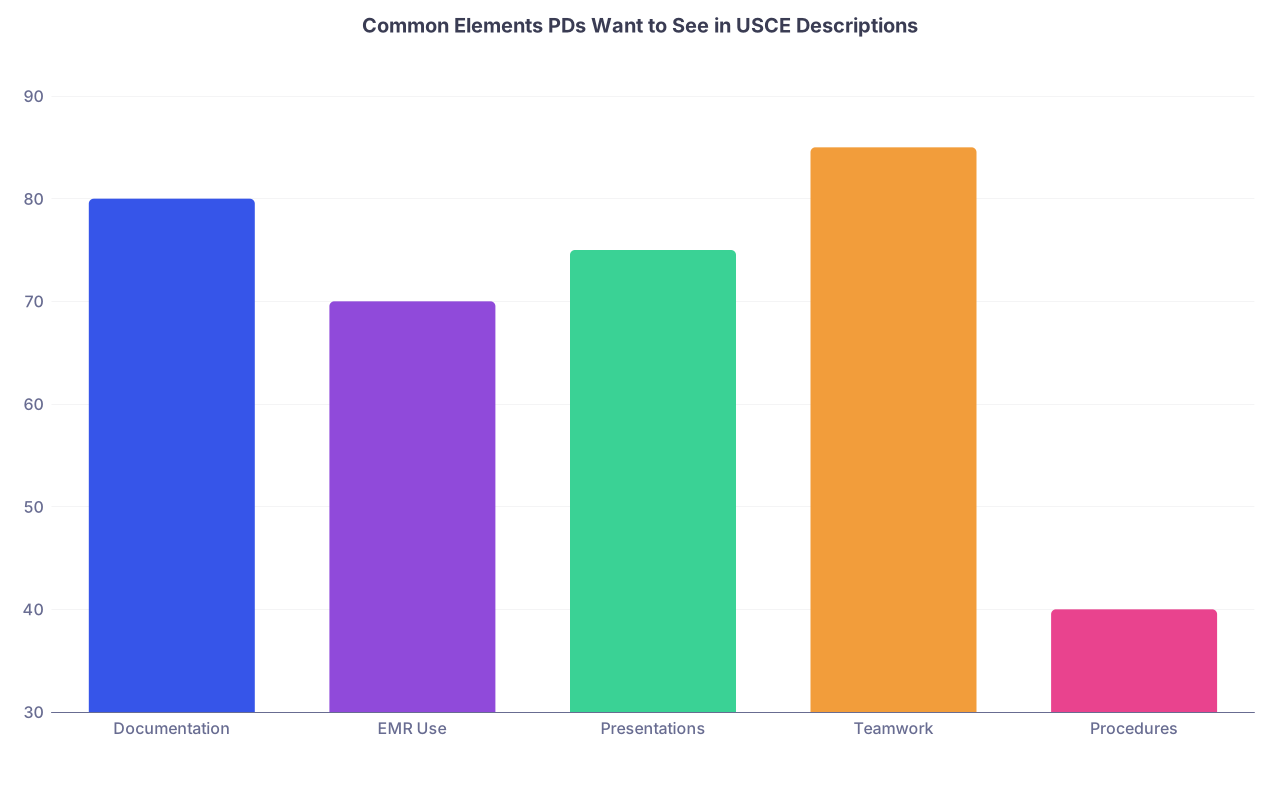
| Category | Value |
|---|---|
| Documentation | 80 |
| EMR Use | 70 |
| Presentations | 75 |
| Teamwork | 85 |
| Procedures | 40 |
(Those percentages are roughly how often PDs bring these up in committee conversations, not some published statistic—this is from being in the room.)
3. Integration into the Team: Were You Just “That Observer”?
A dirty secret: attendings frequently forget observers’ names. Residents sometimes don’t even know what to do with them. PDs know this.
So they look for words and phrases that show you weren’t floating anonymously.
Red-flag descriptions sound like this:
- “Attended morning rounds with the team.”
- “Observed multidisciplinary meetings.”
- “Participated in daily activities of the clinic.”
Those are “I sat in the back of the room” phrases.
Better signals:
- “Assigned 3–4 patients daily to follow with the resident.”
- “Presented new admissions to the attending during table rounds.”
- “Coordinated with social work and case management on discharge planning discussions.”
You’re painting a picture: you weren’t a ghost; you were part of the machine.
One more hint: PDs notice if you consistently use “we” versus “they.”
“We admitted 5 patients per night” sounds like you were in the trenches with them. “They admitted 5 patients and I observed” sounds like… well, exactly that.
4. Alignment with Your Target Specialty
If you’re an IMG applying to internal medicine with 6 months of USCE in dermatology, anesthesiology, and radiology, PDs will ask: “So when did they decide they actually like medicine?”
They want to see:
- At least some USCE directly in your chosen field
- Or a credible path showing your interest evolved logically
For example, a PD’s commentary I’ve actually heard:
“She’s applying to FM, but her USCE is all in cardiology and GI at big academic centers. Is she going to be bored in our community program?”
Your descriptions need to tie the experience to your specialty choice, especially if the field doesn’t obviously match.
Bad for an FM applicant:
“Observed cardiac catheterizations and inpatient rounds on the cardiology service.”
Better:
“While on the inpatient cardiology service, followed patients across transitions of care (ICU to step-down to telemetry to discharge) and saw the importance of longitudinal management of chronic diseases—reinforcing my interest in primary care and family medicine.”
You spell out the connection so the PD doesn’t have to guess.
5. Recency and Progression: Are You Stagnant or Growing?
PDs care a lot about what you’ve done lately. If your best clinical experience is 5 years old, and your recent time is all “gap year” research or non-clinical work, that’s a risk.
When they read your sequence of USCE entries, they’re looking for:
- Are the experiences getting more responsible over time?
- Did you just repeat the same observership three times in three different clinics?
- Does your recent experience show readiness for residency now, not back when you were a fresh graduate?
If you did multiple USCEs, your descriptions should show progression:
Weak pattern:
- “Observed outpatient clinic…”
- “Observed inpatient care…”
- “Observed subspecialty clinic…”
Stronger pattern:
- First USCE: focus on basic exposure, understanding US documentation, EMR navigation.
- Second: mention independent presentations, draft notes, focused exams.
- Third: emphasize leading presentations, suggesting plans, working more closely with residents, maybe participating in quality improvement.
If all your experiences sound identical, PDs assume you didn’t actually grow, or you’re just recycling one generic description three times.
6. Credibility vs. Exaggeration: Does This Sound Real?
Here’s the part people don’t like to hear: PDs are extremely sensitive to exaggeration. Especially for IMGs.
Whenever I review applications with attendings, we do this almost reflexively:
- If an IMG observership description reads like a USMD sub-I with full autonomy, red flag.
- If you claim extensive unsupervised procedures or independent orders, red flag.
- If your duties sound more advanced than what US fourth-years do, big red flag.
You can absolutely say you:
- Drafted orders
- Proposed management plans
- Assisted with procedures
- Wrote notes that were co-signed
But if you start claiming:
- “Independently managed…”
- “Performed unsupervised lumbar punctures, central lines, and intubations during observership…”
You’ve just lost the PD’s trust. And trust is everything.
Pro tip: believable USCE descriptions almost always:
- Acknowledge supervision
- Use language like “under the supervision of,” “drafted,” “assisted,” “proposed,” “for review”
You sound like an adult who understands scope and reality, not a desperate applicant inflating experience.
7. Evidence of Professionalism and Work Ethic (Between the Lines)
No one writes “I showed up late twice a week” in their ERAS. But PDs read your descriptions for clues about reliability and professionalism.
They notice:
- Number of hours/week and weeks (do they make sense or feel fake?)
- Whether you survived a clear workload (e.g., “50–60 hour weeks on inpatient service”)
- Whether you stuck out a tough environment (county hospital, safety net clinic, night shifts, etc.)
If your USCE says:
“Rotation hours: 15/week, mostly clinic observation,”
and someone else has:
“Rotation hours: 40–50/week on inpatient medicine with weekend call,”
guess who they think is more prepared for residency hours.
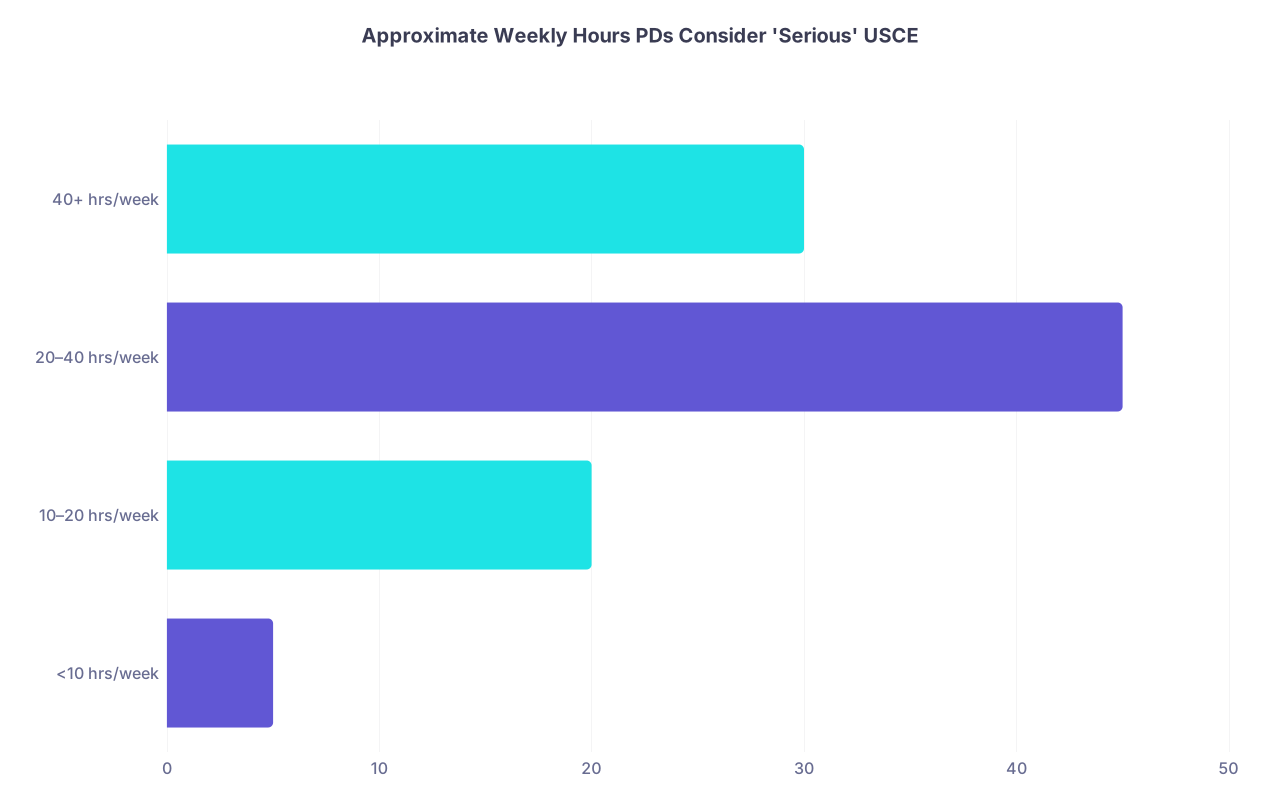
| Category | Value |
|---|---|
| <10 hrs/week | 5 |
| 10–20 hrs/week | 20 |
| 20–40 hrs/week | 45 |
| 40+ hrs/week | 30 |
If you really had limited hours, fine. Don’t lie. But then you cannot describe it like “full immersion” and “extensive responsibility.” PDs notice when the math doesn’t add up.
How PDs React to Common USCE Patterns
Let me give you three very real composite patterns I’ve seen, and how they’re discussed in committee.
Pattern 1: The “Tourist Observership” IMG
ERAS entries:
- 4-week “USCE” in a private cardiology clinic
- 4-week “USCE” in endocrinology clinic
- 3-week “USCE” in GI clinic
Descriptions full of:
- “Observed various procedures…”
- “Gained exposure to…”
- “Learned about…”
No mention of:
- EMR
- Notes
- Presentations
- Assigned patients
- Team role
Typical PD reaction: “Okay, so they watched a lot. But nobody put them to work. Do we really want to be the first program to test them in a real inpatient setting?”
This doesn’t kill you outright, but you start behind others with real, hands-on-sounding USCE.
Pattern 2: The “One Strong Inpatient Rotation” IMG
ERAS entries:
- 8-week internal medicine inpatient USCE at a safety-net academic hospital
- Maybe one short clinic observership
Descriptions include:
- Census numbers
- EMR (Epic or Cerner)
- Drafted notes and orders
- Presented on rounds
- Direct supervision language
Typical PD reaction: “USCE limited but strong. At least we know they’ve seen real inpatient medicine here. Might be workable.”
That single, well-described, believable inpatient rotation can outweigh three fluffy ones.
Pattern 3: The “Progressive, Coherent USCE” IMG
ERAS entries:
- 4 weeks outpatient FM at a community clinic
- 8 weeks inpatient IM at county hospital
- 4 weeks subspecialty (e.g., cardio) but tied to IM/FM interest
Descriptions show:
- Increasing responsibility
- Clear interest in IM/FM
- Thoughtful engagement with system issues (discharges, follow-up, coordination)
Typical PD reaction: “This person has built a convincing US story. They understand the system, they’ve seen the grind, and they still want to do this. Safer bet.”
I’ve watched this type of applicant beat others who had higher scores but scattered, weak USCE.
How To Actually Write Your USCE Descriptions So PDs Respect You
You want a simple mental formula? Use this:
Setting + Team + Your Role + Clinical Tasks + Supervision + Relevance
One strong entry might read like this (for an IMG IM applicant):
“Four-week inpatient internal medicine USCE at a county-affiliated academic hospital. Integrated as part of a resident team (PGY-1 and PGY-3) managing 10–14 patients daily. Pre-rounded on 3–4 assigned patients each morning, obtained focused interval histories and physical exams, and presented updates on rounds. Drafted admission H&Ps, daily progress notes, and discharge summaries in Epic for attending review and co-signature. Under direct supervision, developed assessment and plan for common conditions (pneumonia, CHF exacerbation, uncontrolled diabetes) and discussed rationale with the team.”
That’s the kind of paragraph PDs read and think:
“If this is truthful, this person will not be shell-shocked July 1st.”
Do not waste characters on generic fluff:
- “Improved my communication skills”
- “Learned to work in a multidisciplinary team”
- “Developed empathy and professionalism”
Those are assumed. They don’t differentiate you. Show the work instead; PDs infer the soft skills.