
Last winter, a nervous IMG extern stepped out of a patient room on our wards rotation. She had done everything “right” on paper—Step scores, glowing home-country letters, a neatly ironed short coat. Ten minutes later, in the workroom, one resident turned to the senior and said, “If we rank her, we’re going to be doing a lot of teaching next year.” That one sentence became her entire application at that program.
Let me tell you what actually gets said about IMG externs. Not the brochure version. The version that gets funneled in half-sentences and side comments from residents to the program director—and quietly decides who gets an interview and who never hears back.
How the Pipeline Really Works: From Workroom Gossip to PD’s Notepad
Here’s the part no one tells you: your “evaluation” as an IMG extern is not just the official form. It’s the offhand comments in the workroom that get condensed into two or three words in the PD’s head.
At most programs, the information flow looks more like this than like the formal “objective” process you imagine:

| Step | Description |
|---|---|
| Step 1 | IMG Extern on Rotation |
| Step 2 | Workroom Impressions |
| Step 3 | Senior Resident Opinion |
| Step 4 | Chief Residents / Fellows |
| Step 5 | Program Director |
| Step 6 | Attending Comments |
Residents almost never write long essays about you. They give short labels.
“Solid.”
“Green, but teachable.”
“Wouldn’t trust alone at 2 a.m.”
“Super nice, but slow.”
“Legit. Functions like an intern.”
Those are real phrases I’ve heard residents use when PDs or chiefs ask about externs. And the PD hears these summaries a lot more than they read your CV line-by-line.
Here’s how this actually plays out.
Residents are in the workroom after rounds, PD pops in or sends a message:
“How are the students this month? Anyone we should look at for interviews?”
Or the chief asks the seniors during noon conference:
“Anyone on your team this month you’d be comfortable working with as an intern next year?”
Names get mentioned. Or they don’t. Both outcomes matter.
If your name doesn’t come up at all, you’re already in the “neutral / invisible” bucket. That rarely translates to an interview in a competitive program. Programs do not gamble on people their own residents can’t even remember.
The Five Buckets: How Residents Mentally Sort IMG Externs
Residents will never tell you this to your face, but when externs rotate, they get mentally dropped into buckets pretty quickly—often after 3–4 days. Not weeks. Days.

Roughly, the buckets look like this:
- “We should definitely interview this one”
- “Good, would not be embarrassed to have them here”
- “Nice, but not strong enough for our program”
- “No. Too risky.”
- “Invisible / forgettable”
Let me break them down in the language residents actually use when they talk about you to PDs.
1. “We should definitely interview this one”
Phrases you want residents using:
- “Honestly, they’re functioning at intern level already.”
- “Very little handholding. Picks things up fast.”
- “Patients like them. Nurses like them. I’d take them on nights.”
These externs do not just “work hard.” Plenty of weak externs work hard. The top ones reduce the resident’s workload without creating anxiety. They:
- Pre-round efficiently and bring useful updates, not chaos.
- Volunteer to call consults, write notes, or gather records—and actually do it right.
- Understand the system after a week: where things are, who to call, how orders flow (even if they can’t enter them).
Residents tell PDs: “If we don’t interview them, another program will. They’re that level.”
2. “Good, solid, would not be embarrassed”
Classic comments:
- “Solid. Not a superstar, but I’d be fine with them as a co-intern.”
- “Needs a bit more seasoning with U.S. system, but smart and improves.”
- “No red flags. Just needs time in the system.”
These externs are safe. Competent enough, improving over the month, receptive to feedback. They might get an interview if the program has spots and especially if they’re already leaning toward IMGs.
But if there are only 3–4 interview slots off that rotation, the PD is going to prioritize the intern-level ones first.
3. “Nice, but not strong enough for here”
You’ll never hear this to your face. On your evals, it’ll read like:
“Pleasure to work with, will excel with more clinical exposure.”
The hallway version is:
- “Super nice. But slow.”
- “Sweet, but I had to double-check everything.”
- “Knowledge base okay, but can’t handle volume.”
Residents are trying to be kind. They’re not going to tank your career. But they’re not going to put their name behind you either. In PD language, that translates to: good person, maybe a better fit for a less intense or smaller program.
4. “No. Too risky.”
This is the group that gets actively blocked from interviews. Residents absolutely do this. I’ve watched it happen multiple times.
Resident to PD:
“I would not feel comfortable with them managing a sick patient alone.”
Or more bluntly to the chief:
“Please don’t interview them. They’re a liability.”
Red flags here are rarely about raw knowledge. They’re about safety and judgment:
- Missing obvious red-flag vitals.
- Refusing to call for help when unsure.
- Arguing with nurses when they escalate concerns.
- Faking information or cutting corners in notes.
Those externs sometimes still get polite evaluations on paper. But the off-the-record message is clear: do not rank.
5. “Invisible / forgettable”
This is more common than you think.
- Shows up.
- Does what’s asked.
- Never really takes ownership or leaves a mark.
When PDs ask about these students, residents struggle to remember anything specific. That vagueness is death. Programs are not looking to fill precious spots with “adequate but invisible.”
What Residents Actually Look For (It’s Not Just Knowledge)
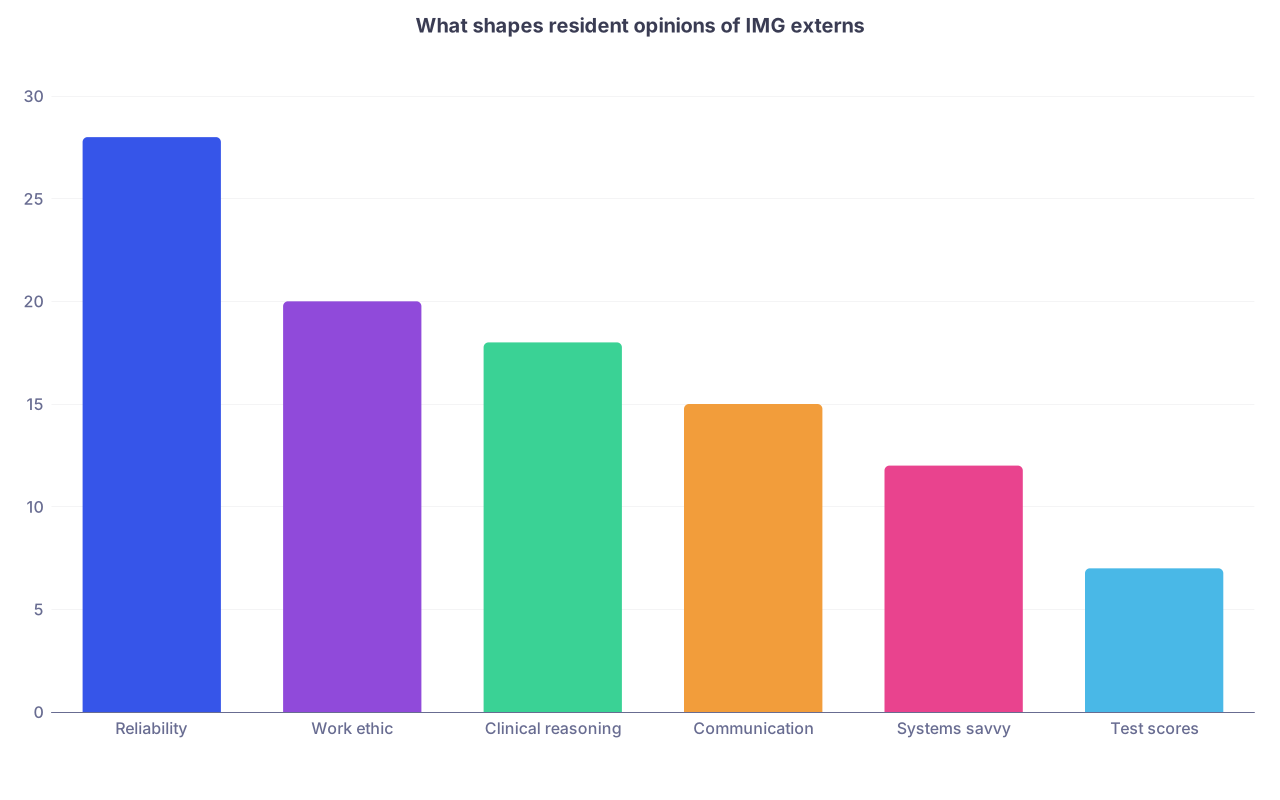
IMGs obsess over knowledge and Step scores. Residents care about something else first: “Can I trust this person at 3 a.m. when I’m covering 40 patients?”
| Category | Value |
|---|---|
| Reliability | 28 |
| Work ethic | 20 |
| Clinical reasoning | 18 |
| Communication | 15 |
| Systems savvy | 12 |
| Test scores | 7 |
Reliability and work ethic are not clichés. Residents repeatedly say variations of:
“I’d rather have someone a bit green but reliable, than a genius who disappears when it’s busy.”
Here’s what specifically shapes how they talk about you.
Reliability: Do you do what you say you’ll do?
If you tell a resident, “I’ll go check the potassium result,” and they hear back from you 3 hours later after they already fixed it—your stock drops. Quietly but sharply.
Residents say to PDs:
“Smart, but I couldn’t count on them. Things slipped.”
Reliability cues they notice:
- Coming back with lab results when you said you would.
- Calling consults when you offer to—and not needing to be chased.
- Being on time. Every day. Especially post-call, when everyone’s tired.
One missed thing might be ignored. A pattern is not.
Clinical reasoning: Can you think, or just recite?
Residents are listening for whether you can connect the dots, not just list everything from UpToDate.
Bad: “This 67-year-old male with shortness of breath could have CHF, COPD exacerbation, pneumonia, PE, ACS, pulmonary HTN…” (you just vomited a differential without committing).
Good: “I’m most worried about CHF exacerbation because of the orthopnea, JVD, edema, and CXR with congestion. I still want to rule out pneumonia because of the fever.”
The resident’s summary about you becomes:
“Actually reasons through problems” vs. “Just lists everything.”
Communication: How do you interact with nurses, patients, and the team?
Here’s something IMGs underestimate: residents listen to nursing feedback a lot more than you think.
Nurses tell residents:
“She’s great, she explains everything to the patients.”
or
“He’s kind of dismissive.”
Then the senior turns to the PD later:
“Nurses did not like him.” Translation: do not interview.
Residents also notice:
- If you disappear without telling anyone where you’re going.
- If families say, “The student was the only one who explained things clearly.”
- If you can present a patient concisely, without a 7-minute monologue.
Systems savvy: Do you understand how U.S. hospitals actually work?
No one expects you to know the EMR on day one. But by week two, if you still do not know where the CT is or how to call radiology, residents start categorizing you as “slow to adapt.”
They tell PDs:
- “Needed a lot of hand-holding with the system.”
- “By the second week, they were moving like everyone else.”
That adjustment curve matters, especially for PDs worried about onboarding international grads quickly.
The Phrases That Make or Break You
I’ll give you something most people will never say out loud: a rough “resident-to-PD translation guide.” These are the kinds of phrases PDs hear in passing and how they interpret them.
| Resident Comment | PD Interpretation |
|---|---|
| "Honestly functions like an intern already." | Strong interview candidate |
| "I’d be happy to work with them next year." | Safe, likely to interview |
| "Really nice, just a bit slow." | Borderline; maybe for less intense spots |
| "Needs a lot of supervision for basic tasks." | Risky; unlikely to interview |
| "No major concerns, but didn’t stand out." | Low priority / probably no interview |
You will never see these words written in your official evaluation. Residents and attendings sanitize their comments on paper. But they keep the real version for hallway conversations.
A PD hearing “functions like an intern” will remember your name. A PD hearing “nice, but slow” might not even open your ERAS application in detail.
How IMG Externs Accidentally Tank Themselves
Most externs don’t get sunk by one huge mistake. They quietly bleed credibility over days.
Here are the patterns I’ve seen repeatedly that lead to “meh” or negative resident comments.
Trying too hard to look smart
Residents love learners. They hate showboats.
Extern behavior that backfires:
- Constantly answering questions meant for interns on rounds.
- Quoting obscure trials in front of the attending to “impress” them.
- Correcting residents in front of the team.
Residents remember that and later tell the chief:
“Strong knowledge, but not a team player.” PD hears that as: high maintenance, risk for drama.
Overstepping your role
Classic IMG error: acting like a resident before you understand the limits.
Examples:
- Giving families definitive updates without running them by the team.
- Recommending medication changes directly to nurses as if you’re the MD on record.
- Arguing with consultants or nurses.
Residents say:
“Doesn’t know their lane yet.”
or worse, “Scares me a bit.”
Those externs get blocked. Full stop.
Being physically present but mentally checked out
You came all this way, paid insane money for housing, visa, fees. Then on the floor, you look half-engaged.
Residents notice when you:
- Scroll your phone all day.
- Never volunteer for tasks.
- Do the bare minimum—one patient, one note, no extra reading.
Then when PDs or chiefs ask, residents shrug:
“They were OK, I guess.”
That shrug kills more applications than one bad day ever does.
The Rotation Timeline: When Opinions Form
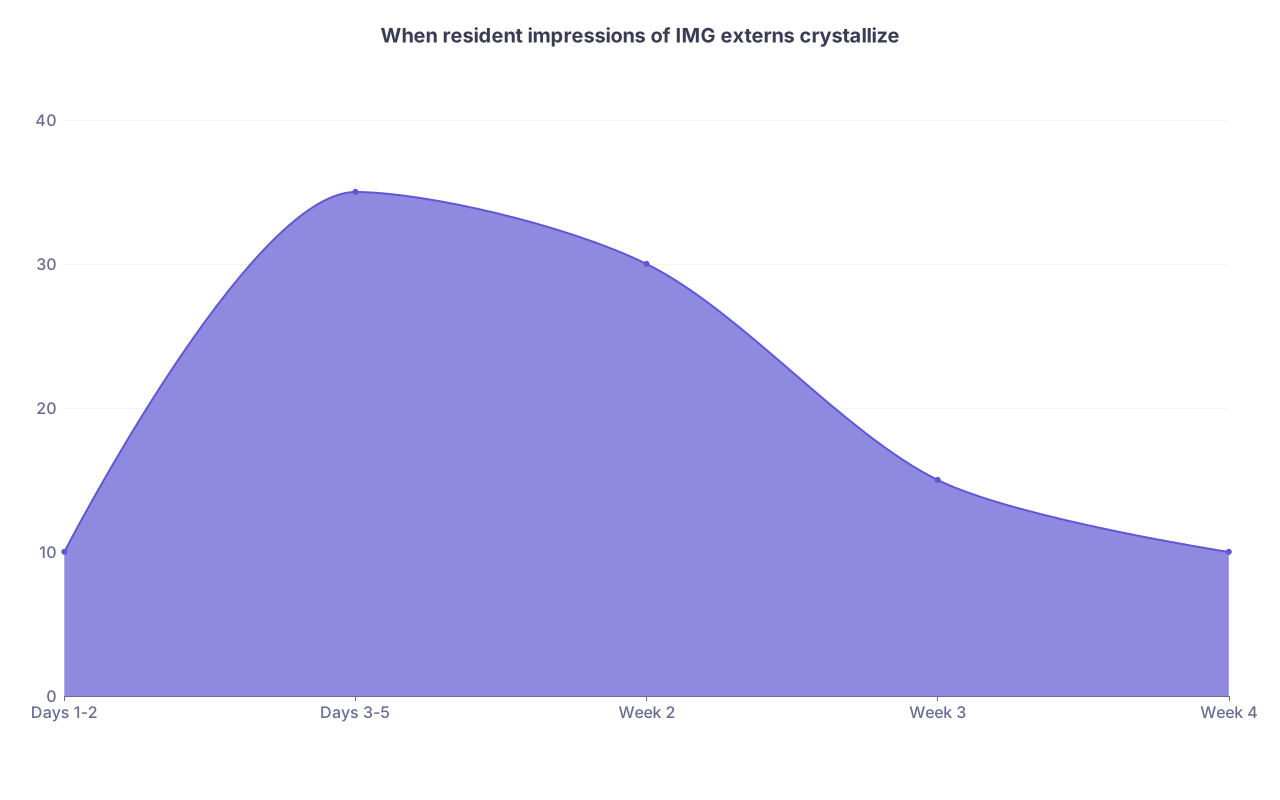
Externs walk in thinking: “I have a month to prove myself.” That’s not how it works. The window is shorter and sharper.
| Category | Value |
|---|---|
| Days 1-2 | 10 |
| Days 3-5 | 35 |
| Week 2 | 30 |
| Week 3 | 15 |
| Week 4 | 10 |
By days 3–5, most residents have already put you into a tentative bucket.
- First two days: They’re just trying to see if you’re weird or reckless.
- Days 3–5: They decide if you’re “strong,” “average,” or “concerning.”
- Week 2: They look for a trend—getting better or stagnating?
- Weeks 3–4: They decide whether to attach their name to you.
So if you “wake up” in week three and start working hard, it’s not useless—but you’re digging yourself out of an early impression.
Strategic Moves That Make Residents Advocate For You
You’re not powerless in this. There are very specific, high-yield behaviors that change how residents talk about you behind closed doors.
1. Ask the right resident the right question early
On day 1 or 2, quietly ask your senior:
“I really want to be the kind of extern residents feel comfortable recommending. What are 2–3 things IMG students mess up here that I should avoid?”
You’ll see their eyebrows go up. They’re not used to that question. And now they’re subconsciously invested in your outcome.
You also just signaled: teachable, self-aware, not fragile.
2. Own one patient, then scale up
Don’t try to impress by grabbing four patients day one. They don’t trust you yet.
Do this instead:
- Take one patient.
- Know that patient cold—history, meds, trends, goals of care.
- Anticipate questions before rounds.
Once the resident sees you can truly handle one, they’ll ask, “Do you want to take another one?” That’s when you say yes.
3. Be the one who makes residents’ lives easier
You want residents to say later:
“She saved me so much time.”
How?
- Offer to pre-chart or collect overnight events for all the team’s patients.
- Volunteer to call family to clarify info, then update the intern.
- Help with discharge summaries by gathering outside records.
You’re not doing scut. You’re buying loyalty.
What Residents Tell PDs When You Ask for a Letter
Here’s another layer IMG externs misunderstand: when you ask a resident or attending for a letter, sometimes the PD will ask them directly, “Would you actually want this person in our program?”
They don’t always say yes. Even if they agreed to write you a letter.
Attending hallway chatter I’ve heard:
“Nice student. I’ll write them a general letter, but I don’t think they’re a fit for us.”
Resident comments when PD asks about a letter writer’s student:
“Letter will be fine, but if you’re asking if I want them here… I’d prefer others we’ve had.”
You cannot read everything from the fact that someone agreed to write. The real endorsement is: would they be comfortable sitting across from you at sign-out as a co-intern? That’s the mental test residents use.
The Quiet Advantage: Consistency Over “Wow”
Let me tell you who PDs quietly love: the IMG extern who is boringly consistent.
Not the genius. Not the one with dramatic “saves.” The one every resident describes roughly the same way:
“Shows up. Reliable. Safe. Learns. No attitude.”
When PDs hear that same description from three different seniors over a year, they start to think, “Our life will be easier with this person on the schedule.”
So when you’re on rotation, stop chasing fireworks. Chase consistency.
Show up on time. Every day.
Follow through on every task.
Improve your presentations noticeably from week 1 to week 4.
Treat nurses well. Always.
Residents do not sit down to write essays about you. They carry a three-word summary in their heads. Your job is to make those three words something a PD can safely say yes to.
The Bottom Line: What You Should Take From All This
First: residents are gatekeepers. They absolutely influence who PDs interview and who they quietly screen out. Not with long letters, but with short, brutally honest phrases.
Second: as an IMG extern, you’re being judged far more on reliability, adaptability, and safety than on how many guidelines you can quote. Residents want to know if they’d trust you at 3 a.m., not if you know every line of UpToDate.
Third: the rotation clock is shorter than you think. Impressions harden by the end of week one. If you focus early on being consistent, useful, and easy to work with, residents will talk about you the way you need them to when the PD comes asking, “Anyone from this month we should interview?”