
The fastest way to ruin an otherwise strong externship is to hound attendings for “feedback” in vague, unfocused ways.
Let me break this down specifically: attendings are not allergic to giving feedback. They are allergic to extra work that feels directionless, time‑wasting, and impossible to answer in 30 seconds between patients. Your job as an IMG on a US clinical externship is to flip that script—make feedback easy, specific, and useful—without ever becoming “that student” everyone complains about in the workroom.
You want strong letters, high written evaluations, and real growth. You will not get that by asking, “Do you have any feedback for me?” three times a week.
You will get it by being intentional.
1. Understand the Attending’s Mental Framework
Before you say a word, understand how your attending experiences you.
They are typically tracking, in the back of their mind, a few things about each learner:
- Clinical reasoning: Can you think? Or are you just reciting UpToDate?
- Efficiency: Do you slow down rounds or help move things forward?
- Communication: With patients, team, nursing, consultants.
- Reliability: If they ask you to do something, do they have to check again?
- Professionalism: On time, prepared, not disappearing mid‑day.
They are not sitting there with a mental bullet list of “constructive feedback items” ready to download on demand. Most attendings will default to “You’re doing fine” unless you force more specificity by asking better questions.
Also, remember the time reality: on a typical inpatient IM month, an attending might:
- Pre-round with residents / review labs
- Round on 10–20 patients
- Field calls and messages all day
- Teach some
- Do documentation
- Maybe have clinic
Your “5 minutes for feedback” is competing with their notes, pages, and getting home to their own life.
So the core rule: if feedback feels heavy or open‑ended, they will avoid it. If it feels contained, time‑bounded, and clearly answerable, they will usually give you more than you expected.
2. Know When To Ask (Timing Is Half the Battle)
You can ask for feedback at the wrong time and instantly become annoying—even if your question is perfect.
High-yield moments for feedback
Use these. They work.
Right after a discrete performance
Example: After you present your patient on rounds. After you counsel a patient on new diabetes meds. After you call a consult and the attending was listening.End of the day, but before everyone is exhausted
For many services, this is that 3–4 pm window when rounds are done and notes are close to finished. They are still in work mode, but the pressure is lower.End of the week / end of the block
This is when you ask for global feedback and for help improving before your next rotation. Not randomly on week 2 after a hectic code.In scheduled teaching time
Some attendings will say “Any questions?” during sit-down teaching. That is a great time to ask, “Could I get quick feedback on my presentations so I can adjust before I leave this month?”
Terrible times to ask
Avoid these unless you genuinely have no other option:
- While they are clearly behind on notes and typing furiously.
- During an emergency, rapid response, or emotionally heavy situation.
- Mid-rounds, when 5 people are waiting and the attending is staring at the door of the next room.
- When they just sat down with a coffee and visibly look like they are taking their first deep breath all day.
If you are unsure, you can do a soft check:
“Dr. Smith, is now an OK time for a quick question about how I can improve, or would another time work better?”
That single sentence shows awareness, respect, and gives them a face-saving exit if they are overloaded.
3. What To Ask: Turn Vague “Feedback” Into Specific Targets
The question “Do you have any feedback?” usually yields:
- “You’re doing great.”
- “Nothing major. Keep it up.”
- Or a generic platitude they have told a hundred students.
You want actionable data. To get that, you must narrow the scope.
Pick one domain at a time
Think in domains, not “everything about me”:
- Oral presentations
- Assessment and plan / clinical reasoning
- Notes / documentation
- Communication with patients
- Efficiency / task management
- Professionalism / team interaction
Then ask about one of those.
Examples that work extremely well:
- “For my oral presentations, what is one thing I could change this week to make them more focused?”
- “On my assessment and plan for Mr. Lopez, was my problem list organized the way you like, or is there something I should do differently?”
- “You heard my counseling about insulin earlier. What’s one thing you’d recommend I add or change next time I explain it to a patient?”
- “Compared with other students at my level, is there one area where you think I should focus to improve my clinical reasoning?”
Notice the pattern:
- One domain.
- One concrete adjustment.
- Framed as “this week” or “next time” to signal you plan to act on it right away.
This structure is almost impossible to ignore politely, so they will usually give a real answer.
4. How Often To Ask (So You Don’t Become a Nuisance)
You are right to be worried about being “too much.” There is a rhythm that works.
Here is a simple, realistic cadence for a 4-week externship:
| Week | Type of Feedback | Frequency | Example Trigger |
|---|---|---|---|
| 1 | Micro, skill-based | 1–2 times | After presentations or patient counseling |
| 2 | Micro + 1 mini global check | 2–3 times | After a case, plus end-of-week |
| 3 | Targeted domain refinement | 1–2 times | Ask about a known weak area |
| 4 | Summative + letter groundwork | 1–2 times | Mid-week and final day |
That is total, not per day.
Micro-feedback moments
These are 20–40 second questions right after you do something.
Example script:
“Dr. Patel, for that presentation—was the level of detail about the labs about right, or should I focus more on the assessment next time?”
You did not say “feedback.” You framed a binary, specific question. That feels much lighter to them.
Do this:
- Week 1: once every day or two.
- Week 2–3: when you are deliberately working on something.
- Week 4: focus on big-picture readiness and letters.
Global feedback moments
These are 3–5 minute conversations.
- Once at the end of week 1 or 2: “Am I on track? Where should I adjust?”
- Once at the end of the rotation: “What should I carry into residency?”
If you find yourself asking more than 3 real feedback questions in one day, stop. You are now noise.
5. Phrases That Annoy Attendings (And Better Replacements)
I have heard attendings complain about this in the residents’ room far more than students realize.
Here are classic “annoying” approaches and how to fix them.
Problem 1: Vague and constant
Annoying:
“Do you have any feedback for me?” (asked three times this week)
“Any feedback today?” as they are putting on their coat to leave.
Better:
“Today I tried to make my presentations more concise like you suggested yesterday. Did you notice an improvement, or is there one more thing I should tweak?”
Why this works: You show you listened, implemented, and are asking for calibration—not starting from zero each time.
Problem 2: Demanding a full evaluation mid-rotation
Annoying:
“Can you tell me all my strengths and weaknesses?”
“Can you go over my evaluation now?”
Better:
“I am aiming for an internal medicine residency in the US, and I know my clinical reasoning is the most important part. Based on what you have seen so far, is there one specific pattern in my reasoning that I should work on before residency?”
Narrow, purposeful, and clearly linked to your future.
Problem 3: Making it about grades, not growth
Annoying:
“Am I doing well enough for a strong letter?”
“Do you think I’ll get honors / an excellent evaluation?”
Better:
“I am very committed to improving and matching in the US. Could you tell me one thing that, if I improved it, would make you more confident in recommending me as a resident?”
The subtext is the same, but the second version sounds like maturity rather than fishing for praise.
6. Structure Feedback So It Is Easy To Give
You can actually “pre-format” the feedback in your question.
Use simple scaffolds:
“What is one thing I should continue doing, and one thing I should change?”
“On a spectrum from X to Y, where am I right now?”
Example: “On a spectrum from too detailed to too brief in my presentations, where do you think I am? What should I shift toward?”“Compared to other students at my level, is there an area where I stand out positively or negatively?”
Most attendings can answer these faster than an open essay question.
7. Cultural and IMG-Specific Considerations
As an IMG, you are dealing not only with clinical performance but also with:
- Accent and communication differences.
- Different hierarchies and expectations from your home country.
- Fear of being perceived as pushy or “needy” in a foreign system.
You cannot afford to be completely passive. But you also cannot behave like some overconfident US MS4 who feels entitled to an hour-long feedback session daily.
Calibrating assertiveness
Here is a sane middle ground:
- You speak clearly and directly, not in over-apologetic language.
- You ask permission for timing: “Is now a bad time?” rather than just launching in.
- You signal that you respect their time: “Just a quick question so I can improve…”
Avoid:
- Over-explaining your question. The more words you use, the more they feel drained.
- Bringing printed self-evaluation forms and asking them to fill them out during rounds.
- Asking in groups about your individual weaknesses. That puts them on the spot.
Dealing with accent / communication concerns
If you suspect your communication style is an issue, you must address it. Directly, but with humility.
You can say:
“I know I have an accent, and I want to be sure it does not interfere with patient care. Have you noticed any phrases or situations where my communication is unclear, especially with patients or nurses?”
Most attending physicians will respect this self-awareness and give you very practical tips. That kind of question does not annoy them. It reassures them.
8. Use Residents and Fellows Strategically
You do not need to get all your feedback from attendings. In fact, if you try, you will fail.
- See you more.
- Know your day-to-day performance.
- Remember what it felt like to be in your shoes.
Attendings:
- Sign the final evaluation.
- Decide on your letters of recommendation.
- See your “best” or most curated performance.
So split your strategy:
- Daily, nitty-gritty, repeated micro-feedback → senior resident, fellow.
- Big-picture progress, letter-worthiness, readiness for residency → attending, 1–2 times each month.
You can even prep the attending via the resident:
“Dr. Jones, I want to ask Dr. Smith for feedback about my clinical reasoning at the end of the week. Is there a way you recommend I phrase that? Is there anything you think they are paying closest attention to?”
Now your attending hears a more sharpened question from you later, and your resident has already helped you refine your ask.
9. Document and Demonstrate That You Act on Feedback
Nothing irritates an attending more than giving the same feedback repeatedly and seeing no change.
So do two things:
Write it down that day
Keep a tiny “externship improvement” note on your phone (obviously not open while talking to patients). Immediately after rounds, jot:- “Shorten HPI; front-load one-liner + problem list.”
- “Slow down speech with elderly patients.”
- “Prioritize sickest patients first in pre-rounding.”
Explicitly show you acted on it
The next day, signal it, very briefly:“Dr. Lee, yesterday you suggested I front-load my one-liner and problem list. I tried that this morning with Mr. Adams. Was that closer to what you prefer?”
This does two things: it reinforces your own learning and triggers the attending’s desire to invest further. You are clearly a learner who uses feedback, which makes the time they spend on you feel valuable.
You are also inching them toward “this student is serious and coachable,” which is exactly the kind of phrase that appears in good letters.
10. End-of-Rotation Feedback and Letter Positioning
This is where most IMGs freeze or overplay their hand. You need two separate but related things:
- Summative feedback you can carry forward.
- Clarity on whether this attending can write a strong letter.
How to request summative feedback without being annoying
Timing: 2–3 days before your last day, not the final 10 minutes of the rotation.
Script:
“Dr. Nguyen, I finish my time with you this Friday. At some point before then, could I get 3–5 minutes of feedback on how I have progressed this month and what I should focus on before residency? I want to make sure I am improving in the right areas.”
You have:
- Given them notice (they can think about it).
- Bounded the time.
- Framed it as preparation for residency, not ego.
During that discussion, you listen more than you talk. You can ask one follow-up question like:
“If you had to pick one priority for me to work on in my next rotation, what would you pick?”
That is it. No defensive explanations.
Transitioning to a letter request
If the feedback is generally positive and specific, and they have seen enough of you (at least 2–3 weeks of real work), you can move to the letter.
Not immediately in the same breath. But often within the same conversation.
Example:
“Thank you, that is very helpful. I am applying to internal medicine residency in the US this year, and this rotation has been very important for my clinical development. Based on your experience with me, would you feel comfortable writing a strong letter of recommendation for my applications?”
That word—strong—matters. It gives them an honest exit if the answer is no.
If they hesitate, or say something like “I can write you a letter” without “strong” or “enthusiastic,” that usually means it will be lukewarm. Accept gracefully and find someone else.
If they say yes clearly, follow with:
“I will email you my CV and personal statement draft, and any specific details you would like included. Is there anything in particular you would like me to highlight for you?”
Again, this makes their life easier. Less annoying.
11. Concrete Scripts You Can Use Tomorrow
You want plug-and-play. Here you go.
After a presentation (micro-feedback)
“Dr. Smith, quick question—was the level of detail in my assessment for Mr. Jones about right, or would you prefer I focus more on problem-based reasoning next time?”
Middle of rotation (global direction check)
“Dr. Patel, I am halfway through my time here and want to be sure I am improving in the right ways. Compared with other students at my level, is there one area where you think I most need to focus?”
Communication / accent concern
“I want to ensure my communication is as clear as possible for patients and the team. Have you noticed any situations where my phrasing or speed made it harder to follow me, especially on rounds or with patients?”
End-of-rotation feedback request
“Dr. Lee, I finish this Friday. At some point before then, could we take 5 minutes for feedback on how I have progressed and what I should prioritize before residency?”
Letter of recommendation segue
“Thank you for all the guidance this month. I am applying to [specialty] residency this year. Based on what you have seen of my work, would you feel comfortable writing a strong letter of recommendation for me?”
Use these as written if you like. They are deliberately concise and non-annoying.
12. Quick Reality Check: What Not To Obsess Over
You are not trying to:
- Impress attendings with how “feedback-seeking” you are.
- Collect pages of feedback like a trophy.
- Force every attending to act as your career coach.
You are trying to:
- Sharpen two or three key skills each month.
- Signal that you are coachable, reflective, and improving.
- Identify which attendings actually know you well enough to write a strong letter.
You will not get perfect feedback from everyone. Some attendings are simply bad at this. They will say “You’re doing fine” no matter what. Do not take it personally. Move on and extract what you can from the residents and the cases.
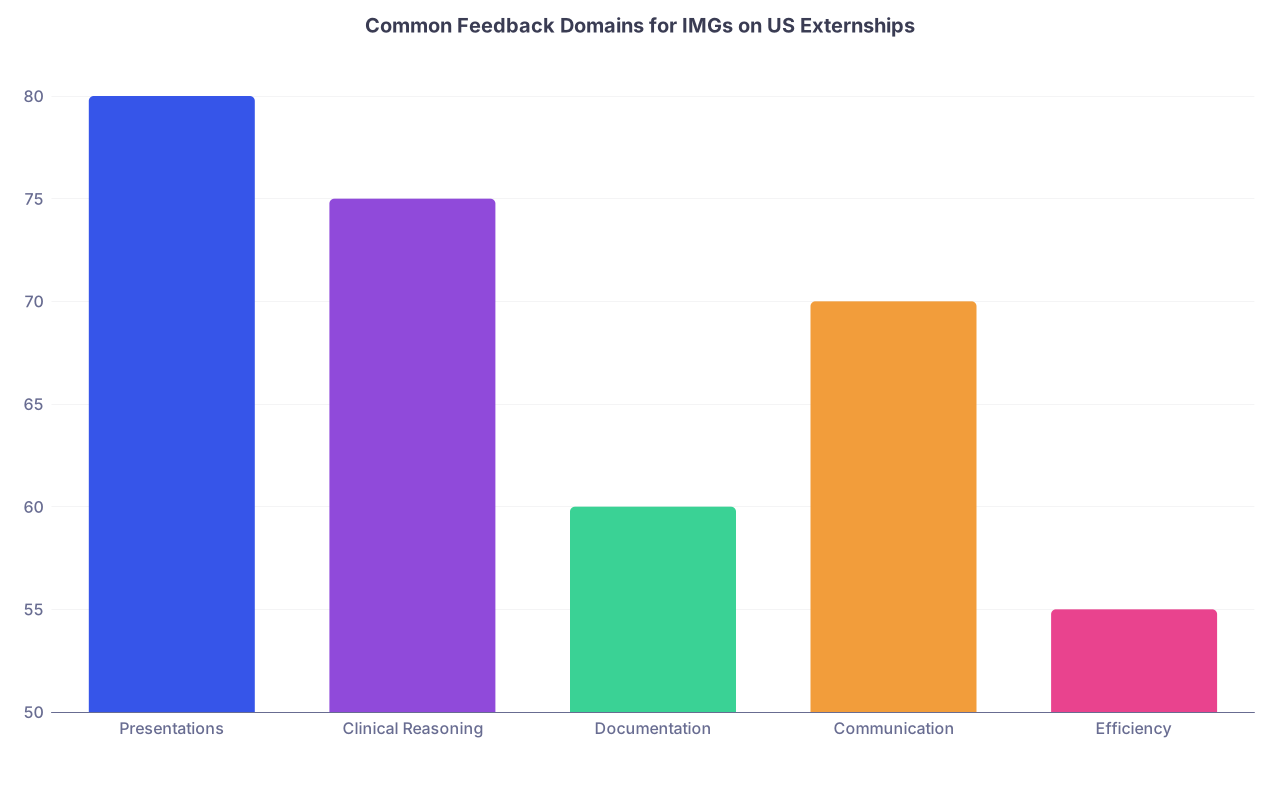
| Category | Value |
|---|---|
| Presentations | 80 |
| Clinical Reasoning | 75 |
| Documentation | 60 |
| Communication | 70 |
| Efficiency | 55 |

| Step | Description |
|---|---|
| Step 1 | Identify specific skill to improve |
| Step 2 | Choose right timing |
| Step 3 | Ask a focused, time-bounded question |
| Step 4 | Document feedback same day |
| Step 5 | Apply change in next similar situation |
| Step 6 | Ask for calibration: did it improve? |
| Step 7 | End-of-rotation global feedback + letter request |


FAQ (Exactly 4 Questions)
1. How soon into an externship is it reasonable to ask for feedback from an attending?
By the end of the first week you should ask at least once. Earlier than day 3, your attending often has not seen enough of you to say anything meaningful. Start with micro-feedback after a presentation or patient counseling on days 3–5. Save bigger global questions for the end of week 1 or start of week 2.
2. What if my attending always says, “You’re doing fine,” and nothing else?
Assume they are either busy, conflict-avoidant, or genuinely think you are fine. Shift your approach. Ask binary or contrast questions: “Are my presentations closer to what you prefer now, or still too detailed?” or “Between my clinical reasoning and my efficiency, which one should I focus on improving?” If they still give nothing specific, stop pushing and focus on residents/fellows for detailed feedback.
3. Can asking for feedback hurt my evaluation if the attending thinks I am insecure or needy?
If you ask vague, frequent, and time-consuming questions, yes, it can backfire. If you ask targeted, infrequent, and time-bounded questions, it usually helps. Attings respect learners who are coachable and efficient. One or two well-phrased questions per week to the attending, plus micro-questions to residents, will not make you look insecure. It will make you look serious.
4. Should I tell attendings I am an IMG and need strong letters for the Match when I ask for feedback?
You do not need to make a big speech about being an IMG every time. It is enough to contextualize once when asking for global feedback or a letter: “I am applying as an international graduate to US internal medicine programs, so your perspective on where I should focus is especially important to me.” Then keep the rest of the conversation about skills and performance, not about desperation for letters.
Key takeaways: Ask for feedback in specific domains, at sane intervals, and at times that respect your attending’s workload. Make their job easier by asking narrow, time‑bounded questions and then visibly acting on what you are told. Do that consistently, and you will stop worrying about “annoying attendings” and start collecting the kind of comments and letters that actually move your Match application.