
The biggest mistake IMGs make after a great USCE rotation is disappearing.
You worked hard, impressed people, maybe even heard, “You’ll be a strong applicant” from an attending. Then you left. Months go by. No updates. No contact. Then, suddenly, you email in January: “Dear Dr. X, I hope you remember me, could you please send an updated LOR and tell the committee I am very interested?” That is how you turn a strong advocate into a polite, generic paragraph in your file.
You need a timeline. From the day your USCE ends until Match week, you should know exactly how you will maintain those relationships.
Below is your month‑by‑month and then week‑by‑week guide.
Big Picture: Your Post‑USCE Relationship Timeline
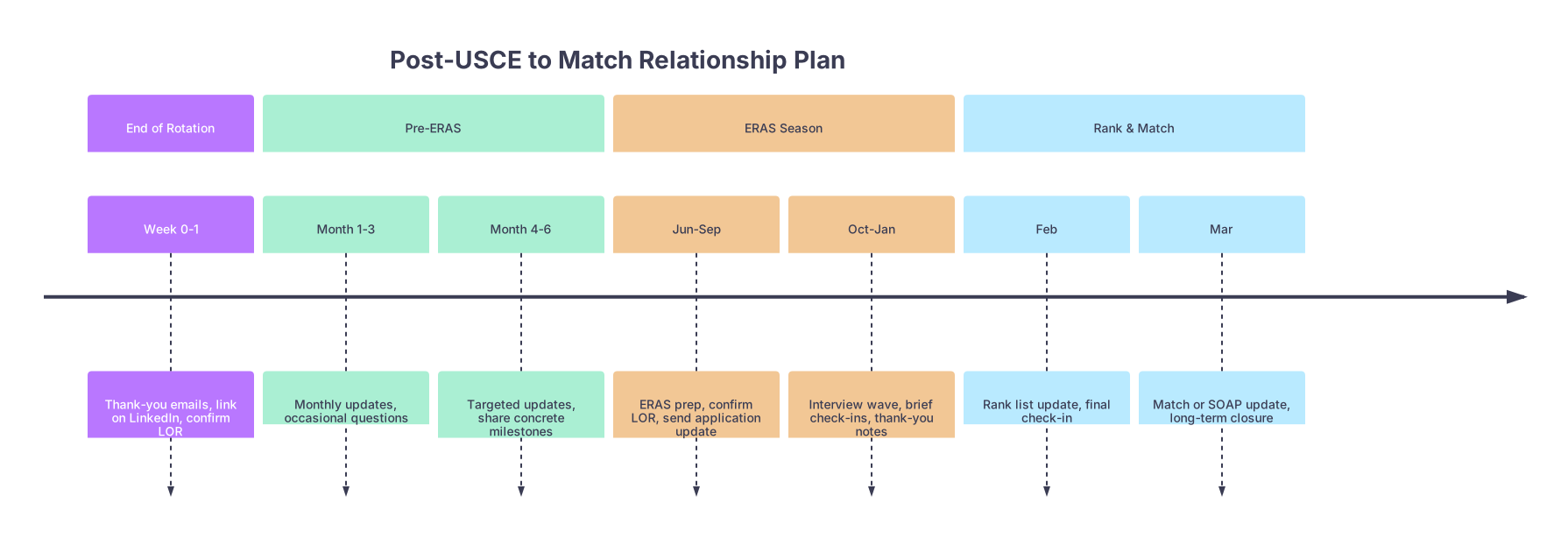
| Period | Event |
|---|---|
| End of Rotation - Week 0-1 | Thank-you emails, link on LinkedIn, confirm LOR |
| Pre-ERAS - Month 1-3 | Monthly updates, occasional questions |
| Pre-ERAS - Month 4-6 | Targeted updates, share concrete milestones |
| ERAS Season - Jun-Sep | ERAS prep, confirm LOR, send application update |
| ERAS Season - Oct-Jan | Interview wave, brief check-ins, thank-you notes |
| Rank & Match - Feb | Rank list update, final check-in |
| Rank & Match - Mar | Match or SOAP update, long-term closure |
At each point, you should be doing three things:
- Staying visible (but not annoying).
- Giving real updates (not “I am still studying very hard”).
- Making it easy for faculty to help you.
Week 0–1 After USCE: Secure the Foundation
These first days decide whether your relationship survives past the rotation.
Within 24–72 hours: Thank‑you and documentation
At this point you should:
- Send a short, specific thank‑you email to each key person:
- Main attending(s)
- Any faculty who supervised you closely
- Chief resident or program leadership if they were involved
Keep it tight:
- Mention 1–2 concrete things you learned from them.
- Reference a patient or case (HIPAA‑safe) that mattered.
- State clearly that you are applying to residency in X specialty and appreciated their guidance.
Example structure:
- Subject: “Thank you from [Your Name], [Rotation/Month]”
- Line 1: Immediate thanks
- Line 2–3: Specific lesson or case
- Line 4: Your target specialty / next step
- Line 5: Hope to keep in touch
Not an essay. 6–8 lines is enough.
Within the first week: Lock in the recommendation
If you have not already asked for a letter of recommendation:
- Do it now. Not “later”. Now.
- Ask in a way that lets them decline gracefully if they cannot be strong.
Something like:
- “Would you feel comfortable writing a strong letter of recommendation in support of my application to [specialty] this coming ERAS cycle?”
Then, at this point you should:
- Send:
- Your CV
- Personal statement draft (even if early)
- ERAS ID if you have it
- A bullet list of 3–5 specific cases or strengths they saw you demonstrate
You want them writing the letter while you are still fresh in their mind.
Also in Week 0–1: Connect on professional platforms
- LinkedIn: Send a short, customized connection request.
- Program email system: Save their work emails; do not rely on personal accounts.
You are building channels. Later, you will need them.
Months 1–3 After USCE: Low‑Friction, High‑Value Contact
This is the quiet build‑up period. You are probably:
- Studying for/retaking Step 2
- Finishing other clerkships or observerships
- Starting to shape your specialty choices
At this point you should be touching base about once a month, not more.
Month 1: The first update email
Goal: Show continuity, seriousness, and progress.
Your email should:
- Be 1–2 paragraphs max.
- Include:
- A short reminder of who you are (1 line).
- One or two concrete updates:
- “I completed another internal medicine observership at [Hospital].”
- “I passed Step 2 CK with a score of [X].”
- One next step:
- “I am now preparing my ERAS materials for internal medicine.”
If you have nothing big to report, do not write fluff. Two real updates are better than six vague sentences.
Month 2: Ask one focused question
You are not a newsletter. You are a junior colleague asking for guidance.
At this point you should:
- Send a brief email with:
- A quick update (1–2 sentences).
- One specific, “expert‑level” question that respects their time.
Examples:
- “Based on your experience, do community internal medicine programs usually value a second US letter more than a strong home‑country letter?”
- “If I am applying with a 220 Step 2 and 3 US letters, do you think adding a research month in your specialty is worth delaying applications by a year?”
You are not asking them to fix your whole life in one long paragraph. One good question. That is it.
Month 3: Demonstrate alignment with the specialty
Now you show you are serious about their field.
At this point you should:
- Send:
- Any specialty‑related updates:
- Joined a cardiology journal club
- Presented a case report at a virtual conference
- Started research in their area
- One sentence explicitly connecting it:
- “Your teaching on [X topic] really pushed me toward [specialty].”
- Any specialty‑related updates:
Months 4–6 After USCE: Pre‑ERAS Positioning
This window is where many IMGs disappear. They think, “I will contact them when ERAS opens.” Wrong. That is when they are busiest and your email gets buried.
Month 4: Status checkpoint and expectations
At this point you should:
- Confirm:
- Your exam status (Step 1, Step 2, OET / TOEFL).
- Your target application year (this cycle or next).
- Your specialty plan (single or dual apply).
A short “checkpoint” email might:
- Summarize in 3–4 bullet points:
- Steps passed and scores
- USCE experiences completed since their rotation
- Research or publications if relevant
- End with:
- “I still plan to apply in [year] to [specialty]. I remain very grateful for your support.”
Do not ask for anything here unless you lack a letter. This is about clarity and reminding them you are a serious applicant.
Month 5: Strategic question + signal of responsibility
Here you can ask a slightly “bigger” strategic question, because they now have context.
For example:
- “Given my profile (220 Step 2, 3 US LoRs, 2 months USCE), would you recommend applying to 2 specialties or focusing only on internal medicine?”
Or:
- “From your experience on the selection committee, is there anything that tends to hurt strong IMGs that they do not realize?”
At this point you should:
- Show that you have already thought about the issue:
- “I am currently planning ~120 IM programs plus 20 FM as backup, but I would value your input if you think that is unwise.”
Faculty respect applicants who have a plan and want refinement, not someone asking them to design their life.
Month 6: ERAS preparation email (for upcoming cycle)
If you are applying this upcoming ERAS:
At this point you should:
- Send an email titled something like:
- “Update before ERAS – [Your Name], [Rotation/Month]”
Include:
- When you plan to submit ERAS (e.g., early September).
- Final exam status.
- Confirmation that you are still honored to have their LoR.
- Ask:
- If they would be willing to update the letter if necessary, or if they are satisfied with the current version.
You are not demanding a rewrite. You are:
- Showing respect for their time.
- Signaling that your file is almost ready and they are a key part of it.
June–September (Application Season): Precision and Timing
Here the volume of email in their inbox explodes. If you are sloppy, you will lose them.

June–July: Final LOR logistics
At this point you should:
- Make sure:
- ERAS Letter ID is created and sent to them with clear instructions.
- Their name and title are correctly formatted.
- In your email:
- Remind them of:
- Rotation dates
- Your role (observer/external rotator/sub‑intern)
- Any stand‑out cases or feedback they gave you
- Remind them of:
You are helping them write and upload faster. Many of them write letters in one sitting; make that sitting easy.
August: “Application is ready” update
When your ERAS is essentially done (personal statement, experiences, exam data):
At this point you should:
- Send a short status email:
- Confirm:
- You will be applying to [X specialty] and possibly [Y backup].
- Their letter is planned as one of your primary US LoRs.
- Thank them again for their support.
- You may attach:
- Your finalized CV
- Final personal statement (if they were interested earlier)
- Confirm:
Do not ask them to review your entire ERAS or edit your personal statement unless they have explicitly offered. That is a fast way to irritate some busy attendings.
September: Submission and gratitude
Once you submit ERAS:
At this point you should:
- Send:
- One concise email:
- “I submitted my ERAS application on [date] to [approx number] programs in [specialty]. Your letter is a very important part of my file and I am truly grateful.”
- One concise email:
If you are geographically or specialty‑targeting their program:
- You may add:
- “I have applied to [their institution] and would be honored to interview there.”
Stop there. Do not ask, “Can you help me get an interview?” unless they themselves previously said, “I’ll try to help you with our program.”
October–January: Interview Wave – How to Stay Visible Without Begging
Here is where many IMGs cross the line from “professional” to “desperate.” Do not be that person.
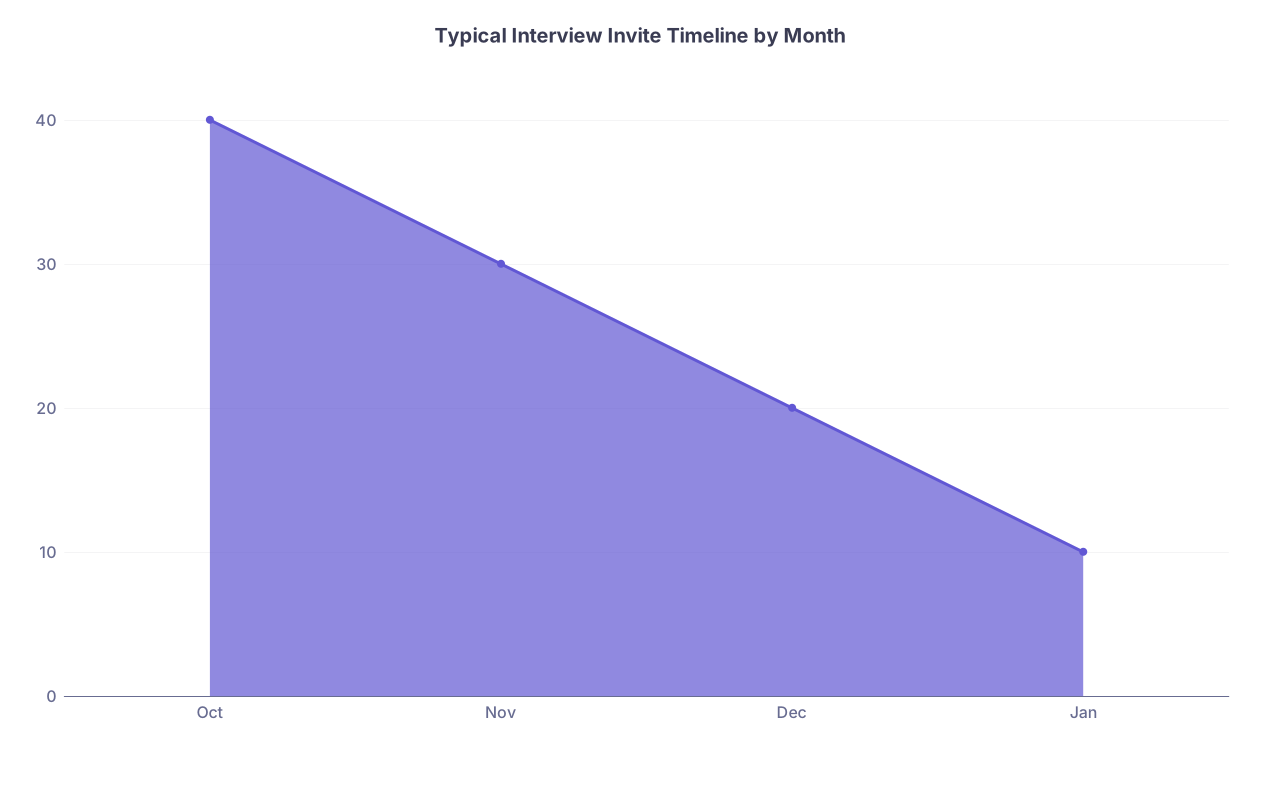
| Category | Value |
|---|---|
| Oct | 40 |
| Nov | 30 |
| Dec | 20 |
| Jan | 10 |
Early Interview Season (Oct–Nov): First outcome update
At this point you should:
- After you receive your first few interview invites (even 1–2):
- Send a status email to your main faculty advocates.
Include:
- Number and type of interviews so far (no need for exact program names unless they ask).
- A short line: “Your letter and guidance have been incredibly valuable in reaching this stage.”
If you received an interview at their institution:
- You must tell them:
- “I was very happy to receive an interview invitation from [their program] on [date]. I look forward to seeing the team again.”
This gives them a chance to quietly mention your name at a meeting. That is how advocacy actually works.
Mid‑Season (Nov–Dec): Targeted thank‑you and micro‑updates
You are in the middle of traveling or virtual interviews. At this point you should:
- Send maybe one email in this period to key faculty (not everyone you ever met).
- Content:
- Rough total number of interviews (e.g., “about 10 internal medicine interviews so far”).
- 1–2 short reflections:
- Patterns you are seeing.
- How their advice played out.
If you have zero or very few interviews?
- Do not vanish. Instead:
- Be honest but not emotional:
- “So far I have [few/no] interview invitations. I maintain strong interest in internal medicine and appreciate your earlier support. If you have any additional advice at this stage, I would be very grateful.”
- Be honest but not emotional:
Do not ask them to “contact programs for you.” Many will not. A few may choose to on their own if they believe strongly in you.
Late Season (Dec–Jan): Pre‑rank interactions
By late January you roughly know where you stand.
At this point you should:
- Send a final pre‑rank update, especially to:
- Faculty whose letters are central
- Anyone at institutions where you interviewed
Include:
- Whether you completed all scheduled interviews.
- General sense of fit (no drama).
- One explicit thank‑you line:
- “Your support has been a critical part of me reaching this point.”
You may briefly mention:
- Regions or types of programs you are most strongly considering.
- If their institution is near the top of your list and you interviewed there, a polite line like:
- “I felt especially at home at [their program] and it remains one of my top choices.”
You are not required to say “number 1” unless you actually mean it. Do not over‑promise; program directors talk.
February: Rank List Finalization – Last Strategic Contact
This is your final structured touch before Match week.

At this point you should:
- Decide whom to contact:
- Faculty who wrote you strong letters.
- Faculty at your top 3–5 programs.
- Send a short “closing the loop” email.
Content:
- One sentence: you have submitted your rank list.
- One sentence: you appreciate their mentorship / support.
- If relevant:
- A short, honest statement if their program is ranked highly.
For example:
- “I ranked [their program] very highly and would be honored to join the team if I match there.”
No begging. No drama. Professional tone.
March: Match Week – How to Respond, Match or No Match
Match week is emotional. This is where many applicants send impulsive emails that age badly. You will not.
If you match
At this point you should:
- Within 48–72 hours:
- Email every major faculty supporter:
- Tell them where you matched and in what specialty.
- Explicitly thank them for their role.
- Email every major faculty supporter:
- For attendings you were closer to:
- Consider a brief handwritten card mailed to the hospital or department. Very few people do this. Those who do are remembered.
You just turned a short‑term supporter into a long‑term mentor.
If you do not match
Painful, yes. But this is where professional relationships pay off.
At this point you should:
Wait 24–48 hours to calm down.
Then email key faculty with:
- A factual statement:
- “I unfortunately did not match this cycle.”
- A short, mature reflection:
- “I intend to continue working toward internal medicine and I am evaluating options (research, additional USCE, reapplication).”
- A request:
- “If you have any guidance or would be willing to briefly discuss my next steps, I would be very grateful.”
- A factual statement:
Some will not have time. Some will. I have seen unmatched IMGs get meaningful help (research positions, new USCE, second‑cycle letters) because they handled this exactly like that.
Do not disappear from embarrassment. They know IMGs fail to match every year. Hiding looks worse than being honest.
How Often to Contact Whom: A Simple Structure
To keep yourself from over‑ or under‑doing it, use a tiered system.
| Faculty Type | Typical Contact Frequency |
|---|---|
| Primary letter writer, mentor | Every 1–2 months |
| Secondary LoR writers | Every 2–3 months |
| Brief contact attendings | Only for major updates |
| Program leadership (PD/APD) | 2–4 times per cycle |
If you are wondering, “Is this too much?” it probably is. Err on the side of fewer, higher‑quality emails.
Common Relationship Killers (Avoid These)

At this point you should be ruthlessly honest with yourself about your behavior. I have watched many IMGs damage their relationships with a few poor choices.
Mass, generic emails
- Sending “Dear Professor” blasts to 10 people with identical text.
- They can tell.
Over‑sharing personal problems
- Long stories about visa stress, family issues, money.
- Short mention is fine; emotional dumping is not.
Asking them to pressure programs
- “Can you call X program and ask them to interview me?”
- If they want to do that, they will. Unprompted.
Last‑minute demands
- “I need a letter in 3 days.”
- You will get a rushed letter or a silent refusal.
Vanishing until you need something
- Zero updates for 9 months, then “Please send new LoR tomorrow.”
- That is how you become “just another IMG” in their inbox.
Example Annual Rhythm (If You Finished USCE 1 Year Before Applying)
To tie this together, here is a condensed “at this point you should…” timeline for someone finishing USCE in March and applying that September.

March (Week 0–1)
- Thank‑you emails, confirm LOR, send CV + PS draft + bullet list of strengths.
April
- 1st update: exam status, current plans, short email.
May
- Focused question email: ask one targeted specialty/application question.
June
- Specialty alignment: share any related research, observerships, or conferences.
July
- Checkpoint: confirm exam results, application year, single vs dual specialty.
August
- ERAS prep: confirm they still support you, send near‑final PS and CV.
Early September
- Submit ERAS; email them to say it is submitted and thank them for the letter.
Oct–Nov
- First interview update: share approximate number and type of interviews.
Dec–Jan
- Mid‑season update: brief reflection, total interviews, continued gratitude.
February
- Rank list submitted: short note and thanks; mention if their program is high on your list.
March (Match week)
- Match: send result and thanks.
- No match: send factual update and request for guidance.
Key Takeaways
- Relationships with US faculty survive on structured, periodic, specific contact, not random “Hi doctor, how are you?” emails every few weeks.
- At each stage—from week 1 after USCE to Match week—you should know exactly what you are updating, what (if anything) you are asking, and how often you are writing.
- If you behave like a junior colleague rather than a desperate applicant, good attendings will treat you like a junior colleague—and that is who they advocate for when it matters.