
The biggest mistake IMGs make with USCE and Step 2 CK isn’t effort. It’s timing.
If you stack these in the wrong order, you lose letters, you waste visa-friendly opportunities, and your ERAS looks “half-finished” on the only date that actually matters: opening day.
Let me walk you through when to schedule US clinical experience relative to Step 2 CK if you want maximum impact on your Match chances—not just “some USCE” and “I passed the exam.”
Big Picture: How Step 2 CK and USCE Fit Into the Match Clock
At this point, you need to anchor everything to one date: ERAS application opening for residency (usually early–mid September).
Programs don’t care when you planned to have USCE or Step 2 CK. They care what’s already done and visible in ERAS on:
- ERAS submission day (September)
- And the first 4–6 weeks after, when they send most interview invites
Here’s the simple hierarchy programs use, whether they admit it or not:
- Do you have a Step 2 CK score they can judge?
- Do you have recent, US-based clinical experience?
- Do you have strong US letters of recommendation (LoRs) from that experience?
- Is everything uploaded and finalized by the time they screen?
Your job is to time Step 2 and your USCE so that:
- Step 2 CK score is back in ERAS by early September
- At least 1–2 USCE rotations are complete by August
- 2–3 strong US LoRs are uploaded before most programs start reviewing heavily (late September/early October)
To see it cleanly, here’s how the key pieces interact:
| Item | Ideal Timing vs ERAS | Why It Matters Most |
|---|---|---|
| Step 2 CK Exam | 8–10 weeks pre-ERAS | Score ready on Day 1 |
| First USCE Rotation | 4–6 months pre-ERAS | Start building LoRs |
| Last USCE Rotation | 0–2 months pre-ERAS | “Recent” and relevant |
| LoR Upload Deadline | 0–4 weeks post-ERAS | In time for screening |
Now we build the real timeline.
12–18 Months Before ERAS: Set the Sequence
At this point, you should decide the order:
- Step 2 CK → then USCE
- USCE → then Step 2 CK
- Or a staggered combination
Here’s my blunt opinion after years of watching IMG applications:
If your Step 1 is weak, old, or missing (pass only), you schedule Step 2 CK first and do not cram serious USCE before it. Your score is your ticket to interviews. No Step 2 = many filters auto-reject you.
If You’re Still in Med School (Final Year)
At this point, you should:
- Map your graduation date
- Confirm if you can take Step 2 CK before or right after graduation
- Block out dedicated Step 2 study time (at least 6–8 weeks)
- Identify available USCE months during electives or just after graduation
For still-in-school IMGs, the clean sequence for the Match you’re targeting often looks like:
- Final year: Core rotations at home, minor Step 2 prep started
- 9–12 months before ERAS: Dedicated Step 2 CK prep
- 8–10 months before ERAS: Take Step 2 CK
- 6–0 months before ERAS: Stacked USCE (2–3 months total)
If You’ve Already Graduated (Older Grad / Gap Years)
You don’t have the luxury of looking “in training” forever. At this point, you should:
- Decide your target ERAS year now (do not drift)
- Get an honest score projection (NBME/Free 120) for Step 2 CK
- If your clinical skills are rusty, consider 1 low-intensity observership before Step 2, but nothing that derails your study schedule
For most older grads:
You prioritize Step 2 CK. Then you load USCE in the 6–9 months before ERAS.
Month-by-Month Timeline: Ideal 12-Month Plan Before ERAS
Assume ERAS opens September of Year X. Work backward.
October–December (Year X–1): Foundation & Strategy (–11 to –9 months)
At this point you should:
- Lock in your target specialty (IM, FM, psych, etc.)
- Book your Step 2 CK exam for around mid-May to June
(Gives enough buffer for delays and for the score to post) - Start booking USCE for March through August
(US rotations fill up quickly; good ones are gone 6+ months ahead)
Rough plan:
- October: Research USCE providers and hospital-based electives
(e.g., AMO, MedClerkships, institution-based programs) - November: Apply, pay deposits, and lock dates for 2–3 months of USCE
- December: Build your Step 2 content plan and NBMEs schedule
January–March: Heavy Step 2 CK Prep, Minimal USCE (–8 to –6 months)
At this point you should:
- Treat Step 2 CK as your full-time job
- Avoid intensive USCE that eats your mental bandwidth
Your weekly rhythm:
- 5–6 days/week: UWorld blocks, Anki, system-based review
- Every 3–4 weeks: NBME or self-assessment to recalibrate
- Admin:
- Confirm USCE dates and housing options
- Gather documents: immunizations, CV, dean’s letter, transcript
If you really insist on some early exposure:
- Do one 2–4 week observership in February or March
- Use it mainly to:
- Understand US rounding style
- Get feedback on communication
- Hear what attendings actually praise/criticize in IMGs
But again: do not let this delay or weaken your Step 2 CK performance.
April–June: Step 2 CK Execution, Start of Serious USCE (–5 to –3 months)
This window is critical.
Step 2 CK Timing
You want the Step 2 CK score report available by early August at the latest.
- Step 2 scores usually take 2–4 weeks to post
- So, your exam date should be between mid-May and early July
At this point you should:
- April:
- Increase practice tests
- Fill any weak subject gaps (OB/GYN, peds, biostats)
- May:
- Take Step 2 CK in the first half of the month if ready
- June:
- Hard stop: if you are still not at your target NBME scores by late May, you can push the exam into June—but no later than early July if you want the score in ERAS on Day 1
First Strong USCE Rotation
If your Step 2 is scheduled for late May/early June, then:
- Book your first major USCE rotation for:
- Late June or July (right after the exam)
- This way:
- Step 2 CK is off your back
- You can fully focus on impressing attendings
The goal of this first major USCE:
- Adjust to US hospital systems
- Learn EMR workflow, pre-rounding, presenting
- Identify at least one potential letter writer
July–September: USCE Peak + ERAS Launch (–2 to 0 months)
This is where the timing of USCE directly affects your Match odds.
July–August: Most Important USCE Window
At this point you should:
- Be in full-time USCE, preferably:
- In your target specialty
- In programs that have a residency or are affiliated with one
- Be actively hunting for letters
- Tell attendings by week 2: “I’m applying this cycle. I’d be honored to get a letter if I meet your expectations by the end of the rotation.”
Why July–August rotations hit hardest:
- LoRs from these months are:
- Recent (“just rotated with us this summer”)
- Fresh in attendings’ memory
- These letters can be:
- Requested immediately
- Uploaded to ERAS by late September/early October
You should aim for:
- 2–3 USCE rotations total before ERAS is heavily reviewed
- At least 2 strong US letters from those rotations, ideally 3:
- Same specialty as your application
- US-based, inpatient or strong outpatient with continuity
Step 2 Score and ERAS (September)
Now, the key question: Where should your Step 2 CK result be by ERAS opening?
For maximum impact:
- Best case: Step 2 CK score already in ERAS by early September
- Acceptable: Score arriving by late September if you indicate the date in ERAS and some programs are willing to wait
- Bad idea: Taking Step 2 in September or later, hoping they wait. Many will not.
At this point you should:
- Have your ERAS application 90–100% ready by early September:
- Personal statement done
- CV complete
- Experiences polished
- Step 2 CK result in (or at least taken)
If your Step 2 CK isn’t done by September, your USCE cannot fully compensate at highly competitive or even mid-tier programs. Too many filters hinge on that number.
Day-by-Day Focus Inside Each USCE Rotation
Order matters inside the rotation itself, too. You’re not just “there to observe.” You’re there to engineer LoRs before ERAS files start getting sorted.
At this point in any given month-long USCE, your internal clock should look like this:
Week 1: Prove You’re Safe and Reliable
- Show up early. Every day. No exceptions.
- Learn:
- Clinic flow
- How to write notes (even if unofficial)
- How they want presentations
- Say clearly to your main attending:
“I’m really hoping to learn US-style medicine so I can apply to residency here.”
Week 2: Increase Responsibility
At this point you should:
- Start presenting patients with structure (CC, HPI, assessment/plan)
- Offer:
- “Would it be helpful if I pre-round on patients 3 and 4 tomorrow?”
- Ask for feedback:
- “Is there anything I should adjust in my presentations to be more in line with your expectations?”
Week 3: Set Up the Letter Ask
- Identify who seems happy with your work
- Ask for a mid-rotation check-in:
- “I’m applying this year. If by the end of the rotation you feel you can write a strong letter, that would mean a lot to me. Is there anything I should work on in these last two weeks to get there?”
Week 4: Close the Loop
- Directly ask for LoR from 1–2 attendings
- Provide:
- Your CV
- Personal statement draft
- ERAS LoR request form / email link
- Ask for a deadline:
- “Programs start downloading files in late September. Would it be possible to submit the letter by the end of this month?”
This week-by-week intensity is exactly why you don’t want Step 2 CK hanging over your head during your most important USCE months.
Alternative Scenarios: What If Your Timing Is Off?
Life happens. Let’s walk through three common “off-timeline” cases.
Scenario 1: Step 2 CK Taken Late (August–September)
Impact:
- Score might not appear by early application review
- Some programs will screen you out automatically
At this point you should:
- Still complete strong USCE in July–October
- Email programs (selectively, not spam) once your Step 2 result posts, updating them
- Make sure your ERAS indicates that Step 2 was scheduled at the time of submission
You can still match. But you’ve made the path steeper.
Scenario 2: USCE All Done Early (January–March), Nothing Recent
I see this constantly: IMGs do USCE early in the year and then disappear to study.
Impact:
- Letters are older (6–9 months old by the time of review)
- You miss the recency effect programs look for
At this point you should:
- If budget allows, add 1 short USCE rotation in July–August
- Or at least get updated letters from prior attendings, asking them to:
- Add a fresh paragraph about your ongoing progress
- Keep in light email touch with letter writers so they remember you
Scenario 3: No USCE Before ERAS, Plan for Post-ERAS Rotations
This is common among late planners or budget-limited applicants.
Impact:
- Your ERAS looks weaker on Day 1
- Some community programs will still consider you if you show active, current USCE and update them
At this point you should:
- Still apply to a broad list
- Start USCE in October–January after submitting ERAS
- Then:
- Ask those attendings to email programs directly supporting you
- Update programs through ERAS with new LoRs and experiences
This is not optimal timing. But it’s better than skipping USCE entirely.
Visual Timeline: Ideal Year Before ERAS
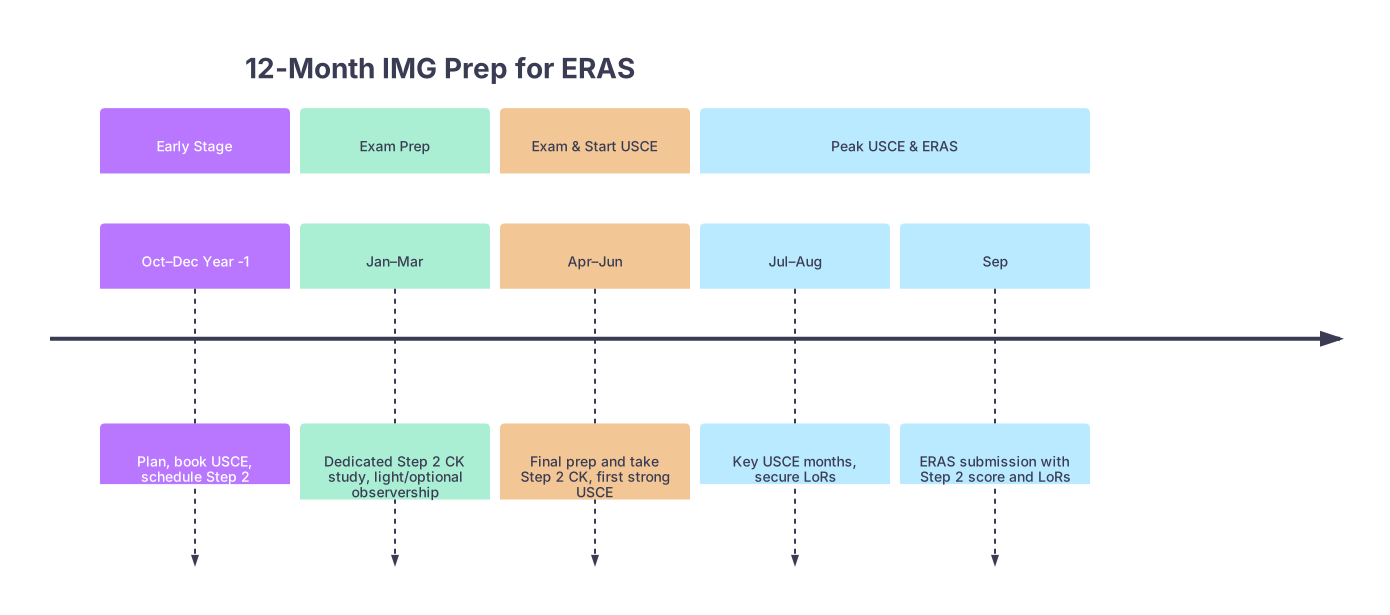
| Period | Event |
|---|---|
| Early Stage - Oct–Dec Year -1 | Plan, book USCE, schedule Step 2 |
| Exam Prep - Jan–Mar | Dedicated Step 2 CK study, light/optional observership |
| Exam & Start USCE - Apr–Jun | Final prep and take Step 2 CK, first strong USCE |
| Peak USCE & ERAS - Jul–Aug | Key USCE months, secure LoRs |
| Peak USCE & ERAS - Sep | ERAS submission with Step 2 score and LoRs |
How Programs Actually Weigh These Pieces
To ground this, think like a PD in internal medicine reviewing 2,000 IMG applications.
- Filter 1: Step 2 CK above cutoff?
If no → many files never seen. - Filter 2: Recent graduation or current clinical activity?
If nothing clinical in the last 2–3 years → big red flag. - Filter 3: US letters from real clinical work?
Observership-only letters with generic fluff carry less weight than hands-on sub-internship–style letters.
That’s why the relative timing looks like this on a graph of influence:
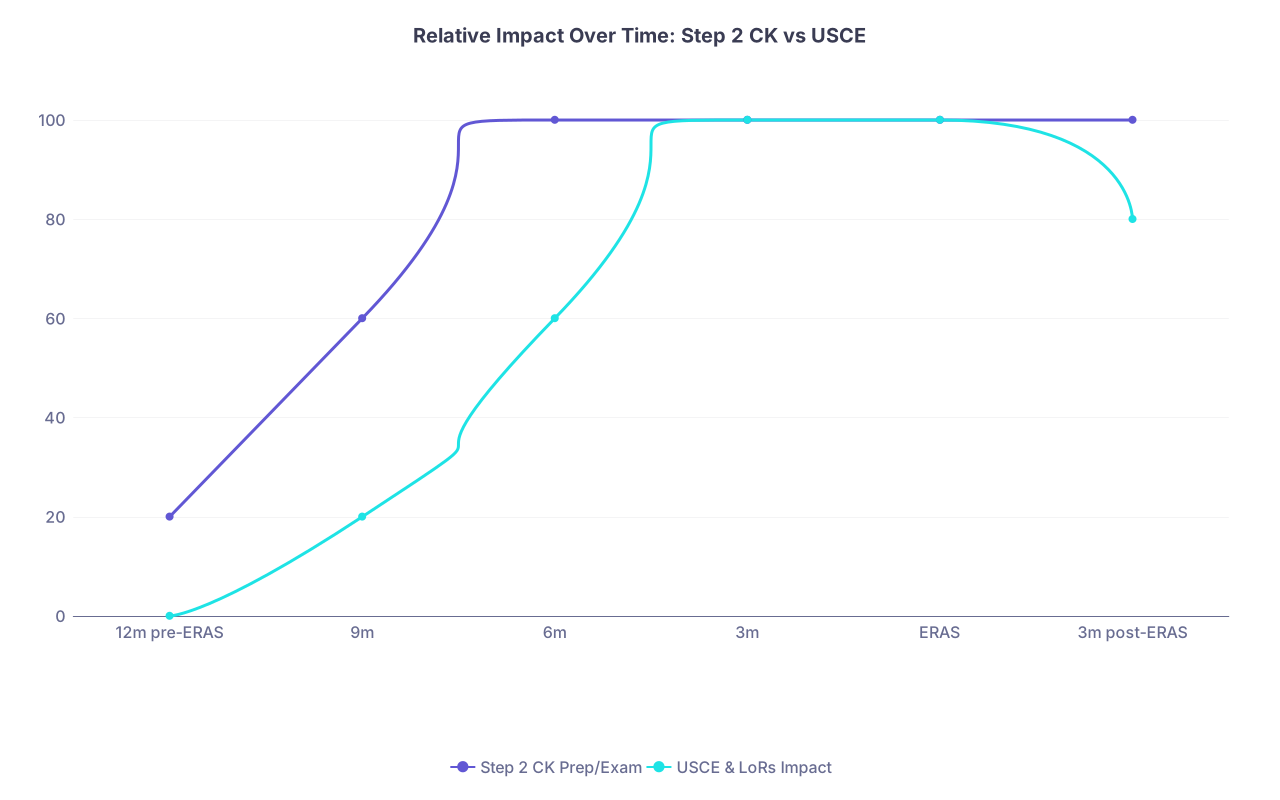
| Category | Step 2 CK Prep/Exam | USCE & LoRs Impact |
|---|---|---|
| 12m pre-ERAS | 20 | 0 |
| 9m | 60 | 20 |
| 6m | 100 | 60 |
| 3m | 100 | 100 |
| ERAS | 100 | 100 |
| 3m post-ERAS | 100 | 80 |
The Step 2 CK score matters throughout.
USCE and LoRs peak in influence right around ERAS and the first wave of interview invites.
Quick Specialty-Specific Tweaks
This isn’t one-size-fits-all. A few nuances:
- Internal Medicine / Family Medicine / Pediatrics
- 2–3 months of USCE before ERAS is ideal
- Step 2 CK score early is critical for filters
- Psychiatry
- USCE in psych helps a lot, but any recent USCE is better than nothing
- Communication skills during USCE heavily influence letters
- Surgery / OB-GYN
- Hands-on, sub-internship–style rotations are best
- Step 2 CK must be strong; don’t sacrifice score for extra USCE months
But in all of them, the logic is the same:
Score before filters. USCE before letters. Letters before review.
Final Takeaways
Keep it simple:
- Take Step 2 CK 2–3 months before ERAS so your score is posted by early September. Without this, your USCE impact is capped.
- Stack your strongest USCE in the 3–6 months before ERAS, especially July–August, so your US LoRs are recent and ready during screening.
- Use each rotation week intentionally—Week 1 to adapt, Weeks 2–3 to shine, Week 4 to lock letters—so your time in the US converts into something programs can actually judge.