
What if you spend thousands of dollars, fly across the world for US clinical experience… and your attending never offers you a letter of recommendation? Or worse, you ask—and they say no?
Yeah. That’s the nightmare.
Let’s walk straight into it instead of pretending it doesn’t happen. Because it does. A lot.
First: What “No Letter” Really Means (And What It Doesn’t)
Here’s the fear that usually shows up in your head:
- “They hate me.”
- “I must have done terribly.”
- “My chances of matching are dead.”
- “Everyone else in this rotation got a letter and I didn’t.”
Reality is usually way less dramatic and way more boring.
Some common reasons an attending doesn’t offer a letter:
- They never write letters for rotators or “observers” as a rule
- They feel they didn’t work closely with you long enough
- Hospital policy is weird about visitors/observers
- They’re overwhelmed, burned out, or just disorganized
- They already committed to letters for 4–5 students and can’t add more
And yes, sometimes:
- You didn’t stand out
- Your performance was average
- Your communication wasn’t great
- They’re not comfortable putting their reputation behind you
But “no letter from this one attending” ≠ “you’re unmatchable.”
I’ve seen people match IM, FM, psych with zero letters from their most prestigious USCE site… but 3–4 strong letters from other attendings or home-country supervisors who actually knew them.
So no, this is not the game-over moment your brain is telling you it is. It is a problem, but it’s a solvable one.
Before You Panic: Did You Actually Ask Clearly?
A lot of us (especially IMGs) do this thing:
We “hint” instead of ask. Like:
- “I really enjoyed this rotation with you.”
- “I’m applying for internal medicine this fall.”
- “Your mentorship has meant a lot to me.”
And we hope the attending will magically say, “Oh, would you like a letter?”
Many won’t. Not because they don’t like you. Because they’re busy and not reading your mind.
You need to ask directly, and you need to ask in a way that lets them say no without destroying you.
Something like:
“Dr. Smith, I’ve really appreciated working with you this month. I’m applying to internal medicine this Match cycle, and I wanted to ask if you’d feel comfortable writing me a strong letter of recommendation based on my performance on this rotation?”
Key word: strong. That gives them a way to say, “I don’t think I can write you a strong letter,” which is basically a polite no.
If you haven’t asked this clearly, you don’t actually know where you stand.
If You Asked… and They Said No (or Dodged It)
This is the part that really stings.
You finally work up the courage, ask properly, and you get something like:
- “I’m not really writing letters this year.”
- “I don’t feel I worked with you long enough.”
- “I’m not the best person to comment on your clinical skills.”
- Or the classic: “Sure, send me your CV,” and then silence for months.
Here’s what that doesn’t automatically mean:
- It doesn’t always mean you were bad
- It doesn’t always mean they disliked you
- It doesn’t always mean they’re secretly writing letters for everyone else
I’ve literally heard attendings say to residents:
“I just don’t write LORs for observerships. Too risky.”
“If I didn’t work with them closely, I’d rather not write anything than write something generic and hurt them.”
You know what’s worse than “no letter”?
A lukewarm letter.
The kind that says:
“X is polite and punctual. They observed patient care and seemed interested. They will do well in any program.”
That letter is basically admissions committee code for: “I don’t know this applicant and I’m not staking my name on them.”
Programs read between the lines. They’ve seen thousands of these. You’re better off not having that letter at all.
So weirdly, their “no” might be protecting you from a bland, damaging letter.
How Much Does Losing One USCE Letter Actually Hurt?
Let’s put this beside the anxiety for a second and look at it structurally.
Programs usually want something like:
- 3 letters minimum
- 4 letters max (ERAS hard cap)
Common mix for IMGs:
- 1–2 US clinical letters
- 1–2 home-country letters (including your dean’s/MSPE if applicable)
- Possibly one research letter if it’s strong and recent
If you expected:
- 2 letters from this USCE rotation
and you end up with - 0 from this attending (or 1 instead of 2)
You’re still not done.
You have other sources:
- Other rotations (even unpaid externships, clerkships, or telerotations, as long as there was real interaction)
- Previous USCE from last year
- Department chairs back home who know you clinically
- Research supervisors (if they can comment on work ethic, reliability, and clinical reasoning)
| Scenario | USCE Letters | Home Country Clinical | Research/Other |
|---|---|---|---|
| Minimum to Apply | 1 | 2 | 0–1 |
| Solid but Common | 2 | 1–2 | 0–1 |
| Strong for Competitive IM | 2–3 | 1 | 0–1 |
You don’t need a letter from every USCE attending. Programs care about the quality and clarity of your letters more than your total number of sites.
I’ve watched applicants match with:
- 1 USCE letter + 2 excellent home-country letters → matched FM/IM
- 0 USCE letters but phenomenal home program support → matched less competitive IM
- 3 USCE letters, but all generic → weak interview season, low match
So losing this single letter is a setback, not a death sentence.
How to Fix Things During the Rotation (If You’re Still There)
If you’re still on the rotation and getting the sense that your attending:
- Doesn’t see you much
- Only sees you on rounds
- Barely knows your name
You’re right to be worried about a letter from them.
Two moves here.
1. Increase Face Time and Responsibility (Without Being Annoying)
You can’t get a strong letter from someone who’s barely seen you think.
Try:
- Asking to pre-round on a small subset of patients and present briefly
- Preparing 3–5 minute teaching blurbs on relevant topics for the team
- Volunteering to write mock notes (if observers can’t chart) and asking for feedback
- Staying a bit later to help with signout or calls (within reason)
You want them to see you:
- Think through differential diagnoses
- Follow up on labs/imaging
- Communicate with nurses/patients professionally
- Admit when you don’t know something and then actually read up on it
2. Find Another Attending/Fellow on the Same Rotation
Some programs allow letters from:
- Fellows who supervised you closely
- Senior residents (co-signed or supported by attendings)
- Another attending who rounded with you more often
Ask the coordinator or chief resident quietly:
“Is there anyone else on this service who might be appropriate to ask for a letter, if they work closely with me?”
Spread your risk. Don’t anchor your entire future on one person’s mood.
If the Rotation Is Over and You Walked Away Empty-Handed
Okay. Worst-case-ish. Rotation is done, you flew back home, no letter.
You’ve got two separate problems now:
- The emotional punch (“I wasted money and time. I must suck.”)
- The practical gap in your application
Let’s deal with both.
1. Emotionally: Interpreting This Without Destroying Yourself
Ask yourself—honestly, not dramatically:
- Did they actually see my best work?
- Was I timid, quiet, or scared to speak up?
- Did language/accent issues slow me down a lot?
- Did I understand the system, workflow, EMR, enough?
- Did I get any informal feedback, good or bad?
Sometimes the issue was just: you were anonymous.
You weren’t horrible. You just weren’t memorable. And attendings aren’t going to attach their name to “I don’t really know them.”
That’s fixable on future rotations. It’s not some permanent verdict on your worth as a doctor.
2. Practically: Patching the Letter Gap
Here’s what you can still do:
Reach out politely once by email:
- “Dr. X, thank you again for the opportunity to rotate with you in [month/year]. I learned a lot, especially about [specific thing]. I’m applying to [specialty] this Match and wanted to ask if you’d feel comfortable writing a strong letter of recommendation commenting on my clinical skills and performance during the rotation. I’ve attached my CV and personal statement. I completely understand if you’re unable to at this time.”
- If they ignore that, you move on. Don’t chase.
Strengthen other letters:
- Go back to home faculty who like you and say:
- “Would you be willing to highlight my clinical reasoning, teamwork, and reliability in a detailed letter for US residency?”
- Go back to home faculty who like you and say:
Add new USCE (even short-term):
- Another 4-week US inpatient/outpatient rotation where you’re more assertive about:
- Getting feedback mid-rotation
- Asking for a letter early if feedback is positive
- Working closely with one main supervisor instead of floating everywhere
- Another 4-week US inpatient/outpatient rotation where you’re more assertive about:
Use a research mentor (if they can talk about work habits, independence, communication) as a 4th letter, not your main clinical one.
Load-Balancing Your Letters: Strategy, Not Panic
The goal is not “get letters from everyone.” It’s:
- 3–4 letters where at least 2 clearly say:
- You can function on a clinical team
- You think logically
- You’re safe, reliable, and teachable
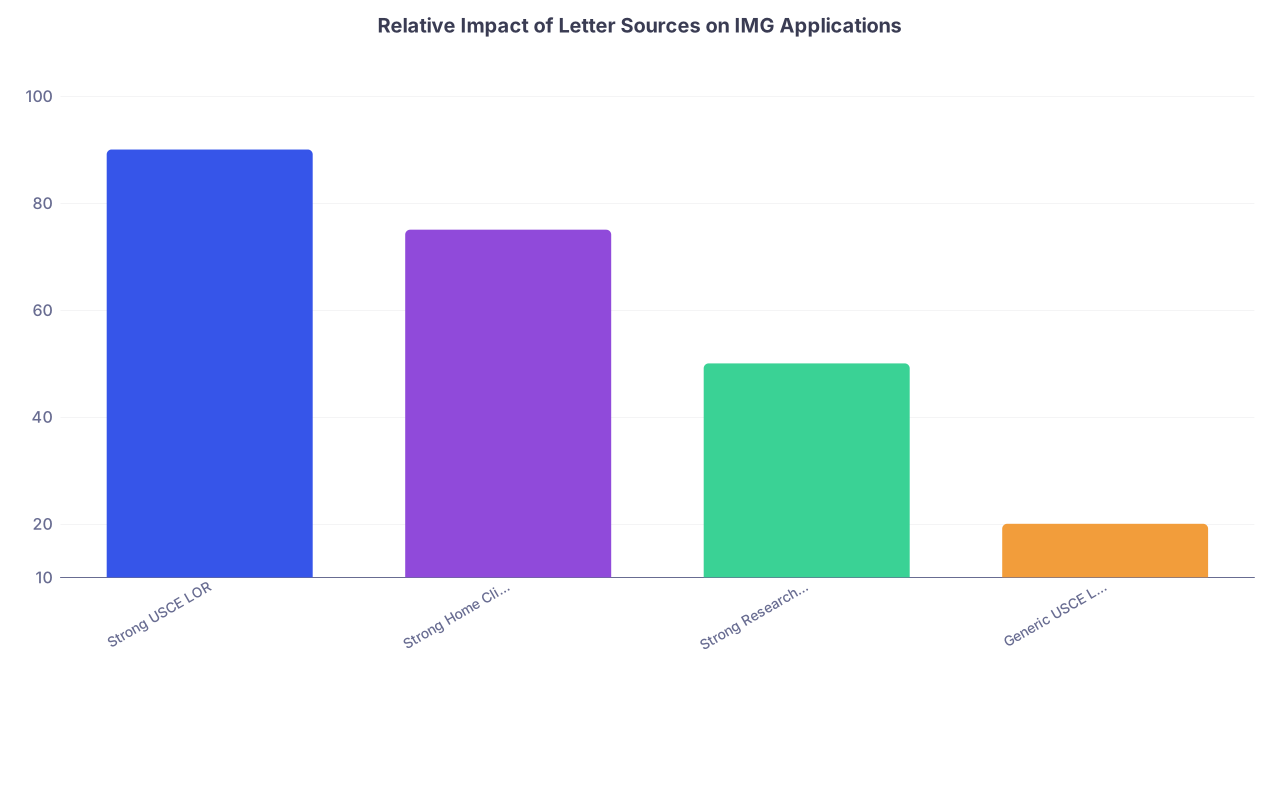
| Category | Value |
|---|---|
| Strong USCE LOR | 90 |
| Strong Home Clinical LOR | 75 |
| Strong Research LOR | 50 |
| Generic USCE LOR | 20 |
Generic USCE letters are honestly overhyped. A strong home letter from a department head who actually knows you can absolutely compete.
If you’re applying IM/FM/psych/neuro as an IMG, programs are asking:
- “Did any actual physician put their name on this person and say: I trust them with patients?”
- “Do they understand basic inpatient/outpatient flow?”
- “Are they a nightmare to work with?”
You don’t need twelve people to say yes. You need 3–4.
What To Do On Your Next USCE So This Doesn’t Repeat
This is where your anxiety can actually become useful. Let it push you to be intentional instead of just scared.
On your next USCE:
Ask for feedback early.
Around week 2:“Dr. Y, could I get some feedback on how I’m doing and what I could improve over the rest of the month?”
This gives you a chance to fix things before it’s too late.
Target one main letter-writer per rotation.
Don’t try to impress 8 attendings. Focus on 1–2 who:- Actually see you work
- Let you present patients
- Give you direct instruction
Ask around week 3 if things feel positive.
Don’t wait until the last day when they barely remember you and are sprinting to clinic.Make it easy for them.
- Send CV, personal statement
- Bullet a few specific cases you worked on with them as reminders
- Remind them of deadlines without harassing them
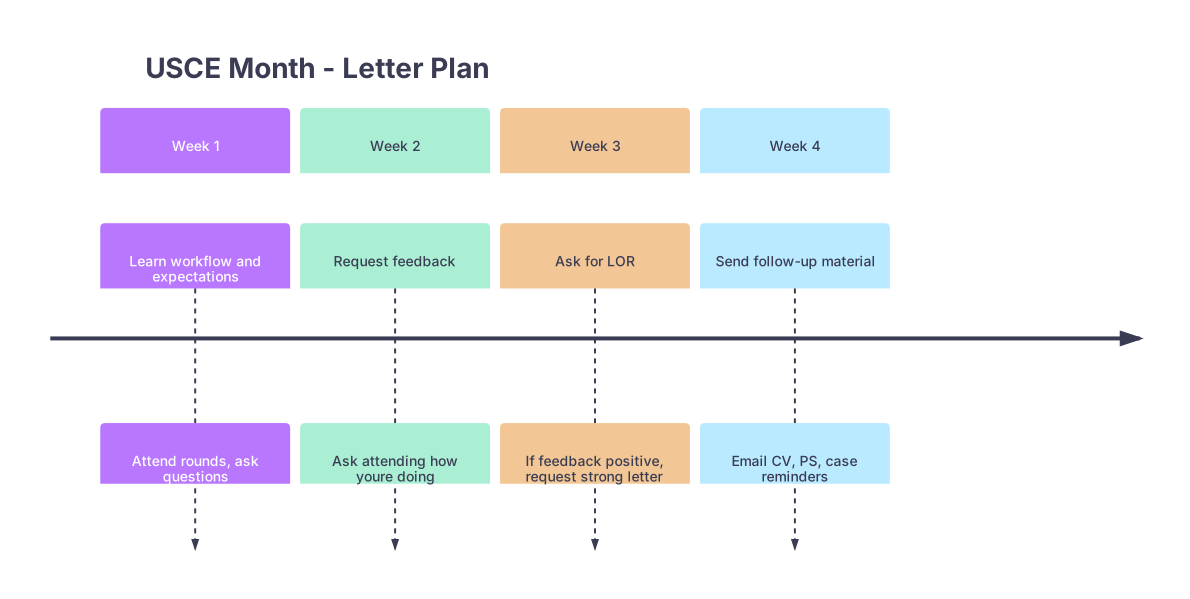
| Period | Event |
|---|---|
| Week 1 - Learn workflow and expectations | Attend rounds, ask questions |
| Week 2 - Request feedback | Ask attending how youre doing |
| Week 3 - Ask for LOR | If feedback positive, request strong letter |
| Week 4 - Send follow-up material | Email CV, PS, case reminders |
This is how you keep from walking away empty-handed again.
When Should You Actually Start to Worry?
Worry is your baseline state—I get it. But let’s separate rational worry from your brain’s disaster fanfiction.
You should start to worry strategically if:
- You’ve done 2–3 USCE rotations and still have 0 letters from any of them
- Every attending gives vague or negative feedback
- People avoid committing to a letter even when you ask clearly and early
- Your only letters are:
- Old (5+ years back)
- Non-clinical
- From people who barely know you
That pattern might mean:
- There’s a real gap in your clinical skills or communication
- Your English/communication issues are serious enough to block letters
- You’re too passive/quiet
- You’re choosing observers where attendings simply never write letters
Then yes, it’s time to:
- Sit down with someone honest (mentor, PD back home, resident you trust)
- Ask for brutally honest feedback
- Possibly consider another year to fix gaps (language course, more hands-on USCE, research with clinical exposure, etc.)
But one attending. One rotation. One “no” or silence?
It hurts. It’s not fatal.
FAQ (Exactly 4 Questions)
1. Should I still list that USCE on my ERAS if I didn’t get a letter from it?
Yes. Absolutely. The rotation still counts as experience. Programs don’t expect a letter from every single experience you list. You just don’t highlight it as your main letter source. If they ask in an interview why no letter from there, you can say: “Dr. X doesn’t routinely write letters for visiting rotators, and I ended up getting my letters from attendings who worked more closely with me.”
2. Is one USCE letter enough as an IMG?
It can be, but it’s not ideal. One strong USCE letter + 2–3 strong home-country letters is workable, especially for FM/IM. For more competitive programs, 2 USCE letters is safer. If you’re stuck at 1, just make sure it’s very strong, and that your other letters are detailed, recent, and from people who know your clinical work well.
3. Should I ask an attending for a letter if I’m not sure they liked me?
Ask for feedback first. Something like: “Do you feel I’ve been performing at the level expected for this rotation?” If their answer is weak, vague, or negative, do not ask for a letter. You don’t want a polite-but-bad LOR. If they genuinely seem positive, then you can ask for a strong letter. If they hesitate, back off.
4. What if I already asked, they said yes, but they’re not uploading the letter?
Give them 1–2 gentle reminders spaced 1–2 weeks apart, especially as deadlines approach. Make it easy: resend the ERAS instructions, your CV, PS, and maybe a list of cases you worked on together. If they still don’t send it, assume it’s not coming and don’t rely on it for your minimum 3 letters. It sucks, but it happens. Build your application as if that letter doesn’t exist, and treat it as a bonus if it finally shows up.
Key Takeaways
- One attending not offering you a letter does not automatically mean you’re a bad candidate—or that you won’t match.
- A weak or generic letter is often worse than no letter; a “no” can be protective, even if it feels awful.
- You can and should build a strong letter set from other attendings, home-country supervisors, and future rotations—if you’re deliberate about how you work and when you ask.