
Last week, an IMG from India messaged me at 2:17 a.m. her time. ERAS profile open on one screen, NRMP statistics on the other, she typed: “I have zero US clinical experience. Be honest… should I just give up this cycle?”
If you’re reading this, there’s a decent chance you’re sitting in the same headspace. Tabs open: Reddit, AAMC data, “USCE requirements,” some old SDN thread where everyone sounds like a genius with 260s and five U.S. letters. And in your head, that awful sentence keeps replaying:
“I don’t have U.S. clinical experience. I’m already screwed, right?”
Let me answer that directly: No, you’re not automatically doomed. But you are behind in a way you can’t afford to ignore or sugarcoat.
You can still match.
You just don’t get to be casual about this.
What “No U.S. Clinical Experience” Really Signals To Programs
Let’s rip off the Band-Aid. Programs don’t see “no USCE” and think, “Ah, we hate foreigners.” That’s the lazy story we tell ourselves when we’re scared.
What they actually think is more like:
- “We have no proof this person can function in the U.S. system.”
- “We don’t know if they understand U.S. documentation, EMR, or patient communication norms.”
- “We don’t have any U.S.-based attending we trust saying, ‘Yes, this person is safe and teachable.’”
So “no USCE” is not a moral failing. It’s a data problem. They’re trying to reduce risk, and you’re basically asking them to trust a system thousands of miles away, with no local references to back you up.
That’s the core issue:
- No U.S. evals
- No U.S. letters
- No demonstrated adaptation to U.S. culture/workflow
And in a competitive pile of applications, that’s a real disadvantage.
Not fatal. But real.
Here’s how it plays out in the numbers.
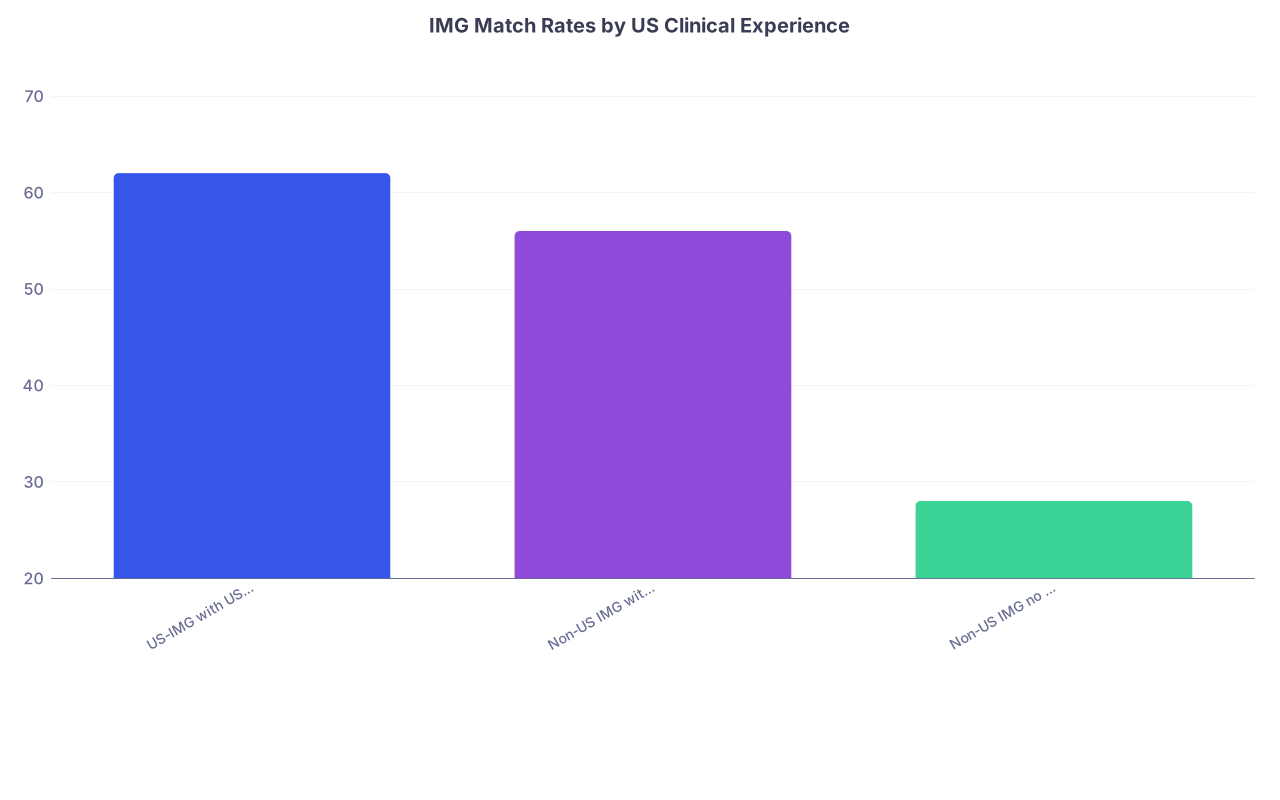
| Category | Value |
|---|---|
| US-IMG with USCE | 62 |
| Non-US IMG with USCE | 56 |
| Non-US IMG no USCE | 28 |
Those aren’t official AAMC numbers; they’re in the ballpark of what I’ve seen across cohorts: non‑US IMGs with no U.S. experience get crushed compared to those who have even a few months of rotations or observerships.
So no, your application isn’t automatically dead.
But if you submit with:
- No USCE
- No U.S. letters
- Average scores
- Generic PS
You’re basically playing on hard mode with no weapons.
The Ugly Truth: Where No USCE Hurts You The Most
You feel anxious for a reason. Some of that anxiety is exaggerated, but some of it’s your brain correctly noticing, “Hey, this is a weak point.”
Here’s where no USCE hits hardest:
Interview Filters
A lot of programs, especially the community IM ones that are usually more IMG-friendly, have a quiet filter: “USCE required or strongly preferred.” They may not write it on their website, but the coordinator reading 5,000 applications definitely sees “no USCE” and moves on.Letters of Recommendation
Programs love reading: “I supervised this applicant in my U.S. clinic/ward and would rank them in the top 10% of students I’ve worked with.”
If all your letters are from your home country and nobody in the U.S. has ever seen you write a note in Epic or present a patient, you’re asking them to take your file on faith.Perceived “Flight Risk” / Adjustment Risk
They worry you might:
- Struggle with English in real-time patient encounters
- Be thrown by U.S. hierarchy and expectations
- Need a lot more hand-holding the first months of intern year
USCE is their test drive. No USCE = “We have no test drive. We’re guessing.”
- Reddit + Myth Culture Making You Feel Even Worse
There’s a toxic feedback loop:
- People who matched: “I had USCE at Harvard, 265, research, 4 pubs.”
- People with no USCE who didn’t match post bitter horror stories.
You read both and conclude: “Everyone with USCE matches. Everyone without fails.”
That’s not true.
But it’s loud. And it gets in your head.
When No USCE Is a Big Problem vs When It’s Just a Weakness
Not all “no USCE” situations are equally bad. Here’s where I’ve seen the difference.
| Profile Type | Impact of No USCE |
|---|---|
| Non-US IMG, average scores | Very high impact |
| Non-US IMG, strong scores | High but survivable |
| US-IMG (Caribbean etc.), decent scores | Moderate to high |
| US citizen, foreign school, strong scores | Moderate |
| Already doing U.S. research with patient contact | Lower impact |
You’re in real trouble if you’re:
- A non‑US citizen
- No U.S. rotations
- No U.S. letters
- Step 2 CK around average (say 220–230)
- Gap years with nothing recent clinically
This combo makes programs nervous. They’ll ask:
“Why haven’t they even shadowed in the U.S.? Are they serious about practicing here?”
On the other hand, I’ve seen people match with no formal “USCE” when:
- They had strong scores (240+ CK)
- They did U.S. research in a clinical department, with some patient exposure
- They had at least one U.S. letter (research mentor, volunteer clinic, etc.)
- They applied smartly (IMG-heavy, community programs, broad list)
So no, there’s no single rule like, “No USCE = 0% chance.” Anyone saying that is exaggerating.
But if you’re applying with zero U.S. anything, and nothing recent, you’re asking for a long, painful rejection season.
“I Have No USCE And This Cycle Is Coming Up. Now What?”
This is the part where your brain wants a magic fix:
“Do this one observership and boom, problem solved.”
It doesn’t work like that. But you can still improve your odds in a focused way, even late.
1. Get Some U.S. Exposure — Even If It’s Not Perfect
Is a 4-week hands-on elective at a big-name academic center ideal? Sure.
Is it realistic for many IMGs late in the game? Not really.
Here’s what’s still useful:
- Observerships in community hospitals
- Shadowing in outpatient clinics
- Telemedicine shadowing/observership (not perfect, but better than nothing)
- Volunteer roles in free clinics where you see workflows and interact with patients
Programs know IMGs don’t always have visa or school-approval flexibility. Even a humble community clinic letter that says, “This person showed up, took feedback, and communicated well with patients" is better than nothing.
If you’re 3–6 months from application season, I’d rather you have:
- Two months of a low-prestige but real U.S. observership + 1 solid letter
than - Zero U.S. exposure while you obsess over “brand name” and end up with nothing.
2. Secure At Least One U.S. Letter, Ideally Two
If I had to pick one lever that matters most: get a U.S. attending to write you a detailed, specific letter.
Not “To whom it may concern, they are hardworking, punctual, blah blah.”
But something with:
- Concrete scenarios
- Comparison to U.S. grads/trainees
- Comments on communication and professionalism
How to get this fast:
- Observership → show up early, ask for feedback, ask for small tasks (notes drafts, literature searches), then request a letter.
- Research position → if you’re in a U.S.-based group, ask the PI to comment not just on research but your reliability, communication, and clinical insight.
- Community clinic → you may get more facetime with attendings here than at a huge academic hospital where you’re “Observer #47.”
If you enter the match with zero U.S. letters, your file screams, “Nobody here has seen me work.”
You want at least one person in the U.S. willing to vouch for your clinical brain and work ethic.
When It’s Smarter To Delay a Cycle
I know you don’t want to hear this. You want “Yes, apply now, maybe you’ll get lucky.”
But I’ve seen people burn $5,000–$10,000 on a hopeless cycle when they would have been much better off waiting one year and actually fixing their weak spots.
You should seriously consider delaying if:
- You have no USCE, no US letters, and no realistic way to get any before applications open
- Your Step 2 CK is < 230 and you’re aiming for IM/FM but your CV is otherwise thin
- You graduated > 5 years ago and have nothing recent to show you’re still clinically active
A “Hail Mary” application with:
- No USCE
- No U.S. letters
- Old graduation
- Average scores
isn’t brave. It’s wasteful.
Use a year to:
- Do 3–6 months of observerships/externships
- Get 2 U.S. letters
- Volunteer clinically in the U.S.
- Polish your story so it doesn’t sound like “I randomly decided I like internal medicine last week”
And yes, it sucks to wait. It hurts to see classmates matching while you “fall behind.”
But matching one year later is infinitely better than not matching three cycles in a row because you never fixed the same fundamental problem.
How To Frame “No USCE” Without Sounding Defensive
You can’t just ignore it and hope no one notices. But you also shouldn’t write a 500‑word apology in your personal statement.
Use a simple, honest strategy:
- Briefly acknowledge reality
- Explain your constraints (briefly)
- Show what you did do to adapt to U.S. medicine
- Tie it to your readiness now
For example, in a PS or interview:
“Because my medical school did not have formal affiliations with U.S. institutions, I wasn’t able to complete a traditional U.S. core rotation. Recognizing this gap, I arranged a three‑month observership at a community internal medicine clinic in New Jersey, where I observed outpatient management, EMR documentation, and communication with a diverse patient population. This experience, combined with my clinical training abroad, has prepared me to adapt quickly to a U.S. residency environment.”
That sounds a lot better than:
“I had no opportunity for USCE.” (Full stop. No effort.)
Programs don’t demand perfection. They want to see:
- Awareness of the gap
- Effort to close it
- Evidence you understand what U.S. training looks like
Reality Check: Can You Match With Zero USCE At All?
Yes. People have. I’ve watched it happen. But they usually had some mix of:
- Very strong Step 2 CK (240+)
- Recent graduation (≤ 2–3 years)
- Research or work in the U.S. (even if not formal USCE)
- Clear, focused specialty choice (usually IM/FM, occasionally neuro/psych)
- Massive, targeted application lists (80–150 programs, heavily IMG‑friendly)
What I haven’t seen — and I’m being blunt here — is:
- 5+ years since graduation
- No U.S. anything
- Mid‑range scores
- Vague CV
…magically turning into a match in IM/Peds in one cycle.
I’m not saying it’s impossible. I’m saying I wouldn’t bet your time, money, and mental health on it.
Where To Focus If You Feel Paralyzed Right Now
If your brain is spinning — “I have no USCE, I’m dead, I’m late, I’m behind” — strip it down to the next concrete moves.
In the next 3–6 months, prioritize:
- Get in the room
Any U.S. clinical-ish environment is better than none:
- Hospital observership
- Outpatient clinic
- Free clinic volunteer role
- U.S. research with clinic exposure
Earn at least one strong U.S. letter
Don’t just show up; stand out. Ask for feedback. Be useful. Then ask for a letter early enough that it can help this cycle (or the next).Be brutally honest about whether to apply this year
Ask yourself:
- Do I have anything that shows I can function in the U.S. system?
- Or am I sending an application based on hope and desperation?
If it’s the second, strongly consider waiting and building what you currently lack.
The Bottom Line
Your application is not “already doomed” just because you don’t have U.S. clinical experience yet. But programs are not blind — they see “no USCE” as a real risk, not a tiny detail.
Three things to keep in your head:
- No USCE is a serious weakness, not an automatic death sentence.
- You can partially compensate with targeted U.S. exposure, solid U.S. letters, strong scores, and smart program selection.
- Sometimes the most rational, least emotionally satisfying move is to delay a cycle, fix the problem properly, and then apply once like you actually mean to match.
You’re not behind forever. You’re just not where you want to be yet. And that’s fixable, if you stop pretending it isn’t a problem — and start treating it like the main project.