
It’s late evening. You’re clicking through your CV for the hundredth time, staring at the “US Clinical Experience” section.
One month of paid externship at a private clinic.
Two months of “observerships” at community hospitals.
Strong home internal medicine rotations at your med school.
And the question burning in your head is the one nobody answers honestly:
When a program director looks at this, how are they really ranking these experiences? What actually matters behind those closed-door ranking meetings?
Let me tell you how it actually plays out.
What PDs Really Think When They See “USCE” on an IMG Application
Forget the brochure language. Program directors mentally bucket your experiences in about three seconds.
The real question in their minds is not “Does this count as USCE?”
It’s: “Did this person function like one of my own students in a real US system, with real responsibility, and did someone I trust vouch for them?”
Everything else is noise.
Here’s the rough mental hierarchy I’ve watched PDs use when looking at IMG applications, especially in IM, FM, Neuro, Psych, and even some lower–mid-tier surgical programs.
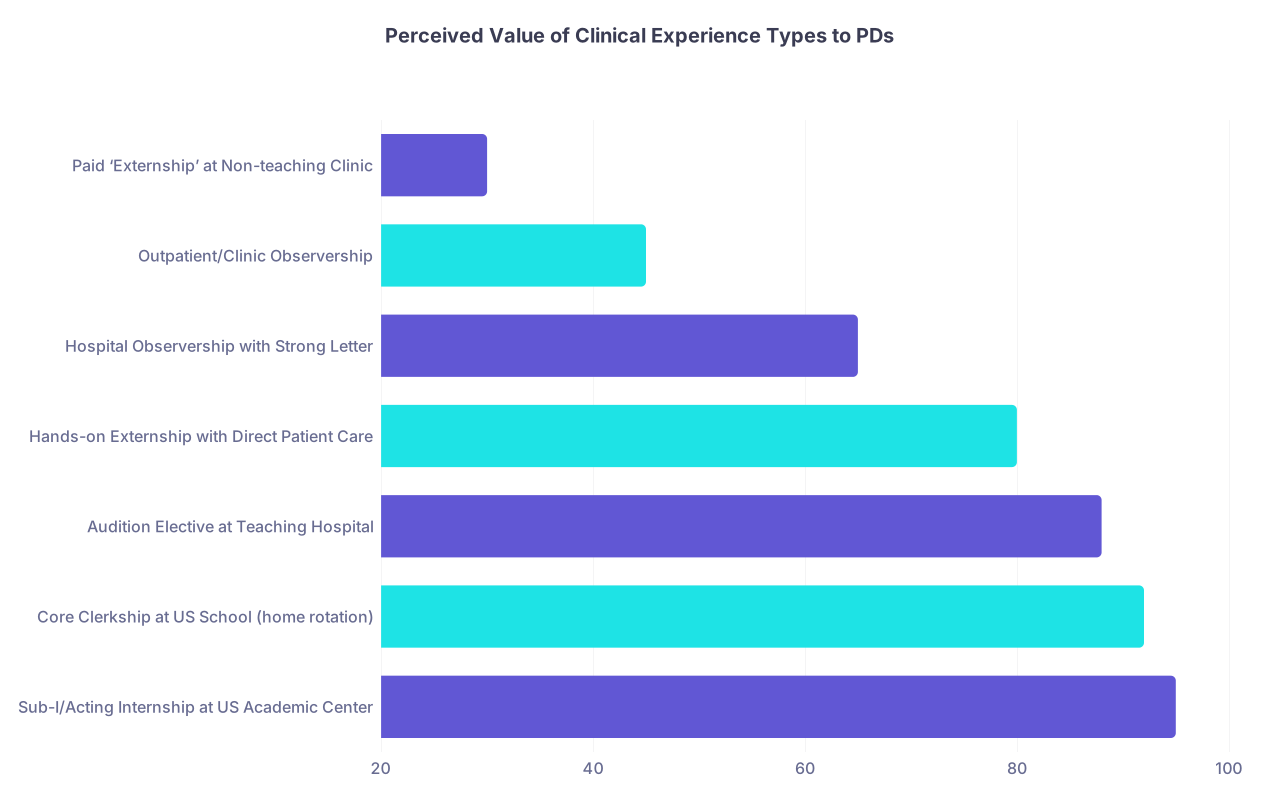
| Category | Value |
|---|---|
| Sub-I/Acting Internship at US Academic Center | 95 |
| Core Clerkship at US School (home rotation) | 92 |
| Audition Elective at Teaching Hospital | 88 |
| Hands-on Externship with Direct Patient Care | 80 |
| Hospital Observership with Strong Letter | 65 |
| Outpatient/Clinic Observership | 45 |
| Paid ‘Externship’ at Non-teaching Clinic | 30 |
That chart is the unofficial, unspoken value scale.
For IMGs, you usually don’t have “home rotations” in the US. Your “home” is your non-US school. So PDs are really comparing:
- Your home rotations abroad
versus - Your externships / observerships / electives in the US
And the blunt truth: A mediocre US rotation with a real, solid letter often beats an excellent foreign home rotation with glowing but irrelevant praise.
Why? Because PDs are not trying to judge your entire medical career. They’re trying to answer one brutal question:
“If I put this person on my ward team next July, will they survive?”
USCE is their shortcut prediction tool.
The Hidden Ranking System: How They Sort Your Rotations
When PDs and faculty skim your ERAS, they won’t say this out loud, but they do a quick internal ranking along these lines.
Tier 1: “This person already played our game”
These are the gold-standard experiences that matter most in ranking committees:
- Sub-internships / Acting Internship at a US teaching hospital
- US “audition” electives with full integration into the team
- Any rotation where you wrote notes in the EMR, presented on rounds, and had your own patients
For IMGs, this is usually an “elective” or “externship” at a real hospital, especially at:
- University-affiliated IM programs (think: university community affiliates, big teaching hospitals with residents)
- Large community hospitals with ACGME-accredited residencies
What PDs care about:
- Did you function at the level of a US M4?
- Did someone with MD/DO + academic title say, “This student functioned like a sub-intern”?
- Did you get an LOR that sounds like the writer actually watched you work, not just “attended lectures”?
That’s Tier 1. And yes, PDs mentally place these even above your strongest home rotations abroad.
Tier 2: Strong but limited – “Good, but not fully tested”
These are experiences that still help a lot, but don’t fully prove you can handle residency on Day 1:
- Inpatient observerships at teaching hospitals where you shadowed but were clearly limited by policy
- Rotations with case presentations, maybe notes for “educational purposes,” but no real order entry or independent decision-making
- US clinical exposure with relevant LORs but minimal documented responsibility
This is where many IMG “externships” secretly sit. They call them “externships,” you wear a white coat, maybe see patients, but you’re not actually in the EMR, not writing real orders, and the hospital lawyers would have a stroke if they saw the brochure.
PD translation: “Exposure and interest demonstrated, but not proven under pressure.”
Do these help you get ranked? Yes. Especially if:
- The LORs are concrete: “She pre-rounded independently, synthesized data, and presented concisely.”
- The writer is known or trusted in that specialty or region.
- You did at least one inpatient rotation at a US site.
These experiences live in the middle of the hierarchy. They don’t make you a slam dunk, but they can absolutely move you from “unknown” to “let’s interview.”
Tier 3: Box-checked or pure marketing
Now we hit the bottom of the real PD hierarchy:
- Paid “externships” in non-teaching clinics with no residents and no real evaluation structure
- Pure shadowing in private offices or urgent cares
- “Research externships” sold as clinical but are 90% data entry and 10% standing in the back of a clinic room
Here’s the part the companies will never tell you:
Most PDs discount these heavily.
They see the names. They know which organizations churn out 500+ generic LORs a year.
Often, the letters read something like:
“Dr. X observed patients under my supervision and showed interest in internal medicine. They were punctual and professional.”
You might as well have written that yourself. That letter will not move you up a rank list in any meaningful way.
Will these kill your application? Not necessarily. But they don’t help you nearly as much as you think. And they definitely do not “replace” a strong home rotation or a real hospital experience.
Home Rotations vs. Externships: The Real Comparison in a PD’s Head
Let’s be specific about what you’re worried about:
You’re thinking: “My home rotations were actual hands-on medicine. My externship was more limited. How are they judging that?”
Here’s the internal monologue I’ve heard from PDs a hundred times:
“Ok, so this IMG did core internal med at their Caribbean/Indian/Latin American school. I don’t know that hospital. I don’t know their grading. They say ‘Honors’ but what does that actually mean? Now here – one month at XYZ Community Hospital in New Jersey, supervised by Dr. So-and-So, who wrote a detailed letter. They’ve at least been on a US ward team. I know that environment.”
Foreign home rotations carry weight for baseline competence. They show you actually completed medical school, you weren’t sitting idle, and you know how to examine and talk to patients.
But for ranking and risk, PDs trust what they understand: US systems, US hospitals, US evaluation language.
So they unconsciously do this:
| Category | Home Rotation Abroad | US Externship/Elective |
|---|---|---|
| Clinical skills baseline | High | Medium–High |
| Ability to function in US system | Low | High |
| Relevance of grading/eval | Variable/Unknown | High |
| LOR influence on rank list | Low–Medium | High |
| Risk comfort for Day 1 intern | Medium | High if strong eval |
Notice something: your technical skill may actually be better demonstrated abroad. But your predictability as a US intern is better demonstrated in even a short US inpatient experience.
That’s the bias you’re up against.
The Single Biggest Secret: Who Wrote Your LOR Matters More Than Where You Rotated
Rotations are currency. Letters are the actual purchase.
I’ve been in rank meetings where twenty minutes were spent debating one candidate. Nobody cared whether it was called “externship” or “elective.” They cared what the letter said and who signed it.
Here’s how PDs silently re-rank your experiences based on LORs:
Academic attending at a US teaching hospital, same specialty, detailed letter
This can upgrade even a mid-tier externship to Tier 1 in their mind.Community attending with hospital appointment, specific examples, clear comparison to US students
Very powerful. “She functioned at the level of our best M4s” is a golden sentence.“Program Director” or “Clerkship Director” at that rotation site
PDs pay attention. “If this PD trusts them enough to put their name on this, maybe I can too.”
On the flip side:
Generic, templated letters from high-volume “IMG externship” companies? PDs recognize the style. It dilutes your experience’s impact.
Long, glowing letters from foreign home institutions? Honestly, many PDs skim them. They’ve read too many “best student I’ve ever had in 30 years” letters that meant nothing in practice.
So when you ask, “Is my externship better than my home rotation?” the real question is:
“Which rotation will generate the most believable, specific, US-style letter that makes a PD less nervous about me?”
That’s the one that wins.
How PDs Read Between the Lines in Your ERAS Experience Section
Let me walk you through how a savvy PD or APD actually reads the Experience section when you’re an IMG.
Imagine this entry:
“Clinical Extern – Internal Medicine
ABC Medical Center, New York, NY
July 2024 – August 2024
Responsibilities: Took histories and performed physical exams, presented patients to the attending, participated in rounds, wrote notes in the EMR (for teaching purposes), attended didactics, and assisted in discharge planning.”
Here’s what’s happening in their head:
- “Medical Center” in NY – is this a real hospital or just a clinic calling itself a ‘center’? They’ll sometimes Google it. Quickly.
- “Presented patients,” “participated in rounds,” “EMR notes” – that signals at least partial integration into a real team. Good.
- “For teaching purposes” – they’ll assume no official orders, but that’s fine. This is standard for IMGs.
- If there’s a letter attached from an attending there, they’ll read that next.
Now compare this to:
“Clinical Rotation – Internal Medicine
XYZ Clinic, Dallas, TX
May 2024 – June 2024
Responsibilities: Shadowed attending physician, observed patient encounters, and discussed diagnostic and management plans.”
PD translation: “Shadowing. Outpatient. No responsibility. Probably paid program.” This will sit at the bottom of their internal ranking for your experiences.
And your home rotation?
“Core Clinical Rotation – Internal Medicine
University Hospital, [Non-US Country]
January 2023 – April 2023
Responsibilities: Managed patient panels with supervised decision-making, participated in ward rounds, performed procedures, documented in hospital records.”
They’ll respect this. But they don’t fully know what it means in their world. It proves you can do medicine. It does not prove you can do their medicine. For ranking, that matters.
The Politics Nobody Tells You: Internal vs External USCE
Another ugly little secret: rotations at the program’s own hospital carry more weight than any external “fancy” externship.
PDs are inherently risk-averse. If you’ve rotated at their hospital:
- Their own faculty already tested you.
- Their residents already worked with you.
- They know exactly what “Honors” or “Excellent” means in their own evaluation system.
That one month in their system often jumps ahead of three months of decent experiences elsewhere.
So if you’re splitting hairs between:
- A well-known externship program in another state
versus - A less flashy but in-house elective at a program you might actually want to match at
Go in-house. Every time. The “audition” opportunity beats reputation 9 times out of 10.
Strategic Takeaways for IMGs (Without Sugarcoating)
Let me boil this down into actionable reality.
If you’re an IMG trying to decide how to stack externships vs relying on home rotations, this is the order of priority from a PD’s perspective:
Any US inpatient rotation at a teaching hospital with residents, where you:
- See patients regularly
- Present on rounds
- Get a detailed LOR
US rotations at hospitals that actually sponsor residencies in your specialty (even if they’re community). PDs see that environment as “real world.”
Home rotations abroad that show strong clinical work, especially if:
- You can emphasize workload, responsibility, and type of patients
- You have at least one home letter that sounds credible and specific
Outpatient or non-teaching US externships/observerships at private clinics mainly help as:
- A “US exposure” checkbox
- A timeline filler to avoid gaps
But they don’t carry heavy weight in ranking unless the letter writer is uniquely influential.
If you have limited time and money, you’re better off with:
- 1–2 high-quality, inpatient US rotations with strong letters
instead of - 4–5 low-yield, outpatient shadowing months from programs emailing you daily with “Last Few Spots Left!!!”
Timeline Reality: When USCE Actually Matters Most
USCE isn’t just about “having it.” It’s about when you have it:
- If your strong USCE is before you apply, those LORs can be in your ERAS file and read before interview invites.
- If your best rotation is during interview season or after, it can still matter if:
- You send an updated letter
- You signal programs you’re rotating with them
- You’ve already secured interviews, and this helps in the final rank discussion
Here’s the rhythm PDs operate on:
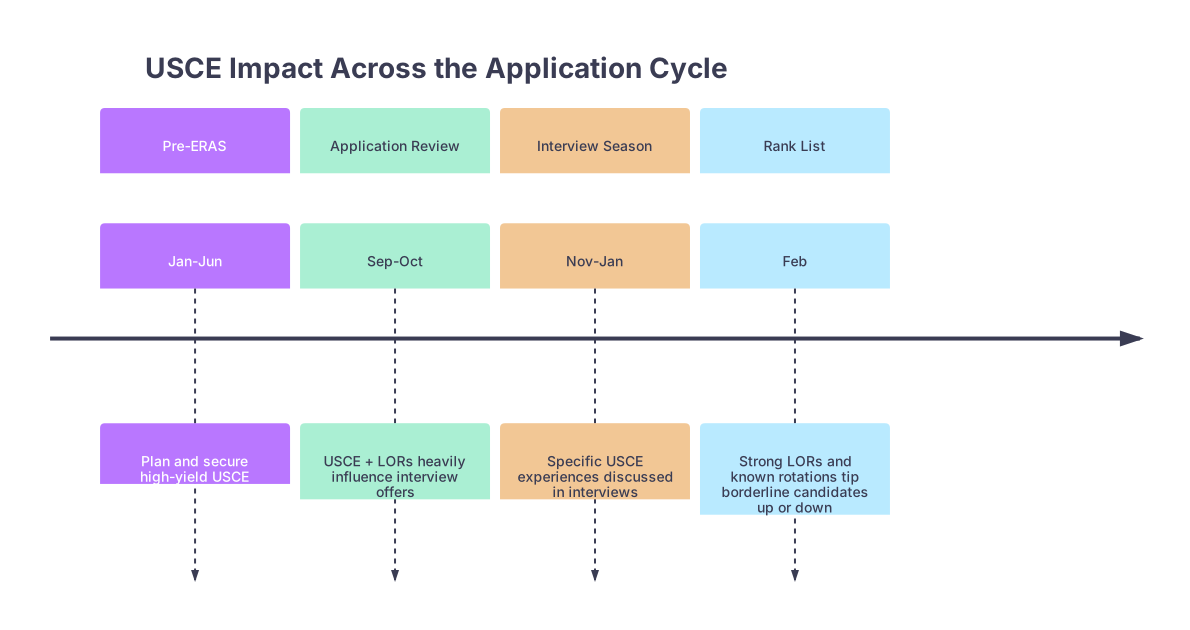
| Period | Event |
|---|---|
| Pre-ERAS - Jan-Jun | Plan and secure high-yield USCE |
| Application Review - Sep-Oct | USCE + LORs heavily influence interview offers |
| Interview Season - Nov-Jan | Specific USCE experiences discussed in interviews |
| Rank List - Feb | Strong LORs and known rotations tip borderline candidates up or down |
If you’re late in the game and thinking of stacking a bunch of low-yield externships, understand this: once interview season starts, the marginal value of yet another random outpatient month drops. You’re better off shoring up Step 2, personal statement, and targeted communication with programs.
The Bottom Line: How PDs Secretly Rank Your Experiences
They will never say this on a webinar. But behind closed doors, the ranking logic is ruthless and simple:
- Real responsibility at a US teaching hospital
- With a believable, detailed letter from someone they trust
- In a setting that looks like their own residency
…beats everything else. Including your “best student in our country” home evaluations.
Your task is not to chase labels like “externship” or “observership.” Your task is to engineer at least 2–3 experiences that let someone credible say, “I’ve seen this person work in our system, and I’d be comfortable having them as an intern.”
Years from now, you won’t be thinking about which externship brand name you chose. You’ll remember the one or two rotations where someone actually took a risk on you—and how that letter quietly carried you onto a rank list you had no business being on.
FAQ (5 Questions)
1. Does a paid externship look bad to PDs if they know I paid for it?
No one cares that you paid. Many IMGs do. What PDs judge is the quality of the environment and the letter. If it’s a real hospital with residents, structured teaching, and concrete evaluation, it can help a lot. If it’s a storefront clinic churning out templated letters, they discount it whether it was free or paid.
2. Are home rotations in my own country completely ignored by PDs?
Not at all. They matter for showing you completed serious clinical training. But for predicting performance in a US residency, home rotations are secondary to US-based experiences. They’re part of your foundation, not your differentiator.
3. Is an observership at a big-name academic institution better than a hands-on externship at a smaller community hospital?
If the “big-name” observership is pure shadowing with a weak letter, and the smaller hospital externship gives you real team participation and a strong LOR, most PDs will take the latter. Prestige helps, but concrete performance in a residency-like setting wins.
4. How many months of USCE do I actually need as an IMG?
Most PDs start feeling comfortable around 2–3 solid months of relevant USCE, ideally with at least one inpatient month in your intended specialty. More than 4–5 months of low-yield shadowing doesn’t impress anyone; it just raises questions about why you weren’t doing something higher-yield.
5. My best rotation is at a hospital with no residency program. Does it still help?
Yes, it can—if the environment is real (inpatient, structured, EMR, multidisciplinary teams) and the letter is detailed and comparative. But if you have a choice, prioritize sites with actual residencies, because PDs instinctively trust evaluations that come from environments similar to their own.