
Strong letters of recommendation are not “earned” by showing up; they’re destroyed by small, repeated behaviors you think no one notices. They notice.
If you’re an IMG doing USCE, especially an externship where the entire point is to get a powerful LOR for your residency application, you cannot afford these quiet mistakes. They don’t usually lead to open confrontation. What they lead to is something worse:
- The bland, generic LOR.
- The “damning with faint praise” LOR.
- Or no LOR at all.
Let me walk you through the patterns I’ve seen sink otherwise smart, hardworking IMGs.
1. Acting Like a Tourist, Not a Temporary Team Member
Your externship is not a paid observership vacation. If you behave like you’re “shadowing,” you will be treated like you’re shadowing — and nobody writes strong letters for a shadow.
Red flags attendings and residents notice:
- You stand in the back of the team cluster on rounds, never close to the action.
- You don’t carry a notebook, don’t write anything down, just stare.
- You never volunteer to present, even if it’s just overnight events or vitals.
- You disappear when work needs to be done: discharge summaries, consent forms, calling consults (where allowed), patient education.
Here’s what goes through an attending’s head:
“This extern was… fine. Quiet. Didn’t get in the way. I can say they were polite and punctual. That’s about it.”
That’s not a letter. That’s a death sentence in a competitive Match cycle.
What you should be doing instead:
- Ask early: “Doctor, for externs on your team, what level of involvement do you prefer? Can I help with notes, presentations, or patient follow-up?”
- Be physically with the team: right up front on rounds, listening, ready.
- Take ownership (within your allowed role):
- “I’ll follow up on the MRI result.”
- “I’ll talk to the nurse and update you.”
- “Can I draft the progress note for you to review?”
If you’re not sure whether you crossed into “tourist mode,” ask yourself: “If I missed a day unexpectedly, would the team’s workflow change even a little?” If the answer is no, your LOR will be weak.
2. Being “Too Polite” to Ask for Feedback
Silent failure is common. You think everything is fine because no one yells at you. Meanwhile the attending is quietly deciding you’re “not ready for residency in the US.”
I’ve seen IMGs finish 4–8 weeks, absolutely convinced they did great, and the attending literally says, “I don’t feel comfortable writing a letter for them.”
Typical mistakes:
- Never explicitly asking for feedback in the first week.
- Interpreting no criticism as you’re doing well.
- Waiting until the last week to ask, “Is there anything I can improve?” when it’s already too late.
Here’s the problem: US physicians are busy and conflict-avoidant. If you’re underperforming, many won’t correct you aggressively. They’ll simply mentally downgrade you from “strong letter” to “generic letter” and move on.
Better approach:
In week 1 or early week 2, say something like:
“Doctor, I really want to use this externship to grow and to be competitive for residency. Could you tell me one or two things I should focus on improving this week?”
Then shut up and write it down. Do not defend yourself. Do not explain why you did something. Just:
- Listen.
- Ask a clarifying question if needed.
- Actually change your behavior.
If you don’t create a feedback loop, you’re guessing. And you’ll guess wrong.
3. Confusing “Confidence” with Recklessness
Another classic LOR killer: the IMG who is so desperate to show initiative that they cross the line into unsafe or inappropriate behavior.
This gets talked about in the break room. A lot.
Examples that make faculty nervous:
- Placing orders you’re not authorized to place (or “pre-entering” them without permission).
- Giving medication or management recommendations directly to patients without running it by the team.
- Calling consults without being asked to, or speaking “on behalf” of the attending.
- Presenting guesses as facts during rounds instead of admitting you’re not sure.
I’ve actually heard attending comments like:
“I’d rather work with a quieter student who knows their limits than someone who’s going to get me sued.”
Once an attending has even one safety concern about you, your chances of a strong LOR drop to near zero. At best, they’ll write: “With appropriate supervision, they can grow into a safe physician.” Translation: red flag.
How to show initiative without being dangerous:
- Use phrases like:
- “My impression is X, but I’d like to confirm with you.”
- “I’m not certain; would you mind walking me through how you’d think about this?”
- Before doing anything beyond note-writing or data gathering, ask:
- “Is it okay if I call the lab for this result?”
- “Would you like me to pre-draft these orders for you to review, or would you prefer I just watch this time?”
- When you don’t know something, say:
- “I’m not sure, but I can look it up and get back to you in a few minutes.”
You don’t earn respect by pretending to know. You earn it by knowing exactly where your limits are.
4. Passive Communication and “Vanishing” From the Workflow
Programs want residents who communicate clearly and reliably. If you’re hard to find, slow to respond, or vague, your LOR will quietly poison your application.
Behaviors that look small but add up:
- Not telling anyone when you’re leaving early (even if you think it’s implied).
- Not confirming your responsibilities: “Am I following just my assigned patients or the whole list?”
- Responding slowly to messages (email, WhatsApp, whatever your team uses).
- Going to lunch and taking an extra 20–30 minutes because “nobody said anything.”
This is how attendings describe these externs: “Nice, but not dependable.” That phrase kills letters.
Better habits:
- Over-communicate your location and plan:
- “Doctor, I’ll be in the ED seeing our new admission; I’ll be back on the floor in 20–30 minutes. Is that okay?”
- When you finish a task, close the loop:
- “I spoke with the nurse; the CT is scheduled for 3 pm. I updated the note.”
- If you’re unsure about staying:
- “Is there anything else I can help with today, or is it okay if I head out?”
You want the attending to think: “If I give this person something to do, it will get done and I will hear back about it.” That’s LOR gold.
5. Poor Note-Writing and Sloppy Clinical Thinking
Many IMGs underestimate how much their documentation and reasoning shape an attending’s impression. You might be extremely hardworking, but if your notes are chaotic and your assessments are superficial, the letter will quietly downgrade you from “top 10–20%” to “average.”

Things that set off alarms:
- Copy-pasting huge blocks of text without understanding them.
- Writing assessments that are just restated facts:
- “Patient with pneumonia, continue antibiotics.” (That’s it.)
- Wildly disorganized notes: no problem list, no prioritization, contradictions.
- Misusing medical abbreviations or using non-standard ones from your home country.
- No plan for follow-up: no mention of trend monitoring, contingency plans, or what to do if things worsen.
Faculty judge your readiness from this. If your notes are weak, they assume your thinking is weak. That directly affects what they write about your “clinical reasoning” in your LOR.
How to avoid this trap:
- Ask early: “Could you show me an example of what a good daily note looks like on this service?”
- Simplify your structure:
- Problem-based assessment.
- For each problem: brief summary → differential or status → plan (with specifics).
- Use safe language:
- “Will monitor,” “consider,” “if… then…” statements.
- Don’t write absolute decisions that the attending didn’t approve.
You want the attending to feel comfortable signing a note you drafted. If they are constantly rewriting from scratch, they’re not going to call you “strong.”
6. Not Understanding the Unwritten “Hierarchy Rules”
US teams have a culture and a hierarchy. If you ignore it, even accidentally, you will irritate people who have significant influence over your LOR.
And it’s not always the attending you need to impress. A bitter senior resident or fellow can quietly kill the tone of your letter by saying, “They were… okay. Nothing special.”
Common hierarchy mistakes:
- Going directly to the attending with minor questions instead of the resident first.
- Overshadowing other students or interns on presentations (talking over them, jumping in to answer everything).
- Arguing with nurses or dismissing their concerns.
- Acting like the attending’s personal extern and ignoring the rest of team.
I’ve heard residents say, “They’re clearly trying to impress the attending only. I’d never want to work with them as a co-resident.” That comment will creep into your LOR subtext, even if it’s never written explicitly.
Better strategy:
- Default sequence: nurse → intern → resident → attending. Deviate only when explicitly told.
- Before your first day, or early on, ask the senior:
- “What’s the best way to communicate on this team?”
- “Should I come to you first for questions, or is it okay to approach the attending?”
- Publicly support, don’t compete:
- If another student is presenting and misses something, wait. Don’t interrupt to “show off.”
- Offer to help behind the scenes: “Want me to check that result while you’re finishing your note?”
Strong LORs often mention being a “team player.” You don’t earn that by impressing one person. You earn it by not making anyone feel disrespected or sidelined.
7. Cultural Misreads Around Professionalism and Boundaries
IMGs get tripped up here constantly. Without anyone saying a word. They just quietly downgrade you.
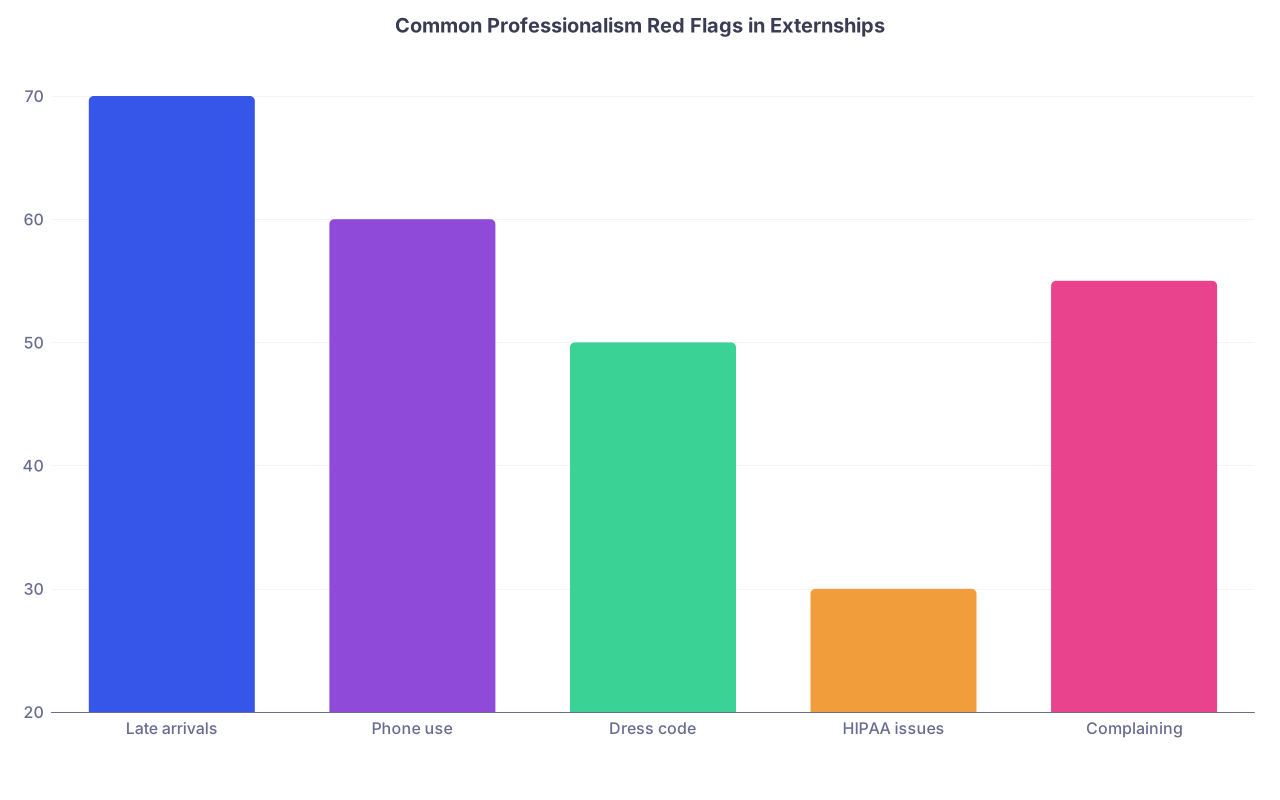
| Category | Value |
|---|---|
| Late arrivals | 70 |
| Phone use | 60 |
| Dress code | 50 |
| HIPAA issues | 30 |
| Complaining | 55 |
Silent professionalism killers:
- Repeatedly being 3–5 minutes late and thinking “that’s basically on time.”
- Using your phone on rounds, even “just to check UpToDate.”
- Dressing too casually or too flashy: sneakers, loud colors, excessive perfume, big jewelry.
- Discussing patient details in elevators, cafeterias, or public hallways.
- Complaining even mildly about hours, cases, or “unfair” expectations.
You might think, “But the residents are on their phones too!” You’re not the resident. They’re already in the system; you are on trial.
Simple fixes:
- Aim to be 10–15 minutes early. Not “right on time.”
- Keep your phone in your pocket. If you must use it for reference, say:
- “Would you mind if I quickly look something up?” and step aside briefly.
- Ask your coordinator or resident: “Is my dress appropriate for this service?” then adjust.
- Never complain about:
- Hours
- “How things are done in my country” vs here
- Patients being “not interesting”
HIPAA and privacy mistakes especially are instant LOR killers. You might not even know you broke a rule. You’ll just get the bland letter.
8. Underestimating How Much Enthusiasm Matters
You don’t have to be fake. But if you look bored, tired, or disengaged, people don’t want to go out of their way for you. That includes writing your letter.

| Step | Description |
|---|---|
| Step 1 | Externship Start |
| Step 2 | More Teaching & Responsibility |
| Step 3 | Minimal Involvement |
| Step 4 | Attending Knows You Well |
| Step 5 | Attending Barely Remembers You |
| Step 6 | Strong, Detailed LOR |
| Step 7 | Generic or No LOR |
| Step 8 | Visible Enthusiasm? |
Behaviors that read as disinterest:
- Flat affect all day, no matter what happens.
- Saying “fine” or “okay” to everything, never “Yes, I’d like to try that.”
- Refusing chances to present or take on more involvement when offered.
- Never asking questions, even simple ones.
Attending thought process: “They were… okay. Hard to tell if they really care. I can’t strongly recommend them.” That’s how your “meh” attitude shows up on paper.
How to show genuine interest without being fake:
- When offered opportunities, say things like:
- “Yes, I’d love to try presenting if that’s okay.”
- “I’m very interested in this case; could I follow it more closely?”
- Ask a modest number of focused questions:
- 1–2 per case, not 20.
- “For my learning, could you explain why you chose X instead of Y?”
- When leaving the rotation, explicitly say:
- “I really appreciated working with you; I learned a lot about X, Y, Z.”
You cannot be low-energy, minimally verbal, and expect someone to go to bat for you in a letter.
9. Mishandling the Actual LOR Request
Many IMGs survive the rotation just fine… then mishandle the letter request itself.

Classic mistakes:
- Waiting until the last day, in the hallway, to say: “Can you write me a letter?”
- Not clarifying whether the attending feels they know you well enough.
- Not providing a CV, personal statement draft, or list of programs.
- Asking someone who clearly didn’t work with you much just because they’re “famous.”
What often happens next:
They say yes, then write a lukewarm, content-thin letter because they barely remember you. Programs see right through that.
A smarter approach:
1–2 weeks before the end, say:
“Doctor, I’m applying to Internal Medicine this year and I’d be honored if you’d consider writing me a strong letter of recommendation if you feel you can. I’d really value your support, but I also understand if you don’t know me well enough.”
That “if you feel you can write a strong letter” gives them an out. If they hesitate or say something vague like, “I can write a letter,” but not “strong,” be cautious.
Then immediately offer:
- Updated CV
- US-style personal statement draft
- ERAS ID and deadline
- A brief bullet list reminding them of specific cases or contributions you made
If you’re doing multiple rotations, target the attendings who:
- Saw you the most days
- Let you do the most
- Actually corrected you and watched you improve
Those people can write credible, detailed letters. Detail is what makes a LOR powerful.
10. Thinking “No Major Complaints” = “Strong LOR”
This is the most dangerous belief IMGs carry.
You think:
- “No one yelled at me.”
- “I didn’t cause any big problems.”
- “They seemed nice to me.”
So you assume: “They’ll write me a good letter.”
Wrong.
| Attending Category | What It Means | Letter Quality |
|---|---|---|
| Outstanding | I’d fight to recruit them | Detailed, strong, specific |
| Above average | Definitely recommend | Positive, supportive |
| Average | Fine, nothing special | Generic, weak impact |
| Below average | Would avoid as resident | Damaging, faint praise |
| Unsafe/problematic | Serious concerns | Red flag or no letter |
Your goal isn’t to avoid the bottom two categories. Your goal is to get yourself into “outstanding” or at least “above average.”
Avoiding criticism merely puts you at “average” — which in today’s Match, especially as an IMG, often isn’t enough.
How to tell where you really stand:
Near the end of the rotation, ask directly:
“Doctor, based on what you’ve seen, do you feel I’m performing at the level you’d expect of a strong incoming intern on this service? And is there anything you’d want me to work on before residency?”
Pay attention to:
- The speed and confidence of their answer.
- Whether they mention specific strengths.
- Whether their “concerns” are minor or fundamental.
If the response feels lukewarm, do not assume they’ll write you a powerhouse letter. You may need to prioritize getting LORs from other rotations where you got stronger signals.
FAQ (Exactly 4 Questions)
1. How many USCE rotations do I really need to get strong LORs as an IMG?
You don’t need 10 rotations. You need 2–3 where you were truly known and trusted. A couple of high-quality, detailed letters beat a pile of generic ones. If your first externship goes poorly or only yields a weak letter, treat that as practice and focus on being much more intentional in the next one.
2. What if I realize late in the rotation that I’ve made some of these mistakes?
Own it and adjust openly. You can say: “Doctor, I realized I’ve been too quiet and not asking enough feedback because I was afraid to bother you. I’d like to correct that in this last week and get your honest input.” People respect self-awareness and late improvement more than quiet, unacknowledged underperformance.
3. Is it better to skip asking for a letter than to accept a weak one?
Yes. A generic, lukewarm LOR from a US attending can silently harm you more than having fewer letters. Programs read between the lines. If you sense hesitation when you ask, or the attending avoids terms like “strongly recommend,” don’t push. Thank them for the rotation, learn from it, and focus on someone who can genuinely advocate for you.
4. How can I tell if my externship behavior is on track early, not at the very end?
Use a structured mid-rotation check-in. Around the middle, say: “If you were filling out an evaluation on me today, what would you list as my main strengths and main areas to improve?” If they struggle to name strengths or can only say generic things like “punctual,” you’re not yet standing out. That’s your signal to increase ownership, communication, and visible engagement immediately.
Key takeaways:
- Strong LORs come from being memorable in a good way — not just avoiding mistakes.
- Most externship LORs die from quiet, small behaviors: passivity, poor communication, weak documentation, or cultural misreads.
- Ask for feedback early, act like a true team member, and only request letters from people who actually know your work and can honestly call you strong.