
The way most IMGs pick observerships is wrong—and it quietly kills their chances in the Match.
You are not “just getting USCE.” You are building or breaking your future application with every choice. I have watched very strong IMGs waste months and thousands of dollars on shiny but useless observerships that did absolutely nothing for their Match prospects.
Let me walk you through the biggest traps so you do not become another “great CV, no interviews” story.
Mistake #1: Choosing Any Observership Just To “Get USCE”
The most common and most expensive error: treating all observerships as equal.
They are not.
I have seen this exact pattern too many times:
- IMG pays $3,000+ for a private observership company
- 4 weeks of shadowing, no real involvement
- LOR: one generic paragraph, reads like a template
- Match results: nothing changed
You cannot afford that.
Bad mindset:
“I just need US clinical experience; any observership is fine.”
Correct mindset:
“I need observerships that will strengthen my specific application and produce strong, credible letters.”
You must avoid:
- Random sites with no connection to your target specialty
- Programs in locations where you will not realistically apply
- Rotations with no path to a real letter
Ask yourself before accepting any site:
- Will this directly help my target specialty?
- Will this be credible on my CV to a PD?
- Will I have real interaction with attendings?
- Is there an actual possibility of a personalized LOR?
If you cannot answer “yes” clearly, do not spend your money there.
Mistake #2: Ignoring Whether The Site Actually Writes Strong LORs
This one is brutal. Many IMGs focus on “brand name hospital” and never ask the only question that really matters:
“How do letters of recommendation work here—who writes them, and under what conditions?”
Common disasters:
- You observe for 4 weeks, attending says, “Our institution does not allow formal LORs for observers.”
- Or: “We only provide a standard letter verifying participation, nothing personalized.”
- Or: letter is written on plain paper with no institutional letterhead.
That letter will be almost worthless.
You must clarify before you commit:
- Are LORs:
- Allowed?
- On institutional letterhead?
- Signed by MD with academic title?
- Personalized and specific to your performance?
Ask very direct questions to the coordinator or the observership office:
- “Do observers typically receive letters of recommendation from attendings?”
- “Are those letters on official hospital/department letterhead?”
- “What percentage of your past observers matched to US residency, and in which specialties?”
If the answers are vague, defensive, or they avoid specifics, that is a red flag.

Mistake #3: Falling for Paid “Clinical Experience Companies” Without Scrutiny
Some companies are decent. Many are glorified tourism agencies with white coats.
Typical marketing phrases:
- “Guaranteed US clinical experience”
- “Work side-by-side with US doctors”
- “High Match success! (no data shown)”
What actually happens for many IMGs:
- You stand at the back of the room
- You are not allowed to touch the chart (no EMR access at all)
- You never present a patient, never write a note, never get meaningful feedback
- The attending barely knows your name
Then they hand you a “participation certificate” and call it a day.
Here is how to check if a paid observership site is worth considering:
Hospital credibility
- Is the hospital an ACGME-affiliated teaching hospital?
- Does it host residents/fellows in your specialty?
- Can you find the attendings’ names on the hospital website?
Level of involvement
- Will you:
- Attend rounds?
- See patients (even if just observing)?
- Present cases?
- Or will you only “shadow” with minimal interaction?
- Will you:
Letters and outcomes
- Do they provide actual data on:
- Past IMG participants
- Match rates
- Specialties matched
- Can they show anonymized sample LORs (with identifiers removed)?
- Do they provide actual data on:
If they avoid real details and only push marketing language like “Great for your career!” you should walk away.
Mistake #4: Choosing Sites With No Connection to Your Target Specialty
Doing an Internal Medicine observership when you want Psychiatry is not “close enough.”
Program directors care about:
- Specialty-specific exposure
- Specialty-specific letters
- Commitment to the field
I have seen Psychiatry applicants with:
- 3 months of USCE
- All in Internal Medicine
- Zero psych exposure
They wonder why psych programs do not take them seriously.
Your observership mix should look intentional:
- Applying to Internal Medicine?
- Aim for multiple IM rotations (wards, clinic, subspecialties like cardio, GI).
- Applying to Pediatrics?
- Do pediatrics rotations (outpatient, inpatient, NICU if possible).
- Applying to Psych?
- Prioritize psych wards, outpatient clinics, consult-liaison psych.
Do not assume “any medicine is okay.” It is not.
Mistake #5: Ignoring Program Type and Setting
Where you do USCE matters almost as much as what you do.
Too many IMGs spend all their time in:
- Small private clinics
- Non-teaching community hospitals
- Observerships with no residents or academic structure
These settings are not automatically useless, but they are far less persuasive for many PDs.
You want, as much as possible:
- ACGME-affiliated teaching hospitals
- Sites that host residents in your specialty
- Attendings with academic titles (Assistant/Associate/Full Professor)
Why? Because program directors trust:
- People they know (faculty in similar environments)
- Systems they understand (teaching hospitals)
- Letters written in the academic style they are used to
If you have a choice between:
- A solo private clinic with no residents
- A busy community teaching hospital with residents and morning reports
Pick the second, even if it feels more intimidating.
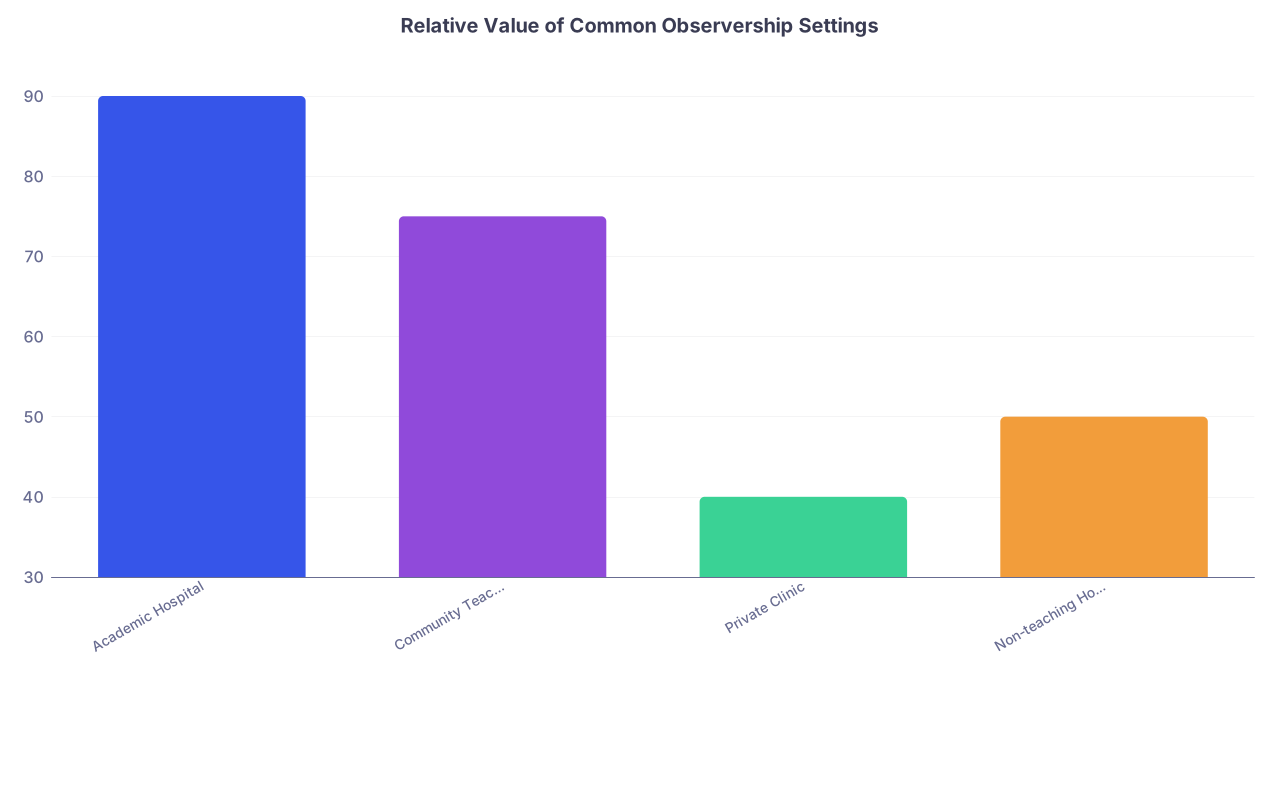
| Category | Value |
|---|---|
| Academic Hospital | 90 |
| Community Teaching | 75 |
| Private Clinic | 40 |
| Non-teaching Hospital | 50 |
(Think of these numbers as rough “impact scores” on a PD’s perception. Not exact science, but this is how it often plays out.)
Mistake #6: Chasing Reputation Over Practical Match Value
Yes, that big famous hospital in New York is exciting.
No, it may not be your best move.
Typical trap:
- IMG gets observership at “fancy” hospital
- No real interaction, no responsibilities
- No strong letter
- They still believe “Name alone will impress programs”
Name helps only if:
- You get a strong, detailed, personalized LOR
- You can discuss actual clinical experiences there in your interviews
- The attending is willing to pick up the phone or answer emails about you
I would take:
- A strong, personalized LOR from a well-known community teaching hospital
over: - A generic, one-paragraph “To Whom It May Concern” from a top-10 institution
Any day.
Do not confuse prestige with usefulness.
Mistake #7: Not Checking Visa and Institutional Policies
I have watched observership plans collapse the week before the start date because of one avoidable mistake: poor visa planning and not reading institutional rules.
Common issues:
- Hospital requires B1/B2 but IMG has only ESTA / tourist waiver
- Site requires US citizen/green card only (for EMR access, badging, etc.)
- COVID or credentialing policies that block foreign medical graduates
You must ask very specific questions:
- “Do you accept international medical graduates on B1/B2 visas?”
- “Do you require ECFMG certification?”
- “Do you require US malpractice insurance even for observers?”
- “Is there any restriction based on graduation year (e.g., within 5 years of graduation)?”
If the coordinator sounds uncertain or says “We will see when you arrive,” that is not good enough. You need clarity in writing.
Mistake #8: Underestimating Location and Networking Value
Many IMGs pick observerships randomly across the map—Florida, then California, then Ohio—without any geographic strategy.
Residency programs:
- Prefer applicants with some connection to their region
- Notice when all your USCE is in one area
- Are more likely to believe you will actually move there if you have ties
If you know you will target:
- East Coast IM programs → focus your observerships in that area
- Midwest community programs → get experience there
- Texas → try to rotate in Texas
And do not ignore networking:
- Attend morning reports, grand rounds
- Introduce yourself to residents and fellows
- Ask sensible questions, show up consistently, be reliable
Far too many IMGs come, observe silently, leave, and then expect miracles. You are not just a passive observer; you are building a professional reputation.
Mistake #9: Accepting Extremely Short or Overcrowded Observerships
A 2-week observership with 5 other observers per attending is almost useless for letters.
Why?
- The attending cannot objectively evaluate you in that time.
- You will barely speak, let alone show your clinical reasoning.
- Your LOR, if you get one, will be generic and weak.
You want:
- At least 4 weeks per site whenever possible.
- Small team size:
- 1–2 observers with 1 attending is ideal.
- More than 3 becomes a crowd.
If a program tells you:
- “We can only offer 10 days”
- “We take 8 observers per month with one attending”
You are not going to stand out. You will be a face in the crowd and a name on an email list. That is not worth serious money.
| Factor | Strong Site | Weak Site |
|---|---|---|
| Duration | 4+ weeks | 1–2 weeks |
| Team Size | 1–2 observers per attending | 4+ observers per attending |
| Setting | Teaching hospital with residents | Private clinic, no residents |
| LOR Policy | Clear, personalized, on letterhead | Vague, “maybe,” or certificate only |
| Specialty Fit | Matches your target specialty | Unrelated or mixed with no focus |
Mistake #10: Not Aligning Observership Timing With Application Cycle
Timing mistakes quietly hurt IMGs all the time.
Two classic problems:
Too late
- Observership in October or November when you are applying that same September.
- LOR not ready in time for ERAS.
- Programs never see your most relevant letter.
Too early with no follow-up
- Observership 2–3 years before application.
- Attending barely remembers you.
- Letter sounds vague or backdated.
Ideal:
- Do major observerships within 12 months of applying.
- Make sure you:
- Finish the observership
- Request the LOR
- Upload it to ERAS
all before programs are reviewing applications seriously (usually by early–mid September).
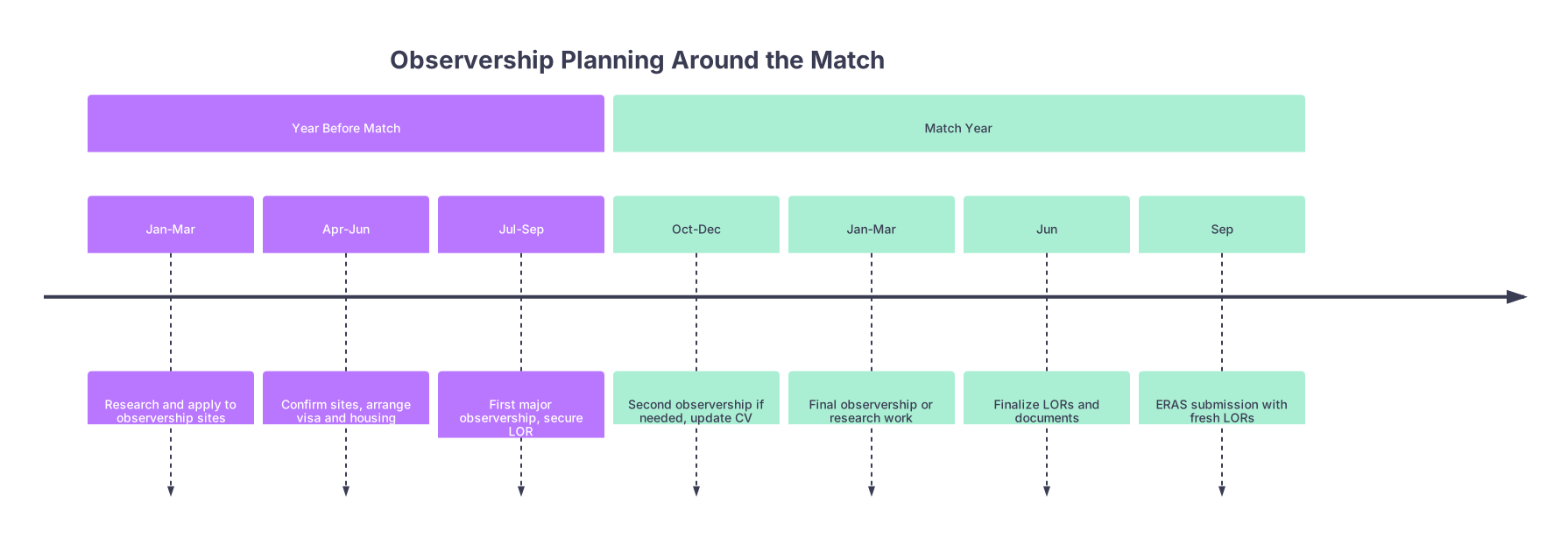
| Period | Event |
|---|---|
| Year Before Match - Jan-Mar | Research and apply to observership sites |
| Year Before Match - Apr-Jun | Confirm sites, arrange visa and housing |
| Year Before Match - Jul-Sep | First major observership, secure LOR |
| Match Year - Oct-Dec | Second observership if needed, update CV |
| Match Year - Jan-Mar | Final observership or research work |
| Match Year - Jun | Finalize LORs and documents |
| Match Year - Sep | ERAS submission with fresh LORs |
Mistake #11: Not Budgeting Realistically (And Then Running Out Midway)
Observerships are expensive. Not just the fee.
Hidden or underestimated costs:
- Visa fees
- Flights
- Local transport
- Housing (short-term rentals are brutal in some cities)
- Food
- Mandatory hospital fees (ID badges, background checks, immunizations)
I have watched IMGs:
- Spend everything on a “premium” first observership
- Then have no money left to do a second, better-planned one
- Or decline an excellent opportunity later due to lack of funds
Before committing:
- Map out your total budget for USCE.
- Decide how many months you can realistically afford in the US.
- Prioritize fewer, higher-quality observerships over many low-impact ones.
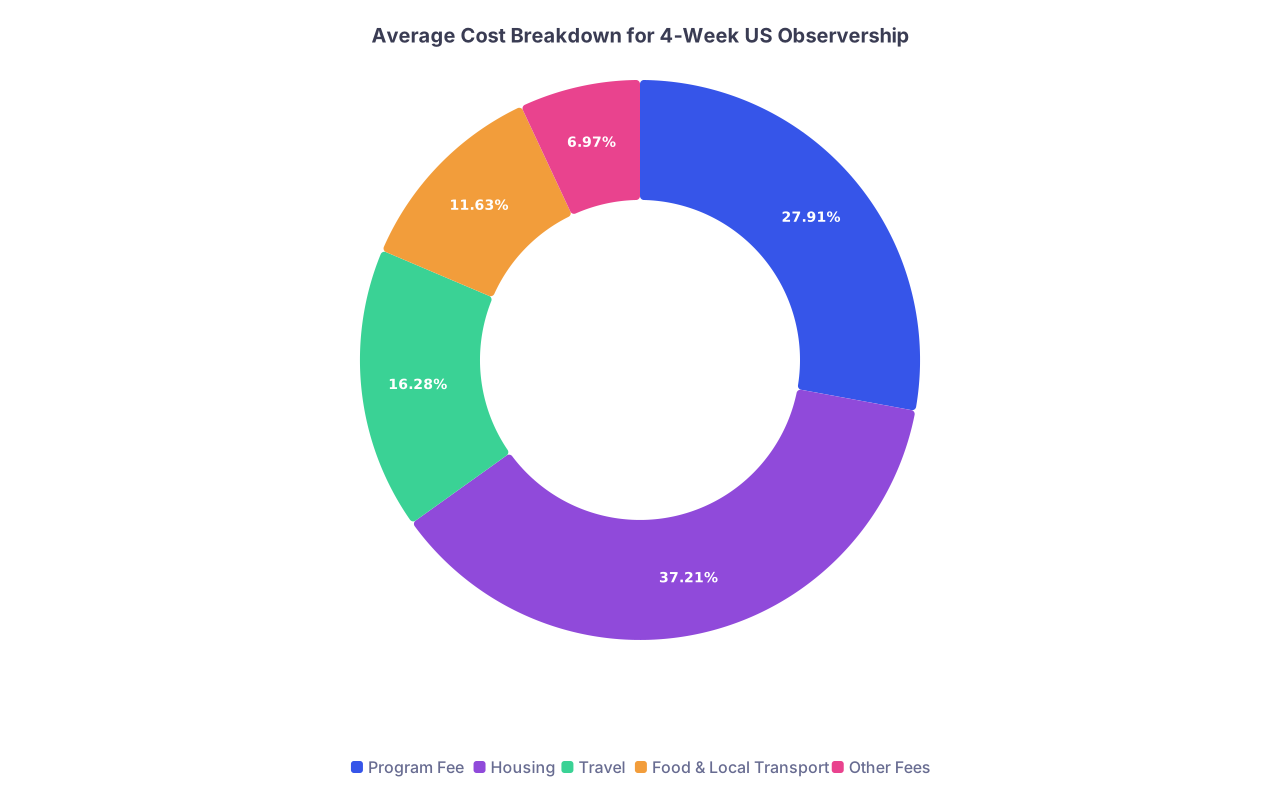
| Category | Value |
|---|---|
| Program Fee | 1200 |
| Housing | 1600 |
| Travel | 700 |
| Food & Local Transport | 500 |
| Other Fees | 300 |
If your budget is limited (like most IMGs), you cannot afford to waste a month at a weak site.
Mistake #12: Not Vetting the Site’s Reputation With Real People
Websites can lie. Coordinators can exaggerate. Former observers rarely do.
Too many IMGs:
- Decide solely based on the institution’s website or a company’s brochure.
- Never talk to anyone who has actually rotated there.
- Then get surprised by how limited and superficial the experience is.
What you should do:
- Search Facebook / WhatsApp / Telegram IMG groups.
- Ask directly: “Has anyone done an observership at [Hospital/Program/Company]? Honest feedback please.”
- Look for:
- Whether observers actually saw patients.
- Whether LORs were meaningful.
- Whether faculty were engaged vs. burnt out and indifferent.
Red flags in feedback:
- “It was okay, but very hands off.”
- “They were always too busy to teach.”
- “The LOR was generic, one paragraph, no details about me.”
Those are polite ways of saying: low value.
FAQ (Exactly 4 Questions)
1. How many months of US observerships do IMGs really need for the Match?
For most IMGs, 2–3 months of solid, high-quality US clinical experience in your target specialty is enough, if:
- The sites are credible teaching environments.
- You secure 2–3 strong, detailed LORs from US attendings. More months do not always mean stronger applications if the quality is poor. Three targeted, well-chosen months usually beat six random, low-impact months.
2. Are clinic-based observerships useless compared to hospital rotations?
Not useless, but usually weaker. Outpatient clinics can be helpful if:
- They are part of a teaching program.
- The attending is well-known or academically active.
- You get to present and discuss cases regularly.
However, if you must choose, inpatient teaching hospital rotations generally carry more weight with program directors, especially for Internal Medicine and Surgery.
3. Can I match with only home-country clinical experience and no US observerships?
It is possible but significantly harder, especially in Internal Medicine, Pediatrics, Psych, and competitive specialties. Many programs explicitly prefer or “strongly recommend” US clinical experience. Without USCE, you are asking PDs to take a larger risk on someone untested in the US system. If you can afford it, at least 1–2 months of US CE is strongly advisable.
4. What is the biggest single red flag that an observership is not worth it?
The biggest red flag: no clear path to a meaningful, personalized LOR.
If the site:
- Refuses to talk about letters,
- Only offers “participation certificates,” or
- Limits you so much that no one can actually assess your performance,
then you are paying for a line on your CV with almost no Match impact. That is rarely a smart use of your money or time.
Key things to remember:
- Not all observerships are equal—prioritize teaching hospitals, your specialty, and strong LOR potential.
- Ask hard questions up front about letters, involvement, and policies; vague answers usually hide weak experiences.
- Plan strategically: specialty fit, region, timing, and budget must all align with your Match goals—or you will pay a lot for almost nothing.